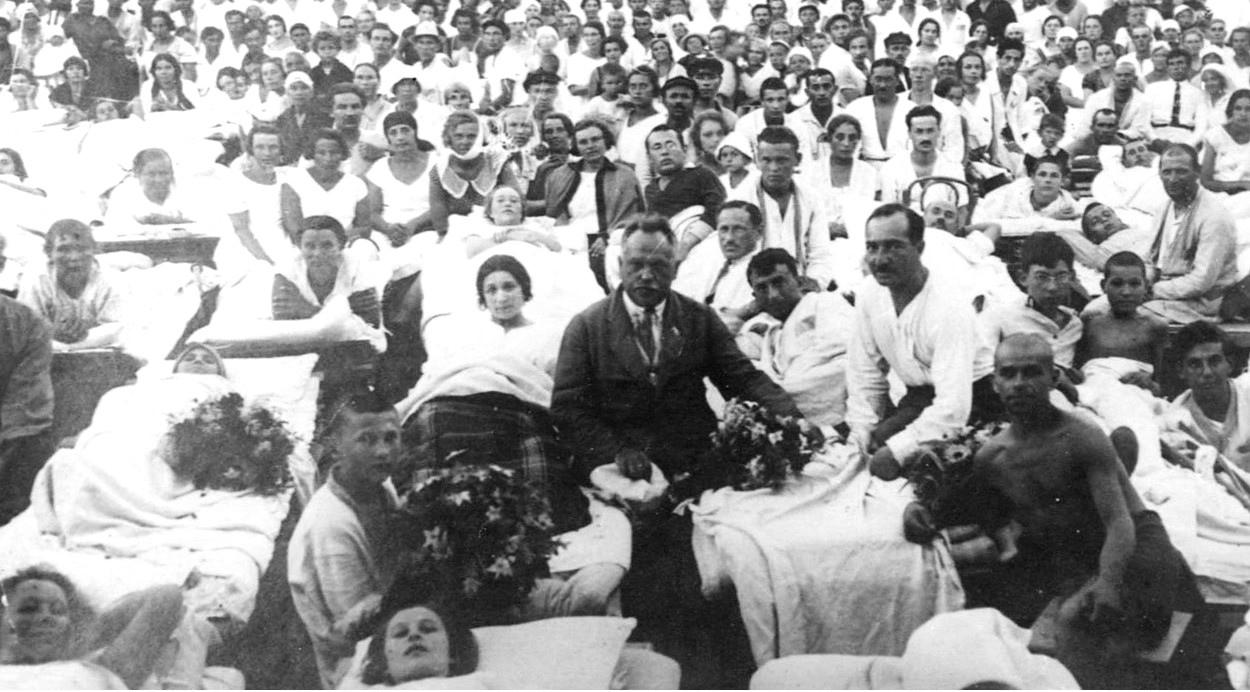
A 1921 overview from the Commissariat of Public Health on the conditions, tasks, and accomplishments of what remains an inspiring system of health provision. Tasked in 1918 as People’s Commissar of Public Health, Doctor Nikolai Semashko directed the pioneering public health care carried out by the Soviets in the first decade of the Revolution. Serving as Health Commissar until 1930, the preventative, child-focused, dispersed, and research driven system devised by him, the ‘Semashko System,’ would later be taken up in the Cuban Revolution where it remains the basis of their health programs today.
‘Caring for the Health of the People First’ from Truth (Duluth). Vol. 5 No. 21. May 27, 1921.
Medical Department of Soviet Government Issues Important Statement
The World War laid bare the ills of modern society, and forced humanity to search for new forms of social relations. Russia was the first to take a new path; she severed her connection with the past and made labor and the interests of the toiling masses the main concern of the government.
The new social order was bound to reflect itself in such an important state function as the care for public health. Relieving that the health of the population is the foundation of the prosperity of the country, the Soviet Government spared neither expense nor effort in the care of the population. By a series of bold and original reforms the Commissariat of Public Health was enabled to cop© with the most severe epidemics, and under conditions of unparallelled difficulty.
It is thought that it may interest the American people, irrespective of political opinions and sympathies, to know of the work of the Commissariat of Public Health of Soviet Russia. With this end in view, a series of articles are to be issued on various activities of the Commissariat.
***
At the beginning of 1917 Russia was already exhausted through the prolonged war, which she was unable to carry on, and through the inefficiency of the Czar’s government and the complete incompetence of the Lvov and Kerensky governments, which followed it. The latter did nothing to conserve the feeble economic and cultural forces of the country. They only augmented the ruin of its economic life. When the power passed to the Soviets, the country was already in chaos. Then came rebellions, conspiracies and all the inevitable destruction of cities and entire regions by civil war, and boycott and sabotage by the intellectuals. Finally there came the blockade.
All these disorders could not fail to affect the condition of the public health. In July 1918 the newly organized People’s Commissariat of Public Health had to fight epidemics over an area covering almost one sixth of the globe, among over a hundred million people living under the conditions described above. There was a shortage of physicians of whom many had been called to the front; there was a lack of medical supplies and disinfectants, which could not be brought in from abroad because of the blockade. Prior to the war, Russia had obtained the bulk of her chemical and medical supplies from abroad.
The Commissariat of Public Health had to organize on entirely new lines, and with new personnel—it had to mobilize, concentrate and distribute its forces, and at the same time combat its enemies who, although invisible, are none the less dangerous.
The Commissariat of Public Health successfully accomplished these apparently impossible and superhuman tasks. It came out victorious, and now, after a year of effort, during which the general sanitary conditions and the epidemics were brought under control, we can speak with assurance and with definite figures at hand.
What gave such power to the Commissariat in its work with conditions which apparently boded nothing but defeat?
The foreign foes of Soviet Russia prophesied failure in this sphere, and pointed out that the Soviet Government would not be able to cope with the epidemics, and that, with the coming of peace there would be a general popular uprising, which would result in the downfall of the Soviet Government. Others prophesied the almost complete extinction of the Russian people, and invited the International Red Cross to organize expeditions to save Soviet Russia and to fight epidemics.
These dark forebodings fortunately did not come true. Soviet Russia defied the epidemics by her own forces and without foreign aid, despite the blockade and the difficult conditions of life. The reasons for these surprising results can be found in the principles on which the organization of public hygiene in general, and the struggle against epidemics in particular, were built.
Never in any country was the problem of public health given such wide and complete attention, and never was a population so actively enlisted in the preservation of its health. Even in the Western countries, which consider themselves the most advanced, public hygiene has been largely in the hands of officials, scattered among several departments. The defects of such an organization were recognized by investigators as far back as 1913. Mr. Mirman has pointed out that in the French government there is no regular department responsible for public health and public hygiene. In the case, for instance of parliamentary interpolation on measures for the prevention of tuberculosis, such an interpolation would have to be addressed to at least four ministers of state, in addition to the ministers of the army, the navy and the colonies.

The first thing the Soviet government did in the matter of public health was to bring all the public health work together under one organization, the Commissariat of Public Health. Thereby it removed one of the greatest obstacles to the advance of public hygiene, especially in the struggle against epidemics. This unification was not merely the setting up of a crude and formal authority. The Soviet Government understood that medical work has its peculiarities with respect to different groups of the population, and in different localities. This had been taken into consideration. The Commissariat achieved the complete unification of all medical organizations, civil, military and naval. Wherever the local peculiarities of medical work require continual submission to a central authority (as is the case with the military organization) or where they do not coincide territorially with local administrative bodies, there was applied the principle of coordinating the work of the medical departments under central control. Other forms of medical work which do not require such permanent central control were given to local and medical sections, which enjoy wide freedom, and have to follow only the general directions of the central body, which does not interfere with their work as long as it is of a local character, unconcerned with questions of state importance.
In a word, the basic principle of the organization of public health in Soviet Russia is this: The Commissariat of Public Health unites all forms of medical work and sanitation which had previously been scattered among all the departments— Locally the medical units (in the form of district and city medical sections) have sufficient independent authority for their local medical and sanitary affairs, under general instructions and regulations of the Commissariat. The Commissar of Public Health is a member of the government, and by participating in all general legislation has every opportunity to be on guard for the people’s health.
The second principle of Soviet Hygiene is the participation of the population itself, through the representation of the toiling masses in the actual work of public hygiene. Everyone who has bad to fight epidemics under former conditions knows from experience how this work was jeopardized through the lack of participation by the population. The people were merely addressed through orders and regulations were enforced by the police power, without the control and participation of the population. The very essence of medical and sanitary measures, however, is such that they cannot be enforced without the conscious participation of the people themselves. The widest sanitary rule will remain a dead letter, unless the people themselves take part in its formulation and in the control of its enforcement. The Soviet Government, realizing this elementary truth, invited the population to participate in the care of its own health. “The health of the toiling people is the concern of the toilers themselves.” This watchword became the guiding principle in all the activities of the People’s Commissariat of Health.
Among the first steps taken were the introduction of certain measures for popular education in Hygiene. By 1921 the Commissariat of Public Health had distributed over 15 million leaflets, a million pamphlets, and eight hundred thousand posters, in addition to books, instructions, and scientific publications. In thirteen provincial capitals there were opened large medical museums. Medical exhibits were organized in 26 district towns. Seven travelling exhibits on wagons and seventeen exhibits in railroad cars were sent cut. Sanitary schools were opened in seventeen provincial capitals. At these institutions permanent lectors and discussions on medicine and sanitation were instituted. To draw the toiling masses into this work sanitation councils, in which the central bodies and trades unions were represented were established in the central and provincialities. Not less than half of the membership of the local councils consists of representatives of labor organizations. The councils have discussed the reports of the Commissariat of Public Health and such questions as the struggle against small-pox, the prevention of the spread of epidemics, sanitary measures in the Red Army, etc.
Thus the discussion of the most important sanitation measures was carried on through the participation of the interested persons and not under the secrecy of departmental routine, as is the case abroad even now. With the same end in view, a special effort was made to secure the cooperation of representatives of the workers in special fields of endeavor. Thus, for instance, there were organized councils with representatives of labor organizations at the schools, for combating tuberculosis and venereal diseases. The participation of the population in medical and sanitary measures became necessary when the spreading of epidemics to unheard of proportions, and the special conditions under which they had to be combatted, made it obvious that the old methods of organizing this campaign were useless.
Not only in the provincial capitals, but almost in all district cities there were organized so-called labor commissions, and similarly in many villages. Their task was to look after the sanitation of the town or the village, to see that he public hygiene measures were enforced, to keep clean all places of public assemblage, such as railroad depots, prisons, dormitories, schools, etc. and also to safeguard the water supply bath houses, laundries, etc. Besides these there were commissions to teach the population cleanliness, and an understanding and respect for the regulations on sanitation. Women workers and physicians were drawn into this work.
In the campaign against venereal disease the mothers’ organizations were relied upon, the Communist Youth, and the commissions for the preservation of maternity and babyhood. In all departments of public health work, the Union of Medical Sanitary workers, Vsemediksantrud—took the most active part. A device to interest the people in the work of caring for their health were the special “weeks” devoted to this or that department of sanitation. During these “weeks” the entire population was invited to participate in sanitary and anti-epidemic measures. Thus, for instance, during the spotted-typhus epidemics there were the “Clean-Up-Weeks” and the “Bath-House-Week” which were devoted to special effort for sanitation and personal cleanliness. “Water Supply Week” was organized to prevent cholera, and during that week it was possible to enforce quickly a series of measures for Improving the water supply. Such “weeks” have great educational value. They can be compared to practical exercises in schools. They instill into the population the importance of sanitary measures, and they teach the people that common endeavor is necessary for the preservation of the public health, a thing which in the western countries has not been recognized at all.
These are the main features of the Soviet Medical organization which enabled the Commissariat of Public Health to come out victoriously from a struggle in which the greatest authorities on all sides predicted nothing but defeat. Life put us through the severest examination and the Soviet authorities passed it brilliantly.
The Commissariat itself is divided into separate departments and sections. In each department and section all proposals and measures are subjected to a preliminary discussion at meetings of the workers of the respective department or section. The Commissariat debates general questions in a collegium composed of managers of departments and their assistants. Thus all institutions of the Commissariat of Public Health observe the collegiate principle which holds good with all government institutions of Soviet Russia. On scientific questions the Commissariat hears the opinions of Its scientific medical council composed of representatives of medical scientists elected by the highest scientific and educational institutions of the Republic.
In conclusion we wish to illustrate the results of the work of the Commissariat by a few figures, bearing on its struggle against epidemics. The number of cases of spotted typhus in February 1920 was 401,907, in September of the same year it was 16,487, and at the present time it is 47,288. During 1919 the entire number of cholera cases was 6,000. At the present time this disease has been almost eradicated. The Bubonic Plague was localized and prevented from spreading from the Urals and the Astrakhan province and Batoum to other parts of Soviet Russia. Likewise, the epidemics of typhoid fever, dysentery and small-pox have been halted.
In view of the extraordinary conditions under which this struggle had to be carried on, the success achieved cannot but demonstrate the correctness and the vitality of the principles on which the Soviet medical work is based.
Truth emerged from the The Duluth Labor Leader, a weekly English language publication of the Scandinavian local of the Socialist Party in Duluth, Minnesota and began on May Day, 1917 as a Left Wing alternative to the Duluth Labor World. The paper was aligned to both the SP and the IWW leading to the paper being closed down in the first big anti-IWW raids in September, 1917. The paper was reborn as Truth, with the Duluth Scandinavian Socialists joining the Communist Labor Party of America in 1919. Shortly after the editor, Jack Carney, was arrested and convicted of espionage in 1920. Truth continued to publish with a new editor JO Bentall until 1923 as an unofficial paper of the CP.
Access to full issue:
 Revolution's Newsstand