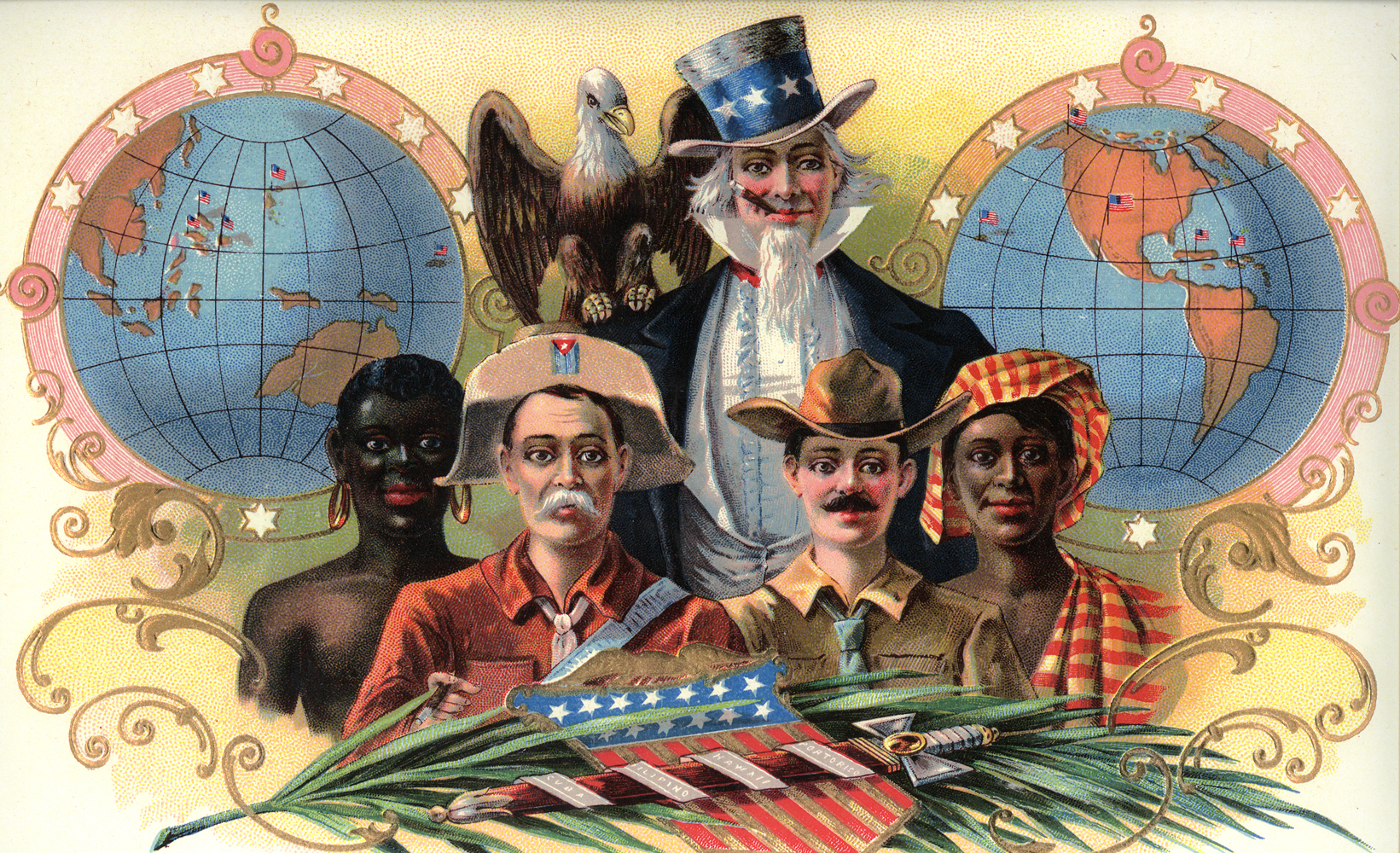
Cuba has been central to the imperial vision of the plunderbund that is the United States since its beginnings, and until 1959 considered a ‘keystone’ of the project. Indeed, the reversal of that revolution has been a central perspective of the Empire since.
‘Cuba—Keystone in the Arch of Empire’ by Harrison George from The Daily Worker. Vol. 6 No. 211. November 9, 1929.
The island of Cuba, with an area about equal to that of Pennsylvania, has a special importance greater than its size would indicate, precisely because it occupies a strategic position in relation to the imperialist world and represents, with the present Yankee dominance through the “republic” of Machado, a fortified outpost of American imperialism pressing still further southward and making the Caribbean an American lake.
Julio Mella, murdered last year in Mexico by agents of Machado at the orders of American imperialism, once referred to Cuba as no longer an independent republic, but a “Yankee plantation.” This was and remains true, but Cuba is more than a plantation which produces 28 percent of the world’s sugar. The sugar is incidental to the main importance of Cuba in the fight between American and British imperialism for world domination.
By its position athwart the eastern area-way of the Caribbean Sea, not only the Caribbean, but the whole Gulf of Mexico is subject to the naval power of the United States. This is most necessary to the United States plans for pushing its control into all Latin America, but naturally meets the resistant force of British imperialism, which though weak in comparison is nevertheless strengthening its defenses, both in capital investments and naval bases throughout all this region in anticipation of the coming war with the United States.
The fact that American imperialism, in its first infant steps in imperialist aggression, during the Spanish-American war, seized Cuba as one of its chief prizes, indicates how Wall Street regards Cuba as necessary to its aim of world dominion. Nor has the United States for one moment released its grip on Cuba. On the contrary, that grip has been ever tighter. Wall Street intended and still intends never to release Cuba from its grip (however much it be willing for the Cuban bourgeoisie to play at independence with a parliament whose acts an American general supervises and a president who gets his orders from the National City Bank). This is shown by the infamous “Platt Amendment” forced on Cuba in 1901, which binds Cuba to the chariot of American imperialism by forbidding its government to make treaties Washington don’t like, compels this “independent” nation to do all that Wall Street desires, or agree in advance to suffer armed occupation.
POWER SWEETER THAN SUGAR.
With this control, Cuba has been an important outlet for surplus capital, no less than $1,505,000,000 of Yankee wealth being invested there, largely in sugar production—though this wealth and the matter of sugar, as remarked, not the main thing desired by American imperialism. To press its control over Mexico, Central America and the northern coast of South America, all regions of enormous natural resources in oil, minerals, fibers and other products, and to control the eastern approaches to the Panama Canal, is far more important than sugar, important though sugar may be, although it is just now a drug on the world market.
The recent Wall Street loan of $50,000,000 to the Machado “government,” in spite of the economic insecurity of Cuban economy based on the tenuous value of sugar in a world over-supplied with that commodity, indicates clearly that at this particular moment of history America by no means will permit a loosening of Cuba’s chains—barring a revolution stronger than its own power, or an armed attack by another imperialist power taking it away from Yankee hands.
Nor is this, in view of the general world struggle between England and America, beyond the bounds of possibility. MacDonald’s trip to America only certified that Britain would not dismantle a solitary naval base of the many which menace American power in the Western Hemisphere. The Halifax base must be kept, so it was said, because some mysterious “Canadian imperialists” would raise the devil if it were dismantled. But nothing was said about the British naval base at Jamaica, only 85 miles south of Cuba. MacDonald would be exposed completely if he would have claimed his “desire” to dismantle bases in the Caribbean and Mexican Gulf is defeated by “Jamaican imperialists.”
THE PLAY OF WORLD FORCES.
The whole area of the Caribbean and the Gulf of Mexico is a powder magazine where the two great imperialist rivals watch each other. Although the British investment in Cuba by no means compares to that of America, being only some $75,000,000, England undoubtedly appreciates the value of having American control ousted, just as America appreciates sticking, for strategic reasons. This must not be forgotten in estimating any apparently “spontaneous” movement to oust America which is not based on the mass revolutionary initiative of the workers and peasants of Cuba, but which is led by dissatisfied elements of the nationalist bourgeoisie. American imperialism has its naval base at Guantanamo in Cuba, another in the nearby Virgin Islands, and still another in Porto Rico.
But against these are the British naval bases at Jamaica, another at Trinidad, one in British Honduras, still another in British Guiana—nor must one forget the base at the Dutch Island of Curacao, it being understood by those who understand anything, that the Royal Dutch Shell Oil Company which owns not only Curacao, but great properties in Mexico, Venezuela and Colombia—in all three of which imperialist rivalry has recently turned into covert armed struggle—will in a world war side with England.
THE PERSPECTIVE FOR MASS REVOLT
The workers’ revolutionary movement everywhere, not only in America and England, but particularly in these two rival imperialist countries now arming for war, must realize the powder magazine which is the Caribbean, and Cuba that that is its center. Also, must they realize that the lop-sided economy of Cuba, which (being based on an over-produced commodity) is in such a crisis that great masses of its 3,500,000 people are literally starving, and that this is creating a ferment of revolutionary desperation among the masses only weakly reflected thus far by the intellectual and petty-bourgeois independence movement.
Yet without these masses of workers and peasants, no independence movement can hope for success. It is therefore imperative, because the struggle for Cuban independence is part of the world revolution, that the greatest attention and aid be given the workers and peasants of Cuba in their struggle, most particularly, of course, by the revolutionary workers of the United States.
The Daily Worker began in 1924 and was published in New York City by the Communist Party US and its predecessor organizations. Among the most long-lasting and important left publications in US history, it had a circulation of 35,000 at its peak. The Daily Worker came from The Ohio Socialist, published by the Left Wing-dominated Socialist Party of Ohio in Cleveland from 1917 to November 1919, when it became became The Toiler, paper of the Communist Labor Party. In December 1921 the above-ground Workers Party of America merged the Toiler with the paper Workers Council to found The Worker, which became The Daily Worker beginning January 13, 1924.
Access to PDF of full issue: https://www.marxists.org/history/usa/pubs/dailyworker/1929/1929-ny/v06-n211-NY-nov-09-1929-DW-LOC.pdf
 Revolution's Newsstand