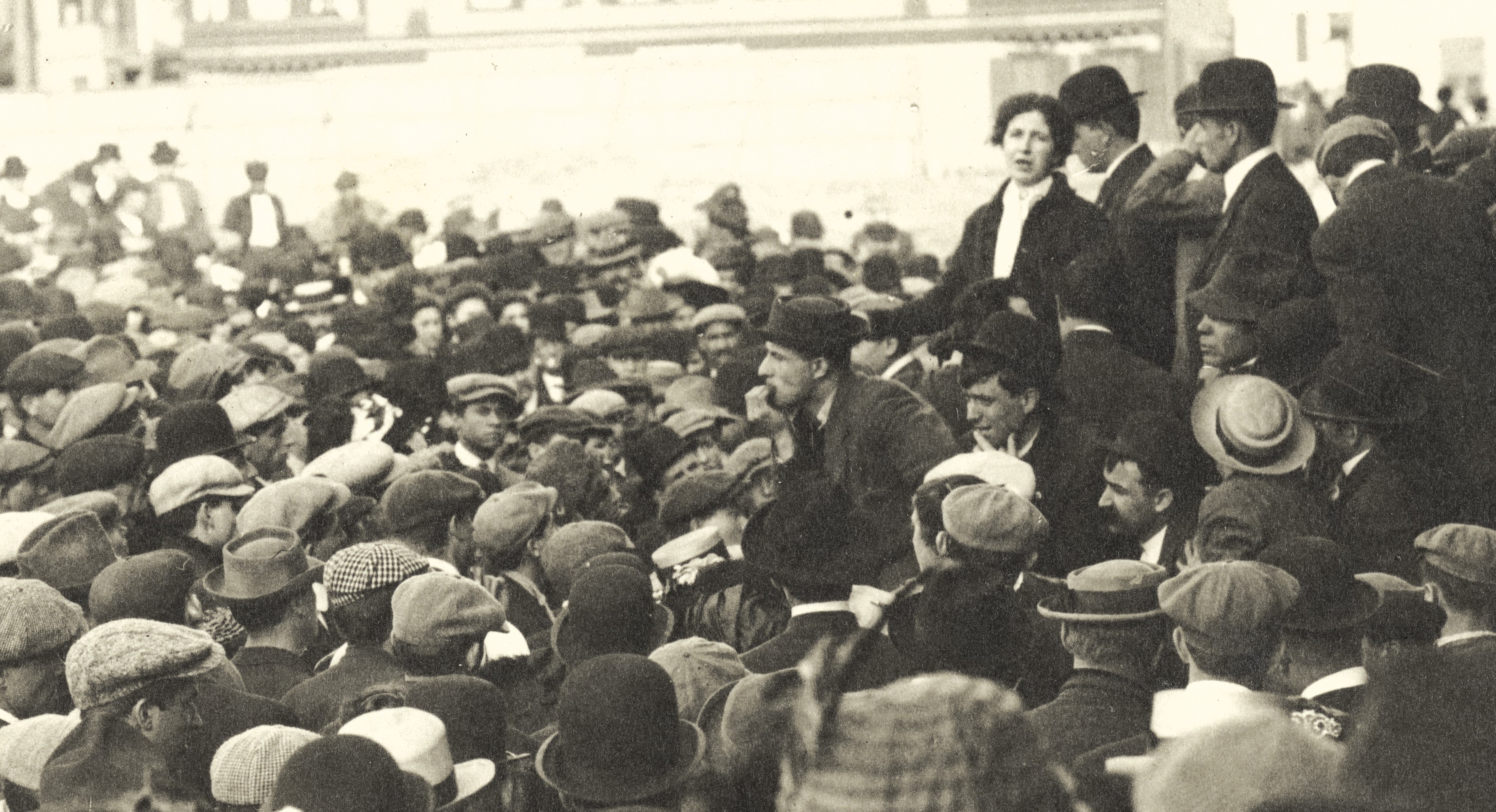
Flynn dresses down members and locals for not coming through in response to an appeal from 100 of their fellow workers in I.W.W. Local 20 striking the Atlantic Cotton Mills in Lawrence, Massachusetts. Within weeks, 30,000 workers in the city would be out in what would become known as the Bread and Roses Strike, one of defining struggles of that era.
‘Help the Textile Workers’ by Elizabeth Gurley Flynn from Industrial Worker. Vol. 3 No. 35. November 23, 1911.
I want to refresh the memory of your readers on a matter of vital importance of which appeared in the “Worker” recently, viz., the strike of the textile workers. An appeal was published from Local No. 20, I.W.W., of Lawrence, Mass., which deserves the serious attention and enthusiastic support of every local and individual member of our organization.
Since its publication the appeal has been received by the locals everywhere and has, in all likelihood, been given consideration at their respective business meetings. Therefore the facts set forth in the statement of conditions in the Atlantic mills should be familiar to all of us. The corporation attempted to increase the individual weavers’ output from fourteen to twenty-four cuts per week, accompanied by a reduction in price from 79c to 49c per cut. Thus each weaver would be compelled to tend twelve looms instead of seven, yet receive but 70 cents a week for the additional work, while the company pocketed $7.20 a week more on each man. But three men were to be hired for every five hitherto engaged.
Against this virtual decrease of wages, lengthening of hours the speeding and forcible stimulations of the unemployed ranks, one hundred members of our organization rebelled last August. They have been engaged in a bitter struggle with their employers, against such heavy odds that but for their indomitable spirit, they would have been crushed weeks ago. Now after waging their brave battle alone and unaided for over three months, they come to us for assistance. They ask for funds, for our “spare ammunition” that their wives and little ones may be protected from the pangs of hunger and the merciless cold of a New England winter. They ask in the spirit that “An injury to one is an injury to all,” and knowing that their victory or courageous battle, supported by the entire I.W.W., though it may end in temporary defeat, will give new impetus to the spirit of industrial banks of the Merrimack river. They want to safeguard their own conditions, as well as prove by deeds more eloquent than any speaker’s words to the oppressed and disheartened slaves of the mills that the I.W.W. stands for their interests and fights their battles.
What has been the reception accorded this appeal in your local, fellow worker? Are you so busy discussing referendums, “decentralizing,” the tyranny of the G.E.B. the necessity of a 2c per capita, etc., that this appeal was simply read in a perfunctory manner and filed? Did you, like one local I know of, turn it over to the secretary and “let him see what he can do,” which is a polite way of sliding out of doing anything yourself? Or did you salve your “conscience” for your stinginess with platitudes like another member of the I.W.W. I heard say, “We need our money ourselves, besides a long strike is a lost strike and you can’t beat the bosses with money.” This happened in two separate mixed locals, ladies that are never forced out as a unit on the firing line of the economic warfare; but who unfortunately too often degenerate into a position similar to a drummer boy, making much martial noise at a safe distance from the fight.
A long strike may often be a lost strike, yet surely those who are on the ground aiding the fighting and the suffering, many of whom have been in the I.W.W. since it was launched, are in a better position to judge the chances of success than those who are many miles away? They may be wrong but if so, they are the ones who must learn through the experience. They are certainly not going to learn through our withholding assistance, and liberally giving cold-blooded advice. Platitudes are no substitute for nourishment! We must not become dogmatists who measure all conditions by the yardstick of a theory or we become as ridiculous as an English Socialist I met who said, “I understand all about American conditions I’ve read Marx.”
When men and women are engaged in a legitimate struggle they don’t want verbiage, they want economic and financial support. If we fail to do our best in this regard we forfeit their respect and lose them from the organization. If we are not so situated that we can help them through economic action, there is but one alternative–give them every possible financial assistance.
IS YOUR LOCAL DOING THIS? ARE YOU DOING IT? GIVING EVERY POSSIBLE FINANCIAL ASSISTANCE?
If not, get busy!
Get that appeal from the secretary’s files next meeting and dig up a dime, a quarter, a dollar for the list. Get the local to donate a few dollars from the treasury. If you’ve done it once, do it again. It won’t hurt you and it will help lighten the load of your fellow worker in Local No. 20 and keep his children over the holidays.
Of course you can’t fight the boss with money alone. We all know that, so do the textile workers. But while you are struggling to conquer them by the power vested in you as workers, it’s good to know there’s a commissary department and you’re going to have your dinner. Still better is it for a man to know that while he’s fighting his fellow workers will take care that his family do not suffer needlessly.
A strike in a New England town is quite different from a free speech fight in a western city and to my mind in the difference lies the reason why the “floater” should not be given undue credit when he fights at the drop of a hat and the “homeguard” sneered at when they hesitate. Young, single, husky fellows with no dependents and no personal responsibility weighing heavily on them have little excuse not to fight. But the man of the mills is usually struggling under the burden of a large family and lacks the physical strength and endurance of the western floater. Consequently when he, the weary, nerve-racked weaver raises his head from the loom and resists oppression, he becomes a truly heroic figure!
On behalf of these fellow workers I appeal to you.
Think of men trying to raise families on $11.06 a week and put a donation in an envelope addressed to Wm. Taylor, 4 Mechanic street, Lawrence, Mass., as a blow at such a system.
Are you opposed to more work for less pay?
Are you opposed to the speeding up that throws men on the street and makes nervous wrecks of the worker?
or
Are you opposed to enriching greedy mill owners, while weaver’s children starve weave their lives into cotton and woollen cloth?
Do you believe in less work, shorter hours, more pay, health and happiness for the textile worker?
Do you want to see ONE BIG UNION of all the textile operatives throughout New England, English, French, Portuguese, united as one man?
Then answer the appeal of local No. 20; answer it every week till the fight is over. Send the brave fellow workers repeating replies in the form of coin of the realm.
Make their fight your fight! Help them on to weave the shroud of capitalism!
Speed them to solidarity, victory and freedom.
ASSISTANCE IS NEEDED
(From Industrial Worker. Vol. 3 No. 31. October 26, 1911. )
TEXTILE WORKERS REBEL IN THE REBEL IN THE INDUSTRY–ASSISTANCE IS NEEDED TO WARD OFF SUFFERING OF WOMEN AND CHILDREN.
Fellow Workers, Greeting:
Since the latter part of August our Local Union has had an ardent fight to sustain with our common enemy; CAPITAL.
One hundred cotton weavers are fighting against the following conditions which the Atlantic Mills are trying to impose on them.
12 looms instead of 7, at 49c per cut, instead of 79c; these are, in a few words, the conditions against which the weavers are revolting.
Seven looms producing two cuts per week at the rate of 79c per cut gave a salary of $11.06 per week: 12 looms producing 2 cuts each per week at the rate of 49c per cut gives a salary of $11.76.
Admitting that each weaver can make 24 cuts each on 12 looms, which is practically impossible, he will necessarily have to operate 5 more looms, and produce 10 more ents each week for the sum of 70c; so that it is really a theft of $7.20 per week which the corporation will make on each and every weaver, and at the same time throw two employes, out of every five, on the streets, Fellow Workers:
Can we suffer such a system, such a disgrace to solidarity that they wish to impose upon us? NO!
Have we not the right, and is it not our duty, to resist such an abatement from our means of existence?
Remember that Lawrence, Mass., is the stronghold of the big speculators of the textile industries; until today, the barons of this industry have always thought themselves under cover of any organized resistance on the part of the workers.
Today, Local Union No. 20 of the I.W.W. opposes itself to the encroachments of these speculators; it is growing stronger every day, anticipating the big fights of the future. As this local is at the beginning of its plan of organized resistance to the above mentioned encroachments, it is up to the organized workmen to sustain it to victory in its fight against the common enemy.
Our only defeat if defeat it is, is that we are financially poor, but with the assistance of you all, we will be the victors.
Now, Fellow Workers and friends, we again ask you to stand by us. Our defeat means further discouragement to the workers along the Merrimack river and elsewhere.
Our victory means the rise of new hope. We are on the firing line, pass us your spare ammunition. We shall expect you to call on us to do likewise when your turn comes; for we recognize that in our struggles an injury to one is the concern of all.
Funds are needed to save our women and children from suffering.
Hoping to receive a favorable answer to our message, we remain.
Fraternally yours for Industrial Unionism. For the Strike Committee and by order of
Local Union No. 20 of the I.W.W.
JOSEPH BEDARD. WILLIAM TAYLOR. AUG. DETOLLENAERE.
Forward all contributions to Wm. Taylor, 4 Mechanic street, Lawrence, Mass.
The Industrial Union Bulletin, and the Industrial Worker were newspapers published by the Industrial Workers of the World (IWW) from 1907 until 1913. First printed in Joliet, Illinois, IUB incorporated The Voice of Labor, the newspaper of the American Labor Union which had joined the IWW, and another IWW affiliate, International Metal Worker.The Trautmann-DeLeon faction issued its weekly from March 1907. Soon after, De Leon would be expelled and Trautmann would continue IUB until March 1909. It was edited by A. S. Edwards. 1909, production moved to Spokane, Washington and became The Industrial Worker, “the voice of revolutionary industrial unionism.”
PDF of full issue: https://www.marxists.org/history/usa/pubs/industrialworker/iw/v3n35-w139-nov-23-1911-IW.pdf
 Revolution's Newsstand