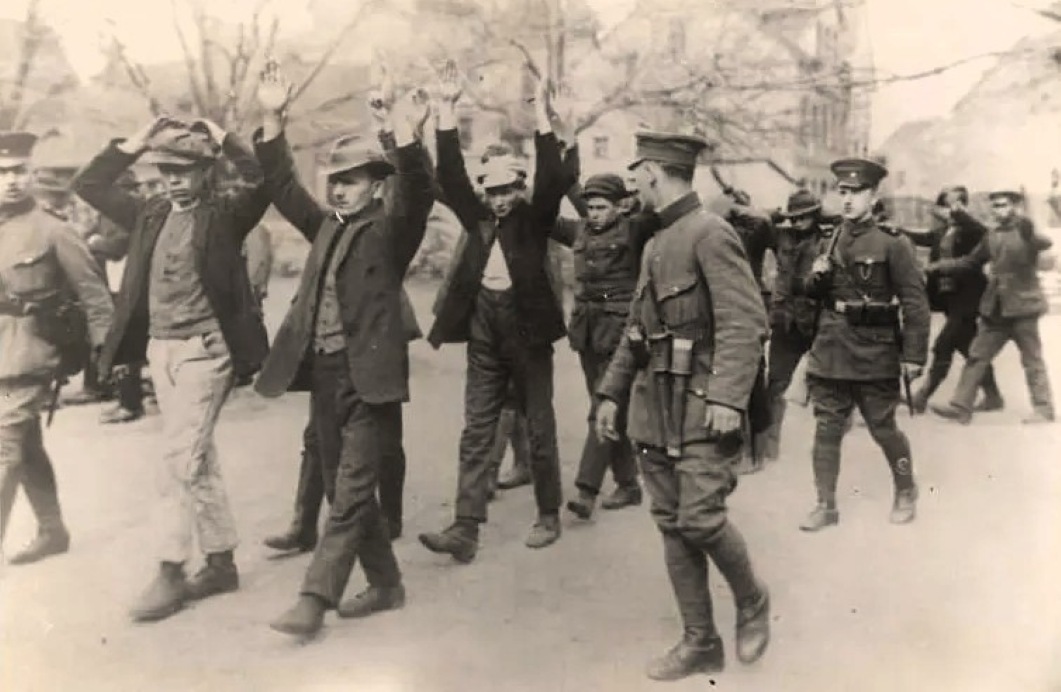
Radek analyses the ‘March Action’ of 1921 and the fallout in the Germany Party, particularly Paul Levi’s Communist Workers Group, formed from a split over differences on those events. First published as a series in Pravda.
‘The Crisis in the Communist Party of Germany’ by Karl Radek from The Toilers. Nos. 178-181. July 2-July 23, 1921.
Article from the “Moscow Pravda,” May 5-7, 1921. Translated from the Russian by J. Milner
When in December last, the Union of Spartacus, numbering about 100 thousand members, united with the Left Independents, leading into the Communist International from the party of the Independents about 400 thousand workers, for every one knowing the situation in Germany, it was clear, that the unified Communist Party must go through a whole series of crises before it really became a Communist Party. Under the pressure of the mass of German workers there flocked to it a considerable number of organizers and editors, who after great wavering joined the program and tactical views of the Communist International. These elements, of course, did not outlive their indecision by signing the 21 conditions of the second congress of the Comintern. Moreover, the Party was confronted with new problems. A party of half a million members having influence over a million and a half of trade unionists, cannot limit itself only to propaganda and agitation. It must participate in great battles, that inevitably should emerge, if the Party fulfills its task, and receiving blows from the bourgeoisie must answer with counter blows. But even among the leaders of the Union of Spartakus, at the time of the German Kornilovist Putsch, could be noticed a tendency to the Right. Being burnt in the battles, in which in 1919 the unhardened Spartacides threw themselves, they saw in every revolutionary manifestation of the minority but a sudden flash, regardless that hundreds of thousands participated in it. A shift from propaganda and agitation to action inevitably should bring about differences and conflicts; and only by a solving of these problems can a fighting Communist Party be formed. The six months history of the unified party of communists of Germany is the history of this inevitable process.
Conflicts began when both chairmen of the Party, the ex-Spartacide Paul Levi, and the ex-Left Independent Daumig, in the most energetic way acted against the admission in the Communist International of the Communist Labor Party of Germany in the capacity of a sympathetic organization. The Communist Labor Party represents the “left” communists, who broke away from the Union of Spartakus, not agreeing on the work in the old trade unions and on exploiting parliamentarism for revolutionary agitation and organization. As it is known, the second congress of the Comintern completely justified the view of the union of Spartacus, reckoning that communists have no right to withdraw from the mass organizations of the workers and that they have to exploit for the aims of communist agitation and propaganda all means that are given it by the bourgeois State. But justifying as a whole the view point of “The Spartacus,” the Executive Committee of the Comintern, could not shut its eyes before the fact that the Communist Labor Party reflects the rebellious leanings of the unemployed and the poorest working masses. On this account the Executive Committee admitted temporarily this, party in the capacity of a sympathizer, in order to keep in touch with it and to influence it, making easier for the unified communist party to merge with this left group and the elements standing behind it. In the historical lamentations of Paul Levy against this step was expressed the inability to discover the way to the heart and senses of the various layers of the proletariat in whom the collapse of capitalism creates desperate rebellious leanings. This inability brought about the leaning to the right, for he, who actually wants revolution, must understand, that revolutionary struggle cannot be carried on by pushing away the layers of the proletariat most dissatisfied by capitalism. The right tendency, promulgated in this case by Levy, expressed this simple fact: that part of the party’s organizers were afraid of these turbulent but revolutionary actions by the unemployed and allied layers of the proletariat.
The inability of the Paul Levy group to connect with the rebellious proletarian elements was combined with the intention to attract to the Communist International the remaining layers of the proletariat with moderation and orderly forms of agitation that is: actually by not only renouncing the most expressive revolutionary forms of agitation but actually joining hands with the centrist elements. This tendency emerged openly, when Levy, returning from the convention of the Italian Socialist Party in Livorno, began to criticise the Executive Committee of the Communist International, stating that it scared away Serrati, that it created an artificial breach in the Italian party, tending to create small but pure communist parties. Levy reproached the Executive Committee of the Comintern, with the identical charge which hitherto was the chief weapon of the Centrists against the Communist International: a reproach of sectarianism. To many this dissention appeared as brought about by lack of information about the situation in Italy and the intentions of the Executive Committee. But the leading groups in the party understood, that here at hand was the leaning toward centralism, that Levy, regardless or how he fenced himself off from Serrati indeed assisted this wavering revolutionist in the struggle against Italian communists. When the Central Council of the Party, consisting of the Central Committee of the Party and the representatives of the districts, accepted a resolution, rejecting strictly and clearly the view point of Levy, Levy resigned the powers of the chairman of the party and with him left the Central Committee of the party, comrade Klara Zetkin and four former Independents. This fact proved not only that a right wing had formed within the party, according to the example of all opportunistic groups, who do not reckon with revolutionary discipline. To hold in a party that demands from the that they go on the first call of the Central Committee against the armed whites, is a post that cannot be left without the order of the party. The party’s congress put Levy and those thinking like him in party positions. Leaving these positions without the consent of the party, they proved that they are intending to put themselves above the party and dictate their conditions, as always was done by the intellectuals in the labor movement.
Levy and his followers declared, that they will serve the party as common soldiers, taking no responsibility for its political leadership. In the days the party could be convinced that these were only words, that comrades who were not able to carry on their tasks as commanders of the red army, also where not in a position to do it as privates in the red army. The March days saw not only the sabotage of the followers of Levy, but direct betrayal by the former chairman of the party Levy, who, for this betrayal is expelled from the Communist Party of and from the Communist International.
II.
The fundamental question that stood before the Communist Party of Germany at the moment of its organization, was: can it continue a policy of agitation and waiting, that was carried on by necessity, by the Spartakus as an organization small in numbers, and as it was conducted by the left part of the Independents, bound arms and feet by the rights of the Independents, or will it carry on a policy of battle. The manifesto of the unity congress of the party declared: a party counting half a million of advanced revolutionary workers, leaving the Independents not on theoretical differences, but because the Independents covered their inactivity by loud revolutionary phrases, it cannot limit itself to agitation and propaganda. Furthermore, it cannot limit itself to agitation and propaganda for the following reasons: that the growing need of the mass, the growing danger of the mass to fall in a complete slavery of German and Entente capital, demands from the vanguard of the proletariat, that it not by words but deeds strives to arouse to its feet the much betrayed masses, masses that have outlived, to a considerable extent, the democratic illusions, but not believing in their own power, in the possibility of a revolutionary struggle. The congress of the party declared in its manifesto, that the party will be a party of battle, that it will attempt to deepen, broaden and unite every struggle of the workers.
How did the party fulfill this task? In the first weeks of its existence it showed that it knows not how to exploit the forms of propaganda; even such questions as unemployment it did not understand how to sufficiently exploit. In January last it appeared that Germany faced great events. Simultaneously drifted on the movement of the railroad workers, the postal employees and the unemployed. The party to do everything possible in order to centralize and place these movements on a higher plane than merely a struggle for higher wages. To do this a preliminary review of forces was necessary. The party turned to all organizations resting upon the working class, with an open question: are they ready to take part in the common struggle for determined daily slogans, responding to the most pressing needs of the working class? Putting these questions the party issued from the predetermination that, depending on the answer of the Scheidemanists and the Independents, whether to march out in common with them, in order in the struggle, depending on conditions, to broaden and deepen the character of this struggle; or, if the Independents and also the Social-democrats at once reject the common marching out, then attack them on the same daily questions, comprehensible to the broadest masses, to acquire sufficiently strong influence in this way, over large masses of trade unionists to carry on an independent struggle. The tactic of the “Open Letter” was crowned with great success. It showed the lagging masses that not the Communists but the Independents and Scheidemanists are splitting the forces, and that when the question is not on the problems dividing the proletariat, dictatorship and democracy, that they want no struggle at all, that they are simply parties, holding back the workers from all struggle. During the process on the “Open Letter” the party decided to organize in the Trade Unions its communist factions and to broaden and strengthen their influence over the broad noncommunist masses. However, further than that the party could not go. Partly because, that the party press and the party organization and the Central Committee, being in the hands of the moderate communists to a considerable extent, were not in a position to carry on a live, fighting tendency.
Capitalists Take Offensive.
During this time the domestic and foreign condition of the German proletariat became worse. The world’s economic crisis, increasing in Germany incited the capitalists to assume an offensive against the working class. The capitalists began to reduce wages and prepare an offensive against the workers in the main centers of communism. The Communist Party being especially strong in central Germany, is the mining district; the German government decided to start a cleaning there, leading in under the mane of the police of defense, strong military squadrons, the task of which were to disarm the workers and handle them with thorny gloves. The disarming of the workers of the central region served yet another purpose, to serve the aims of the foreign policy. The time was nearing when the German government must make the final decision in its relations towards the Entente. Whether it will accept the demands of the Entente or it will decide for a battle against the Entente. In the first instance the deal will be on the account of the toiling German masses, who, doubtlessly, will agree to carry a double burden, the burden of the German and Allied bourgeoisie. As the predetermination for this compromise with the Entente was the annihilation of the centers of the communist movement, if the government decides to reject the demands of the Entente, then so much less can it suffer the existence in the center of Germany of a proletarian stronghold that may threaten its freedom of troop movements etc.
Party Prepares To Resist.
Under these conditions convened the Central Council of the party on the 17 of March, which, as we said, consists of the Central Committee of the party and the representatives of the districts. Bearing in mind all the above-mentioned conditions, the party council with all votes against one, decided to put the party on a war footing, to strengthen the illegal organization, sharpen the tone of the party’s press, call upon the workers to answer blow for blow. The Central Committee received instructions not evade the approaching conflicts but to sharpen and unite them. When the social-democratic lackey of the bourgeoisie, Goersing, carried out the threat of the Prussian government and lead in the defence police in the central mining district, this district answered not only with strikes but with armed actions. The battle began at a very unfortunate moment, a few days before Easter, which, cutting into the preparatory work of agitation and propaganda, made difficult the creation of a common front. The Central committee of the party understood the unappropriatness of the moment, but did not refuse to march out, for it reckoned that a withdrawal without a battle would be a greater evil than a defeat. To the call to battle responded a million and a half of workers, made up in part of noncommunist workers. The conflict assumed various aspects in the different regions of Germany. Various means were demonstrations, strikes and armed manifestations.
Moderates Becomes Traitors.
The fate of the struggle was decided by the fact that not only the Scheidemanists but also the right Independents went over openly to the side of the bourgeoisie. The right Independents went hand in hand with the government against the struggling workers. Their press lamented the movement as a contrivance of agents of Soviet Russia, believing it in its last days. When it became obvious that the movement was going to lose, the Central Committee gave an order to cease the struggle. After the armies of Goersing finished their bloody work, the field courts began their work. Tens of death sentences, more than a thousand years of penitentiary sentences were pronounced by the democratic German government of the republic, represented externally by the social-democrat Ebert, who, as President has the right of amnesty, but did not exercise that right. The headmen of the right wing of the party took no part in the struggle but in many places sabotaged it, At the moment, when, under the blows of the enemy the party was forced to retreat, leaving hundreds of corpses and thousands of captives, when all the bourgeois and all the social-democratic press raised their savage howl against the party, demanding its destruction, the leaders of the right wing of the party began in the party’s organizations to charge the Central Committee, that “on orders from Moscow” it had thrown itself in the adventure, and demanded the resignation of the Central Committee.
Levy’s Traitorous Act.
Within sounds of the shots executing the death sentences of the field courts martial, under the lamentation of all bourgeois society, demanding a reckoning with the communist party, came out on the 14 of April the outbursts, in which these charges are made in the tone of a renegade, and directed against the Central Committee of the party and against the Executive Committee of the Communist International, (Comintern). The brochure of Levy was wafted to all the bourgeois and circulated in all former chairman of the party, Paul Levy, with a brochure entitled: “Our Road in the Struggle against Sudden the social-democratic press and the press of the Independents and became the main weapon against the Communist Party and against the Comintern. The Central Committee of the party did not interfere with Levy and the criticism of his followers, while it was conducted in the party organization, but expelled him from the party, when his activities were carried on outside the Party ranks. The Executive Committee of the Comintern approved this step. With Levy united comrade Zetkin and a number of the leaders of the former left Independents, with Daumig, Gaier and Brass at their head. Local District conferences of all important organizations of the party: Berlin, Hamburg, Bremen, Leipzig, Chemnitz, Wuertemberg (district in which C. Zetkin worked for 30 years), all declared in favor of the Central Committee. Among them also the much-suffering central district of Halle. Because of the solidarity of a number of members of the parliamentary faction, with Levy, the Central Committee answered with a demand that these members, pending the decision of the Council, that was to convene on the tenth of May, should not exercise their parliamentary duties, for they cannot, considering the position they have been taking, defend the party.
In view of the fact, that Levy and his followers criticise the party not only on the mistakes committed during this movement, and such mistakes, of course, are many, but are advancing principal charges against the party, cutting across the viewpoint of the Comintern, we are bound in the succeeding article to deal with the questions advanced by the March movement, which, regardless of all mistakes committed by it, is a step ahead on the road of the creation of a real communist party in Germany.
III.
Lessons of the March Movement.
When the workers of Central Ge many arose to fight against the invasion of their district by the detachments of Hersing, the entire bourgeois, social-democratic and independent press raised an alarm about a “putsch” being engineered by the Communist Party which it was alleged was throwing the masses into an adventure for the reason of the danger that was threatening Soviet Russia. The movement was only at the beginning and it was impossible to predict what magnitude it would assume, when the former chairman of the party and the present renegade, Paul Levi, gave it the same appraisal as the bourgeois press. It is needless to assert that the Soviet Government and the Comintern only received information of the events in Germany after the Berlin wireless spread the news all over the world. The best proof of this assertion is my article in the “Pravda”, the 25th of March, in which I attempted to analyse the sources of the movement and very guardedly spoke of its possible future course. The Central Executive of the German Communist Party repeatedly emphasised that its decision of the 17th of March about increasing the Party’s fighting capacity was prompted by the home and foreign situation, and that neither the Executive Committee of the Comintern not anyone of its representatives over demanded that the Party should hurl itself into an open combat. The movement which followed a few days after the session of the 17th of March was provoked by the attack of the government upon the workers of the central mining district. We touch upon this side of the question only because it indirectly exhibits the renegade centrist character of the Levi group. Since when do we, Communists, dispute the right of the Comintern to offer any advice to all of its affiliated parties in reference to their conduct of the revolutionary struggle? Only the Hilferdings and Crispiens reproached the Comintern for its tendency towards a Moscow dictatorship in its efforts to thoroughly centralize the conduct of the revolutionary struggle. Even if the German Communists, convinced that the existence of Soviet Russia is the guarantee of the world revolution, and basing themselves on this correct assumption, forced the course of events for the sake of Russia,–and this would certainly be a mistake, because the world revolution, cannot be artificially accelerated, this mistake would be a demonstration of revolutionary internationalism without which the proletariat cannot be victorious in any country. The apostacy of Levi and of those who did not straightway disavow him was proven by their outcry against the Moscow dictatorship and by their foul charge that the Central Executive provoked the struggle in order to hasten the victory of the proletariat in Germany and thereby render aid to the Russian proletariat.
As we stated above, this charge is entirely baseless. The decision of the 17th of March was dictated by the concrete situation and fully corresponded with the problems and interests of the Communist movement in Germany. The March events were the direct result of a brutal provocation by the Prussian Government. The Social-Democrat Severing, Prussian Minister of the Interior, in an article, in the “Getreuer Eckard” cynically admitted that when he noticed the growing activity of the Communist Party, he decided to lure the Communists into a fight before they were prepared. It is possible to criticise the Central Executive for accepting the challenge, notwithstanding the very disadvantageous moment, but it is altogether inappropriate to speak) of “Putschism”.
Putschism, in the mouth of a Marxist has a defiance: this term signifies an attempt by an insignificant minority. The Central Committee of the German Communist Party did not at this time aim to capture power. If Levi would have raised this charge against the Party, i.e. that it aimed to seize power, here could be some reasonable argument about “putschism”. All the readers of Levi’s pamphlet were convinced that this was really his charge and insisted that he shall produce evidence of the Central Executive seriously aiming at the capture of power. In the preface–the German bourgeoisie fought savagely for this pamphlet and bought its entire edition in a few days–he declared that he never made such a charge against the Party, but his accusation is that the movement was purposelessly organized by some muddlehead representative of the Executive Committee of the Communist International. But in this same pamphlet Levi recognized that town after town in Central Germany was swept into the revolutionary movement and the workers fought heroically and died gladly. Levi emphasises that all this was done by order of the Central Executive of the Party. But who among conscious revolutionaries will believe that hundreds and thousands of workers would go into battle without knowing what for, and blindly follow an Executive Committee of a young Party which did not command much authority, and what little authority it did command was weakened by the resignation of its most prominent members. Only an arrogant intellectual, isolated from the labor movement, alien to the conditions of life of the working class can argue to such absurdities. The workers of Central Germany fought heroically because they excellently understood the situation, understood that affair was a question of defence against the White offensive, which signified the beginning of an offensive of German Capital against the working class.
The charge of “Putschism” is nothing else than the concealment with Marxist phrases, of the abandonment, not only of the offensive tactics of Communism, but also of the policy of active defence. In charging the Central Committee of the Party with “Putschism”, Levi does not say what the Party should have done when Hersing moved his troops into Central Germany. Should the Party have remained silent, or should it have asked Levi to make an eloquent speech of protest in Parliament?
By attacking the Party at the moment when the Courts Martial were most active, Levi automatically excluded himself from the Communist International. But if there had not been treachery, his position would nevertheless have been an abandonment of Communism, for he advocated a policy of inactivity, a waiting policy at the moment when the position above all demanded action.
In answer to this charge, Levi argues in favour of local action if the majority of workers in the particular districts are with us. But the advance which the Communist Party in Germany has made during the past year consists precisely in the fact that after scores of local defeats the Communist Party represents the united vanguard of the proletariat on a national scale, which avoids local defeats and renders possible the transition to fighting along the whole battle line. Realising the weakness of his position, Levi, in the preface to the second edition to the pamphlet we have already referred to, refers to a report which he submitted to the Central Committee of the Party on the 10 of March, in which he had developed a plan of action invented entirely out of his own head. This report merely proved that Levi was a doctrinaire who shielded himself from the actualities of life by clouds of vague schemes, for what indeed does Levi’s plan consist of?–The German bourgeoisie are in a deplorable position. The Entente is imposing ruinous conditions which are arousing indignation among wide circles. The bourgeoisie would not agree only in alliance with Soviet Russia. But the acceptance of the Entente’s conditions are so dangerous for the petty bourgeoisie and the Scheidemann elements that it is possible to rally large masses with the cry of alliance with Soviet Russia and war with the Entente. The struggle for an alliance with Soviet Russia might lead to a struggle for power–This plan makes the error in assuming that, if it is impossible to move the Scheidemann workers into battle for the defence of their immediate interests it is nevertheless possible to move them into battle for the avoidance of the future consequences of the acceptance of the Entente conditions. Equally with the Entente–that they cannot be skinned more than once. They even speculate on the point that if the Entente will want to exploit them, the former will have to supply them with provisions. The Scheidemann workers are wrong, but they will only convince themselves of their error after the occupation of Germany by the Allies. Levi’s plan is the project of a thinker who believes that “he who today runs away from the battlefield of reality lives to fight another day”. In the sphere of his fantasies, Levi, like Hamlet’s father speaks of daggers in order not to employ his dagger.
When comrades Zetkin, Brass, Geyer, and others declare that the point of view of Levi conforms to the principles and tactics of the Comintern, they are responsible for a very flat jest. From the very first day of its existence the Comintern said to the workers of the whole world that the last fight, the final victory, will not fall from heaven, but will grow out of the individual battles for the vital interests of the proletariat, out of the battles which the Communist Party must extend and deepen. To avoid these battles because at a certain stage they may result in defeat, means to abandon fighting altogether, and convert the Communist Party into a propagandist circle. Levi charges the Communist International with pretending to have the secret of pure Communism, but as a matter of fact if the Party followed his advice, it would become converted into a sect. The Party proved its vitality by rejecting the policy of Levi. This proof is the more valuable for the fact that the local and district organizations of the Party rejected Levi’s policy in spite of undoubted defeats, and in spite of errors committed in the March Days.
IV.
The International Significance of German Events.
The German Communist Party committed a number of errors, in the March movement. Its main “error”, the sudden change from propaganda and agitation to active struggle, is the direct result of the past, the responsibility for which falls first of all upon the right wing of the party, on Levi and Daumig, the former party presidents, who failed to prepare the party sufficiently for the inevitable struggle. For this reason, when the party was obliged to undertake the defence of the miners of Central Germany, the transition to the necessary action had to lead to defeat. The second mistake was the failure of the Central Committee of the party to keep complete control of the armed workers, in having allowed them to manifest activity when the character of the movement had not yet become fully defined, and before it was made clear whether it would not have been better merely to proclaim a strike. But this error was also the result of the fact that until recently the decision of such questions rested with one of the right wing comrades. For reasons of secrecy the Central Committee lacked complete knowledge of the actual state of things. Where the present Central Committee is really at fault is in that it was not capable from the very first moment clearly to define the political significance of the movement, and that even now, with the struggle over, it is still in error with regard to the actual character of the movement. The March movement is the type of movement which is known in military science as “active defence”. Instead of emphasising the defensive character of the struggle, which was forced upon the proletariat, the party spoke of an offensive; this made it easy for the opponents to create an impression Amongst part of the proletariat that the movement was artificially created by the Communists. The theory put forward by a number of leading German comrades that the party should now follow an offensive policy is an illusion and arises from their failure to take their present circumstances into their full consideration. The party must and will fight in dependance on actual conditions. The party can adopt an offensive policy only after due consideration of the actual state of things. Its policy does not depend solely on its own will, it is not determined by the decision of the Central Committee independent of actual conditions. The spirit of activity now to be observed in the ranks of the party, a spirit ardently welcomed by the Communist International, should first of all be expressed in increasing the revolutionary agitation for an offensive; it should be expressed in an intensification, both of the organized legal and illegal life of the party, it should be expressed in the constant fighting preparedness of the party. The party will be fully capable of putting up a fight whenever the necessity arises, only when the entire party will be imbued in its every day practice with this spirit.
The transition of the United Communist Party of Germany to a policy of attack is in itself a fact of great international significance. What the West European movement lacks today is just such parties which would be able and willing actually to fight and not only to discuss theses and to carry on the propaganda and agitation of communist ideas. Not only the Central Committee of the German Party, but what is more important, the working masses, and party organizations behind them, have shown their will to put up a revolutionary fight. In view of the fact that the disintegration of the German bourgeoisie is growing daily, the establishment of a party in Germany which would be ready to fight, really signifies the creation of one of the most important prerequisites to a revolution; the thing that Germany lacked most for the purpose of gaining the final victory of the proletariat.
Recent events have also proved one more thing: that the party has changed its policy of agitation to one of a struggle against whom we hitherto considered to be Communists, comrades who have belonged to the Communist International either since the last congress, or for many years. A number of organizers, writers and emissaries of the former fraction of the left Independents were grouped around those men. This proves that we have to deal not with the deviation of one or two men, but with a definite political bureaucratic body which, while fully adhering to the theory of communism, nevertheless fears an actual struggle. This body may be said to be a younger brother of the Dittmans and the Dissmans who fear even the theory of communism. The bureaucratic element in the party which publicly dared to declare its solidarity with the renegade step made by Levi proved that in the event of the party deciding against the will of its bureaucrats the latter are prepared to destroy the entire discipline of the party.
The German Communist Party eventually will be able to compel these elements to submit to the will of the party organizations. It will not permit some 17 men of the parliamentary fraction to treat the decision of the party with contempt. It will not permit party members to publish a journal in conjunction with people who have been excluded from the party for treachery. In this struggle for revolutionary discipline the party will be fully supported by the Communist International which understands well enough that what is happening in Germany really represents a continuation of our struggle with the “Centre”. When the Communist International at the Second Congress opened wide its doors to the working masses which adhered to its slogans, it was fully conscious of the possible danger of having, together with the wave of revolutionary workers, an influx into its ranks of elements whose sole distinction from the Hilferdings and the Crispiens is purely verbal. Being aware of this danger the Second Congress of the Communist International took corresponding precautionary measures. One of the first conditions was that all parties affiliated with it should periodically register all its members. At that time this seemed to many quite superfluous. The present events in the German Party have proved this condition to be necessary. The proletariat has to carry on its struggle for power under such difficult conditions that it is not at all surprising that many of its leaders and especially the intellectuals and bureaucrats of the old epoch become apprehensive, and begin to withdraw. The leading workers see all these difficulties, as has been proved by the decisions carried out by all local organizations without exceptions; they take into consideration all errors with the aim of making further progress so soon as these mistakes have been rectified and the difficulties overcome. This is the international moral to be drawn from the March events in Germany.
The Toiler was a significant regional, later national, newspaper of the early Communist movement published weekly between 1919 and 1921. It grew out of the Socialist Party’s ‘The Ohio Socialist’, leading paper of the Party’s left wing and northern Ohio’s militant IWW base and became the national voice of the forces that would become The Communist Labor Party. The Toiler was first published in Cleveland, Ohio, its volume number continuing on from The Ohio Socialist, in the fall of 1919 as the paper of the Communist Labor Party of Ohio. The Toiler moved to New York City in early 1920 and with its union focus served as the labor paper of the CLP and the legal Workers Party of America. Editors included Elmer Allison and James P Cannon. The original English language and/or US publication of key texts of the international revolutionary movement are prominent features of the Toiler. In January 1922, The Toiler merged with The Workers Council to form The Worker, becoming the Communist Party’s main paper continuing as The Daily Worker in January, 1924.
PDF of full issue: https://www.marxists.org/history/usa/pubs/thetoiler/n178-jul-02-1921-Toiler-rsz-chronAM.pdf
PDF of full issue 2: https://www.marxists.org/history/usa/pubs/thetoiler/n179-jul-09-1921-Toiler-rsz-chronAM.pdf
PDF of full issue 3: https://www.marxists.org/history/usa/pubs/thetoiler/n180-jul-16-1921-Toiler-rsz-chronAM.pdf
PDF of full issue 4: https://www.marxists.org/history/usa/pubs/thetoiler/n181-jul-23-1921-Toiler-rsz-chronAM.pdf
 Revolution's Newsstand