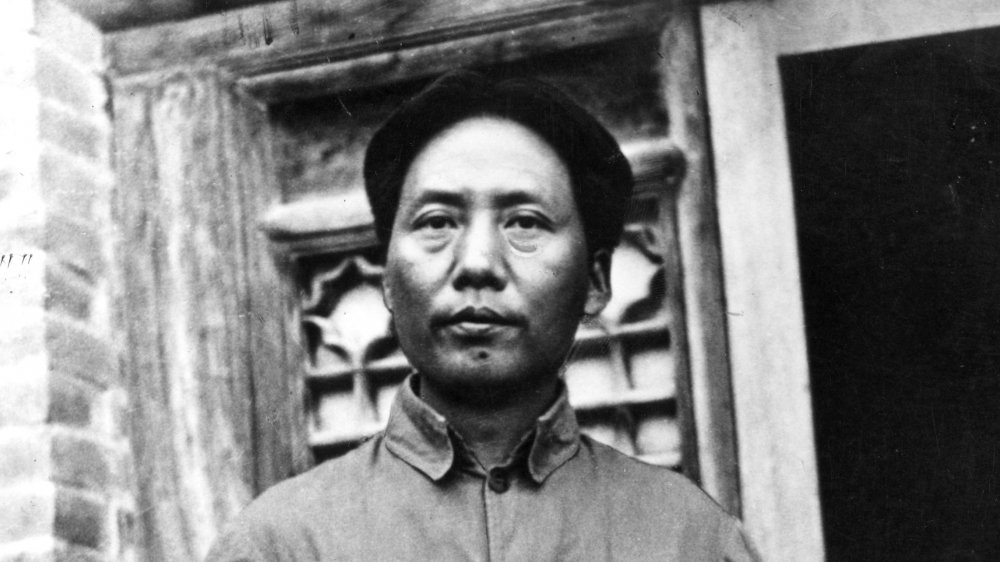
An interesting footnote from history–a Comintern obituary of Mao after he was erroneously reported dead from disease in 1930.
‘Comrade Mau Tze Dung’ by Tang Shin She from International Press Correspondence. Vol. 10 No. 14. March 20, 1930.
News has arrived from China that Comrade Mau Tze Dung, one of the founders of the Communist Party of China and the founder of the partisan troops and the Red army, has died at the front in Fukien as a result of long-standing disease of the lungs. He was the most feared enemy of the landowners and the bourgeoisie. The Kuomintang–the representative of the landowners and the bourgeoisie–had since 1927 placed a heavy price on his head. His sickness several times served as an occasion for announcing his death, and thereby encouraging the counter-revolution. There is no doubt that the death of our comrade has called forth great joy in the camp of our enemies. For the Party, the Red Army, and the Revolution his death means a severe loss.
Comrade Mau Tze Dung came of a peasant family in the province of Hunan. Already as a young student he conducted a hard fight against militarism in China. After the victory of the October Revolution in Russia, he immediately joined the Marxist-Leninist movement. In the so-called Renaissance time, after the Peking student riots in 1919, he developed a wide-scale propaganda campaign in the Yangtse area. In the huge Pinchang mining works he organised a model trade union which to-day constitutes the cadres for the big workers and peasants movement in the Hunan and Kiangsi area, as well as for the Bolshevist party generally.
Comrade Mau Tze Dung had been a member of the Central Committee of the C.P. of China since 1923. He fought constantly against opportunism within the Party, especially at the time of the Wuhan period. When the Party failed in the agrarian revolution, he against the will of the opportunist leadership, worked among the peasant masses in Hunan, and after the coup d’état of May 20, 1927, in Changsha, he organised the peasant revolts in Hunan. At the beginning of 1928 he formed a Red Army with his worker and peasant troops and those of Comrade Chu De, conquered an enormous stretch of territory in Hunan and Kiangse, and set up Soviets in every locality. The Red Army severely shook the counter-revolutionary Kuomintang regime. The troops in the neighbouring provinces–representing altogether seven army corps–were sent to annihilate this Red Army. For tactical reasons a part of the Mau Tze Dung and Chu De troops left Hunan and went on a campaign to Kwangtung and Fukien, where the revolutionary movement was in a state of ferment. More than half the province of Fukien came under Soviet rule. The crushed peasant movement and the Red Army, which had been driven back into the mountain district in East Kwangtung, were roused to fresh activity by the powerful advance of Mau Tze Dung. With troops drawn from six provinces, i.e. more than 60,000 soldiers, the Kuomintang last summer again took up the fight against the Red Army led by Comrade Mau Tze Dung. This powerful army, however, was not able to drive back the Red Army numbering about 10,000 men. On the contrary, it become subject to a process of constant disintegration, whole brigades at a time deserted it and went over to the Reds.
Comrade Mau Tze Dung was the political leader of the so-called Chu Mau troops. He completely carried out in his sphere the decisions of the sixth World Congress and of the sixth Party Congress of the C. P. of China. He thereby helped to expose and annihilate the reformist illusions among certain sections of the city poor, the peasants, and also the working class, which had been called forth by the “Left” Kuomintang, the third Party and To Du Siu.
Comrade Mau Tze Dung has fulfilled his historical mission as a Bolshevik and champion of the Chinese proletariat in the full sense of the word. The working and peasant masses of China will not forget his achievements, and will continue his work until it is completed.
International Press Correspondence, widely known as”Inprecorr” was published by the Executive Committee of the Communist International (ECCI) regularly in German and English, occasionally in many other languages, beginning in 1921 and lasting in English until 1938. Inprecorr’s role was to supply translated articles to the English-speaking press of the International from the Comintern’s different sections, as well as news and statements from the ECCI. Many ‘Daily Worker’ and ‘Communist’ articles originated in Inprecorr, and it also published articles by American comrades for use in other countries. It was published at least weekly, and often thrice weekly.
PDF of full issue: https://www.marxists.org/history/international/comintern/inprecor/1930/v10n14-mar-20-1930-inprecor-Virginia.pdf
 Revolution's Newsstand