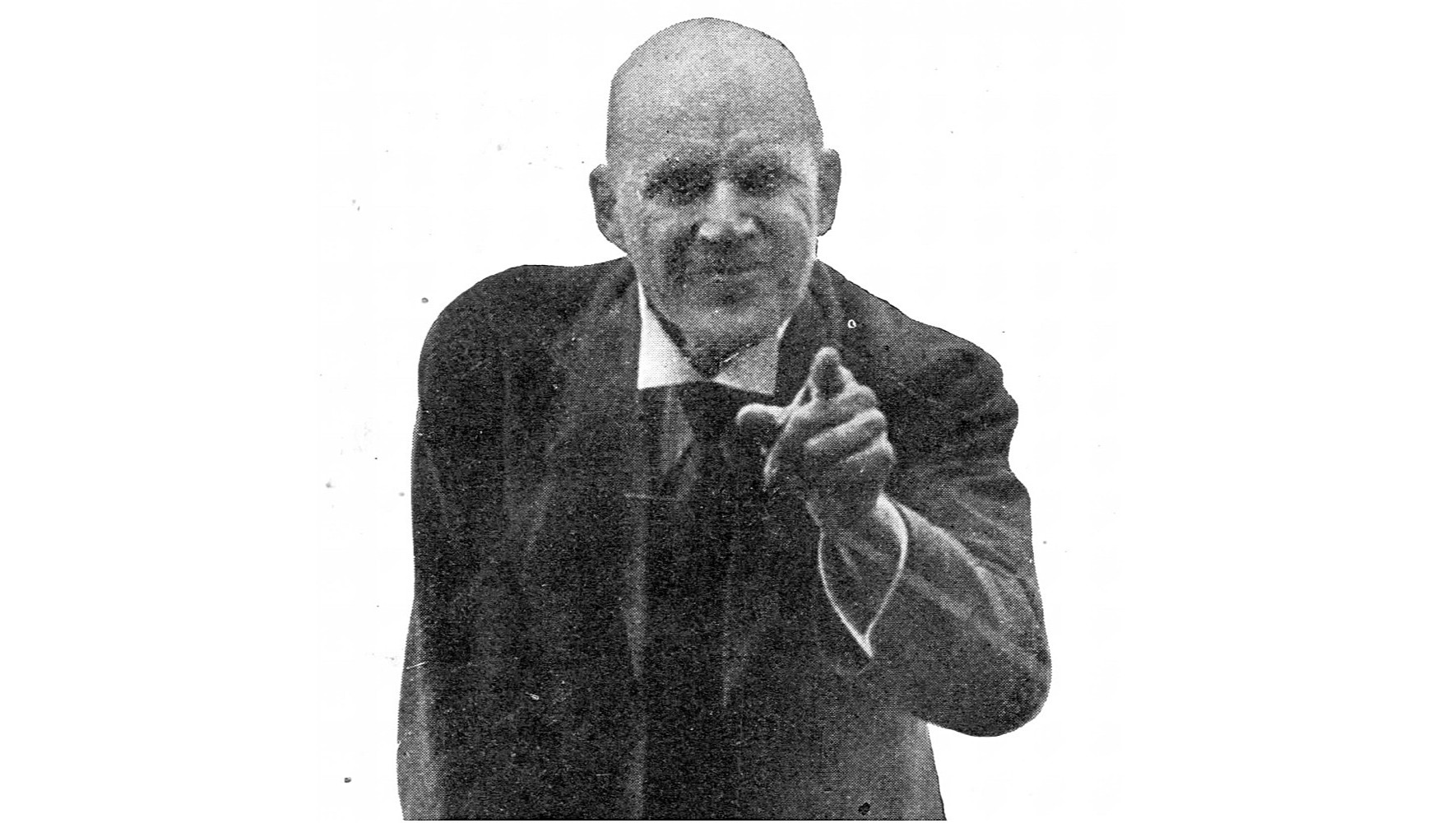
Debs responds to the Zimmerwald Manifesto, warmly greeting the process of rebuilding an international worthy of the name in the aftermath of 1914’s historic and irreversible betrayal.
‘Reorganizing the International’ by Eugene V. Debs from National Rispsaw. Vol. 12 No. 10. December, 1915.
Socialists the world over were not only keenly disappointed, but shocked and stunned with the collapse of the International at the outbreak of the European war. That the International DID collapse, and utterly so, when the crucial test came, it were folly any longer to deny or attempt to extenuate. The fact, humiliating though it be, confronts us and honesty with ourselves and with the world demands that we frankly acknowledge it.
The International went to pieces as a confederation of NATIONALS in the very hour it should have demonstrated its power as an INTERNATIONAL. In a word, when the crisis came, nationalism, patriotism and militarism, the essential components of capitalism, triumphed over internationalism and in a twinkling its vaunted solidarity vanished and our international movement was torn into fragments and these fragments marshalled in battle array by their common enemy, and from that day to this “comrades” have slaughtered “comrades” with the ferocity of fiends on a thousand ensanguined battlefields.
It is admitted that up to the time the war was declared the socialists in the several countries involved, without an exception, did all it was mortally possible for them to do to stay the hand of slaughter and prevent the outbreak of hostilities; but when, in spite of their warning and protest, the dogs of destruction were let loose-in the very hour they should have stood their ground and vindicated the principles of the International at whatever cost–they wavered and broke under the national pressure and were swept into the red gulf of hell where the multiplied thousands of the betrayed victims have been perishing ever since. But it is not to pass judgment upon the past that I now write, but for the purpose of profiting by the calamitous experience of our comrades in Europe and preparing for the future. The day may be nearer than we imagine when we, here in the United States, will have to prove ourselves and the fitness of our movement to survive the onslaught of the murderous military hordes of capitalism.
It is urged by many that we can do but little, if anything, until the war is over, with the result that matters are allowed to drift, and the weakening and demoralizing effect of this policy is becoming more and more apparent with the passing days.
To insist that nothing can be done until the war is over is to confess that the war has paralyzed the socialist movement even here, thousands of miles from the scene of hostilities, and we are certainly anything but socialists if we are inclined to make any such base and cowardly confession.
The truth is that something CAN be done, something vital and far-reaching in its influence if we are possessed of the militant spirit which is the very life of our movement and without which it is dead as a mummy, though its adherents number legions. Now is the very time for the socialists in neutral countries, especially here in the United States, to take the lead in re-affirming the principles of internationalism and preparing the way for the reorganization of the International upon a basis that will make it impregnable to future assaults.
In this connection it is gratifying to note that the first steps have already been taken in Europe to re-unite the dissevered fragments of the old International and to build up a new, more powerful and more revolutionary organization to take its place, care being taken to exclude the nationalists, “patriots” and traitors who were responsible for the downfall of the old movement.
THE INTERNATIONAL IS DEAD, say the kaisers, czars and kings, the rotten bureaucracies and putrescent aristocracies, and all their brood of degenerate hirelings and bootlickers, and we answer with the shout that rings around the earth:
LONG LIVE THE INTERNATIONAL!!
This is the revolutionary spirit in which the socialists of the several warring countries of Europe met in Zimmerwald, Switzerland, in September last to take the preliminary steps toward a complete restoration of the International upon a bed-rock foundation, with the weaknesses of the old organization eliminated. This conference was composed of representatives of nearly all the warring countries and a number of the neutral countries and as a result of its deliberations a ringing manifesto was issued which must appeal to every true-hearted socialist in the world. This manifesto was translated by the New York “Volkszeitung” and reproduced in a recent issue of the Milwaukee “Leader.” It meets the situation, confessedly a most delicate and difficult one, fairly and squarely; it breathes the true socialist spirit, is neither rash nor timid, but gives expression to a prudent, sane, practical purpose and points the way to a reorganized, revivified and triumphant International movement. From this wise, courageous and inspiring proclamation and appeal, which should be read by every socialist, I quote as follows:.
“Proletarians! Since the outbreak of the war you have devoted your strength, your courage, your endurance to the service of the ruling class. The time has now come to stand forth for your own cause, for the sacred purpose of socialism, for the liberation of oppressed peoples, for all subject classes, and for the irreconcilable, proletarian class struggle.”
“It is the task and the duty of the socialists of the warring countries to take up the full burden of this struggle. It is the task and the duty of the socialists of all neutral countries to support with all their strength, their brothers in this struggle against bloody barbarism.”
“In this unendurable condition we, the representatives of socialist parties, unions and minorities of these, we Germans, French, Italians, Russians, Poles, Letts, Roumanians, Swedes, Norwegians, Dutch and Swiss, we, who do not stand on the ground of national solidarity with the exploiting class, but on the ground of the international solidarity of the proletariat and the class-struggle, have come together in order to knit up the broken threads of international relations, and to call the working class to self-consciousness and to the struggle for peace.”
“Never in the history of the world was there more imperative, a higher or more sublime task than this, whose fulfillment must be our common work. No sacrifice is too great, no load too heavy to bear in order to attain the goal of peace among nations.”
“WORKING MEN AND WORKING WOMEN! MOTHERS AND FATHERS! WOUNDED AND CRIPPLED! ALL WHO HAVE, SUFFERED FROM WAR OR THROUGH WAR, WE CALL TO YOU OVER THE FRONTIERS, OVER THE SMOKING SLAUGHTER-FIELDS AND DEVASTATED CITIES AND VILLAGES: PROLETARIANS OF ALL NATIONS, UNITE!!”
This is the first beginning of an international reorganization that gives promises of actual and substantial results. It is the voice of true internationalism that speaks here and proclaims the inviolability of its principles and the indestructibility of the Inter- national movement. In commenting upon the conference and the manifesto, A.M. Simons, in a stirring article under the caption “A Hopeful Sign,” in the New Review, an article worthy of the widest reading, says:
“The Gideon’s band that met in Switzerland is composed of the few that will soon be many, who realize that upon a reorganized, revivified and revolutionary international socialist movement depends the future of civilization in Europe. For these there are coming times even more trying than those that now exist in the warring countries. The least that we can do is to give them our adherence, our sympathy and the pledge of our support when the crucial days come.
“For our own sakes the least we can do is to try to infuse into our own Socialist party some of the spirit that brought them together. If we cannot do that then we can watch enthusiasm, members, votes and even our beloved offices, gradually grow less and less.” Simons is absolutely correct in urging the infusion of the true revolutionary spirit into our party and in sounding the warning note of impending disaster if that spirit be lacking in the days to come. There is never danger of being too revolutionary; the danger that always threatens is in not being revolutionary enough, to the discouragement and disgust and final loss of the virile, active, energetic and inspiriting element that is the very life and soul of the organization.
In the same appeal Simons also says:
“Steady heads will be needed as well as revolutionary enthusiasm and unity in the rush of events that will come with the climax of this war and the peace that will follow it.” “This is the inevitable reaction against the betrayal of political power to the benefit of office holders and the destruction of socialism.” “There is going to be work, big work for an International socialist movement soon. Either that or there will be no more work for it during this generation. We failed once. We cannot fail twice and continue to pose as the leaders of labor and the heralds of a new civilization.”
It is now up to the socialists of the United States to demonstrate their power and their capacity to get into harmonious and effective action in preparation for the inevitable test which awaits the American movement in the not distant future. Well may the members of the Socialist party cease quibbling over minor matters and get together in a serious and determined attempt to build up the party, and each local thereof, to support and strengthen the press and to infuse the virile spirit of revolutionary internationalism in our propaganda and in every thought and act of our organization.
If the Socialist party of the United States can rise equal to its greatest opportunity, the opportunity that is certain to come, either at the close of the war or possibly long before, it will do a work of immeasurable value to the workers of the world, and the very thought of this weighty responsibility should spur every socialist to renewed energy and activity and to the resolute determination to do all in his power to vitalize his local, inspirit his comrades and fellow-workers, and build up, strengthen and make truly militant and progressive the Socialist party in the United States, that it may be equal to every opportunity and to any test or crisis that fate or fortune may have in store for it.
The National Ripsaw, a Free-Thinking, Socialist magazine that, in the 1910s, included the O’Hare’s and Debs on its board. The paper under the O’Hare’s was a voice of the Party’s anti-war wing and became a main literary vehicle for Debs before it, like all of the anti-war Left press, was banned from the postal services. In it’s previous incarnation, The Rip-Saw was an openly racist, exclusionary “Socialist” magazine under editor Seth McCallen from 1903 until 1908 when the paper was taken over by Phil Wagner and the politics of the paper changed. Thereafter it was a leading anti-war voice, changing its name to Socialist Revolution before its banning.
PDF of full issue: https://www.marxists.org/history/usa/pubs/national-ripsaw/151200-nationalripsaw-v12n10w142.pdf
 Revolution's Newsstand