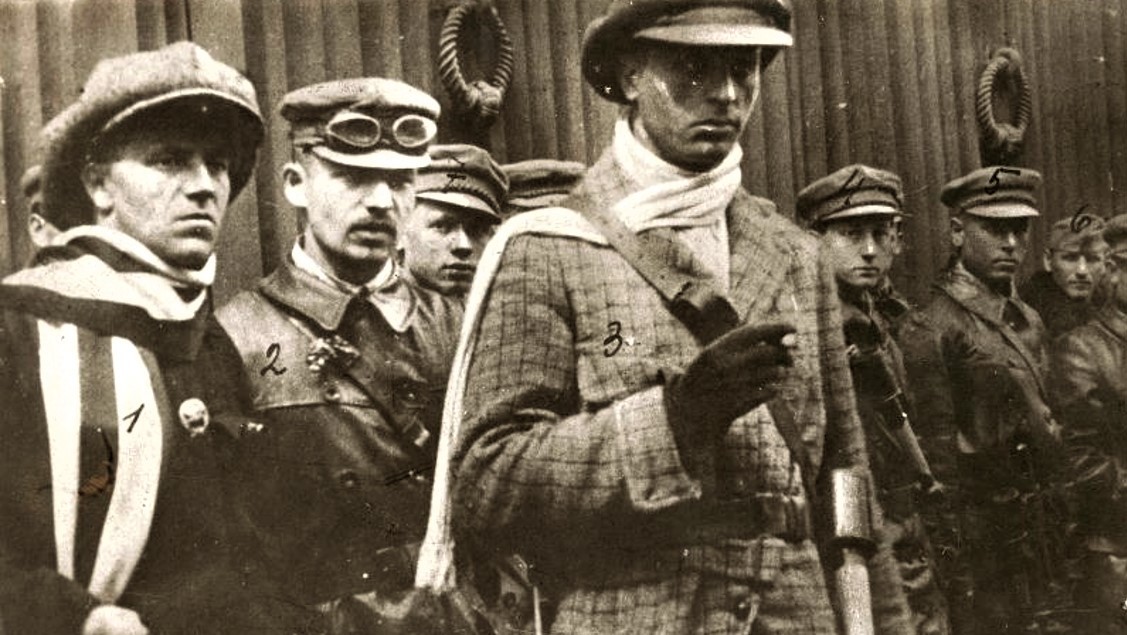
If John Pepper is remembered at all in the States. it is as the Comintern representative on the U.S. Party’s top leadership, assuring a Lovestone-Ruthenberg majority, and his central role in the factional strife that dominated and debilitated the U.S. Party during most of the 1920s. József Pogány, however, played a leading role in a real revolution, Hungary’s short, but dramatic, 1919 Soviet. As well, his prolific and varied writing were very often head-scratching analytical flights of fancy, but occasionally produced real insights and value in understanding his world and ours. Below he speaks to the Budapest Soviet on the war to the knife imposed on the new Hungarian Soviets by local reaction and outside imperialist intervention. The Soviet would fall shortly after, but reaction’s response lasts to this day in Hungary.
‘Soviet Hungary’s Task’ by Joseph Pogany (John Pepper) from Revolutionary Age. Vol. 2 No. 4. July 26, 1919.
People’s Deputy to the Budapest Worker’s Council. Address Delivered in the Council
COMRADES! After the speeches of the various District Deputies, after the speeches of Comrades Kunfi, Kun and Boehm, there can be but one duty for all, for us who sit here, for you who sit there, and for all who stand behind us: To grasp our weapons and in a united body go to the front. Proletarian regiments have been organized; there should be proletarian regiments to protect the Hungarian Soviet Republic against all foes. Comrades! We do not desire to understand only one aspect of the problem. Here it is a question not of administration (that’s so, that’s so!) but of arms. And I am surprised that in this body any other point of view should find expression than that of relentless war. Now no one has the right to say any thing only: “Go out to the fronts, or into the factories through which the troops at the front are sustained and supported.” Otherwise we are at lost.
A Message to the Proletariat of the World.
The session today should be a great expression, a message of the first import to those of our proletarian brothers, who although on the other side of our borders, still view the offensive against us with the greatest horror. We must send them this message: “Comrades, Brothers! Stand fast! Comrades, Brothers! Strike, arise, arm yourselves and help us to victory. We do but emancipate you from foreign imperialists.” (Applause)
Our second message should be addressed to the proletariat who in the Rumanian, Czech, Serbian, and French armies serve the cause of their own oppressors, and to them we must cry out: “Brothers! You have a weapon in your hands and you wield it against us! Comrades, French, Czech, Rumanian and Serbian proletarians and peasants: Do you not know that every shot you fire against the Hungarian Soviet Republic, is in reality fired at yourselves, against your well-being, against your own future, against your proletarian comrades, whose families you destroy?”
Message to the Hungarian Bourgeoisie
Also, Comrades, we must send a message to that Hungarian bourgeoisie who on the other side of the demarcation line seized the first moment to restore the capitalist system, who already dream of a kingdom, who have already raised the white flag with the inscription: “Long live the King!” (Strong exclamations: Destroy them! Fearful noise)
To them we must assert: “Tremble before our vengeance! We will return and this time wipe you off, not only as a class but also in fact to the last man, to the last counter-revolutionist. (Unceasing, deafening, spirited applause and approbation.)
Comrades! With a voice, resounding afar, do we send forth from here, out of this assembly the message to the Hungarian bourgeoisie at home, let them take notice that from today on we consider them as war hostages. Let them not rejoice, let them not place white flags in their windows, for with their own blood will we dye their flags red! (Stormy applause.)
In conclusion, however, Comrades, we must issue a message from this body to ourselves, to our proletarian comrades in the factories and outside in the villages. Openly, without circumlocution Comrade Kun has said in this assembly that the Proletarian Revolution is in danger. We must save the Proletarian Fatherland! Everyone here is a blackguard and a betrayer, a worthless scamp, who, if he can be spared at home, does not go with us, all of us, to the front. This Workers’ Council, this Soviet Government, would be without honor, if it should not immediately want to separate itself: One part to work at home, governing the central administration, the other to go to the front, leading our proletarian brothers out of the factories, from the fields to the front. (Stormy applause.)
The question is one of life or death, and we, Comrades, want life! This beautiful spring that blooms outside, is not here so that we vanish! We cling to life! We cling to that which we have attained, and to that upon which the fate of this country, of the entire proletariat rests. (Spirited hurrahs and applause.)
Comrades! We want to live! We do not want to collapse, and for this reason we give, for our class rule, for our proletarian dictatorship, for the world revolution, if necessary our very lives! (Continued applause.)
That is what we proclaim from out of this assemblage to every proletarian, every bourgeois, over our own borders, out to every Socialist and Workers party. Comrades, this spirit must gush forth from this assemblage. A single, unified, powerful call to all the world: we desire to live, we want to win, we will win! (Continued hurrahs and applause.)
(At the close of the meeting a resolution was carried that half the members of the Soviet Government, the Workers’ Council, and half the general workers should go to the front.)
The Revolutionary Age (not to be confused with the 1930s Lovestone group paper of the same name) was a weekly first for the Socialist Party’s Boston Local begun in November, 1918. Under the editorship of early US Communist Louis C. Fraina, and writers like Scott Nearing and John Reed, the paper became the national organ of the SP’s Left Wing Section, embracing the Bolshevik Revolution and a new International. In June 1919, the paper moved to New York City and became the most important publication of the developing communist movement. In August, 1919, it changed its name to ‘The Communist’ (one of a dozen or more so-named papers at the time) as a paper of the newly formed Communist Party of America and ran until 1921.
PDF of full issue: https://www.marxists.org/history/usa/pubs/revolutionaryage/v2n04-jul-26-1919.pdf
 Revolution's Newsstand