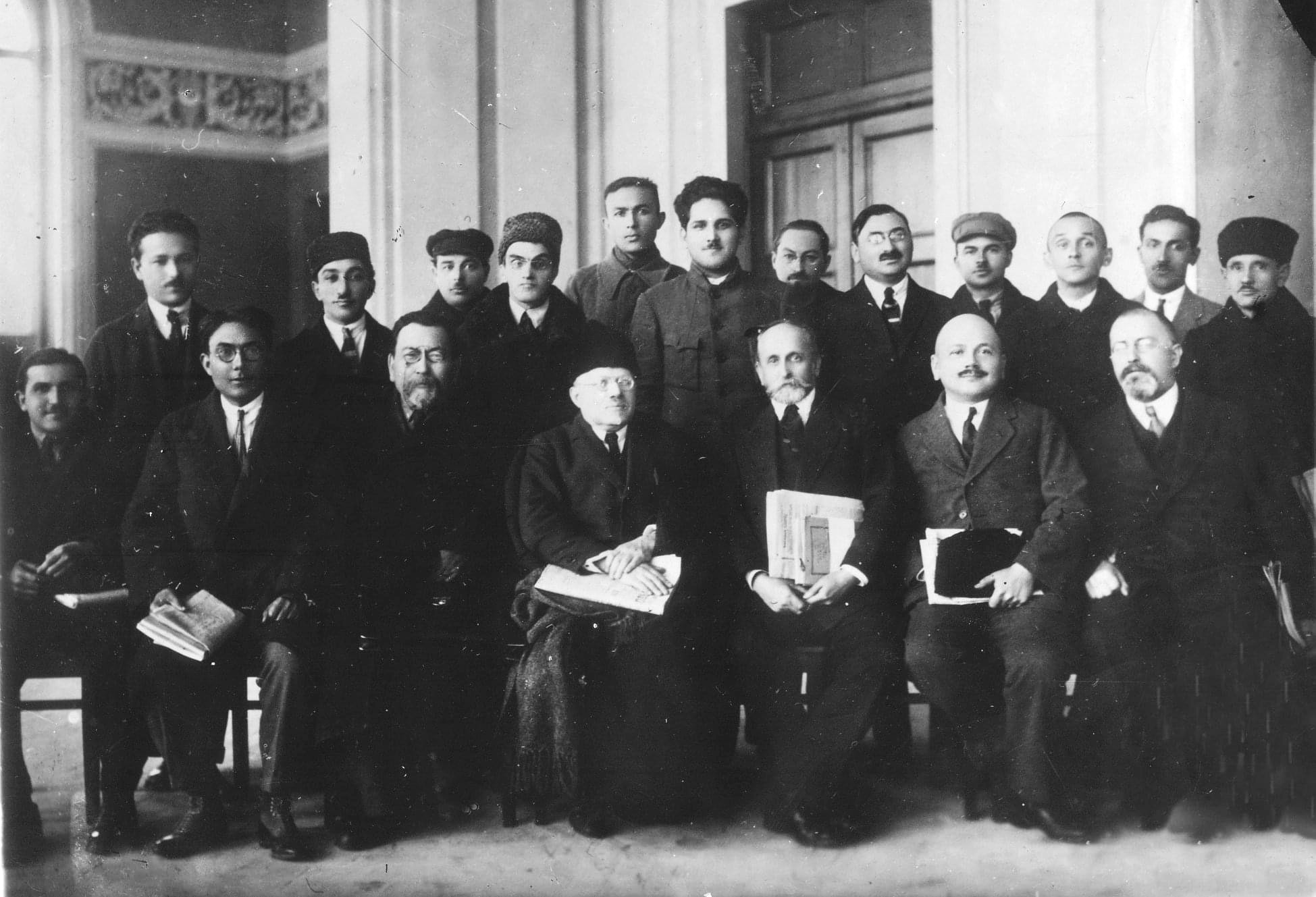
Pavlovitch on the theory and practice of self-determination of the early Soviets. Prolific Marxist writer and historian Mikhail Pavlovitch (Weltman) came from a middle class Ukrainian Jewish family, studied law and history, joined the RSDLP in 1898, he went into exile after the 1905 Revolution, spending most of his time in Paris where he wrote extensively for the international Left press. A Menshevik, he returned to Russia in the Summer of 1917, joined the Bolsheviks and participated in the Civil War. Always interested in the national question, Pavlovitch organized the Congress of the Peoples of the East in 1920, worked in the People’s Commissariat for Nationalities, and began the Moscow Institute of Oriental Studies, editing New East and Marxist History magazines until his 1927 death from cancer.
‘The National Question at the Tenth Party Congress’ by Mikhail Pavlovitch from Moscow. No. 6. May 31, 1921.
The entire history of modern times has proceeded under the slogan of the struggle for the National State and National Unity. But under the conditions of the bourgeois order the National idea and the National State have proven to be as much a political fiction and a deception as the great revolutionary Conquests: the freedom of speech, press assembly, parliamentary elections, etc.
Bourgeois order has proven itself unfit to solve the national problem; on the contrary is has only intensified it.
The Soviet Workers and Peasants Government created by the triumph of the October revolution of 1917 represents the first Government in the world which undertakes the solution of the national question on an entirely new basis guaranteeing the liquidation of national animosity antagonisms among the numberless nationalities comprised by the former Tzarist Empire.
We do not pursue a policy of assimilation neither with regards to such cultured peoples as the Poles, Esthonians, Letts, Jews, Germans etc., nor with regard to the most backward nationalities which enter into the body politic of our conglomerate Federated Republic. We do not wish to deprive the smallest nationalities of their integrity. We not only do not desire to compel them to speak one language, but on the contrary, we facilitate the development of the rudiments of literature amongst such tribes as have none, and thereby we perpetuate and develop the language of every nationality no matter how small.
It is the fundamental contrast between not only the class but also the national policy of the proletarian Government and the class national policy of the capitalist countries that is chiefly responsible for the invincibility of the Soviet Federation in its struggle with its internal and foreign enemies. Our victories on the East tern front over Kolchak, on the Southern front over Denikin are not due to the heroism of the Red Army alone, but also to the support which was rendered by the Tartars, Kirghis, Kalmuks, Dagestans Ossetins, Ingush and other tribes, who were operating in the rears of the White Guard Armies, and compelled the enemy to shift considerable forces for the protection of the rear. On our external from the failure of Churchill’s plan to organise a simultaneous attack upon the Soviet Government by 14 different States, is the result of the fact that in most of the States, such as Finland, Esthonia, Latvia Lithuania and partially Armenia and Georgia even the bourgeois elements considered the preservation of their national independence impossible after the overthrow of the Soviet regime in Russia and its substitution by a new regime whether it be of Milukoff of Wrangel.
We deem it necessary to emphasise the following basic principles which were elaborated by the thesis on the national question at the Tenth Congress of the Russian Communist Party.
As the existence of Soviet Republics, even though the smallest, represents a mortal menace to imperialism, not a single Soviet Republic can individually under the existing international conditions of being surrounded by capitalism; consider itself at all protected and secure from economic exhaustion and military defeat on the part of world imperialism. This indubitable circumstance leads to the logical conclusion of the necessity of an Alliance of individual Soviet republics as the sole means of escape from Imperialist thralldom and national oppression for the reason that the isolated existence of Soviet republics is most unstable owing to the menace of the capitalists states. However, whilst pointing out the imperative necessity for a federation of Soviet Republics and citing the experience which fully corroborates elasticity federated organisation as the general form of the of an Alliance between Soviet Republics, the thesis states that the federation can be maintained only upon the condition of the reciprocal confidence and voluntary agreement of its component parts. That the Russian Federated Soviet Republic is the only country in the world where the experiment of a peaceful cohabitation and fraternal co-operation of a number of national ties and peoples was successfully carried out as undoubtedly the result of the total elimination in that country of all political and economic inequality. Here there are no Rulers and ruled, no metropolis, no colonies, no imperialism, no national oppression. This federation rests upon the reciprocal trust and the voluntary aspiration of the toiling masses of various nationalities to form a free union.
This voluntary character of the federation must be maintained in the future, for only such a federation can become the transitional stage towards that higher unity of the toiling masses of the world in the form of a world wide unified economy, the necessity of which is becoming increasingly more and more evident.
In connection with this point it is necessary to emphasise the fact that the Soviet Federation is the strongest and securest of all existing federations. Even part from the danger which threatens he modern gigantic empires, England, France the United States from the national revolutionary movements in their colonies, the relations between the Metropolis and those parts of the empire which are inhabited by the same nationalities and enjoy equal rights are becoming exceedingly tense. Such are at present the relations between England and Canada and Australia. While England is driven into a closer alliance with Japan on account of her increasingly strained relations with America, those parts of the British Empire which hate and despise Japan are turning towards America.
Disintegration is threatening many of the large world empires, especially the newly formed states. They are liable to collapse under the pressure of internal complications or as a result of military defeats. Especially untenable is the situation of the many relatively small states which luring the war amassed excessive territory such as Jugo-Slavia, Greece, etc. The lightest sign of military failure will be sufficient to blow them to pieces and leave their imperialists on a heap of ashes. Among other resolutions adopted by the Tenth Congress of the Russian Communist Party, special attention should be given to the resolution which deals with the thirty millions of Turcomen. These Turcomen have not as yet passed through the furnace of capitalist development they have almost no industrial proletariat, they are still pastoral and have remained in the patriarchal-tribal stage, (Kirgeesia, Bashkiria, Northern Caucasus). Some of these peoples are still in a semi-patriarchal and semi-feudal stage (Azerbeidjan, Crimen etc.), but have already been drawn into the sphere of Soviet influence.
“The elimination of the actual inequality–according to the theses–is an extended process involving a determined struggle with all the remnants of national oppression and colonial serfdom. Here national inequality rested on the basis of the historically developed economic inequality. This inequality expressed itself first of all in that those outlying parts of Russia, (especially Turkestan) being in a position of colonies and semi-colonies were forced to play the role of the provider of all kinds of raw material which cere converted into manufacture in the centre of the empire. This was the cause of their constant backwardness and pre vent their rise and still more the development of an industrial proletariat amongst oppressed Nations. It was unavoidable that the Proletarian Revolution should come face to face with all this in the Eastern border countries, and that its very first tasks should be the liquidation of all remnants of National Inequality in all branches of public and economic life, the systematic planting of industry, the transfer of the textile, woolen, leather and other industries to the sources of raw material.”
The economic policy of raising production in the border countries is directly opposite to the economic policy of the Capitalist Powers, in relation to all backward countries and colonies, as well to those states generally coming within the sphere of influence of Capitalist Powers.
The economic policy of England, France, Holland, Belgium, Spain, Portugal, etc., was based on the prevention of the development of native industry in the colonies. The policy of the Russian Communist Party is the destruction of the economic inequality between the central and the border countries of the former Tzarist Empire, which was a result of the policy of Tzarism. The grandiose project, of the engineer Pisenkamph, first put forward after the October Revolution by the Central Committee of Public Construction, was not carried out owing to the war against Russia instigated by world imperialism, and the consequent exhaustion of all the material resources of the Russian Socialist Federative Soviet Republic. A further project was put forward at the 8th Congress of Soviets, that of the electrification of the Caucasus, Turkestan and other border countries. This clearly proves that our program of peaceful construction, our single economic plan, aims at, not only raising the productive forces of the Russian Socialist Federative Soviet Republic generally, but also the destruction of the historically formed economic inequality between the Central and the border countries of Russia.
Clause three, is of very great importance, as it treats of the necessity of a most determined struggle against the results of the transmigration policy of Tzarism, in the Bashkir, Kirghese, Tehetehentzeff, Inghushi territories. The consequence of this policy was the usurpation of the best arable districts by the Russian emigrants and the driving of the natives into sterile deserts. The gradual degeneration and dying out of the natives in the border lands was the inevitable result. The Russian Communist Party puts forward the task of returning the arable districts, and generally all suitable lands to the working native masses. We may remark that in many districts, the Russian Republic already before the Congress, made an attempt to execute these necessary measures of recapturing the land from the “rich farmer element” of the Russian peasants and Cossacks, and to return them to the natives, for instance, in Tereck, Caucasus and Turkestan.
A large number of allotments, including the best districts, near the water sources, that were arbitrarily usurped by the “rich farmer” element, have been retaken and returned to the native population. In some instances the Soviet Power did not hesitate, even to evict and transplant whole rich farmer” settlements. This measure, exists in many places in Turkestan, as stated by comrade Saffarov in his report at the Tenth Congress. The same is being done at present in the Caucasus.
After finishing with her external enemies, and entering, the epoch of Trade Agreements with European countries, Soviet Russia energetically took up the task of peaceful reconstruction. The confidence and support and the loyalty of the working masses not only of the central, but also of the border countries in the hard struggle against Denikin and Kolchak, having been proved, we have the guarantee that in spite of the intrigues and the provocations of the bourgeois nationalist elements, the Soviet Power will link up in its federation, the oppressed masses of the population of all the border lands and, in collaboration with them, accomplish the task of the complete economic and spiritual liberation of the natives from the yoke of the predatory “rich farmer”, and from the medieval culture, which prevents the intellectual and ideological development of working masses of the East.
Moscow was the English-language newspapers of the Communist International’s Third Congress held in Moscow during 1921. Edited by T. L. Axelrod, the paper began on May 25, a month before the Congress, to July 12.
PDF of full issue: https://www.marxists.org/history/international/comintern/3rd-congress/moscow/Moscow%20issue%206.pdf
 Revolution's Newsstand