The answer then to be found in Akron, Ohio.
‘Why the U.S. is in The Philippines’ by Harrison George from the Daily Worker Saturday Magazine. Vol. 3 No. 234. October 16, 1926.
NOW we know what the Spanish-American war was about!
It was not to free Cuba from “Butcher Weyler,” even though to turn it over to “Butcher Machado.” Nor was it to free the Filipinos from the Spaniards, but rather—we have found this out after a quarter of a century—to free the Moros from the Filipinos!
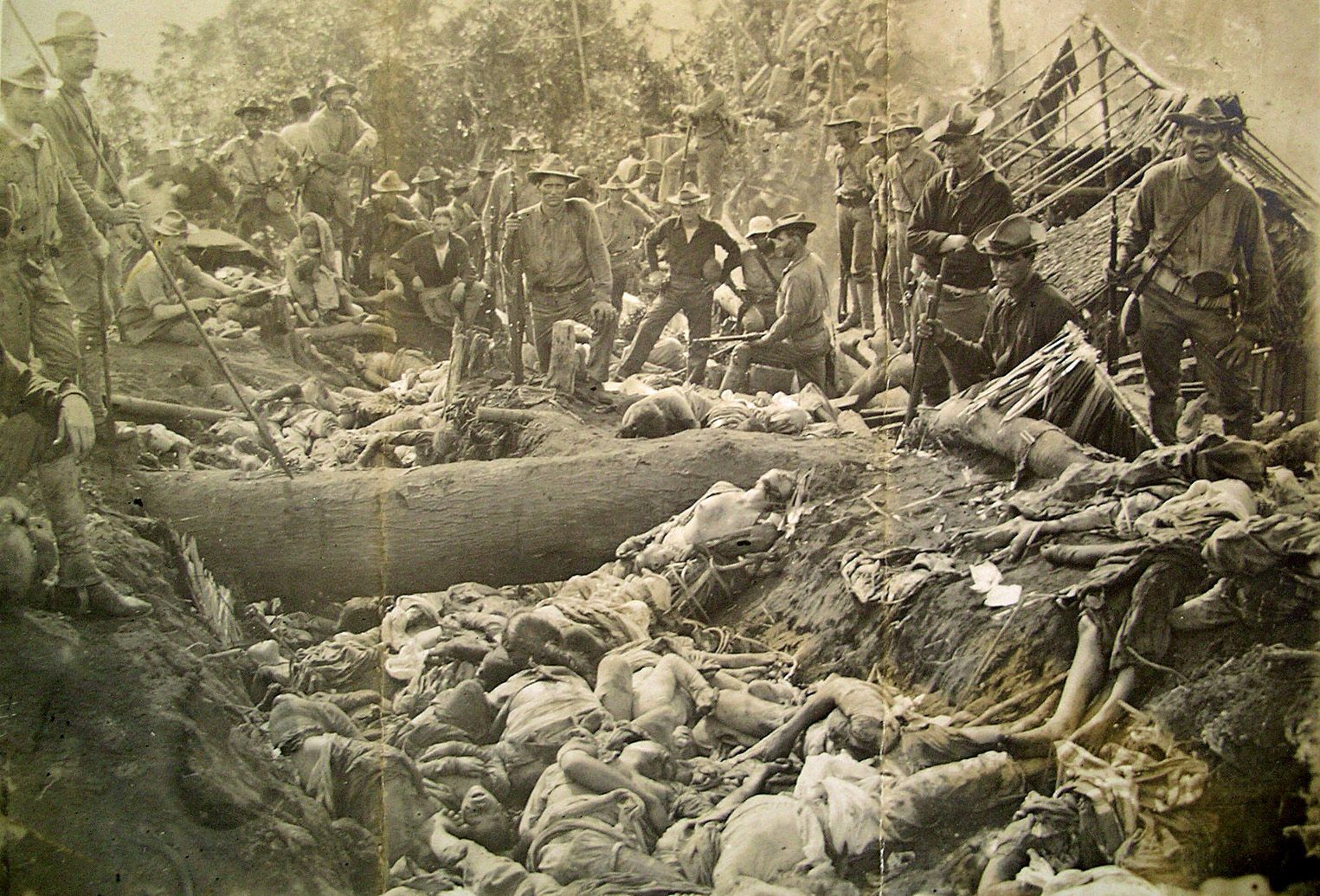
Time was, and the veterans of those days will bear witness, that the Filipinos were regarded as rather decent people, compared to the Moros. That was when the Moros were still unconvinced of the beneficent qualities of United States regulars, who “civilized ’em with a Krag-Jorgeson” rifle and jumped on their bellies after pumping them full of water.
THAT was time, also, when the Filipinos still believed the promise that the United States would grant them full and unrestricted independence. Whoever heard of an exploiting power “granting” anything to its exploited people without it being forced to! Few Filipinos are so naïve nowadays.
But since that distant time the capitalists of the United States have found out that the Philippines are chock full of natural wealth and rich resources, hard woods (not to speak of General Wood), sugar lands, rice paddies, gold mines, coal mines and the lord knows what else. Then, in addition, they recently discovered that Mindanao, in Moro-land, was an excellent place to grow rubber.
It happens that British capitalists caught the Yankees asleep at the switch and got a monopoly on rubber before the Americans woke up. With the result that American automobile owners are paying the British war debt to the United States by the way of the British corner on the rubber supply.
THUS it is that Colonel Carmi A. Thompson, personal representative of President Coolidge, is touring the Philippine islands “investigating” the overwhelming demands for independence coming from the Filipinos who are becoming a little incredulous of Yankee promises.
There Is a law in the Philippines that no corporation can own more than 2,500 acres of land. For some reason or another, Bill Taft’s supreme court has never been able to declare that law unconstitutional. And it now appears that this law restricts the United States Rubber trust from going into the islands whore the Moros are, Mindanao and Basilan, the Sulu archipelago, and turning a patriotic penny into an even more patriotic dollar by developing immense rubber plantations to break the British monopoly.
SO we arrive at what is known as the “Bacon BUI” in the U.S. Congress, which would outwit the vigilant Philippine legislature, by cutting the Moro country loose from Filipino rule and establishing a rather brass-faced dictatorship of American officers over the territory, naturally conducive to giving the American Rubber trust anything its heart desires. Colonel Thompson remarks that:
“The success of the Basilan rubber planters convinces me that a rubber industry could be developed In the Philippines which would make the United States independent of any foreign rubber control and keep pace with the automobile tires and other rubber goods required by the American people.”
THERE are 1,600,000 acres in Mindanao and Basilan, suitable for rubber growing. And Colonel Thompson observes further that:
“Filipino labor is said to be more intelligent and efficient than labor in the Middle West. I am much impressed with their physical vigor, skill and willingness to work. What is needed is capital.”
What can be done with the boon of capital is explained by J.W. Strong, who introduced Para rubber cultivation at Isabella in 1905 and is now manager of the American Rubber company. He told Colonel Thompson that the net profit last year from nearly 2,000 acres of cultivated rubber and soma 225,000 trees, was 16 per cent on the investment. A few years of that would pay of the entire original capital charge and the rest Is clear velvet. It probably has done this for this plantation already.
Although the Moros and Filipinos are supposed, in the American newspapers at least, to be at sword’s points at each other, Mr. Strong remarked that the workers of both races “work peaceably together” and what Is more to the point, they work for 60 cents a day.
WITH profits such as this in view, the American capitalists are prepared to “save the Moros from the Filipinos” or even to save the Moros from themselves. So as a counter move to the Filipino demand for independence we are hearing a chorus of morally righteous editorials in the American capitalist press that the U.S. must not desert the Moros, must protect the Moros, the dear little Moros, from the tyranny of the Filipinos.
The Saturday Supplement, later changed to a Sunday Supplement, of the Daily Worker was a place for longer articles with debate, international focus, literature, and documents presented. The Daily Worker began in 1924 and was published in New York City by the Communist Party US and its predecessor organizations. Among the most long-lasting and important left publications in US history, it had a circulation of 35,000 at its peak. The Daily Worker came from The Ohio Socialist, published by the Left Wing-dominated Socialist Party of Ohio in Cleveland from 1917 to November 1919, when it became became The Toiler, paper of the Communist Labor Party. In December 1921 the above-ground Workers Party of America merged the Toiler with the paper Workers Council to found The Worker, which became The Daily Worker beginning January 13, 1924.
PDF of full issue: https://www.marxists.org/history/usa/pubs/dailyworker/1926/v3n234-oct-16-1926-TDW.pdf
 Revolution's Newsstand