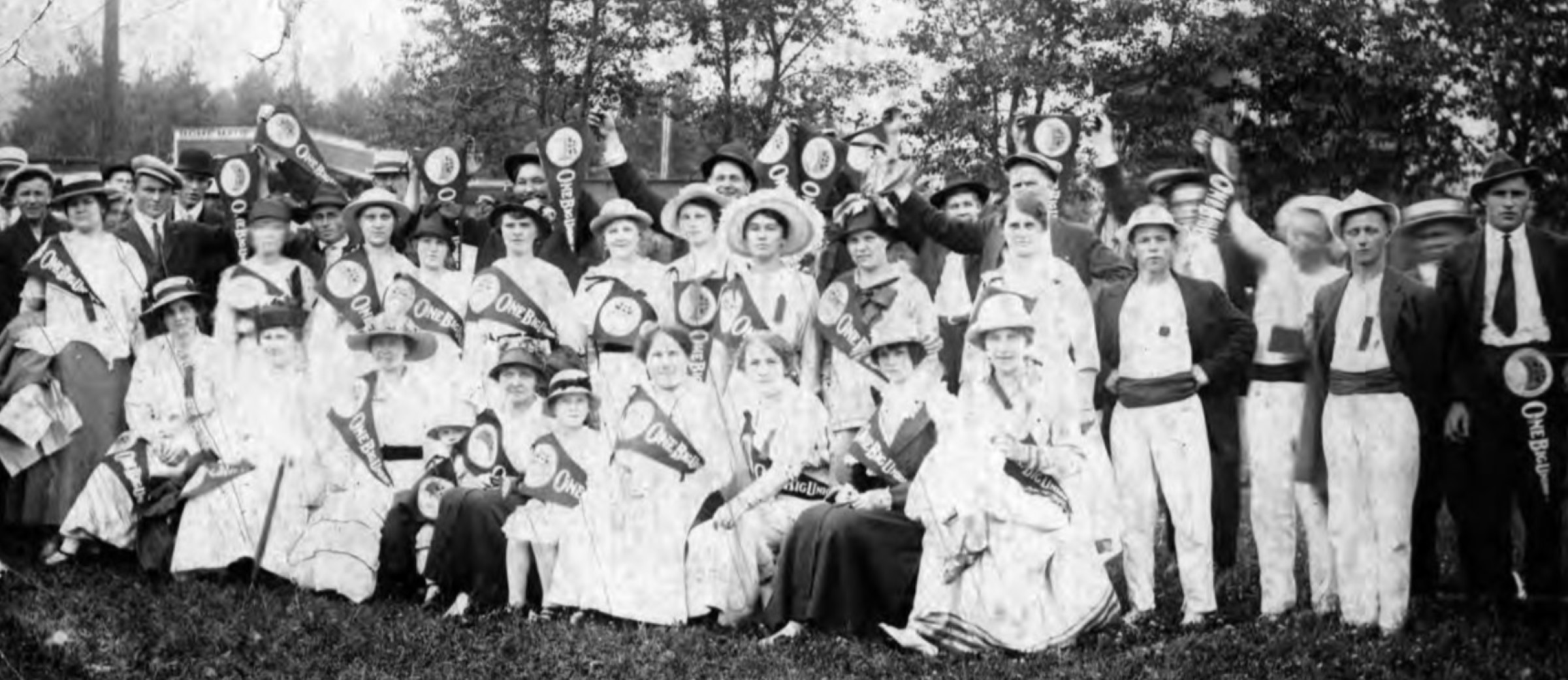
Notices on conditions and activities sent to Solidarity’s weekly column from locals in Washington, Arizona, New York, Minnesota, Michigan, California and Arkansas.
‘Workers War with the Master Class’ from Solidarity. Vol. 7 No. 319. February 19, 1916.
Some News of the Struggle For Organization and Better Conditions in Various Places.
RUBY, WASH.
Indications at present show that conditions in the lumber woods of Washington, Oregon and Idaho are likely to be fairly good during the coming spring and summer. The price of lumber has been raised, and at the same time the demand is heavier than for some years past. Not much logging is being done in some sections this winter on account of the deep snow, some of the camps having shut down in December.
Other lines of work ought also to be fairly active. The intense cold, deep snow and high winds of the entire month of January, and the tides, floods and washouts that are just starting will require large expenditures for repairs. These repairs in addition to new work that is projected ought to make labor in better demand in the Pacific N.W. than for some years. Stumpy.
BEMIDJI, MINN.
Sitting in an office, to an extent directing the field work in this section, to a greater extent being directed both by the men who are the delegates in the field and by circumstances, the writer has not fully realized the sentiment that has been created in the last seven weeks in the territory of which Bemidji is the centre, for the One Big Union of Lumberworkers. It is almost miraculous the strides we have made, till the deep hatred of the conditions that was instinct in the heart of the workers is taken into consideration. They were waiting and longing for some organization capable of combating the bosses to appear in this field. They were disgusted with every method through which they have in the past been robbed.
That the workers have wonderfully taken to the I.W.W. tactics and methods is self evident when in camps where a few weeks ago an I.W.W. speaker would have found it dangerous to speak on Industrial Unionism, now they invite the organizers into camp. The last part of this week the writer spent speaking and agitating at various camps in the territory out of Northolme and Kelliher and especially at the Crookston Lumber Company’s camp.
Invited by the men, acting as a unit to talk there the writer found the sentiment remarkable for organization. The walls were plastered with the stickers of the I.W.W. and its literature was the literature of the camps, and its methods and its power the general topic of discussion. The writer spoke after asking the consent of the men, unanimously given, disregarding, of course, to ask the bosses’ consent. Despite the fact that the writer had not slept the night before and had walked the major part of the day the talk was listened to intelligently and closely.
Finishing more as a test of how evident the fighting spirit of the men was and to discover how many would with the full knowledge of the boss say they were going to join the writ er asked: “How many of you men will join the I.W.W. the first pay day This was not in a street meeting, but right on the job, and still every hand but three in the camp went up and these three did not understand the question, but two of them afterwards said, “Me join, too.” Within a month every man in that camp with a very few exceptions will be lined up solid in the I.W.W. The higher priced men seem all over the territory to be the most enthusiastic, and here also this was decidedly the case. It is unnecessary to say that these men, such as will stand up for their convictions, will make members of which the I.W.W. Lumberworkers Organization can be justly proud.
Camp 4 of the Crookston Company is not different from the others. In their largest camp No. 3, a bunch of the men were singing I.W.W. songs till the bus getting tired of “Up and down the street I wander,” and other songs, got the bull-cook to put out the lights. The men of whom few are as yet organized lit them right away and sang till they got tired Here also the I.W.W. should within a short time have 85 per cent organization Camp 2 is not as yet radical, although they are converting one another rapidly to class organization.
The same condition is general throughout all this territory, although the other camps on account of not letting the men draw money will not be able to line up except as they quit till the camp break up in the spring. One thing is however assured and that is that the Lumberworkers’ Organisation will before this time next season have job control in the woods of this section of Minnesota, and be dictating to the bosses instead of begging, as did the unorganized workers. McDonald.
BISBEE, ARIZONA.
The mines of Bisbee are paying out some of their war profits as wages. Miners get $5.10 and muckers $4,85. When the machine miners of the West find out that the copper trust can pay $5.10 here at Bisbee for eight hours work, there will be something doing at all these so-called mines here in the West in the way of an advance in wages, or there will be such a quitting of work and starting for Bisbee that the rest of the camps will have to increase the pay to keep men on the job. Machine miners can get a job here most any day, but muckers have a hard time connecting. Please let the rest know about our “war profits, for if we grow, so does Solidarity. Press Committee, Local 65.
LITTLE ROCK, ARK.
At Bauxite, Ark., the American Bauxite Co. is working about 1,000 men at present. They will put to work. about 200 more just as soon as they can get more cars. The big flood washed out the tracks and they can’t get cars. Wages are $1.75 for 10 hours. Lots of Italian laborers are working here, others are Southern white men. Outside of the mill it is all surface work, pick and shovel.
Sewer and waterworks going on at Benton, Ark.; wages $1.50 to $1.75, ten hours. This job is wet and muddy, as they have lots of rain. Sewer and water works will start at Malvern, Ark., 13 miles south of Benton, in about 30 days. Wages will be about the same, as it is the same company, and the men stand for conditions. Wencil Francik.
CHICAGO, ILL.
The ice harvest here has been very successful, in so far as it has taught the slaves that the one Big Union, backed by solidarity, is the only way out. The fellow workers here have been very active agitating on the job, and the consequence was a strike at Round Lake for better grub. There were 250 men employed in this ice-house and only five webs on the job; the entire 250 put up a solid front and demanded better food, which they got without any trouble. The fourth day following at 1 o’clock dinner, they again presented a solid front, demanding 20 cents an hour. The foreman tried to arbitrate at 18 1/2 cents, but was met with refusals from all, everybody taking up the cry, “We want 20 cents.” He sure was up against something he could not make head or tail out of. The parasite who owns the ice-house told the superintendent to pay the men what they asked, 20 cents, but the super was an obstinate cuss and would not do his master’s bidding, so the men demanded their money and were paid at the rate of 17 1/2 cents, after some rag chewing. He sure was mad clean through, as he wanted to pay them off at 15c, thus cheating them as the bosses try to do any time the workers do not stand solidly. Another strike was pulled off at Silver Lake, there being only three wobs on the job. Not gaining their demands, the men turned the sab cat loose, with disastrous results to the boss. Action on the job is what counts, so get busy all you wobblies all over the country and boost the One Big Union by getting on the job. Sec’y Local 85, Branch 2.
BROOKYLYN, N.Y.
Leon Grikstos, Lithuanian organizer of the I.W.W., is back in Brooklyn again. Since Oct. 18 he has been on the road agitating. The first stretch of his trip took him into Pennsylvania, where he spoke at Philadelphia, Girardville, Gilberton, Mahanoy, Plane, Mahanoy City and Shenandoah. In Philadelphia, Grikstos aided in reviving the tailors’ local. At the other places he addressed miners, and was well received. Only at Girardsville did he experience opposition. Grikstos finds socialist supporters of the I.W.W. in many cities. In Girardsville he ran up against socialist opponents. The latter sought to have the working class go to the movies to see the Kaiser war pictures, and give 50 per cent of the receipts to German war charities, rather than listen to Grikstos stereopticon lecture on the I.W.W. But he had a good audience, in spite of his opponents. After Pennsylvania, Gristos turned home, and put in a few nights of agitation in Brooklyn. Then he took the second stretch of his trip into Connecticut and Massachusetts. At Waterbury, in the first named state, he held three consecutive weekly meetings. Here opposition was encountered from the police and press. An attempt was made to deny him the use of a hall. But this was got around, and the lecture held; whereupon the press refused to notice it. However, at the last meeting a crowd filled the hall to overflowing. The nucleus of a good organization was formed at Waterbury. Former I.W.W. members were aroused to activity once more. The general interest awakened was good.
In Massachusetts meetings were held in Cambridge, South Boston and West Lynn. A Cambridge the priests in charge of the St. Joseph Lithuanian C. Association of Labor, opposed his lectures The St. Joseph Lithuanian R.C. Association of Labor publishes “Darbininkas” (The Worker) edited by Father Frank Kemeris, an opponent of the public schools and Americanism. This association claims to have 25 locals with about 600 members throughout the United States. It claims to stand for religious labor organization, but is an outspoken friend of the greatest irreligion in existence, namely, capitalism. It is especially bitter against the I.W.W. However, though it picketed Grikstos meeting, and the pickets told all those approaching the hall that Grikstos had been arrested and would not speak, Grikstos had an audience of 120 persons, which he considered very good. At a previous meeting, in the same city, Grikstos also had a good attendance.
The meetings at West Lynn and South Boston were all well attended; no opposition of any kind was experienced. In West Lynn, Grikstos had the assistance of the reds of the socialist party. Other cities were visited and connections established.
At most meetings, Grikstos charges 10 cents admission, In return he gives an I.W.W. pamphlet and a copy of the Lithuanian I.W.W. paper, “Darbininku Balsas” (Voice of the Worker), for whose benefit his trip was primarily undertaken. He gave away and sold over 900 pamphlets His trip has done good for the Voice of the Worker. He has helped to dispose of many of the 130 $10 shares sold by the Voice, and has been informed by the latter that subs are coming in from the places he visited. Grikstos’ aim is primarily educational–preparatory to organization work. He reports a regrowth of sentiment in New England favorable to the I.W.W, among the workers he spoke to. Also that the labor situation in New England is good for the workers in many industries, owing to war orders. He has been active among the sugar house strikers since his return to Brooklyn. His address is 91 South Sixth St., Brooklyn, N.Y.
Grikstos is arranging for lectures in nearby New Jersey cities and towns; also in Long Island City, He has calls from Bridgeport, Conn., and Rochester, N.Y. He thinks the I.W.W. outlook is good. New Yorker.
SACRAMENTO, CALIF.
In about a month from now the plowing and other necessary work will be in full, swing on the hop ranches and in the fruit orchards of California; and it would be a good thing for as many men as can get oh these ranches, to do so. The pride of a farmer’s heart is a nice green field; get on the job in the hop fields and fruit ranches in California and give it to them.
There no need of your advertising yourself on these jobs, but while there “Don’t forget that Ford and Suhr are still in Folsom prison for forcing the state of California to make a pretense of cleaning up those rotten outfits, and that YOU can force them to turn them loose if you will do your share.”
Funds are getting very low here, and as most of you know, we are sending Ford and Suhr a little money every month so they can buy at little extra tobacco and other little. things that help to make their miserable existence a little more pleasant. So if any of you have a little change to spare to enable us to keep up this small, monthly allowance, Bend it along to C.L. Lambert, sec’y Wheatland Defense Committee, 1125 Second St., Sacramento, Calif. C.L. Lambert.
DETROIT, MICH.
Local 16, of this city, is certainly making progress. For the last two lectures, E.F. Doree has had good crowds, and I took notice that they consist of those who have been to previous meetings. We look for a big membership here before spring. I have talked to a number at the factories and with the exception of one or two they think favorably of the One Big organization. The Hudson Motor Car Co. is doubling its force and there is room for plenty on the job here. Only a few seem to be out of jobs here, and I think it will pay any footloose rebels to come to Detroit. Local 16 will probably change to larger quarters in the course of a month or two. J. Butler.
The most widely read of I.W.W. newspapers, Solidarity was published by the Industrial Workers of the World from 1909 until 1917. First produced in New Castle, Pennsylvania, and born during the McKees Rocks strike, Solidarity later moved to Cleveland, Ohio until 1917 then spent its last months in Chicago. With a circulation of around 12,000 and a readership many times that, Solidarity was instrumental in defining the Wobbly world-view at the height of their influence in the working class. It was edited over its life by A.M. Stirton, H.A. Goff, Ben H. Williams, Ralph Chaplin who also provided much of the paper’s color, and others. Like nearly all the left press it fell victim to federal repression in 1917.
PDF of full issue: https://www.marxists.org/history/usa/pubs/solidarity-iww/1916/v7-w319-feb-19-1916-solidarity.pdf
 Revolution's Newsstand