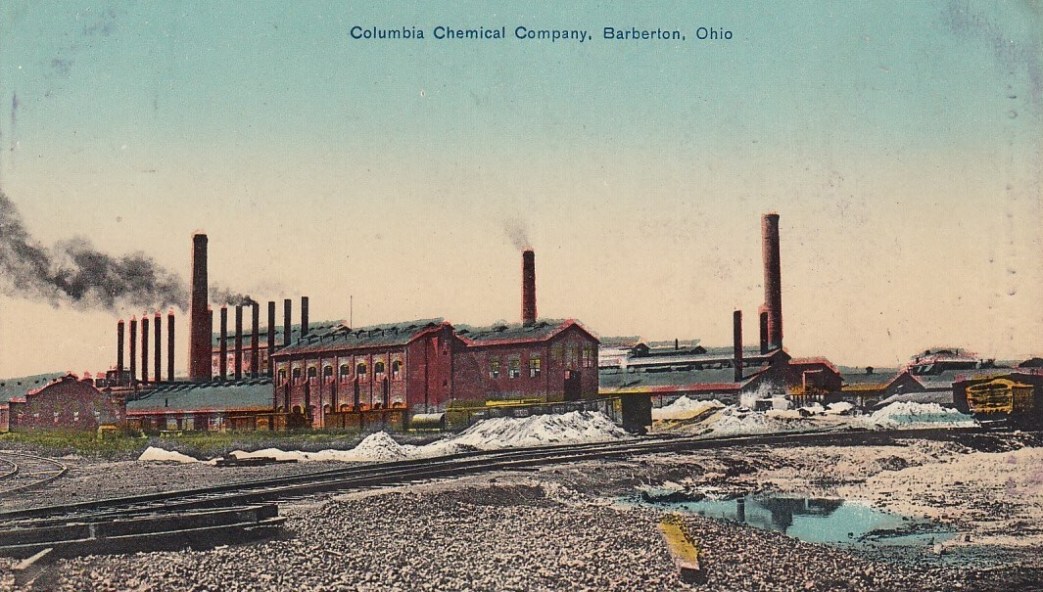
While the sit-down strike is most associated with Flint and the explosion that followed in the Spring of 1937, the tactic was an novel but not new, in the year before Flint it was used to effect in Akron, Ohio. The story of the occupation of the the Columbia Chemical Co. in the Aron industrial suburb of Barberton (on a personal note, home to my grandfather’s family who were participants in the rubber strikes).
‘Sit Down Hits Chemical Plant in Akron Boro’ from New Militant. Vol. 10 No. 9. February 29, 1936.
500 Barberton Workers Force Managers to Vacate
BARBERTON, Ohio, Feb. 22. Company officials of the Columbia Chemical Co. in Barberton, a large industrial suburb of Akron, Ohio, finally moved to negotiate a strike which started last Wednesday when 500 workers seized control of the factory and forced the management to vacate. The men are firmly entrenched and refuse to leave the plant until the company, which owned by the Mellon interests, grants a 4 cents hourly increase in wages and full pay for every day of the strike.
The “sit-down” strike resulted when the management refused to meet the demand of 50 pipefitters for a 4 cents hourly wage raise. The union took up the fight under the militant leadership of A.R. Lee, union president, and called for a general wage increase. Wednesday, 500 men entered the plant, stopped the machinery, and despite the threats and pleading of the company have remained in the factory since.
Meanwhile, 400 other workers are outside of the plant seeing to that the strikers get food and clothing. At first the company refused to let food come into the plant and it had to be smuggled inside over the fence, but finally the management was forced to let the men bring supplies in through the gate. The strikers also have radios and cards and Thursday night they staged a “Mayor Bowes Amateur Hour.” The morale of the men is high.
The management has been forced to move its offices to a downtown Akron building. Although it has threatened to eject the strikers it has made no move to do so. It recalls too well that the strike breaking efforts of the Ohio Insulator Co. resulted in the threat of a general strike by the Central Labor Union a few months back.
The “sit down” is a labor tactic which has proven its worth in Akron and its suburbs during the last month. Four times the workers at the major rubber shops have employed it. Three times it has gained victories for the strikers. The fourth use of, this tactic has resulted in the bitter strike now being fought at the Goodyear Tire and Rubber Co.
The tactic is a very simple one. The men go into the factory but stand by their machines without operating them. They see that no one else does either. Thus in the mass production industries a small number of workers are able to stop production. Up to the Columbia Chemical strike only a few workers in key departments have participated. In the present strike the entire force has not only refused to operate the machines but have taken possession of the factory.
With the possibility of a general strike in Akron, the effect of a victory at Columbia will be tremendous. It is not unlikely, also, that should the tie-up come in Akron, the Columbia strikers will see that it is spread through Barberton.
The present strike is the second in two years. The first was a victory and it is from that time that the militancy of Barberton labor dates.
The New Militant was the weekly paper of the Workers Party of the United States and replaced The Militant in 1934, The Militant was a weekly newspaper begun by supporters of the International Left Opposition recently expelled from the Communist Party in 1928 and published in New York City. Led by James P Cannon, Max Schacthman, Martin Abern, and others, the new organization called itself the Communist League of America (Opposition) and saw itself as an outside faction of both the Communist Party and the Comintern. After 1933, the group dropped ‘Opposition’ and advocated a new party and International. When the CLA fused with AJ Muste’s American Workers Party in late 1934, the paper became the New Militant as the organ of the newly formed Workers Party of the United States.
PDF of full issue: https://www.marxists.org/history/etol/newspape/themilitant/1936/feb-29-1936.pdf
 Revolution's Newsstand