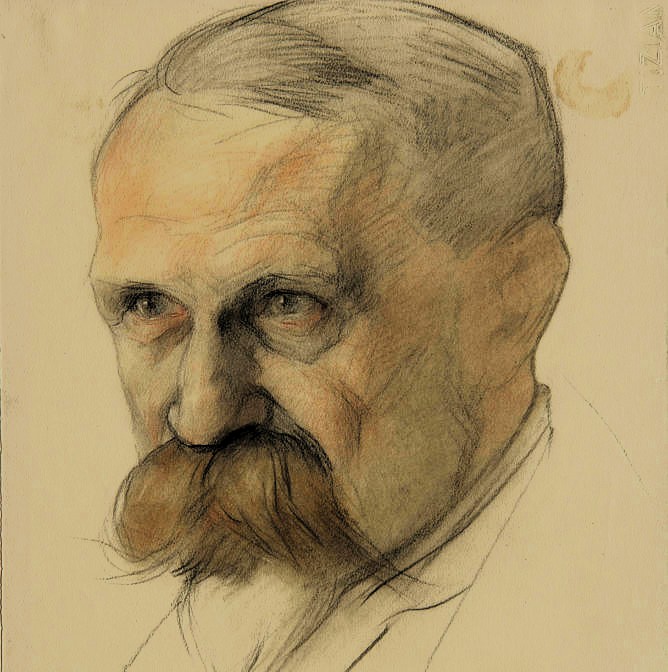
Julian Marchlewski (Karski), comrade to Rosa Luxemburg and Leo Jogiches, writes of the organization founded by them during their 1893 exile in Zurich, the Social Democratic Party of the Kingdom of Poland and Lithuania, and the left wing and internationalist positions it took even before the establishment of the Russian Social Democratic and Labor Party in 1898, let alone the Bolsheviks in 1903.
‘The Old Guard of the International’ by Julian Marchlewski from Moscow. No. 12. June 7, 1921.
Although the Communist Party of Poland collaborated with the Bolsheviki, Spartacists, and Italians in founding the Third International, so far it has not been represented at our Congress by any delegates direct from Poland. The Party has been obliged to work illegally all the time, and has literally been cut off from the outside world. It is still entirely illegal today, and it is not all certain whether it will succeed in sending its delegates to the present Congress
Nevertheless this Party deserves the interest of its foreign comrades. Just as in the days of Tzarism, and later during the German occupation at the time of the world war, the Communist Party of Poland for the past two and a half years, i.e., since the existence of the capitalist Polish Republic, has been systematically persecuted and thwarted is its activities by measures far more severe than those employed under the Tzar’s regime. (Polish Socialists serve in the gendarmerie, police etc. and patriots betray our comrades whom they know personally). And yet, in spite of the fact that frequently half of the party members are in prison, and the party is compelled to work with a proletariat disorganised and enervated by war and unspeakable economic ruin, it has not gone to pieces, but on the contrary, it has established and strengthened itself, and has gained overwhelming influence in the ranks of the Polish proletariat, exercising more and more authority among the workers.
This is due to the fact that the proletariat has faith in its party and adheres to it as to a tried leader. The workers know that the program and policies of the party which were hammered out during the 28 years since the party was founded (in 1893), will not fail them in their hour of need. Its unswerving adherence to its principles, even at the expense of the Polish proletariat, unites the older so-called Social Democratic Party of the Kingdom Poland and Lithuania (S.D.K.P.I.L.) that has existed since 1893, and the younger “Left Wing” of the Polish Socialist Party (P.P.S.) founded in 1906.
The S.D.K.P.I.L. came into existence in 1893 as a result of the breach in the Social Patriotic P.P.S., (also founded in that year which had raised the nationalistic, petty-bourgeois slogan of “Polish Independence”. What Lenin advocated several years later in respect to the Mensheviki, namely, the slogan “Two Parties”, became the norm of the movement in Poland from the very beginning, thanks to the S.D.K.P.I.L. This party called itself “The Social-Democratic Party of Poland” in order to distinguish itself from the Nationalist Polish Socialist Party, and to make clear that it was a party operating in a specific territory, that of Congress-Poland (1815). This party, founded by Rosa Luxemburg, Warski, Marchlewski, and Tyzka, fought not only Social patriotism, but also social reformism and revisionism, and, on Russian territory, Menshevism as well. It issued its proclamations along the lines of the Russian revolutionary movement even before the Social-Democratic movement of Russia had come into being, and when the Social-Democratic Party of Russia was founded. it allied itself to it. It also protested against the establishment of the IIrd International on the basis of National independent parties, and demanded greater centralisation and organic connection of the national parties with the International. The greatest triumph of the Party was the Revolution of 1905 when social-patriotic independence went bankrupt and its champion, the P.P.S. split in two.
Since then the so-called Left Wing of the P.P.S. began to pursue a policy similar to that of the S.D.K.P.I.L. It gained a majority and, in 1906, expelled the “Right Wing” from the party.
After the Left Wing had thus freed Itself from social-patriotism, it kept constantly approaching the standpoint of the S.D.K.P.I.L. battling against the vacillations of those in its own ranks inclined towards Russian Menshevism, as well as against its own centrist elements. Ever since the beginning of the war, the Left Wing lined up with the S.D.K.P.I.L. as a party of the social-revolution and the dictatorship, and is fighting against the social-patriotic deceptions employed in establishing the capitalist Polish state. Side by side with the S.D.K.P.I.L. it participated at the conferences of Zimmerwald and Kienthal. At the Unification Congress of 1918, the Communist Party of Poland recognised the necessity of establishing the Third International on the ruins of the Second.
A “splitting” policy, sharp demarcation from the elements of the “Right”, consistent struggle against the “Union Sacree”, and against the conception “defence of the fatherland”–this last as a result of the terrible national oppression to which Poland was subjected by three Great Powers constituted the principles upon which the Party was founded. Furthermore, not only the traditions of 25 years, but other peculiarly favourable conditions as well, contributed to the establishment of a united Communist Party in Poland. Menshevism and Centrism were in the long run an impossibility in Poland, on account of the absolutely reactionary character of the Polish bourgeoisie and the complete lack of any bourgeois “Liberalism”. Neither can the “left wing” be compared with the left wing of the German Independents, as the former did not become communist through the disillusionments of the war, but very much earlier, through the radical break with the “right wing” in 1906.
Since 1918 there have been no serious conflicts in the Party. During the offensive against Warsaw last year, the Party took a consistent stand on the side of Soviet Russia, laying itself open, as a “traitor party”, to the horrible vengeance of the court-martial. executions, and White Terror. The gaps caused in our ranks at the time have now fortunately been filled. The slight inclination to boycott parliamentary action was overcome with little difficulty at the National Conference of February 1921. This anti-parliamentary movement arose on grounds other than in Germany namely, the insignificance of parliamentarism in Poland since its introduction, for the Reichstag in only a fiction serving to disguise the dictatorship of the bourgeoisie. The same conference pointed out, with respect to the 21 points which it readily accepted, that the Party had been working in entire accordance with the contents thereof long before those points were drawn up.
In unity and experience, the Communist Party of Poland may only be compared with the Russian Party. It is, however, ten years older than the latter. The fate of the Party is inseparably bound up with the fate of the Communist Party of Germany. The party bonds between these two very important sections of the International must be welded as tightly as possible, in order that the Polish Party may be in a position to fulfil its historic duty at the moment of the Communist victory in Berlin, laying a bridge between Socialist Germany and Soviet Russia, and preventing the overthrown Polish bourgeoisie from stabbing the German proletariat in the back, if western imperialism should attempt to strangle Red Germany. May the proletarians of England and France succeed before that time in uniting under the banner of Communism and organising themselves so as to be in a position to thwart the efforts of their bourgeoisie.
J. K.
Moscow was the English-language newspapers of the Communist International’s Third Congress held in Moscow during 1921. Edited by T. L. Axelrod, the paper began on May 25, a month before the Congress, to July 12.
PDF of full issue: https://www.marxists.org/history/international/comintern/3rd-congress/moscow/Moscow%20issue%2012.pdf
 Revolution's Newsstand