Prisoner and exile support were among the very first international campaigns of the workers’ movement. Sasha Small reports from 1933’s conference of 1500 delegates held in Chicago to free Tom Mooney, includes resolutions.
‘At the Mooney Conference’ by Sasha Small from Labor Defender. Vol. 9 No. 6. June, 1933.
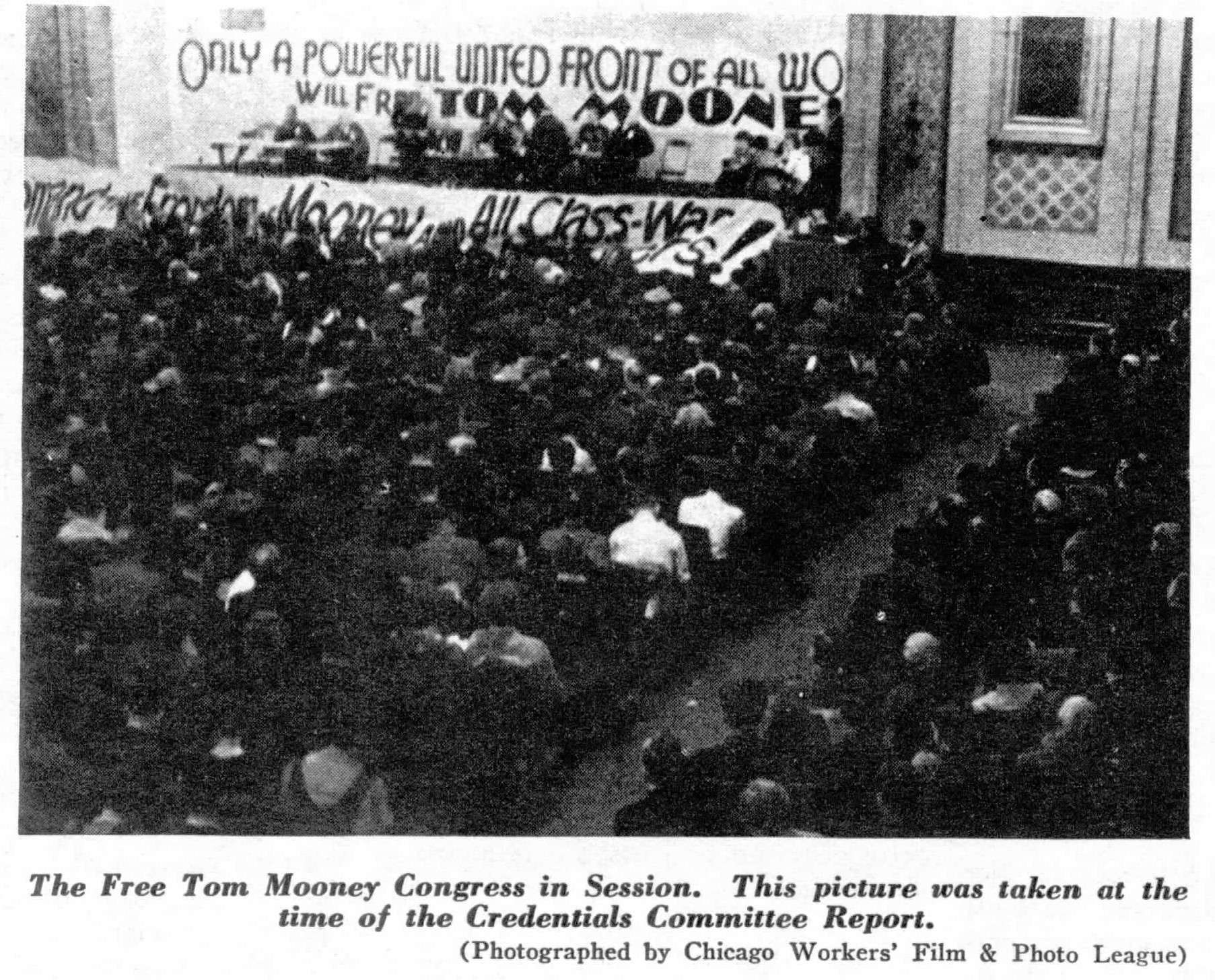
MINERS, lumberjacks, A. F. of L. carpenters and painters, Wobblies in black sateen shirts and red neckties, Negro workers in neat, newly washed overalls, miners’ women in best finery, New York workers, Chicago workers, auto workers from Detroit–1,500 strong, filling the auditorium of the Masonic Temple in Chicago, eyes and ears fastened on the speakers who carried the message of working class unity to free Tom Mooney and all class war prisoners.
Robert Minor, fighter in the ranks of the Mooney struggle from the first day of the frame-up–who sat with Mooney in his cell in the San Francisco jail on the night after he had been sentenced to hang, planning the long fight that was to last 17 years told the story of the Mooney case to the Congress. In all their ugliness he paraded the “witnesses” marshalled by the corrupt state machinery of California to “get” Mooney and Billings–and especially to get them out of the labor movement.
One by one Robert Minor held them up as if in the palm of his hand, before the eyes of the delegates, exposing them with blistering reality and showing who it was that the prosecution had to depend upon for their dirty work. John Macdonald–old circus acrobat, dope addict, degenerated by hunger and disease into a willing tool of the real criminals, Fickert and Swanson–the only real eyewitness that was ever put on the stand–the only one who was willing to “recognize” Mooney and Billings the men who had set the bomb. Fickert combed the jails and the underworld of San Francisco for the rest of his witnesses– thieves, morphine addicts, prostitutes and a woman blessed with second sight who saw Mooney in her astral body more than a mile away from the scene of the actual bombing.
After the main reports to the Congress by Robert Minor on the Mooney Case; Scottsboro and other class war prisoners by William L. Patterson of the I.L.D.; and Workers’ Rights, by A.J. Muste, which he himself characterized as mostly an account of workers’ wrongs, the rank and file delegates took the floor one after the other and described the work carried on in their localities and organizations to push the united front fights for the freedom of Tom Mooney.
Tony Chipless, short and brawny miner representing 24 locals of the United Mine Workers of America, told of the work in Shenandoah, Pa. “Ladies and Gents, comrades all, our men back home as the brother said before, with them the A.F. of L. don’t go so strong. But we of the rank and file don’t have to go according to the officialdom of the A.F. of L. What they done to us, they threw a monkeywrench into the machinery–made a split. Well we’re gonna keep that split and they can stay on their side. If Comrade Mooney is released from jail from seventeen lives in hell–we’re all released from slavery.”
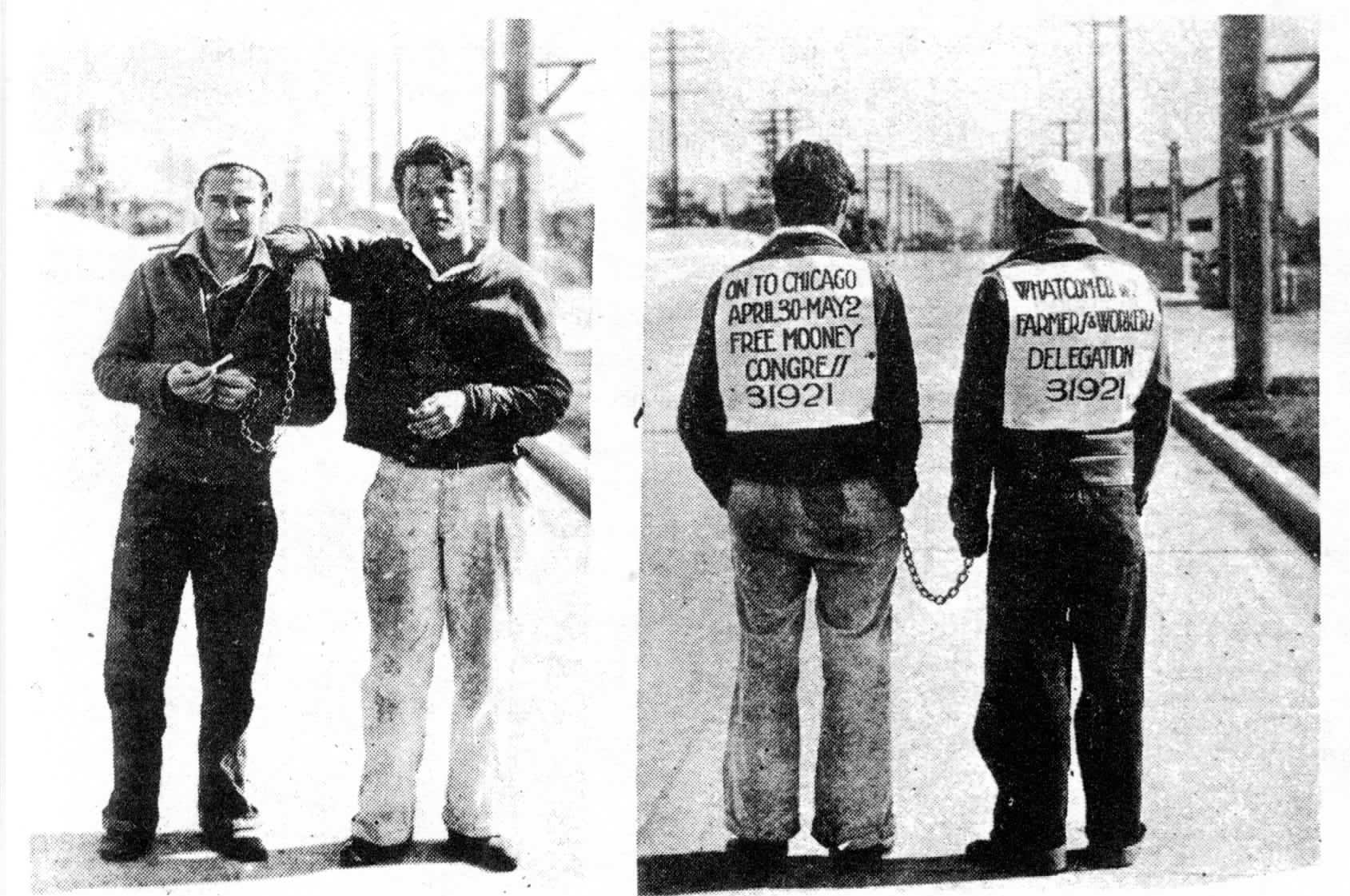
Julius Rodriguez, young Negro worker, elected by the National Scottsboro Action Committee conference at tended by 400 and representing 65 organizations told the Congress how this conference had met to draft a Bill of Rights enforcing the 13th, 14th and 15th amendments to present to President Roosevelt in the march on Washington, elected him as delegate to the Mooney Congress because they realized that the Mooney case could not be separated from the fight to free the Scottsboro boys. “In the march on Washington,” he said, “we will not capitulate to Roosevelt’s hand-shaking policy. Roosevelt has been asking for dictatorship powers. He already used them in declaring the bank holiday, is using them in enforcing forced labor concentration camps–so we are going to ask him why not use them in freeing the Scottsboro boys.” And then there were the two youngsters, delegates from the state of Washington, who hitched their way to the Congress chained together, wearing placards on their backs, selling postcards addressed to Mooney pledging solidarity all along the way. Their trip was not very eventful they said, except that they were arrested five times. They were just picked up on the street, investigated and given “about just so long to get out of town. Every cop we saw threatened to arrest us. In Kamela, Oregon, we went down to the railroad yards and the railroad workers told us we could ride the rails all the way to Chicago if we wanted to. They said the trains were plenty big enough and they’d see we weren’t bothered. They told us to be sure and come back this way and tell them about the Congress. They all bought cards from us and wished us luck.”
Kohler is a 19-year-old farmer and Peterson a 20-year-old miner. The hike was his idea. They were arrested on the afternoon they reached Chicago and registered their credentials at the Congress office. When informed of their arrest the Congress immediately elected a delegation of six to go to the chief of police and demand their release. During the evening session the committee of six reported that they were held for $100 bail. Within five minutes that $100 was raised right on the floor of the Congress.
And so one after the other the delegates came to the platform, told of the work they had done, described the lives and conditions of the workers in their different parts of the country, and pledged their solidarity in one united fight to free Tom Mooney, the Scottsboro boys and all class war prisoners.
Space does not permit a long description of the rank and file delegates of the miners, from Southern Illinois; the young Negro delegates from California; the spontaneous rising of the delegates and the singing of the Internationale after the telegram of greeting from Tom Mooney in San Quentin was read. With his undying enthusiasm, Mooney called on the delegates to continue the fight and not to narrow it down to a fight for Tom Mooney the individual but for Tom Mooney part and symbol of the whole oppressed American working class, pointing out to them the fight for his freedom could not and must not be separated from the fight to free the Scottsboro boys and all other class war prisoners. Statistically, the composition of the Congress was: 148 delegates from 114 A.F. of L. bodies, 53 delegates from 28 independent unions, 117 delegates from 75 T.U.U.L. unions, 64 delegates from 44 political organizations, 198 delegates from 113 Defense organizations, 153 delegates from 104 fraternal organizations, 132 delegates from 83 unemployed organizations, 56 delegates from 35 women groups, 47 youth delegates from 37 organizations, and others from farmers’, Negro, veterans’ and other miscellaneous organizations.
The Mooney Congress was probably the first gathering of such diversified elements in the American labor movement. Great cracks have been made in the walls that have so long kept the different groupings of the American working class apart and divided against each other. With the program of action worked out by the Congress, with the enthusiasm and determined courage of the delegates carried back into all their cities and towns to carry on the work, these walls must and will be completely broken down and then a mighty army can march over the ruins demanding the freedom of Our class war prisoners.
Resolution of the Mooney Congress
(Ed. Note: Because of lack of space we are reprinting only the most important sections of this document)
The power of labor to release its imprisoned martyrs is increased in proportion to the successful strikes which are now beginning to demonstrate that the working class will not tolerate the lowering of the standard of living to a starvation level. The power of the laboring masses successfully to demand the liberation of Mooney is greatly increased at a time when hundreds of thousands of American workers in hunger marches are a living proof that the American people of all exploited classes have reached a turning point at which they intend to resist aggression.
The joining of white and Negro workers together in defense against their common misery brings a vast increase in the strength of labor to compel the release of victims of class and race persecution. The organization and struggle of Negro share-croppers and farmers in the South, no less than the joining of great masses of white and Negro workers together in struggles against unemployment in the cities, testifies to a growing solidarity which makes now for a greater strength in the struggle for the rights of the exploited. The joining of the two mighty currents of protest and demand for the freedom of Tom Mooney and for the freedom of the nine Negro boys framed up at Scottsboro, is the historic mark of the developing strength of the exploited masses against oppression.
The fight for the liberation of Brother Tom Mooney as the greatest outstanding symbol of the American worker’s struggles for bread and freedom can and must be made an inseparable part of all the struggles of the whole working class, of the farmers and of the Negro people against suffering and oppression.
A CALL FOR UNITY
This Congress calls upon trade unions and all workers’ organizations, on the exploited farmers, and on all intellectuals and professional people to form now an agreement of cooperation for those objects on which it is possible to obtain united action for the release of Tom Mooney and checking the persecutions of the working class.
Difficulties stand in the way of securing united action which arise out of divisions in the ranks of the working class. Yet at the present time, regardless of these differences, the needs of the working class call imperatively for united action to halt the encroachments on the rights and interests of the workers.
Therefore, even while sharp differences will continue to exist on many questions, between the various workers’ organizations, it is necessary to bring about concerted action of all workers and of their organizations for certain immediate objectives equally urgent for all workers and workers’ bodies.
We proclaim the first of these to be united action of all for the freedom of Tom Mooney and Warren K. Billings.
In order that such unity of action be made possible under present difficult circumstances of division between workers’ organizations, it is the opinion of this Congress that to obtain such united action, those organizations which enter into such a united front shall refrain from attacks on other participating organizations on the issues and proposals of the united front during the period of common action and while such organizations are loyally carrying out this agreement. Differences of opinion on policies and tactics, of course, can and must be discussed in the course of working out the proposals for common action in order to clarify the issues. Criticism of even the sharpest sort should be directed against any opposed to united action.
PROGRAM OF ACTION
1. National Council of Action
This Congress hereby establishes a National Tom Mooney Council of Action–A United Front for Workers’ Rights and the Rights of the Negro People. In doing this we declare our purpose not to form a body which will supersede any organization, but to bring about cooperation and united action of all existing organizations. We propose a council of representatives of various organizations with different views, but having the common desire to fight for the liberation of Tom Mooney and other victims of capitalist “justice” and for the democratic rights of the working class and the exploited masses.
2. Conditions of Affiliation
The conditions for affiliation to this Council of Action shall be: 1, the acceptance of the proposals here outlined; 2, the readiness of each organization to enter actively into mass struggle as a necessary supplement to legal defense and parliamentary activity for workers’ rights; 3, the mobilization of local organizations for active participation in local councils of action to be set up throughout the country.
3. Mooney Petition
The National Council of Action is also authorized to proceed in cooperation with all organizations which can be brought to cooperate, whether endorsing this Congress or not, with a nation-wide petition campaign for the purpose of obtaining millions of signatures to the demand for the immediate and unconditional pardon of Tom Mooney.
4. Local Councils of Action
This Congress calls upon all organizations here represented and upon the individual delegates to take the lead at once upon their return home in preparing and carrying on local united front conferences with the broadest possible representation, particularly striving to draw in those organizations like the A.F. of L. and Socialist Party heretofore insufficiently represented. Mass meetings should be held where reports are made on the accomplishments of the Free Tom Mooney Congress as a preparation for forming the local conferences. These conferences should have as their task the setting up of local Tom Mooney Councils of Action and the inauguration of the local united front activity.
The National Tom Mooney Council of Action in cooperation with the various organizations should take the lead in the development of the nation-wide campaign for the workers’ and Negroes’ rights–concentrating now on the drive for the release of Tom Mooney and Warren Billings.
5. Mooney Day and Another Congress.
The National Council of Action upon the basis of the development of the broad mass movement, through reports of returning delegates, local conferences, mass meetings, demonstrations and the petition campaign, will be able at an appropriate time to set a national and international Mooney Day of struggle for the release of Tom Mooney and Warren Billings and is authorized to call another Congress at such time as it may deem most proper.
6. Related Issues
We urge the Councils of Action to develop united front support of the outstanding cases today involving workers’ and Negroes’ rights—the Kentucky miners sentenced to life for organizing a union; the Atlanta persecutions for organizing unemployed black and white workers; the Centralia I.W.W. prisoners; the Illinois Progressive Miners arrested and prosecuted for union activities; the Tampa Cigar workers; the deportations for working class activity; the 5 Negro share-croppers convicted in Alabama; Mathew A. Schmidt and J.B. McNamara, A.F. of L. organizers serving life sentences in San Quentin, and the Iowa and Michigan farmers prosecuted under the criminal syndicalism laws for organizing resistance to foreclosures.
7. Call to Mass Action
The Free Tom Mooney Congress calls upon workers’ organizations to be on guard against all illusions concerning the chances of Tom Mooney, Warren Billings, the Scottsboro boys or any other victims of capitalist class justice, obtaining their liberty through mere dependence upon the courts of law, or to secure their rights through constitutional and legal guarantees alone. They have too often been shown to be the instruments of class persecution.
Mass pressure, not the “justice” of the courts, is responsible for such victories as the working class has won. This congress calls upon the masses to enlarge this weapon of mass pressure by quickly establishing the united front of labor for the release of Tom Mooney, Warren Billings and the other victims of capitalist class justice and for the defense of workers’ and Negroes’ rights.
Labor Defender was published monthly from 1926 until 1937 by the International Labor Defense (ILD), a Workers Party of America, and later Communist Party-led, non-partisan defense organization founded by James Cannon and William Haywood while in Moscow, 1925 to support prisoners of the class war, victims of racism and imperialism, and the struggle against fascism. It included, poetry, letters from prisoners, and was heavily illustrated with photos, images, and cartoons. Labor Defender was the central organ of the Scottsboro and Sacco and Vanzetti defense campaigns. Not only were these among the most successful campaigns by Communists, they were among the most important of the period and the urgency and activity is duly reflected in its pages. Editors included T. J. O’ Flaherty, Max Shactman, Karl Reeve, J. Louis Engdahl, William L. Patterson, Sasha Small, and Sender Garlin.
PDF of full issue: https://www.marxists.org/history/usa/pubs/labordefender/1933/v09n06-jun-1933-lab-def.pdf
 Revolution's Newsstand