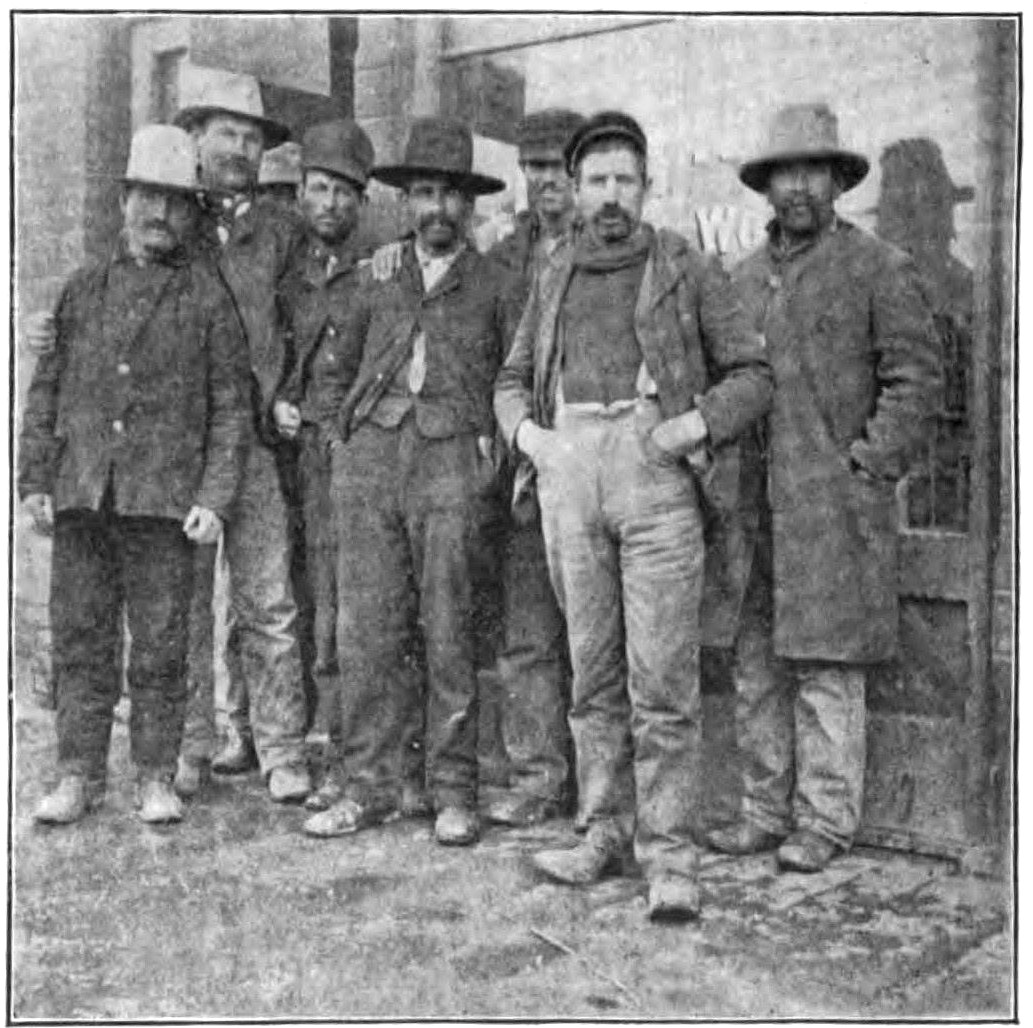
Bertha Mailly, wife of Socialist Party National Secretary William Mailly, sends her first dispatch as she travels to the seat of war during the 1903-4 Western Federation of miners strike in Colorado.
‘In the Strike Region’ by Bertha H. Mailly from American Labor Union Journal. Vol. 2 No. 17. January 28, 1904.
Mrs. Mailly Tells of Conditions—A Scab Herding Priest— Mother Jones Better–Conditions Worse than East– Wife’s Dishonor Price of a Job–Cash Payments not Dispensed
Not much news of the strike of several thousand coal miners in Southern Colorado has reached the outside world. Mrs. Bertha Howell Mailley, wife of the National Secretary of the Socialist party, went to that district from Omaha last week to be with Mother Jones, who was dangerously ill at Trinidad, but who is now happily recovering. While in the strike district, Mrs. Mailly will write a series of articles for the Socialist press, the following being the first. Mrs. Mailly says:
The miners’ strike of Southern Colorado has for its relief center, center, Trinidad, a town set in a ring of coal mines at Starkville, Ingelville, Sopris, Terceo, Segundu, Primero and other places. Here is the headquarters for the officials of the Colorado Fuel & Iron Co., which is the chief master and owner of this mining region.
The main “tent town” is in Trinidad, and at headquarters is a commissary department which is fast being systemized. Here are heaped quantities of provisions, bags of potatoes, of sugar, of carrots, boxes of macaroni, of canned goods, of tea and coffee and great sides of beef. They are fast getting into shape to stand a six months’ strike. Each striker, on presenting his union card, is given an order for an amount of provisions proportioned to his family, the maximum being four for a family of six. Further relief is given by two meals a day served the men in a soup kitchen. Here you must study the faces if you want to see the results of centuries of slavery.
The strike began on Nov. 9th, and not only the mines closed, but the coke ovens, smelters and blacksmith shops, whose workers, were called out. One man traveled 150 miles to be sure that his nephew, who works in the blacksmith shop at Starkville, came out. The start and conduct of the strike have so far been splendid, and nо name receives such high honor as that of Mother Jones, whose untiring work in the cause has exhausted her vitality, and who now lies ill in a hospital here, having narrowly escaped the fatal pneumonia. She is now recovering, and her one thought is to be “in the fight again.”
She has done what it is universally conceded no man could have done by organizing the southern district of Colorado and added thereby thousands to the army of men and women who lovingly call her “Mother.” These days men in Trinidad are asking on every hand, “How is Mother Jones?” or from the poor Italian, “Mr. Modder Jones, she well?”
At every turn one hears stories that show the unfaltering loyalty of both men and women to their class in the present struggle. One story is worth telling.
A Catholic priest who was accustomed to hold mass in Segundu and Primero, campa owned by the C.F. & I. Co., and surrounded by armed deputies, had received strong assistance from the C.F. & L. Co. in building a beautiful church in Primero.
This priest was said to be urging Italians to go to work. He would write recommendations for the men to the company. The strikers found it out and sent two men to get their recommendations. The men brought them direct to the union. It was further ascertained that at confessional he would refuse absolution to the men unless they would promise to go to work for the company. One day he took two such poor intimidated Italians in his carriage across the “dead line” of the camp at Primero. The woman in Segundu who boarded these two men was informed of it and told to watch for the father. Finally she saw him enter a Mexican’s house opposite. She left her house and with a light whistle and a snap of her fingers she summoned two or three of her country women. “The blackbird’s in there,” she said. They waited until he appeared. She strode up to him, a tall, handsome, muscular woman of forty, and seizing his neckcloth wrenched it from his neck and cried: “You are unworthy to wear this.”
Then, quite unaided, she treated the priest’s face anything but gently. It is said she left him with two black eyes, minus three teeth and with a sadly scratched cheek.
He made his way to the train and it is said was sent to Mexico for an indefinite vacation.
The conditions obtaining here are summed up in the words of one miner: “Yes, it was slavery in the east, but nothing like this. It’s the script and the unfair weighing, the terrible hours, the pluck-me stores and worst of all, our honor. The men who can pay the superintendent $10 or $15 can get a good job. The men, especially the Italians, who has a handsome wife, can get a good job, too.”
American Labor Union Journal was the official paper of the ALU, formed by the Western Federation of Miners and a direct predecessor to the I.W.W. Published every Thursday in Butte, Montana beginning in October, 1902 before moving to Chicago in early 1904. The ALU supported the new Socialist Party of America for its first years, but withdrew by 1904 as the union and paper grew more syndicalist with “No Politics in the Union” appearing on its masthead and going to a monthly. In early 1905, the Journal was renamed Voice of Labor, folding into the Industrial Workers of the World later that year. The Journal covered the Western Federation of Miners and the United Brotherhood of Railway Employees, as well as the powerful labor movement in Butte.
PDF of full issue: https://www.marxists.org/history/usa/pubs/american-labor-union-journal/040128-alujournal-v2n17.pdf
 Revolution's Newsstand