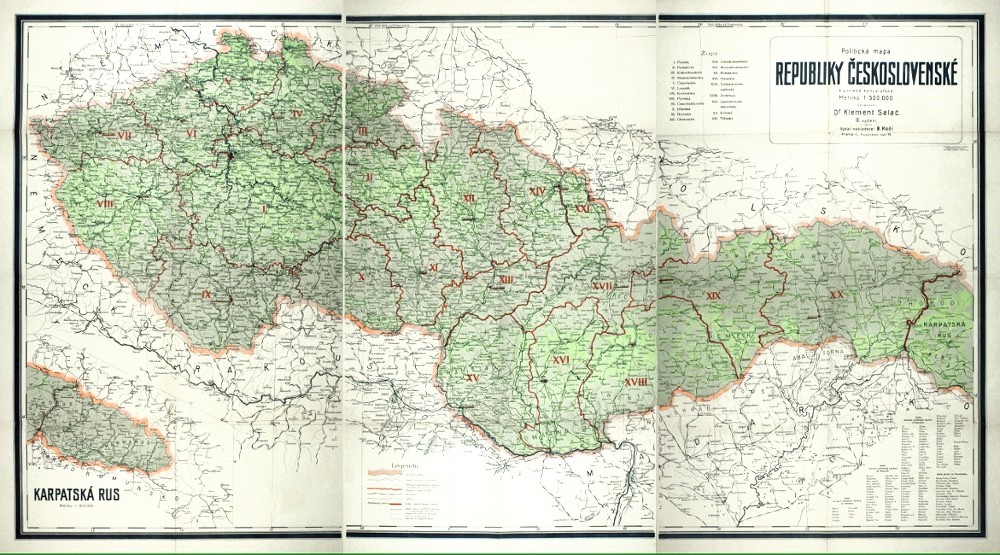
Perhaps the central debate in the creation of Czechoslovakian Communist Party was the national question. A country that came into existence out of the ashes of the Austro-Hungarian Empire and housed a half dozen sizeable ethnic and national groups. The most contentious national question in that period was the German speaking west. Kreibich, a veteran Social Democrat and founder and central figure of 20s and 30s Czech Communism from a German-speaking Bohemian family, took a position against German secession and clashed on that and other questions with his leading rival in the new Party, Bohumír Šmeral at the Comintern’s Third Congress.
‘Nationalism and Communism in Tschecho-Slovakia’ by Karl Kreibich from Moscow. No. 24. June 24, 1921.
At the very detailed discussion concerning the affiliation of the Tschecho-Slovakian Communist Party to the Communist International, the attitude of the leaders of that party towards the problem of nationalism was also carefully considered. In view of the fact that Tschecho-Slovakia is of vast importance for the Proletarian revolution in Central Europe, and the national problem plays a great part in that country, it is no doubt of value to discuss these problems in the columns of the “Moscow”
It was a gross misapprehension on the part of the speaker of the Tehecho-Slovakian delegation to consider the criticism of the attitude of the party leaders towards the national problem as an insinuation of nationalistic tendencies. Such a reproach would be unjustified. But a communist party may not content itself with the mere negative rejection of nationalism or with attempts to pursue an international policy be they ever so earnest. It is the bounden duty of a communist party to thoroughly investigate the national question, as every other question, and after having determined its attitude, to distinctly outline its policy in the matter. This must, above all, be done with due consideration to the role played by the national problem in the proletarian revolution. The assertion made by Comrade Burian that the Third International had already solved the national problem in the writings of its leaders and in its theses, is highly exaggerated. Problems cannot be solved in pamphlets and theses; they can only be discussed therein from the standpoint of principle, and of their application, in the practical revolutionary class struggle while the theses of the Third International can merely indicate the general guiding lines. The task of the Communists in each country is to examine the national problem in their country, on the basis of such writings and theses, and to apply the theses in a revolutionary manner under the particular conditions prevailing in their country. The German Social-Democrats in Tschecho-Slovakia, for example, immediately made use of these clauses in the theses of the Second International Congress, which stated that the Communists were bound to support the struggle for freedom of all oppressed peoples, by declaring that we, Communists, according to these theses, are obliged to cooperate with them in the struggle for so-called self-determination. It was our obvious duty to determine our attitude in the national problem at our inaugural congress. Whoever may desire to look into this matter can refer to the pamphlet containing the discussions in this matter. (The Reichenberg Congress, third pamphlet entitled: “The National Problem,” the address of Comrade Kreibich, the resolution and the appeal to the non-German proletarians. All published by the Volksbuchhandlung Runge et Co., Reichaberg.)
Our own investigation of the national problem has convinced us that the aforementioned clauses in the theses are not applicable to our policy. We, too, must of course take a stand against national oppression. But in the matter of the German regions in Tschecho-Slovakia it is not a question of the oppression and exploitation of a nation by foreign capital: in these regions German capitalism is much more powerful than Tschecho-Slovakian, and it has already entered into a firm alliance with the latter for the exploitation of the proletarians of both nations. It is true that the German capitalists grumble at times, but only because they would prefer to bag all the profits themselves. They have, however, already reconciled themselves to such partnership, as they have discerned that the maintenance of the integrity of this old, consolidated industrial territory by means of a Tschecho-Slovakian state is of advantage to capitalism. Flirtation with national liberation on the part of the German bourgeoisie is at present only a maneuver to keep the masses imbued with nationalistic sentiments, while, for the future it represents the speculation on further triumphs of German imperialism, for the purpose of elevating the German capitalists into supremacy over Central Europe.
It is not a question therefore of the liberation of their own compatriot, but rather of the sole exploitation of the own nation, and the exploitation and oppression of another nation.
From this point of view, we, of left wing in the Social-Democratic party demanded, at the congress of Teplitz 1910 as well, absolute noncooperation with the bourgeois nationalists, and rejection of all flirtation with national irredentism. We called a cessation of the struggle for self-determination in the sense of a struggle for the mere revision of boundary lines between capitalist states. As, however, Social-Democratic party continued to contend that the triumph of socialism would of itself bring the realisation of the right of self-determination, we were obliged to attack such chatter, because in the long run it only signified that the triumph of socialism was desired merely as an event good enough for the solution of the German-Bohemian question.
The first step on the path towards Communism is the conquest of power and the establishment of the proletarian dictatorship. When this has been achieved the solution of the problem of nationalities will become a task of the proletarian dictatorship. Now there are two possibilities: where will the victory of the proletarian revolution first take place, in Germany or in Tschecho-Slovakia? If in the former, it would provide a specious, seemingly revolutionary, nationalistic slogan for the German proletarians living in the adjacent Tschscho-Slovakian regions, separation from capitalist Tschecho-Slovakia and union with the German Soviet Republic. What would however be the practical consequences of such a watchword? Soviet Germany would obtain a territory of little value for its industrial reconstruction and one which it could digest only with difficulty, while a war with Tschecho-Slovakia would inevitably follow, burdening Soviet Germany with a region which, from a strategic viewpoint, would be very difficult to defend. For the sudden separation of its industrial border territory would signify ruin to Tschecho-Slovakia, and no government in that country would be able to view this passively. The menace to the economic foundation of the political independence of the nation, and the separation of the very numerous Tschechian minorities in the border regions, would drive the Tsehechian nation into the arms of a most rabid nationalism. The German proletarian revolution would thus find an echo which would greatly jeopardise it as well as the proletarian revolution in Central Europe in general. As a result of these considerations, our congress decided that, in the event of the revolution breaking out first in Germany, the German communists in Tschecho-Slovakia would have to absolutely oppose every seemingly revolutionary, nationalist-bolshevist policy, and, in common with the Tschechian communists, exert every effort to bring about a revolution in Tschecho-Slovakia as well.
The second case would be the victory of the revolution in Tschecho-Slovakia first. For we do not share Smeral’s dogmatic rejection of an “isolated” revolution. In that case it goes without saying that we, German communists would have to nip in the bud every attempt to weaken and endanger the Tschecho-Slovakian Soviet Republic by any national irredentism. The German bourgeoisie, the German counter-revolutionary forces would undoubtedly make such an attempt. The duty of the German Communists in Tschecho-Slovakia therefore consists creating a very strong shield for the protection of the Tschecho-Slovakist proletarian revolution in the rear. Only when the proletarian Soviet Republic of Central Europe will have been firmly established and united in a close federation, will they take up the task regulating their mutual boundaries in common accord, and with a view to practical requirements. And the boundaries fixed by the Versailles peace will be neither sacred nor sacrilegious to them.
These are our general guiding lines in the problem of nationalism, to the extent that it concerns national boundaries. It must be left to every Communist reader to judge for himself whether that which the German communists have thus laid down as their policy towards the Tschecho-Slovakian state may be considered opportunism, and whether our Tschechian Comrade Vanek was right in placing our attitude on this matter on a level with the assurance of the Tschechian communist Smeral, that he desires not to disrupt the Tschechian state, but to conquer it.
In conclusion we wish to say a few words concerning the reproaches to the Tschechian comrades and to the leaders of the Tschechian party. We do not doubt, for a single moment, their good intentions or their honesty in international politics. We desire merely to state facts. The central organ of the Tschechian party has not only not published in full the resolution adopted at our national congress on this very important Tschechian question, but has not even allowed it to be discussed. As a matter of fact, the party has never yet held a thorough discussion of the principles underlying this problem. This question was completely ignored at the inaugural congress of the Tschechian Communist Party on May 15th, just as no distinct policy was adopted in all the other important questions contained in Smeral’s address, on nationalism, except the single remark that the nationalist sentiments of the workers belonging to the national socialist party must be treated with forbearance. If we point out that the initiative in all attempts to bring about a unification of the German and Tschechian Communist has always been left to us, can we then be accused of exaggeration when we maintain that the leaders of the Tschechian Communist Party have not fulfilled their international obligations in the manner a Communist Party undoubtedly should?
Karl Kreibich
Moscow was the English-language newspapers of the Communist International’s Third Congress held in Moscow during 1921. Edited by T. L. Axelrod, the paper began on May 25, a month before the Congress, to July 12.
PDF of full issue:
 Revolution's Newsstand