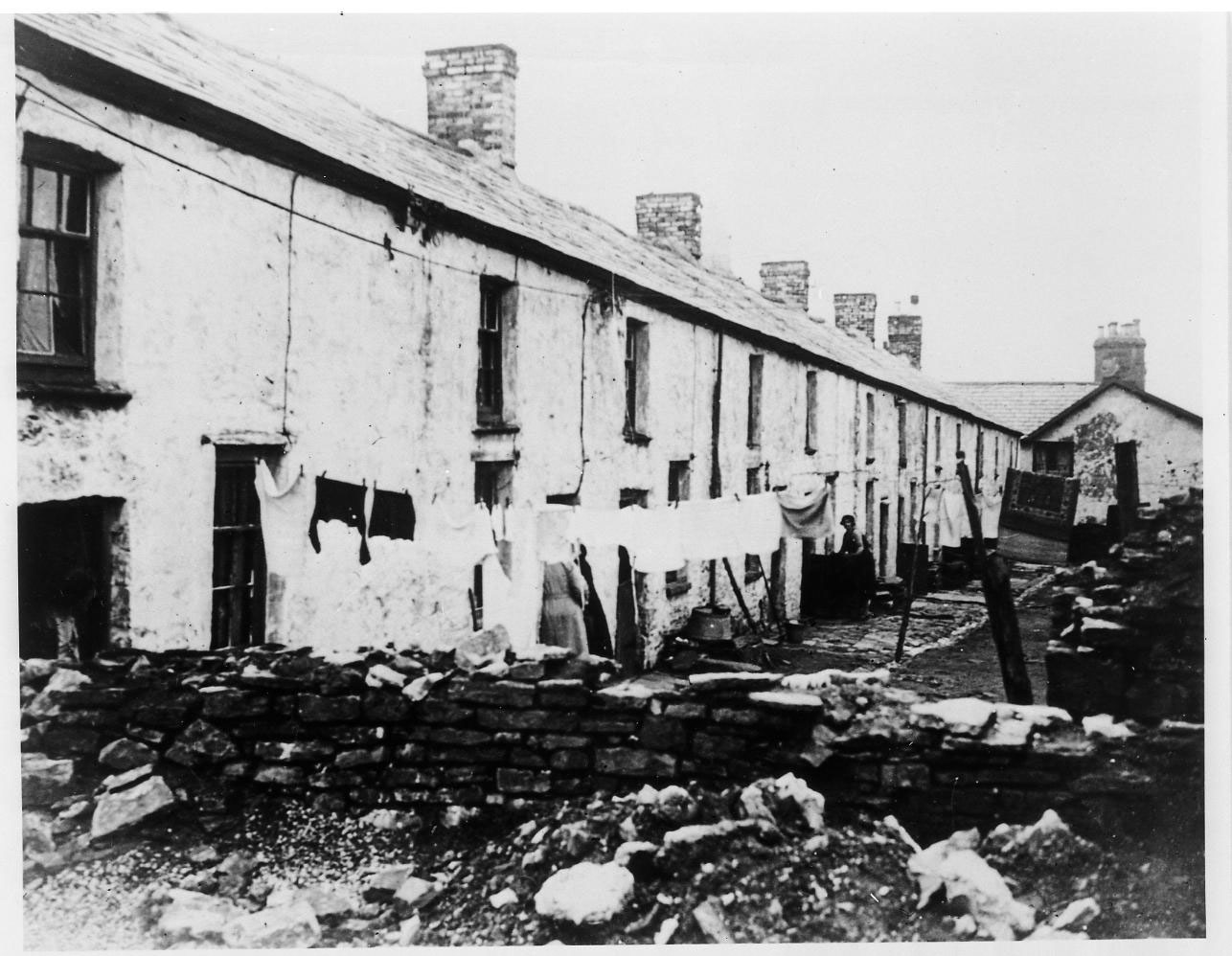
Even at the height of the Empire, Britain’s working class lived in atrocious, cramped, and unhealthy accommodations with little new housing being built, but evictions continuing at pace.
‘The Housing Situation in Great Britain’ by F. Turner from International Press Correspondence. Vol. 5 No. 17. February 26, 1925.
If we need any proof that British Capitalism is crumbling, it is quite evident from the fact that it has utterly failed to house its Workers. Prior to 1914 the situation was pretty bad but has since been aggravated by the lack of Building and the terrible over-crowding that has followed.
Our Mining Villages and Industrial Towns are a standing disgrace to our so-called Civilisation.
Most of the villages consist of houses of one, or at the most two rooms, and in these, very often, large families have to live. The following case is quite common:
In Consett (County Durham) in a house of two rooms, (the upper one being reached by a ladder through a hole in the floor of the upper room,) there lived a man, wife, and 6 children, including two girls of 21 & 23 and a boy of 18.
The average room space for the whole county is 0.77 per person, (1921 census returns) and in the Mining and Industrial District it is very much less than that.
The County of Lanark tells a similar story. In the Northeast corner live 1,539,000 people, (about 1/3 of Scotland’s population) and the district is a mass of slag heaps, chimney stacks, blast furnaces, and insanitary houses. There are 321,471 houses in the county, 61,200 single-roomed, 155,285 two-roomed, i.e. 2/3 of the houses contain at the most two rooms.
The Mining villages are clustered round the pit-shafts, and the dust and grime penetrates to every nook and makes the task of the women hopeless.
In the early days of Capitalism, when Labour was needed for the machines, small houses were rapidly thrown up without any thought of sanitation or health. Many of these are still standing to-day and although condemned years ago, are still occupied. Birmingham, a centre of the Iron and Steel Trades, is typical of our Industrial Towns. To cite but two cases from this city are quite sufficient.
1. Father, Mother, and 4 children all sleep in one bed and live and sleep in one room.
2. Father, Mother and 9 others of the family (aged 3 months to 52 years) have one living room, bedroom and an attic.
These houses often have no water supply or sanitary convenience.
For the privilege of existing in these hovels, the Workers pay, not only exorbitant rents, but often with health, and life.
Rents & Legislation.
At the beginning of the war, the housing situation began to grow more acute. Thousands of Workers flocked into the Industrial Centres, until it was almost impossible to get a room. The Authorities erected Wooden Huts as a temporary expedient, but these were not sufficient to relieve the position. Rents soon soared, but as a result of organised opposition on the part of the Workers, the Rent Restrictions Act (1915) was passed, forbidding the increase of rents.
The first legislation, however, was to prevent eviction, for the dislocation of Industry that followed the outbreak of war had caused much unemployment, and to protect the workers the Courts (Emergency) Powers Act forbade evictions for non-payment of rent without the permission of the Courts.
The Rent Restrictions Act (1915) applied to houses of not more than £35 annual rental, i.e. Working Class houses. No provision was made for furnished houses, with the result that many were let, containing a few inferior articles of furniture, and the landlord had complete control. This Act remained until six months after the war, when it was replaced by a further Act allowing 10% increase in rent and covering houses up to £70. This was amended in 1920 by a bill to last three years and provided for an increase of 40% and also included a clause making profiteering in furnished rooms illegal.
The position had now become so keen that “key money” was often paid for the possession of a house, sometimes as much as £20 being paid for the key of a small cottage.
With the fixed rental, the return on property was small compared to that from Industry, and much of the property found its way on to the market. Many of the Workers bought their own houses, only to find that they had paid a fictitious price for them.
Building & Legislation.
It became quite apparent, after the conclusion of the war, that there was no hope of private enterprise supplying the necessary houses, and the Government took action by passing the Housing of the People’s Act (1919), making it compulsory for the Local Authorities to supply the shortage. 45,000 houses were built as a result, but on the grounds of economy, the subsidy was curtailed and operations almost ceased. The loss on the building, which was being borne by the State, was estimated at £10,000,000 for the year, the cost of the houses being £1,100 each.
Labour Government & Housing.
With the advent of a Labour Government the Workers looked for some relief. Mr. Wheatley introduced his housing bill granting a subsidy of £6 per year covering a period of 20 years, providing that the houses were let at a rent of about 10/- per week. Conferences were called, both of the Building Workers and the masters and each gave their word that they would do all they could to make the scheme a success. The workers agreed to admit others into the trade after an intensive training, and the masters promised not to force up the price of the materials. In spite of this, the price of bricks increased almost the next day, and other materials soon followed suit. The threats of the Government were of no avail, and they took no action. They were too busy enslaving the German Workers to think of the Workers at home, and having accomplished their task, were thrown out of office before any material improvement had taken place.
Tory Government & Steel Houses.
A Tory Government followed, and Lord Weir, who is interested in the Clyde Shipyards, found a method of building houses of steel plates. The Government immediately gave its support to this method in spite of the fact that the cost exceeded that of the brick houses. Some criticism was given of this type, and it was stated on good authority that these houses would prove to be extremely hot in summer and cold in winter, also verminous and damp.
The Minister of Health (?), however was not to be put off so easily, and in replying said, “What if these allegations are true? Are slum houses free from vermin? Are they rain or damp proof? Are they always cool in summer and warm in winter?” Evidently the Tory Government think that the slum standard is good enough for the Workers.
A dispute arose over the rates of pay of the men who were building them. The men employed in the erection were Engineers, who received about £1 per week less than the Building Workers, and the Builders’ Union claimed that these men should be paid the standard rate of the Industry. Lord Weir refused to discuss the question, on the grounds that these men were members of the Engineers’ Union, and received the agreed rates of that Union.
The Rings once more took advantage of the situation, and the Light Castings Federation, the only one that need fear no competition, once more put up the price of their goods.
The Fight against Evictions.
After the end of the war, evictions became prevalent. The control had to some extent been relieved and it was now easier for the owner to obtain possession of his house. The unemployed, unable to pay their rent out of the miserable pittance they received, were the greatest sufferers.
They were, however, well organised, and were not prepared to take the matter lying down. They rallied their forces to the scenes of the evictions, and by force of numbers, either prevented the eviction of the tenant, or replaced the furniture after the officials had left. They interviewed Local Authorities, and were often successful in getting the notices cancelled. But while many of their members were houseless, there were in many localities, houses standing empty, and they took the law into their own hands, and very often seized the houses and put their members into them, while the landlord, rather than go to the expense of the law to turn them out, often let them stay.
Another tactic used successfully by the unemployed was to change over the tenants against whom the notices were served; so that when the officials came to carry out the eviction, the person against whom it was made out did not live in the house, and so it was necessary to go over the whole of the proceedings afresh.
The Workers have often come up against the police in these fights, and many have been severely injured and imprisoned for the part they have taken in the struggle.
Rent Strikes.
The revolt also found expression in rent strikes which took place in various parts of the country. A Tenants’ Defence League had been established to defend tenants in the courts against evictions, and illegal increases of rents. The League was controlled by the Social Democratic element and was most careful to keep well within the law. In Manchester, a rent strike took place. Two streets were involved. The Landlords had not given the necessary “notice to quit” and the tenants, relying on the support of the League, had a clear legal case. The League refused to give its support as they said it was unfair that advantage should be taken of a small error to deprive the landlord of his rights, and so the strike fell through. In London and other centres, strikes took place, with varying degrees of success, but nowhere in the country was the fight so persistently and tenaciously carried on as in the Clydebank area in Scotland.
The Fight in Clydebank.
Clydebank is a town of about 50,000 inhabitants, the main part of whom are engaged in the Engineering works of Beardmore’s and Singer’s.
The houses are owned by these firms and in 1914 they tried to force up the rents. The women of the district revolted and refused to pay the increase. The Workers then organised for the fight in the Clydebank Housing Association.
Enthusiasm was strong, and in the windows cards were displayed bearing such slogans as, “No Increase in Rent”, “No Evictions”, etc.
The landlords tried to force the increase from them by issuing notices of eviction, but they were not so easily beaten. Sentries were posted at the street corners to watch for the coming of the officials, and cycling scouts were in readiness, so that in a very short time, the Workers could be rallied to prevent it.
The Landlords then tried the tactic of suing their tenants in court for debt. On the day of the trial, when the courts were opened, hundreds of dungaree clad men, straight from the workshop, crowded into the court, packing it to the doors. The whole of the Workers of the District had rallied to the call.
The Authorities were aghast. Something must be done, so they got in communication with London. Something was done, the Rent Restrictions Act was passed.
A Victory for Working Class Solidarity.
With the termination of the Act, the landlords demanded an increase of 60% although legally they only could claim 33/3%. This the Workers refused to pay and in August 1920 the whole of Scotland declared a one day’s strike in protest.
A legal flaw was found in the notices that had been served on them. The landlord and not his agent should have signed the notice, and they fought them on the grounds that they were not legal. The well-known case of Kerr versus Bride was taken into the courts and fought on these grounds. The decision was given in favour of the tenant, and although it was carried to the county Sherriff, the Court of Appeal, and in October 1920 to the House of Lords, the tenant still had the victory.
In 1923 the Government passed a bill allowing the tenant to keep the unpaid increases, but made no allowance for the return of these that the landlords had received illegally. It also allowed the right of appeal to the Court of the Sheriff for the making good of any “bona fide” errors or omissions that may have been made. This was fought on the grounds that the errors made were not “bona fide” and as yet no settlement of the position has been reached and all the increases are still illegal.
The struggle is still raging, and in the meantime the rents that are owing are mounting up as it is necessary for the landlord to refuse the offered rent, otherwise that would become the agreed rent and he would have to commence the whole proceedings again. They cannot evict the tenants, for the scouts are still on the alert.
The Labour Council and Provost are on the Workers’ side, although there are £70,000 owing in rates, while the landlords have so far lost £150,000 and the amount is growing at the rate of £50,000 per month. But the Workers are determined to carry on the fight until their demand for the pre-war standard of rent is granted.
The Communist Party.
Through all the phases of the struggle, the Communist Party has been playing its part, encouraging and supporting the Workers in the fight, whether by constitutional or extra-constitutional methods, and putting before the Workers its programme, such as:
Adequate house-room for all badly housed and houseless Workers.
Rationing of all Housing Accommodation.
No Evictions of the Workers.
No Decontrol of Rents.
Municipal Housing Schemes by Direct Labour.
At the same time the Party is pointing out to them that the only hope for the solution of this and all the other evils from which they were suffering is through the revolutionary struggle for the Workers’ Republic.
International Press Correspondence, widely known as”Inprecorr” was published by the Executive Committee of the Communist International (ECCI) regularly in German and English, occasionally in many other languages, beginning in 1921 and lasting in English until 1938. Inprecorr’s role was to supply translated articles to the English-speaking press of the International from the Comintern’s different sections, as well as news and statements from the ECCI. Many ‘Daily Worker’ and ‘Communist’ articles originated in Inprecorr, and it also published articles by American comrades for use in other countries. It was published at least weekly, and often thrice weekly.
PDF of full issue: https://www.marxists.org/history/international/comintern/inprecor/1925/v05n17-feb-26-1925-inprecor.pdf
 Revolution's Newsstand