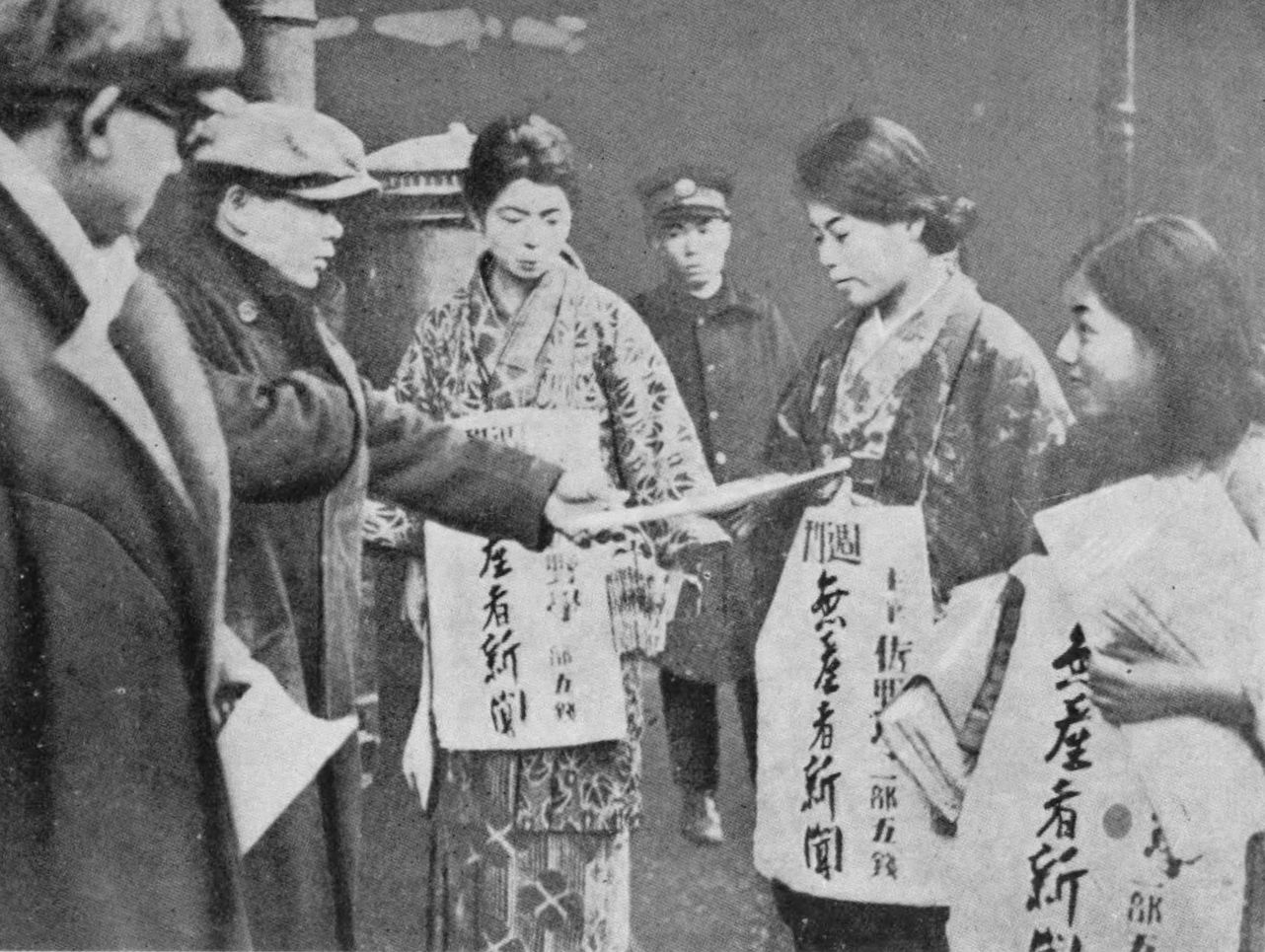
The Japanese Marxist, who spent a number of years of his activity in the U.S., with a valuable survey of Japan’s labor movement in the mid-1920s.
‘The Most Recent Development of the Trade Union Movement in Japan’ by Unzo Taguchi from International Press Correspondence. Vol. 6 No. 65. October 7, 1926.
At the end of 1925 the number of trade unions in Japan amounted to 209 with 249,400 members. Of these, 94% had been organised during the period of the rapid growth Japanese capitalism since 1918, of these again 58% in the last two years 1924 and 1925.
The whole working population of Japan amounts to 9,880,000, of whom the workers in industrial occupations, mines, transport etc., who might be organised in trade unions, are estimated at 4,348,000. This shows that only 5.5% of these who might be organised in trade unions in Japan, are actually organised. The percentage of the working population amounts to rather more than 18% of the whole population of Japan, the percentage of workers who could be organised, to about 7% of the whole population.
The rapid growth of trade union organisation in the last few years, has brought with it various defects.
The first defect which must be mentioned, is that the organisation of the trade unions has up to now proceeded by chance and without any clearly outlined programme. This has resulted, among other things, in the relations between the leading elements of the labour movement and the rank and file being too loose. The whole movement therefore lacks organic unity, and the organised minority finds itself in opposition to an unorganised majority of the working class in Japan.
The second defect is a consequence of the decentralised condition of the labour organisations. The existing 200 trade unions with roughly 250,000 members are distributed among 18 federated groups and 108 individual trade unions. Thus the average number of members of the individual trade union does not amount to more than 80. Furthermore these trade unions are associated in various federations, which are at logger-heads.
The most prominent of these federations are Nippon Roda Kumiai Hyogikai (Trade Union Council of Japan) and Nippon Roda Sodomai (General Workers’ Union of Japan), both of which take a leading part among the trade unions and are of curse in consequence permanently in a state of competition.
The third defect is the insufficient fighting power of the trade unions. 76% of all the Japanese workers organised in trade unions belong to two branches of occupation, i.e. transport and the metal industry. The organised workers in transport, most of whom are seamen, amount to 41% of the category of workers in question, in the metal industry to 28%, in the printing trade to 21% and in the other occupations less than 10%.
Special emphasis should be laid on the fact that the number of those organised in the spinning-mills, on the railways, in the electrical industry, in mining and other important branches of industry only amounts to 1-3%.
The fourth defect is that the workers employed in large works are still only organised to a comparatively small extent, and most of those who are organised, belong to the small or medium works. The number of industrial concerns with more than 100 workers amounts to 2,359 with 1,055,000 workers altogether, which represents about 60% of the whole of the industrial workers of Japan. Among these works 490 employ more than 500 workers each; they employ altogether $65,000 workers, which represents about 38.7% of the whole of the industrial workers.
The number of organised peasants amounts to about 306,000 i.e. about 8.6% of the 3,803,341 families of tenant farmers in the country. If we assume that 40% of the whole peasant population might be organised, the number of those actually organised, amounts to about 21%.
Amongst the peasant organisations the most prominent is Nippon Nomin Kumiai (Peasant Union of Japan), consisting of 961 local peasant unions with a total of 73,000 members. This large organisation has only existed for five years. The other peasant unions have, it is true, altogether about 220,000 members, but they are much dispersed and weak. Chubu Nomin Kumiai (Central Federation of Peasant Unions), Kita Nippon Nomin Kumiai (Federation of Peasant Unions of North Japan), Nippon Nomin Kumiai Rengor (League of Peasant Unions of Japan) are the three largest federations, but apart from them there are about 3000 individual local unions.
Nippon Nomin Kumiai made, in concrete form, the proposal to form a political party of the proletariat and has contributed more than anyone else, both materially and morally, to the foundation of Rodo Nomin To (Worker and Peasant Party), the first political party of the proletariat, which, having come into being after great sacrifices, was dissolved by the Government last year on the very first day of its existence. The foundation of Rodo Nomin To in March 1920 was rendered possible by the great sacrifices made by this peasant organisation, which undertook the preparatory work of organisation on the very day after the suppression of the first political party of the Japanese proletariat.
The first attempt to organise office employees was made last year, first of all in Osaka and Kobe, later in Kioto and Tokio. These local organisations were subsequently federated
a national scale in Nippon Hokiu Seikatsasha Remmai (National League of Employees in Japan). About 10,000 employees are organised in trade unions altogether.
A special form of organisation in Japan is the Suiheisha Musansha Domei (League of Suiheisha Proletarians), composed of members of a pariah class, with the object of liberating them from their oppressed social position which dates from the prejudices of feudal times. The word Suihei itself means equality of position. The League has more than 50,000 members. Thanks to its special position, this organisation has the greatest fighting power in the social struggle against the bourgeoisie and its influence extends to more than one million persons in the whole country.
The proletarian movement has naturally, in the course of its development, divided into two definite and distinct tendencies of which one aims at Marxism and the other leans towards opportunism. It is however a strange and at the same time interesting phenomenon that the split took place in Japan just at the most reactionary period.
The tendency to divide showed itself already very plainly by the end of 1922, but the real split in the movement did not occur till February 1925, when the powerful federation Nippon Rodo Sodomei excluded the Left elements from its ranks, thus calling into being the federation Rodo Kumiai Hyogikai. Thus, in addition to the few syndicalist groups which are still found in the ranks of the Japanese workers, two clearly distinguished camps have arisen in the Japanese labour movement.
Since the division, the two trade union federations, Hyogikai (Marxist) and Sodomei (Opportunist) have developed as regards their number of members, as follows:
1924—1925–1926
Hyogikai–9,000—18,700–23,000
Sodomei–19,000–34,000–43,000
Thus the federation Hyogikai has increased three-and-a-half times since the split, the federation Sodomei two-and-a-half times, whilst the other 18 federations and the numerous local trade unions have only increased to an inconsiderable extent in the same period. This gives us evidence of the increasing influence of the two said federations within the trade union movement.
The two federations, however, are in violent opposition and at times of strikes even serious conflicts occur, as for instance recently in the strike of the Kawasaki cotton factory, during which the two groups encountered one another in the midst of violent strike fighting.
The Government deliberately and systematically promotes the division in the united front of the workers and is now trying, in co-operation with the opportunist labour leaders, to destroy the organisation of the Left trade unions.
The negative attitude taken by the Sodomei with regard to the question of the organisation of a proletarian party, led to the dissolution of the first proletarian party in December 1925. And when attempts were again made to create a political party of the proletariat, to found a worker and peasant party, the Sodomei announced its intention at the last moment of withdrawing from the party, should the Hyogikai join the same organisation.
In these circumstances the Hyogikai and the other revolutionary proletarian elements of the labour movement were compelled to refrain from joining the new political party in order to allow of the undisturbed and complete development of a united proletarian political organisation, the existence of which is of the utmost importance for the whole proletarian movement in Japan in its present position. When however the Worker and Peasant Party, which owes its existence in a great degree to the stimulation of the peasant federation Nippon Nomin Kumiai, stated in a resolution in March 1926 that it would open its doors to the proletarian masses without distinction of trade union membership, the Sodomei again begun its sabotage by repeatedly expressing its intention to secede from the party, since the resolution was too Left in its tenor.
Thanks to the efforts of the Marxist labour leaders, a movement has recently set in for the amalgamation of the local “labour councils” (trade union councils) which already exist in various industrial districts of the country, such as Tokio, Osaka, Kobe, Kioto etc. In June 1926 a conference was held in Osaka, summoned by the Trade Union Cartel of Osaka, in which delegates of various trades councils took part and the object of which was to create a national trade union council which would embrace the whole proletarian peasant and worker population. As was to be expected, the delegates of the Opportunist Sodomei obstinately opposed the formation of an organisation of the kind, declaring that the time was not yet ripe and that they could not take the responsibility in common with the Hyogikai. The result of this opposition of one of the largest labour federations was the complete failure of the conference which was postponed without having achieved any concrete result.
The Redo Kumiai Hyogikai cannot yet boast of a large membership and is only supported front without by a few influential trade unions; it is nevertheless a leading element in almost all the district trade union councils throughout the country. In spite of all obstacles it is working indefatigably at the creation of a united front of the workers and a united proletarian party.
International Press Correspondence, widely known as”Inprecorr” was published by the Executive Committee of the Communist International (ECCI) regularly in German and English, occasionally in many other languages, beginning in 1921 and lasting in English until 1938. Inprecorr’s role was to supply translated articles to the English-speaking press of the International from the Comintern’s different sections, as well as news and statements from the ECCI. Many ‘Daily Worker’ and ‘Communist’ articles originated in Inprecorr, and it also published articles by American comrades for use in other countries. It was published at least weekly, and often thrice weekly.
PDF of full issue: https://www.marxists.org/history/international/comintern/inprecor/1926/v06n65-oct-07-1926-Inprecor.pdf
 Revolution's Newsstand