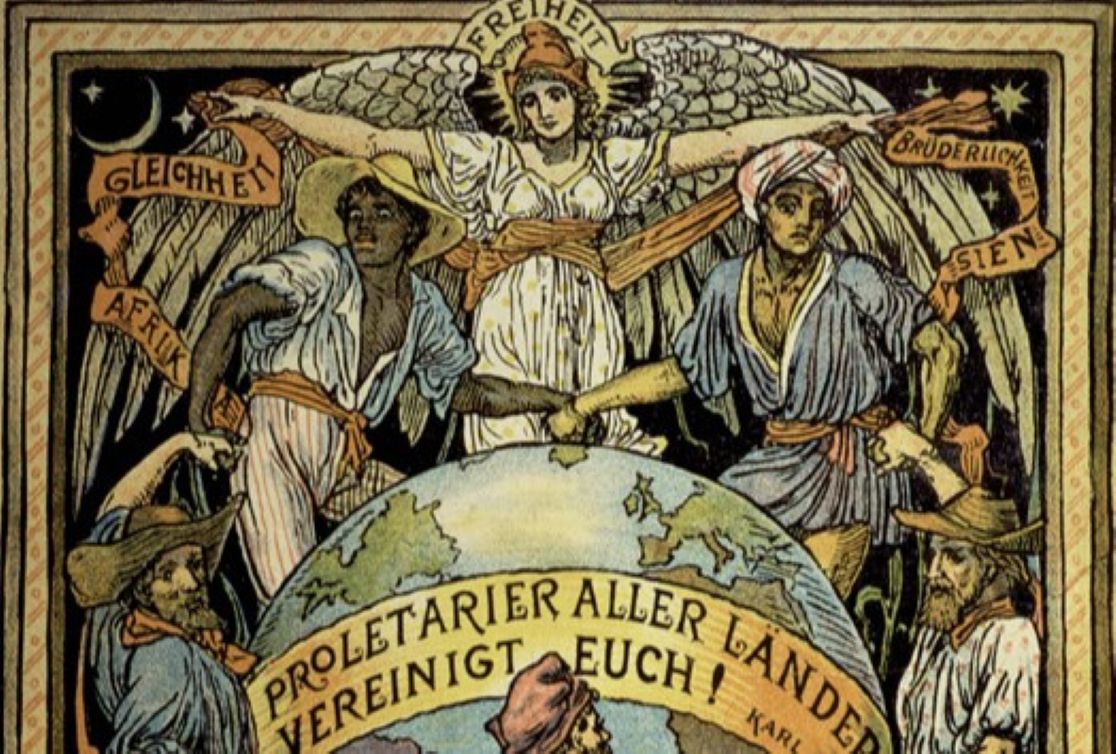
This full-throated defense of the ‘sublimest and truest’ sentences ever spoken, the central slogan of our movement–past, present, and future–was probably written by then editor James Wilson.
‘Workers of the World, Unite!’ from Industrial Worker. Vol. 1 No. 19. July 22, 1909.
This is the most inspiring of the mottoes of the revolution. But it is not a matter of sentiment alone. It points out the only way for the working people, in this day and age, to free themselves, their wives and their children from the oppressions of the ruling class of the world. The industrial power of the modern employing class is world-wide. The revolutionary feelings of the workers is growing world-wide, to cope with the ever-growing power the employing class. Not alone in France, or in America, but in all the countries of the world, is the tide of revolution rising against the robbers who prey on the misery of the millions who make up the working class of the world. If all the governments of Europe should unite against the working class of one country, the outcome would probably be a defeat of the workers, But against the common enemy, the spirit and action of unity is being more plainly shown than ever before, on the part of the workers themselves. In the late postal strike in France, we see the German and the English workers offering help to the strikers in Paris. No longer, as in the days of the eighteenth century, can the rulers command the workers to repress a rebellion with equal hope of obedience. The social sea is agitated by the storm of the impending revolution. The nations of the earth are learning to hate the beast of capitalism, and shall indeed, “make it desolate and naked; eat its flesh and burn it with fire!” The association of men, on the industrial field, while big with progress for the workers, is also heavy with responsibility. Not alone to combat the enemy, but to carry on production, is it necessary for the workers of the world to unite. We little think how the Japanese and the Chinese and the Hindoo, have grown the tea we drink for breakfast. We forget that the peons of Brazil have raised the coffee we drink for dinner or that the laborers in a tropical country have made the chocolate and the cocoa. We find that the simplest article of modern manufacture may be the work of all the zones, of all the races, of all the creeds. Even the varnish on the lead pencil comes from the tropical country. The interdependence of the workers is a plain tale told by every act, and everything of our daily life. Of all the sublime sentences spoken by men, the words, “Workers of the World Unite,” is the sublimest and the truest. Only by a realization of working class unity, for the good of the working class, is it possible for all the forces of nature to be made the servants, and not the tyrants of the working class of the world.
And, oh workingman! The Inspiration of it! The shimmer of the sea of glory, after the roar of the tempest, which can be seen by the workers, let them but life up their heads from slavery! The true inspiration of all the noble deeds of the martyrs, had at least an inkling of the spirit of unity. The religious hymn appeals to us by its call for unity:
“From Greenland’s icy mountains, from India’s coral strand,
Where Africa’s burning fountains roll down their golden sands;
From many an ancient river, from many a palmy plain,
They call us to deliver their land from Error’s chain.”
“Where no vision is, the people perish.” It may be that we are so absorbed in the every day struggle for existence that we lose sight too much of the future. To those of a plain, unfeeling disposition, it may be enough to point out the real hope of shorter hours of labor and bigger pay. But which of those who are in love with the Revolution, has not felt the intoxication of the future? Do we not long to be among those whose names will be blessed by future generations, when all the race of willing slaves are as traceless as the Egyptian mummy?
Fellow workers, let it be said of you and me, that we died in a god Cause, that we gave our lives to the Revolution! With nothing to lose, but misery, poverty and toil, were it not better to offer life as a sacrifice, as a protest against our merciless enemy, the employing class, than tamely to sink into a “peaceful” grave? The unity of the working class is a structure, whose every stone and pillar is a monument to the heroism of the leaders and armies of revolt in all ages. Do you pay a poll tax today? Think of Wat Tyler, dashing out the tax-gatherer’s brains with a hammer! Is the press and free speech throttled? Think of the corpses of the Chicago martyrs swinging from the gallows!
The industrial unity of the working class is the goal for which the race has groaned since the cave man fought the tiger with a club. The industrial unity of the working class is the goal of us who fight the tigers of modern capitalism. The one grand rule for human conduct, the criterion by which to judge all our fellows, is this: are they helping to unite the workers of the world? Those who are not helping to unite the workers, are helping to divide the workers, for there are no onlookers in the struggle for bread.
The Industrial Union Bulletin, and the Industrial Worker were newspapers published by the Industrial Workers of the World (IWW) from 1907 until 1913. First printed in Joliet, Illinois, IUB incorporated The Voice of Labor, the newspaper of the American Labor Union which had joined the IWW, and another IWW affiliate, International Metal Worker.The Trautmann-DeLeon faction issued its weekly from March 1907. Soon after, De Leon would be expelled and Trautmann would continue IUB until March 1909. It was edited by A. S. Edwards. 1909, production moved to Spokane, Washington and became The Industrial Worker, “the voice of revolutionary industrial unionism.”
PDF of full issue: https://www.marxists.org/history/usa/pubs/industrialworker/iw/v1n19-jul-22-1909-IW.pdf
 Revolution's Newsstand