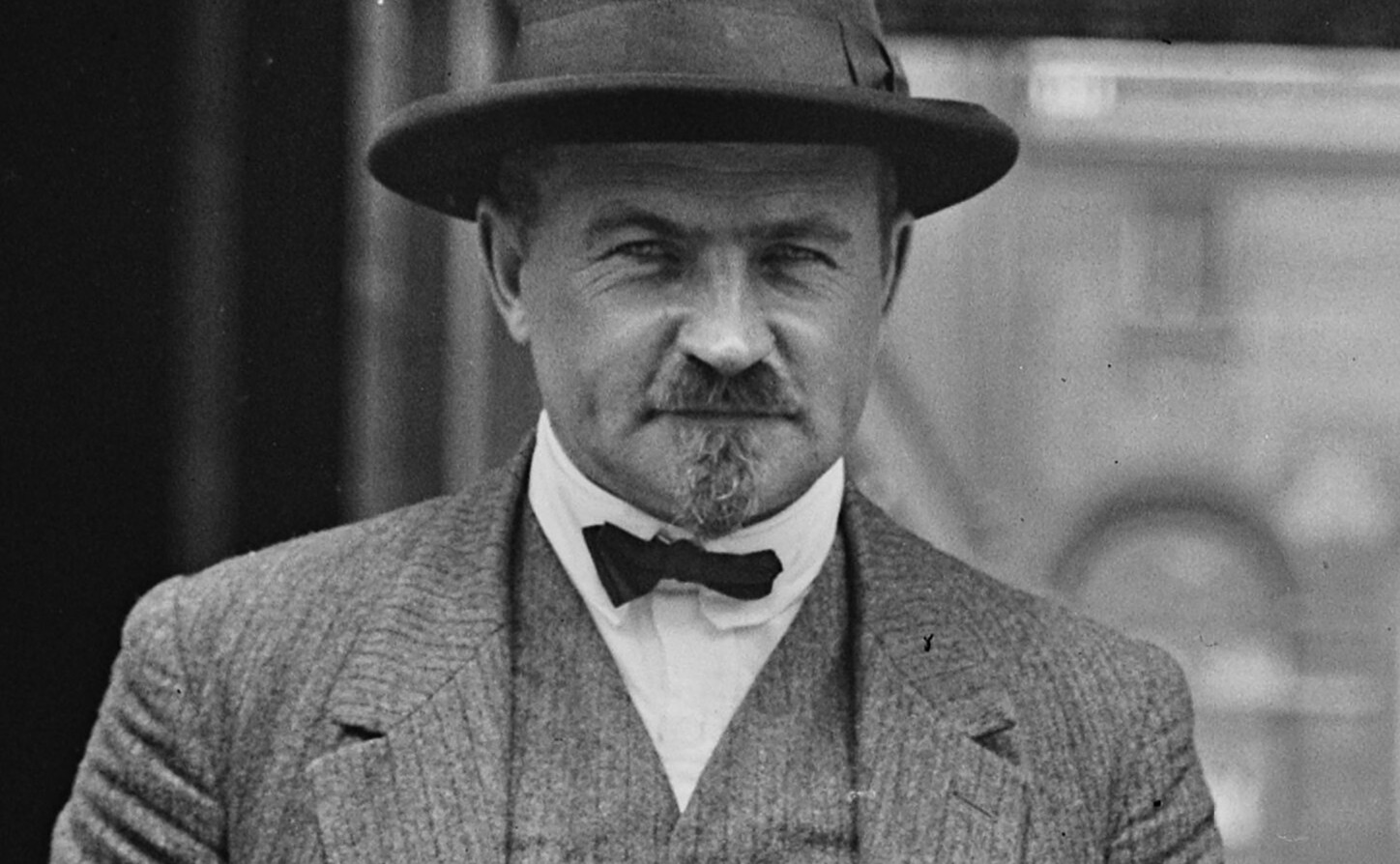
Preobrazhensky explains elements of the New Economic Policy to members of the International in the daily newspaper of the Third Congress, ‘Moscow’.’ As with many articles from Moscow, quickly translated from and into multiple languages, the translation is uncorrected and sometimes curious. Preobrazhensky was an ‘Old’ and leading Bolshevik, an economist widely known outside of Russia for his popular ‘ABC of Communism’ written with Bukharin, his Left Communist comrade from 1918, and translated into dozens of languages. He helped to craft N.E.P., later becoming one of the foremost critics of its implementation, and major figure in the Left Opposition during the 1920s authoring many of its policies and texts. He later recanted and rejoined the Party as Commissar of Light Industry, to again be active in oppositional activities, only to recant again. A victim of the purges, he was arrested in December, 1936 and executed on February 13, 1937.
‘A Few Words on the New Policy’ by Yevgeni Preobrazhensky from Moscow. No. 19. June 16, 1921.
The fundamental motives which inspire our Party to change its attitude toward small industry, and primarily its attitude towards small peasant industry have been made well known by our congresses and conference and party literature. I would like to add a few words to what has already been said, dealing with the role of peasant industry in our system of socialist construction, independent of any policy of the Soviet regime
All the Russian economists know well enough the role which the peasant industry of Russia played in our national economy before the war. It is sufficient to mention that during the most prosperous period of our industrial life, peasant industry was responsible for as much as half of the value of goods produced in the country.
The crisis or prosperity of all industry depends on the harvest. All are aware of the connection between the industrial boom in Russia during the year of 1910. The method of distributing the national income before the war was such that the overwhelmingly greater portion of the peasants produce was used not only to support the parasite classes, the payment of interest on foreign loans etc., but by various means it was used for the reinforcement of the resources of the large capitalist industry. As the most glaring example of this we have the fact that the average domestic budget of the average peasant of European Russia was several times less than the average budget of a skilled worker in a large industry.
The imperialist war, the revolution and the civil war absolutely shattered the whole of the country’s industry. Our total national income is now a half or possibly a little more than that of our pre-war national income. Peasant industry has also suffered intensely, but it has suffered relatively less than our large industry. Unfortunately we have no accurate figures, giving the total value of our production and its distribution throughout all the socialist and non-socialised industries (this is at present being calculated) but preliminary figures show that three quarters of our national income is derived from outside the socialist industry, i.e. from small industry. These figures themselves pretty clearly demonstrate the conditions under which our party must carry out the Dictatorship of the Proletariat and if any question arises it can be only be one, viz: how could the Russian Communists, existing in such petty bourgeois surroundings, have accomplished that which they accomplished during the war?
But the present policy of the Soviet government becomes still clearer if we take into consideration the participation of the peasants in the production of the Soviets and the reestablishment of socialist industry up to the present. We will disregard in this instance the participation of the peasants in the Red Army to an extent of 60% of its numbers and any of their sacrifices other than material losses.
Small industry for the three years of the revolution i.e. 1918-1920 delivered its products to the Soviet government in the form of requisitions and sales in exchange for government paper money of an annual value of from 600 to 620 millions of gold roubles at pre-war prices. If we subtract the value of goods received by the villages from the government and the value of the labour embodied in them we see that the peasants delivered to the government without payment, goods of an annual value of half a milliard roubles or about an eighth of the whole of their budget, or over a quarter of the real budget of socialist production. From this one can see that the role small industry played in its struggle for Soviets and the role which it plays today in feeding the recovering socialist industry with part of its necessary sap. We will not mention here the most important need of Russia, the preparation of fuel, the primary need upon which depends any attempt to resuscitate industry and which cannot be achieved without the help of the peasants’ horses. We will not speak further of other kinds of labor obligations peasants bear for socialist industry, as we will not speak of the petty-bourgeois villages which will not only supply the town with a tremendous amount of valuable produce, but will give them very products, such as food, which are of paramount importance during a world-wide agricultural crisis.
Such briefly is the economic significances of small industry in Soviet Rusia. If we deal only with the absolutely indispensable, neglecting many other importers facts and considerations, if in 1918 we did not have a period of fierce civil warfare then undoubtedly the specific significance of small industry in Russia would have compelled us to adopt the same tactics three years ago, as we adopt today. This policy pre-supposes a long period of co-existence of socialist economy with petit-bourgeois economy and the latter’s gradual economic extinction by the competition of socialist large industry, with the help, of course, of government compulsion in small doses.
This path is long, difficult, wearying, and for many “dull,” but at present it is the only one possible. Until the proletarian revolution of Europe begins, which will undoubtedly, radically change the whole situation and hasten the whole process of our socialist construction.
Moscow was the English-language newspapers of the Communist International’s Third Congress held in Moscow during 1921. Edited by T. L. Axelrod, the paper began on May 25, a month before the Congress, to July 12.
PDF of full issue: https://www.marxists.org/history/international/comintern/3rd-congress/moscow/Moscow%20issue%2019.pdf
 Revolution's Newsstand