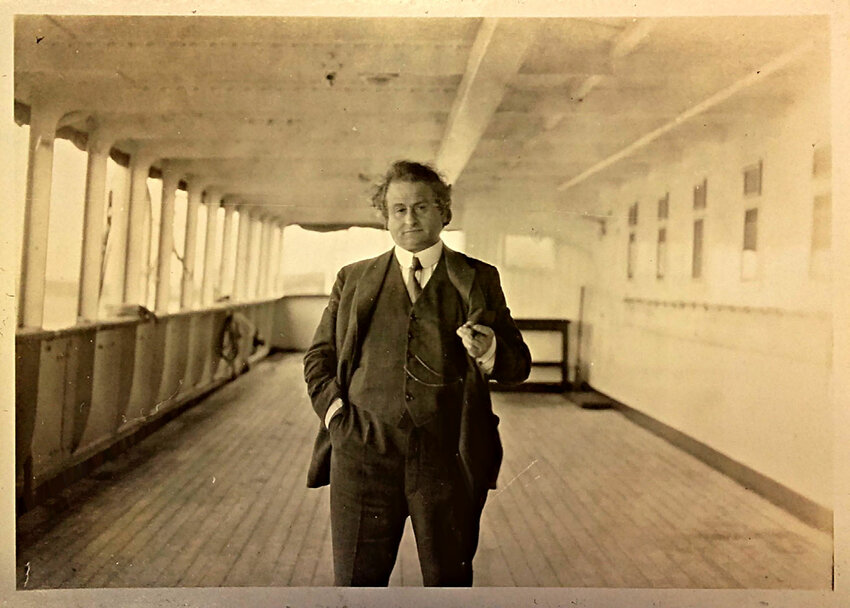
The traveler’s account of a journey to and through Soviet territory in its first decade practically became its own literary genre. Being surrounded by hostile countries, invaded, at civil war, and blockaded, real news from Russia was hard if not impossible to get for a number of years, making precious stories from those who made it through the armed frontiers. While most of the accounts are from adventurers, bourgeois journalists, or diplomats, others came from sympathizers or revolutionaries eager to see and learn for themselves from the new experience. This is easily one of the most compelling of those that I have read. The investigations he details would be codified in a larger and later work, The Economic Organization of Soviet Russia. Dr. Goldschimdt was an intellectual, journalist and Chair of Economics at the prestigious Leipzig University who was for years involved in anti-war, anti-fascist and anti-imperialist solidarity campaigns, particularly around Latin America. His books were among those publicly burned by the Nazis and he went into exile, eventually–like so many others–finding his way to Mexico. Having traveled and written about Mexico before, he worked as an economics advisor for the Cardenas government and aided other anti-fascist refugees. There he died in 1940, receiving a state funeral. While well known in Germany, this account was only translated as a serial in the Friends of Soviet Russia’s New York publication. Below is the first chapter, as Goldschmidt sails to Estonia, crosses the border and takes the train to Moscow, arriving on May Day 1920. The rest to follow. An important addition to the literature from the revolution. A feast.
‘Moscow in 1920: Chapter I’ by Dr. Alfons Goldschmidt from Soviet Russia (New York). Vol. 3 No. 14 October 2, 1920.
Leaves from a Diary
[Preface: These notes were jotted down on the trip to Moscow, as well as in Moscow and on the return journey to Germany. After a hard work of scientific observation, these notes are merely a hasty discharge of accumulated observations. They were a sort of outline, of illumination, for my larger work; a sort of anecdotic inspiration in a vehement period of new birth. I was to undertake a sketch of gigantic phenomena, and needed diversion, in order not to become tired. These little sketches, although separately published, are nevertheless a portion of my scientific work. They are arabesques for this work, but are nevertheless organically connected with it. Always they have a connection, either latent or visible, with the efforts for the extension of the economic revolution of Soviet Russia. A mountain must be covered with verdure, otherwise its effect will be thwarted and it will appear brusque and sudden.—Neckarsteinach. End of June, 1920.]
The Ship
The ship in a revolutionary period is not an ordinary ship. It is not a ship of peace, which one boards without preliminary cares, on which one lives through the day without special disquiet, to enjoy the ocean and the shores and to anticipate the pleasures of the port. It is not easy to go aboard a ship, particularly a ship sailing for the east. For on such a ship there is a supervision of passports, customs inspection, and, if you have not the swiftness of an eel and a tarnhelm to make you invisible, you will not succeed in evading all these examinations. Arguses are on guard, whose eager eyes shoot Roentgen rays of inspection on contraband of every kind. A veritable purgatory of siftings is passed through in the presence of these Arguses. For instance, ministers of police, who diligently pass their noses over anyone aiming for Moscow, and will not approve the addition of a visa until some interest of the fatherland appears to be at stake.
At last, we are on the ship; that is, you are surrounded now only by the salt air and by the odors of tar and oil. A ship that sails in periods of revolution is infected with the pestilence: the espionage pestilence, the stool-pigeon pestilence, the disgusted epidemic of sniveling. Thick vapors, odors of mould, swift double-barbed arrow-glances, furtive amblings around your baggage, your cabin. The whole world is infected, but on a ship that sails in revolutionary periods there is pestilence in concentrated form, accumulated malevolence.
And you behold around you all the classifications, all the degrees of mind and fortune, all the groups, reserves, flights, agilities, and stupidities the revolution has revealed, There are new fortunes created out of foreign money speculation, the misery of emigrants in hail storms and on ice-clad decks, pale self-sacrifice for a great hour, and a placid nursing of time worn values.
I was soon in the midst of the babble of the revolution. There was a table at which were seated those who had been washed to sea by Soviet Russia, and who were again washing themselves to shore, as they expected blessings and quiet from the border states. A former Czarist colonel; with a characterless Tolstoian beard on an egg-like head, and an unheard of appetite for cognac. He gave evidence of a veritable juggler-like skill in arbitrage, and juggled with the exchange quotations as a circus performer does with his balls. Sitting opposite him was a Czarist lieutenant, with his old swiftness in genuflection, his ramrod angularity, his monocularity of the old period. Opposite him, a Russian lady warmed with a sealskin; with long pendants attached to her ears and breast; and then, two border state jobbers, merchandise middlemen, purveyors, of base calibre.
On this table bottles of cognac and red wine were being decimated and completely annihilated. Here you beheld the Baltic fervor against Soviet Russia, inspired by brandy and tempered with the consultation of exchange quotations. While outside the little refugee children were freezing, and dishevelled Jews and homecoming prisoners of war were longing for peaceful barter and the mother’s arms, this table was the scene of a boastful misery that was really not misery at all. Wretchedness was drowned in cognac and red wine and thus transformed to joy. Principles vacillated and found support only in the hope of a favorable development of the quotations. You will always find such rabble on the outer margin of purposeful action and incipient energetic cleanliness. You had it around Christ; you had it around the great French Revolution; you had it when the Americans were liberating their slaves; you find it wherever the clean will of man assumes energetic forms.
What a delight to be able to move one’s eyes from this mess, from this unclean drunkenness, to the sea and to the distant coasts; what a joy to swing on the waves off Gotland, off Oeland. What a double delight to sail for twelve hours or more through the Finnish skerries, through this wondrous fairy land of polished stone toys, distributed with volcanic playfulness. Studded with Liliputian islands, neat little shelters for boats at their edges. Every possible form presents itself to your view: wreaths with water inside of them, giant turtles, lowering alligators, gay islets still dotted with snow in April. Robinsonian retreats, and between them the zigzag of twisting and surprise-strewn calm, placid water, with the most abrupt changes, and seamews flying above. This marvel lasts until you reach Hango, until the moment when the uncouth giant, the sea-lion, the Finnish pilot, with his catlike moustache, descends from the ship and is rowed off to one of the islands that surround Hango like so many castles. After leaving Hango the path becomes dangerous once more, as it was before entering the miracle of the skerries, for here we still have a great mine frontier. Great fields of mines, whole regions filled with pestilentious explosives. Every moment the first officer must be on guard not to foul one of these monsters that will cast us into the air. The war ended in November, 1918, and to this day these vile things lie in wait, covered with blue water cushions, a veritable association of sulphurous assassination. Why not remove the damned stuff? Who has the right to permit death to remain on guard in this way? In places, a disconnected cap, will work itself loose and drift over the sea, lewdly shaking. One of them came within twenty meters of our ship, a dreadfully rusty cap of iron, ready to spew, which our captain shot at in order that it might spew harmlessly; but in vain, the moving pestilence wiggled on. It is harmless if it shakes its head over the quicksilver surface of a sunny sea, for then you can see it even kilometers distant. But, when it comes shaking along during a storm or under the cover of a fog, your ship will be shattered.
Our captain was a careful man. He sailed as it were by pen and slide-rule through the official mine chart and had his ship anchored in the fog. And thus the steamer,—its freight of salt still dry, and all its social classes, heterogeneities, self-sacrifice, vulgarities, longings, stock quotation sharks, and with considerable remains of ham and sausage and other amiable properties—reached Helsingfors. We sailed past the guns of Sveaborg, which were turned toward Soviet Russia, into the calm basin, interrupted by islands and animated with villas and parks, which edge about the modern city, through which electric cars, automobiles, and country-carts are constantly rushing. It is a city that has seen unparalleled terrors, frightful days of extermination, bloody heroisms for the new time, in this land of giant forests and almost vanishing coasts. I was not permitted to enter this city, which has no particular physiognomy in the strip near the harbor—nothing but churches, human caravansaries, customs sheds, shops, and banks. It is a clean city, less clean in its principles than its streets and its skin; for in Finland even the poorest peasant bathes at least once a week.
The trip from Helsingfors to Reval was in blue and moving waters, past a bright red lightship, still bumped by pieces of ice and snow-white foam. Again a narrow path between chains of mines, without any marks to steer by. This wretched business really must stop. The sea must again have its landmarks and be liberated from this pestilence of the ignition-caps. Is there no form of organization that can dispose of this work quickly? It is hard work, dangerous to life. A huge far-reaching pair of scissors is used to cut through the mine chains, and then the creatures are blown up. Many a man has lost his life, many a brain has been shocked, and yet many a mine still threatens, although its destruction has already been announced. For cheating is practiced at this game as in all other games.
No city looks lovelier from the sea than Reval, with islands in front of it, with promenades by the shore, with a handsome port, with towering church spires, visible afar, soaring in the blue. It is handsomer even than white Algiers. The view of the city from the sea is far more attractive than the life in the city. For this city is a grotesque and u slough. The city has wonderful walls of masonry, cupolas, promenades and buffets. But it is nevertheless a grotesque and a slough.
BOUNDARIES
Formerly, before the war, boundaries were already boundaries. Even then there were customs officials, briberies, police spies, and other advantages of the kind. There were nationalistic delimitations, delicate rims surrounding the nations. But there was no such mistrust as there is today. Boundaries still had their pleasures, there was only a cursory ogling this way and that. There were outbursts of joy at the boundaries, loud handshakes, unforced joys at meeting old friends. There was a frictionless, well lubricated intercourse, which went off with the smoothness of the old regime. But today things are different.
Today the boundary is a stimulus to smuggling, much more than it was before. It is a cordon of corruption. It is a wall of distrust and a provocation of nationalistic megalomania, particularly the boundaries of the new small states, the girdle of the so-called self-determination of nations. We here behold an actual birth of madness. A regard which has been already completely undermined and upset by distrust.
You will observe no sign of handshaking, of dignified self-consciousness, of a new pride of origin, such as is proclaimed by the League of Nations. When your ship moors at the Helsingfors quay, you will see customs officials with rigid eyes and Finnish policemen with English hairdress and London clubs. The port is lifeless and exclusive. As you leave the ship you encounter a humorous Prussianism, which is in no way in accord with this primeval forest, the ice and the world of waters. It is a ludicrous Prussianism, with new postage stamps and flags, with its “own” colors, all displayed on all occasions, but controlled by foreign money. A ludicrous Prussianism with an insane fear of the importation of political epidemics, and possessed of an abject paragraphic obedience, which only such money can attenuate. [What is meant is evidently the slavish respect for the letter (the paragraph) of the law, which is characteristic of “Prussianism”.]
The Finnish and Esthonian boundaries are dominated by a terror of the influx of political epidemics and exchange values. Attitudes are not assumed toward the neighbor nation, but against the neighbor nation. When the purchasing power of the Finnish mark is higher than that of the Esthonian mark, Esthonian potatoes may rot in the harbor of Helsingfors, although Finland may be suffering a potato famine. For they will not permit the Esthonian potato to exploit the purchasing power of the Finnish mark. Rather let the Esthonian potatoes rot. This is the self-determination of nations. The country now has a money system which is dictated by a foreign stomach, but it is not permitted to appease its own hunger for potatoes, for the self-determining government is operating with money and not with potatoes.
I never saw so many eyes look so suspiciously on a single object as when the eyes of Finnish agents inspected our ship at Helsingfors. They were the eyes of an Okhrana. In the same ship I later stopped at Helsingfors on the return journey, and there beheld even more Okhrana eyes looking at the ship and me. I had been in Soviet Russia and anyone who has been in Soviet Russia is a wandering infection in the eyes of the Finnish political police.
On the Esthonian border, on the seaport of Reval, the gestures are somewhat freer and the longing for money is less concealed. Smuggling passes more easily ashore than at Helsingfors and the fear of political contamination is moderated by the administration of the coin.
First, the states that were erected on the principle of self-determination adopt postage stamps and flags. Then they create an official class which gradually assumes the proportion of an army. They are pension organizations, enormous new opportunities for uniformed collectors of annuities. The little potato republic of Esthonia, which has no possibility of existing alone, has 25,000 officials and at least 20,000 soldiers, while the total population of the country is about 1,250,000. The diligent peasants of a somewhat blond, Mongolian type, are obliged to support 45,000 parasites. The parasites are always bustling about, but they have nothing to do. When I left Eeval, on June 9, 1920, there were five or six cabin passengers on board, to x-ray whom not less than twelve officials came aboard.
The official apparatus of Reval was founded by the German-Baltic army and retained or even expanded by the Esthonians. In every street you will find a government office or several such. They pass regulations, but create nothing. Reval is a colony of the English pound sterling. The dominant note is the pound note. It is an awful and grotesque democracy, whose new nationalism consumes, deceives, and develops its own conceit. It shoots down idealists, puts its betters to inconvenience, and founds banks, in association with the pound sterling. Ministers arrive and enter the directors’ meetings, and become rich and independent bankers, while the working population becomes poorer and poorer and longs for true independence. Everyone is soliciting or howling or conniving for foreign money, while the common toiler finds it impossible to live. The port is idle, industry going to the dogs. The country is being drawn to the east while the officialdom is leaning to the west. It is a very inorganic form of life, even today. It is as if the umbilical cord had been severed.
You will find all that your heart desires in Reval: lubricous cinemas, magnificent serving-tables covered with delicacies, apples at three Esthonian marks each, girls ready to pounce upon you, gay little theatres, an insane taxation policy, postage stamps with venemous colors, western trust fabrications. Early in June, 1920, the German mark was worth five Esthonian marks, and even I felt impelled to speculate in the exchanges, and bought splendid furs for a song. The thing simply infects you whether you wish or not.
Reval is so to say a window into Soviet Russia. But those looking in see nothing, or when they see anything they see it wrong. It is from here that the fairy tales pass out into the world and do their damage. From here the forging of the news slowly infects the western lands. Those impotent of vision and producing colored news stories are stationed here, where they invent their malicious tales.
Much good might already have been done if stupefaction had not spread from this boundary to the corners of the earth.
Armies have staffs, and staffs are uncommonly important institutions. Particularly, boundary division staffs, with generals at their heads, are today the preservers of the happiness of the world. World happiness means neatly preserved democracy. It is preserved, it is protected with barbed wire, bayonets and paragraphed puppets. At Narva I witnessed a clicking of heels as once in Prussia in its palmy days. I saw half-baked adjutants with a graceful bow not unlike the imperial ball at Berlin, with a rectangular correctness, with jack-knife motions. At last I was again seeing Lieutenants of the old type, lieutenants standing guard, guardians of world happiness. Of course they were not guardians of world happiness at all. Misfortune is lurking all around them and even if bayonets are presented to its skin, it simply makes off for the moment.
Our locomotive passed through the blockade cunning of the Esthonian post near Yamburg, the telephone terrors, to and fro across the barbed wire entanglements. For a few days we were held in check by that terror to preserve the happiness of the world. But then on we went, on and on, although I was driven by a soldier and a bayonet into the German war prisoners’ camp at the rushing Narva River, and although two soldiers with bayonets were guarding the official Soviet car. They even presented their bayonets to the member of the English parliament, Thomas Shaw, in other words, even to friends. They even turned their bayonets against the aged Ben Turner, the English textile-worker, who was lying so peacefully on his divan. If they held down their bayonets toward these two, how do you think they held them down toward me, and yet I passed through both ways, quite legally, accompanied by good wishes, by leers of distrust, by denunciations, and by a number of other vulgarities.
Such is the amiable character of a boundary on the east. It is a doleful boundary. But be consoled, ye who cross the boundaries on your own volition, or on the volition of others: ham and hard sausages are put on board at Helsingfors, to make your mouth water, and the pork chops at Narva are democratic enough to tempt you to overeat.
THE RAILROAD JOURNEY TO MOSCOW
A thousand people have asked me: How should one get to Moscow? To them I can now say: It is not a simple matter, you will be passed through the sieve, seven times, and even then you will be found wanting. Soviet Russia is at war, there has been war for six years; they have passed through all 6orts of experiences. I can say that I saw an international at Moscow that has nothing to do with the Third Internationale, but consists of extremely dubious characters.
The Russian boundaries are veritable tape worms in length. But though you be clad with every manner of legality, you must be tested and found clean. For they have had experiences in Soviet Russia. There have been and still are people in Moscow who are proof against any innovations. All adorned with war decorations in front, and with the eyes of prejudice stuck in their heads, spraying venom with their tongues, they infest the city. There are those who are slicker, and who foment on the quiet. They never even think of being without preconception, of examining with objective eyes. They come to Moscow with the superior attitude of Olympians. Though they look about they behold nothing. Their eyes are dimmed, and dimmed eyes see nothing. The Soviet representation at Reval is perfectly right in sifting its currents of scrutiny to and fro, and he who applies for admission waits at the door for weeks and even months before Chicherin will open it. But once the door is opened, the newcomer is a guest of the Soviet Government and travels unmolested in its courier-car, sleeping, eating, contemplating the scenery from the window, chatting with the other passengers in the car, all the way to Moscow. He is in a Russian car of first or second class, fitted out with Russian railroad comforts.
The locomotive covers about twenty or twenty-five kilometers an hour, not more. There are no longer any express trains in Soviet Russia, and the local traffic locomotives have wood fuel, and are somewhat antiquated and often asthmatic. They are not in a hurry. You at once begin to grasp the serious transportation problem, on the solution of which the economic future of Russia depends.
The road from Yamburg (boundary-station) to Moscow is clean, but run down. The body of the road is no longer sound. This of course goes without saying, and it is the chief trouble of Russia’s economic life. Its veins are calcinated and must be rejuvenated. We made up our minds to do everything that can be done from Germany to aid in rejuvenating them: We made up our minds to this before we reached Moscow.
But in Esthonia also the trains do not hurry. It is a twelve hours’ ride from Reval to Narva. You progress slowly, very slowly. At Reval I saw a locomotive in full fettle, which was a veritable antique. It had been delivered in 1871 by the Berlin Locomotive Works of Schwartzkopff. It still has the vaulted chimney piece and affects a pleasing embonpoint. It is a puffing little locomotive. It was once, together with all the gunboats, maritime steamers, and the rest of Esthonia’s property, the possession of Russia. Today it is self-determined, and like the Esthonian official government its self-determination takes the form of an aggressive snort. You might call it a symbolic locomotive, but a confoundedly old one. Even the notion of self-determination is mighty old and mighty rusty.
A quarter of an hour beyond Narva (the great textile works were idle) you passed through the barbed wire frontier. You might almost say that peace is lurking at the boundary and war not yet asleep. The Esthonian and the Red Guards are barely a stone’s throw apart. Credentials are gone through and consultations exchanged as at Narva. We are now in Soviet Russia, in Yamburg.
There are still signs of Yudenich here. The little city had been a witch’s cauldron of shells and bullets. There is now little life, but there are signs of vehement conflict, broken windows, and the shattered green cupola of the church. Across the rushing river, one section of the town is almost entirely destroyed. I recall the bareness of Belgium and France in 1914; it is a dismal scene, murder coagulate, hollow-eyed desolation. When on my return journey I again passed through Yamburg, I was invited, together with my English companions, to be a guest of the town Soviet at dinner. We ate and sang and I was asked to leave a souvenir. I wrote some poor verses in an album, but my feeling was genuine:
Shells exploded in this town,
Where the idea was enthroned,
Broken windows,
Life dismantled,
Already blossoms the IDEA
Through joys and woe,
Through blood and pain.
The Bolshevists have much to do at Yamburg: at night Red Guards are doubled (no one is admitted after 1 a.m. unless he gives the pass word). There are many propaganda posters at railroad stations and on the houses. There are red flags, there is a club for boys and girls, a news stand with the illustrated monthly issue of the Third Internationale. The drug-store will sell medicaments only on a doctor’s prescription, for Russia has not much in the way of medicaments. Distribution must be closely supervised. My stomach was completely out of order, and I entered the Yamburg drug-store for relief. But I got no relief as I had no doctor’s prescription; to be sure they were very pleasant to a member of the German delegation, but gave him no relief for his stomach. This was quite proper, for nothing can be done if order is neglected (as we say in Germany).
I forgot to speak of the red flag at the boundary. Attached to its birch-sapling it flutters, already quite pink, among the huge shell holes. It has been waving there since the conclusion of peace with Esthonia. Its red is not a savage or a bloody red, a fierce red, but a gentle red, a red of the lamb (if there were such a red). But the flag at Yamburg is a more striking red, it hangs out on the Soviet office and is quite handsome on the railroad building. And the red of the Soviet posters is also more aggressive. Preparations are being made for May First. Red draperies are being removed from a train that has just arrived from Petrograd, colored cloths for meetings, for draping the speakers’ stands. The significance of the First of May is already being proclaimed from the walls, the significance of this day for labor, for the First of May means something else here than in capitalistic countries. In capitalistic countries the proletariat demonstrates its Socialism by refraining from work, in socialistic Russia it works more intensively. Every effort is made to emphasize the difference in the two systems.
At all railroad stations there are armed Red Guards and often consignments of troops, but very few freight consignments; again you think of the transportation problem, and the war that cripples the arteries. Great piles of wood at all stations: preparations for winter. The hardships of the last period of snow have taught much. Fuel for the locomotives, a modicum for the factories, a modicum for domestic uses, must be on hand.
It is April, but already the winter crop is coming up. Long, thin, narrow fields, awakening my memories. Forests, forests, forests. Churches, churches, churches. Onion cupolas, silver as childhood’s joy, ancient green, pale red, golden (bright gold, old gold, gold in every shade). There is still much praying done in Russia. I shall say more of this later. Millions still go on pilgrimages, millions still kneel, millions still long for heaven.
One forest after the other, with but narrow paths between them, worked only with the sokha. The sokha, (Russian coxa), the primitive thorn plow, is the cardinal sin of Russian agriculture. This sokha is guided by God himself. There are regions in Russia that are inhabited by peasants still living in pristine innocence, for whom the sokha is already a step on the road of sin; for God does everything: He created man, he fed him; why interfere with his handiwork? (see Tolstoy).
One forest after the other. Immense possibilities of exploitation. Even here, in this region not favored by nature. Many villa colonies, also factory towns, delightful country seats, little houses with filigree trimmings, brown idylls in logs, enveloped in the budding green bushes of early Spring ; some villages like a flattened form of Swiss settlement. But the sokha must give way—the sokha must give way. We reached Gatchina, forty-five versts from Petrograd: not unlike Potsdam. A balcony on the great Dowager Palace is draped with red flags: a speaker’s tribune for the First of May. Gatchina was as far as Yudenich got. Petrograd then became a regular fortress, a bridge for sorties, for the world advance from the fort of the proletariat organized for struggle. Men and women seized arms. Petrograd wrestled with aggression and depulsion and was threatened only in its rear by a little counter-revolutionary group of officers. Even important Soviet leaders took up the rifle, and Mazin and others fell. Women fought like Germanic Valkyries, Yudenich had to withdraw. His effort has already become a legend. I heard a number of narrations of this period and all those who spoke were proud of their work.
PETROGRAD!
We arrived at the Baltic railroad station. A shower is coming down. Our car is pushed about for hours until it finally gets to Nikolai Station. We go to sleep in the car, between an armored car and a propaganda train in somewhat extravagant colors with the inscription: “Bring the book to the people.” Millions of books are thus transported through Soviet Russia and distributed everywhere. Propaganda speakers, artists and specialists of all sorts travel through the country in placarded trains and play, speak, dance and sing for Communism. The most famous propaganda train is the Lenin Train, adorned with the astutely smiling diplomat’s countenance, the peasant head with the privy councillor’s face, the genial revolutionary hotspur, Ilyich (he is thus affectionately called) on its walls.
I enter the city with the head of the delegation. In spite of all the glowing descriptions, I am nevertheless surprised, for here there is no desolation, no stagnation, there is no fallow land; there is live life. Electric cars full of passengers, although not overcrowded, circulating about the Nikolai Station, I see the first rushing Soviet automobiles, shooting along at an alarming speed, a speed to raise your hair on end. A military speed, a campaign speed, a speed for providing the munitions, a speed to replace men at the front.
My first impression: It is a city of proletarians. The worker rules, the worker dominates the streets, the life of the city. We enter the Nevsky Prospect, the principal business and pleasure street of the old empire. Many shops are boarded up, many shops are still open and doing business, but it is clear at first sight that they are selling out superfluous things, gewgaws, perfumes, expensive writing paper, photographs, pictures; 400 Soviet rubles for a small bottle of perfume, 500 Soviet rubles for a small silver mesh purse. I later grasped the money problem and was no longer surprised.
Nevsky Prospect is very lively about noon, there are no hitches in traffic. At street corners cigarettes and pastries are being sold, and these places are respectfully avoided by foot traffic. Everywhere you still see the old signboards of former pastry-shops, tailors, etc. As a financial writer I am interested particularly in the bank buildings.
In my day I produced many a criticism of Petrograd stock speculation, contributed to German commercial papers. Now the building of the Petrograd International Commercial Bank, the chief financial institution of Russia, is hollow-eyed. Look behind the window panes and you will find nothing. Russian banks have ceased to be banks, there is only one clearing house still in use, at Moscow, the National Bank, it is really only a bank of issue, with distributing branches all over the country.
Preparations for the First of May: These are particularly active at Petrograd. Red everywhere. Troops marching along the Prospect, and here and there groups led by armed women. The groups include also bourgeois people, some of them calm, downcast, poorly shod; others, on the other hand, cheerful. There is no trace of terror, devastations, of the type featured in capitalistic propaganda, no ravages of disease, no persons falling dead in the street. The street has been deprived of its splendor, but it is a clean street; it has lost its wood trimmings, but it is clean. It is thoroughly swept; carriages move about; automobiles dash about; pedestrians walk unmolested. Everywhere in Russia I heard sung the praises of Zinoviev, the rations-dictator, the organizer of Petrograd. But I can only speak of what I saw; I shall say no more and no less than that.
The railroad journey from Petrograd to Moscow takes twenty-three hours; you still have cars of several classes, but the classification of humans according to their railroad purses has disappeared. You pay the same fare for all classes. They tell you that people travel only on regular traveling passes (this is made necessary by the desire to ration out the poor resources in transportation). But as a matter of fact people travel in other ways too; many travel as stowaways; to be sure punishment is threatened, but punishment does not appear to deter. A juristic adherent of deterrent punishment, of the school of Liszt, would find little grist for his mill; life insists on living and on traveling, and communications operate in spite of all threats. And even the threats do not bite as badly as they bark. Decrees in Russia are often propaganda decrees and not decrees of law. At any rate people do travel by the railroads, bargain, visit friends in other cars, and buy milk at the stations at the rate of 125 rubles for 1/4 litre, get hot water from the station supply, have a good time, perspire, and are distracted with care, sing, and hope, and everything goes on in the train itself. For the Russian railroad car is a moving dwelling, including everything, even the W.C. Our progress is slow, but at least it is progress. If Eichendorff has permeated you with his romantic lyricisms, if you have longings for forest arches, for white birch-trunks appearing between pines, for dancing trains between forests, and summer houses by the brown roadside, then take the railroad from Petrograd to Moscow; it is a beautiful journey, a fragrant journey, a journey in the spring. These wayside forests, these mountains and fields, have all the poetry of the German forest. It is a simple sort of journey. There are cities with their onion-domed churches, groups of summer homes, and then again nothing but forests. There is no country in the world that has so many forests as Russia (it is an interesting problem from the standpoint of concessions and foreign trade).
Moscow does not extend its arms so greedily into the surrounding country as Petrograd does; Petrograd is surrounded with the bald industrial suburbs of a great city. Moscow is surrounded by green idylls.
We arrived at Moscow on May first at noon, under a bright sky. On the day of the proletarian festival, the Red day, the day of world jubilation.
Soviet Russia began in the summer of 1919, published by the Bureau of Information of Soviet Russia and replaced The Weekly Bulletin of the Bureau of Information of Soviet Russia. In lieu of an Embassy the Russian Soviet Government Bureau was the official voice of the Soviets in the US. Soviet Russia was published as the official organ of the RSGB until February 1922 when Soviet Russia became to the official organ of The Friends of Soviet Russia, becoming Soviet Russia Pictorial in 1923. There is no better US-published source for information on the Soviet state at this time, and includes official statements, articles by prominent Bolsheviks, data on the Soviet economy, weekly reports on the wars for survival the Soviets were engaged in, as well as efforts to in the US to lift the blockade and begin trade with the emerging Soviet Union.
PDF of full issue: https://www.marxists.org/history/usa/pubs/srp/v3n14-oct-02-1920-soviet-russia.pdf
 Revolution's Newsstand