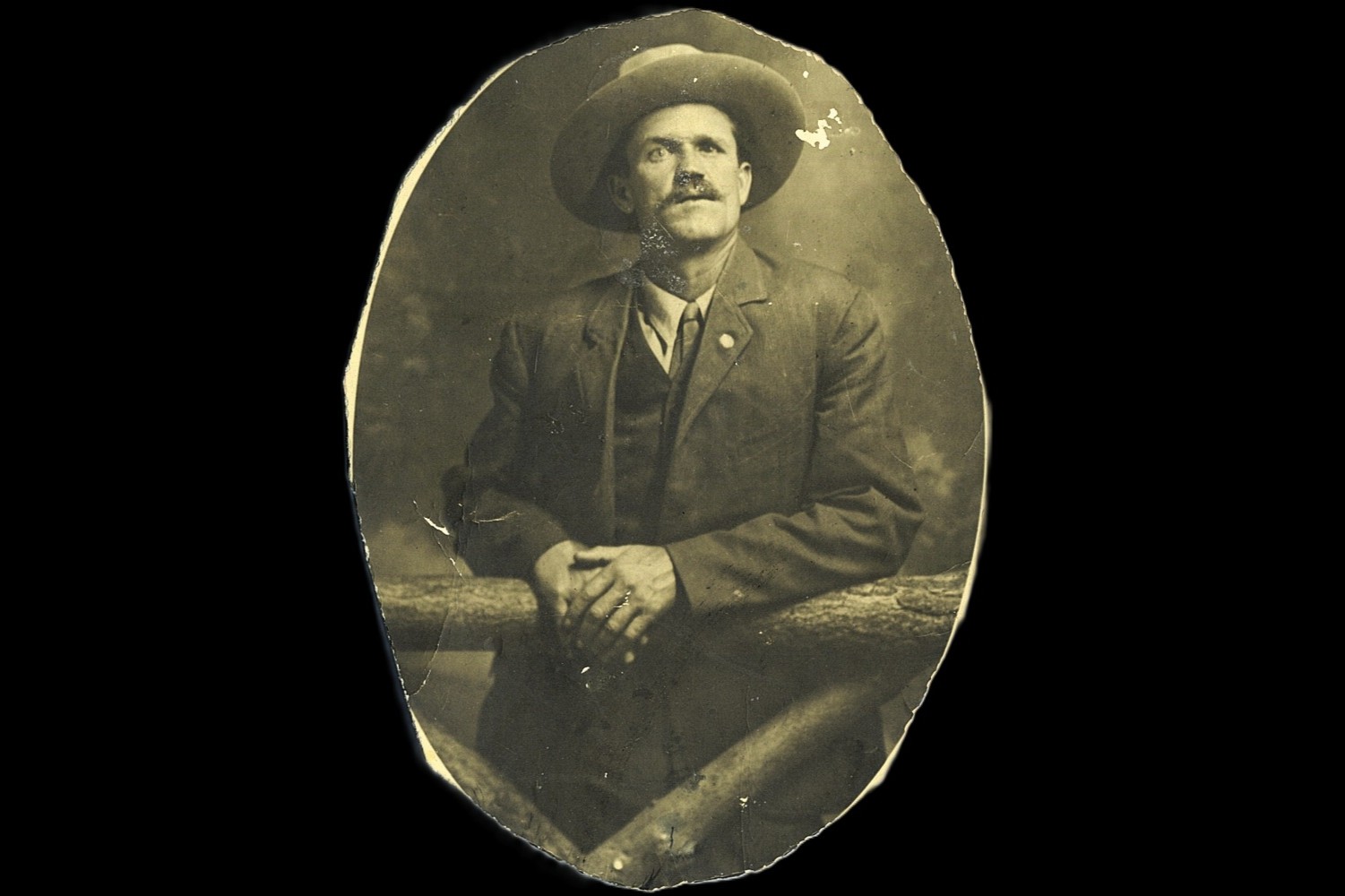
Frank Little was driven, a warrior to the end. Organizing for the Metal Mine Workers Industrial Union, Below are some of his last pieces published while alive as Solidarity prints several items on the copper strike in Bisbee. One is the text of the telegram sent to the Arizona governor protesting the mass deportation on July 12, 1917. After that event he took a train for Butte to help the miners there in the aftermath of the Speculator Mine disaster. He would be lynched less than two weeks later.
‘One Big Union the Need of All Mine Workers’ by Frank Little from Solidarity. Vol. 8 No. 393. July 21, 1917.
One Big Union the Need of All Mine Workers
Metal Mine Workers’ Industrial Union No. 800 of the I.W.W. is making great strides in the West. The old-time fighting miners, who have made the hard fights in the W.F. of M. before that organization became a boss-controlled union, are now building up the new fighting union.
The miners have met down in the hot stopes, crosscuts and raises, drifts and shafts. The men who crank the Burley machine, the swivel tail and jack hammer, the muckstick artist and car-runner–in fact, all the workers in the mines, mills and smelters, have decided that they must organize a union that the membership can and will control, an organization whose purpose is to assist them in their battles against the bosses.
The demand of Industrial Union No. 800 are for the present: A six-hour day, six-day week, with a minimum wage of $6 per day, abolition of the rustling card and physical examination, abolition of the sliding scale of wages, abolition of the contract and bonus systems. Besides these things the I.W.W. demands two men to work on all machines and two men to work on all raises. These demands are only á starter.”
The W.F. of M. have always sought to justify their demands for the eight hour day by pointing to the fact that a miner can do more and better work in eight hours than they could before in ten hours; in other words, that union men were willing to work eight hours per day at a ten-hour pace. As a consequence, miners and muckers were forced to live up to this rule. Today they are doing more work by far in eight hours than they ever did in ten.
Now the I.W.W. wants the six-hour day for all mine workers because we want to do LESS WORK for the bosses instead of more. We want more time to study, to agitate, to strengthen our organization in order to be able to demand and enforce the four-hour day. The miners are organizing in order to have the power to gain, with the general strike of the metal mining industry if necessary uniform hours, wages and working conditions for the workers in this industry everywhere. All miners into one big industrial union so that when we go on strike in one place to enforce these demands, we can close down all the mines of the big mining companies in order to make them come across.
An injury to one is an injury to all! So all together, you diggers and muckers, boost for the organization that is going to get you the things that will make life really worth living. Force the bosses off your backs, put them to work down in the hole with the producers; hand them their muck sticks and make them earn their living for a change.
If you haven’t got a card in the M.M.W.I.U. No. 800 get one NOW. Take out credentials and become a job organizer. The initiation fee is $2, and dues 50c per month.
What the Metal Miners Are Striking For and Why They Need YOUR Support
The Metal Miners of Montana and Arizona are on strike against the Iron Heel rule of the Mine Owners. As can be seen by even a casual examination the demands of the strikers are just:
1. The six hour day.
2. The abolition of the sliding scale and the establishment of a minimum scale of $6.00 for all men working underground and of a scale of $5.50 for men working on the surface and in the mills and smelters.
3. The abolition of the rustling card and the physical examination.
4. Two men to work on all machines.
5. Two men to work on all raises.
6. Examination of all mines semi-monthly.
7. All men to be paid semi-monthly.
8. Abolition of the use of carbide lamps.
Now for an examination of the reasonableness of these demands:
1. The six hour day is considered long enough for any man to work down in the hot stopes of the metal mines. When a man works for a few years in these hot stopes or in the poisonous copper-water, his health is ruined, and like a piece of worn-out machinery he is thrown on the strap-heap of industry.
2. The sliding scale of wages is based upon the quotation of the metal market. But the boss holds the “slide,” and he always slides up or down to suit his own interests. But the miners now propose to have a say as to what price they shall sell their labor power for.
3. The rustling card and the physical examination are both systems of blacklisting miners. Besides this they give the mining companies a chance to evade the state laws against blacklisting for belonging to the union or holding ideas that are not liked by the companies.
4. Two men at each machine is a very conservative demand when we consider that twenty-five years ago miners worked two on each machine and did much less work than they do at present.
5. Two men to work on all raises. This demand is one designed to protect the life and limbs of the miners.
6. All mines to be examined semi-monthly by expert miners. The demand is made necessary in order to insure the safety of the men who produce the metal. Conditions that will minimize the possibilities of accidents and disasters can only be insured in this way.
7. By paying twice a month the miners have a better chance to “pay cash” and fight the high cost of living.
8. The carbide lamp has been adopted by the mining companies for the reason that it is cheaper than wax candles. The use of the carbide lamp has been a contributory cause of many mine disasters where hundreds of lives have been lost.
The parasites have been making millions and millions of dollars out of the copper that the miners have produced. Many of the rich stockholders in the Copper Trust are German citizens. The “Loyalty League” and other scab-herding associations are trying to force the miners to go back to work for inadequate wages and under intolerable conditions. Why not get after the mine owners and ask them to show their “patriotism” by meeting the miners’ demands.
The men on Strike need your assistance. The miners and their families must have sustenance to give them the strength to carry on the strike. This strike must be brought to a successful ending, and it can be done. The Copper Trust is in a groove and must give in soon. Help the miners hold out for victory.
These men who now need your help have always come to the assistance of all workers who have faced the master class on strike. They will do so in the future. But at present they need YOUR help. Now is your opportunity to show them that you and your fellow workers will stand back of them to the end. Don’t delay. Act at once.
Send all funds to Grover H. Perry, Secretary M.M.W.I.U. No. 800, 506 Boyd Park building, Salt Lake City, Utah.
FRANK LITTLE WIRES GOV. CAMPBELL.
The following telegram is reported to have been sent to the governor of Arizona by Organizer Little:
“Understand that the mine owners’ mob will take same action at Globe and Miami as was taken at Bisbee. The membership of the I.W.W. is getting tired of the lawlessness of the capitalist class and will no longer stand for such action. If you, as governor, cannot uphold the law we will take same into our own hands. Will you act, or must we?”
Governor Campbell, without referring to the outrage already commit ted at Bisbee, or without giving assurance that he could make future corporation thuggery Impossible, branded the wire as “disloyal” and “untimely.”
Can it be that the governor is willing to leave the union miners and their families at the mercy of Copper Trust mobs?
The most widely read of I.W.W. newspapers, Solidarity was published by the Industrial Workers of the World from 1909 until 1917. First produced in New Castle, Pennsylvania, and born during the McKees Rocks strike, Solidarity later moved to Cleveland, Ohio until 1917 then spent its last months in Chicago. With a circulation of around 12,000 and a readership many times that, Solidarity was instrumental in defining the Wobbly world-view at the height of their influence in the working class. It was edited over its life by A.M. Stirton, H.A. Goff, Ben H. Williams, Ralph Chaplin who also provided much of the paper’s color, and others. Like nearly all the left press it fell victim to federal repression in 1917.
PDF of full issue: https://www.marxists.org/history/usa/pubs/solidarity-iww/1917/v8-w393-jul-21-1917-solidarity.pdf
 Revolution's Newsstand