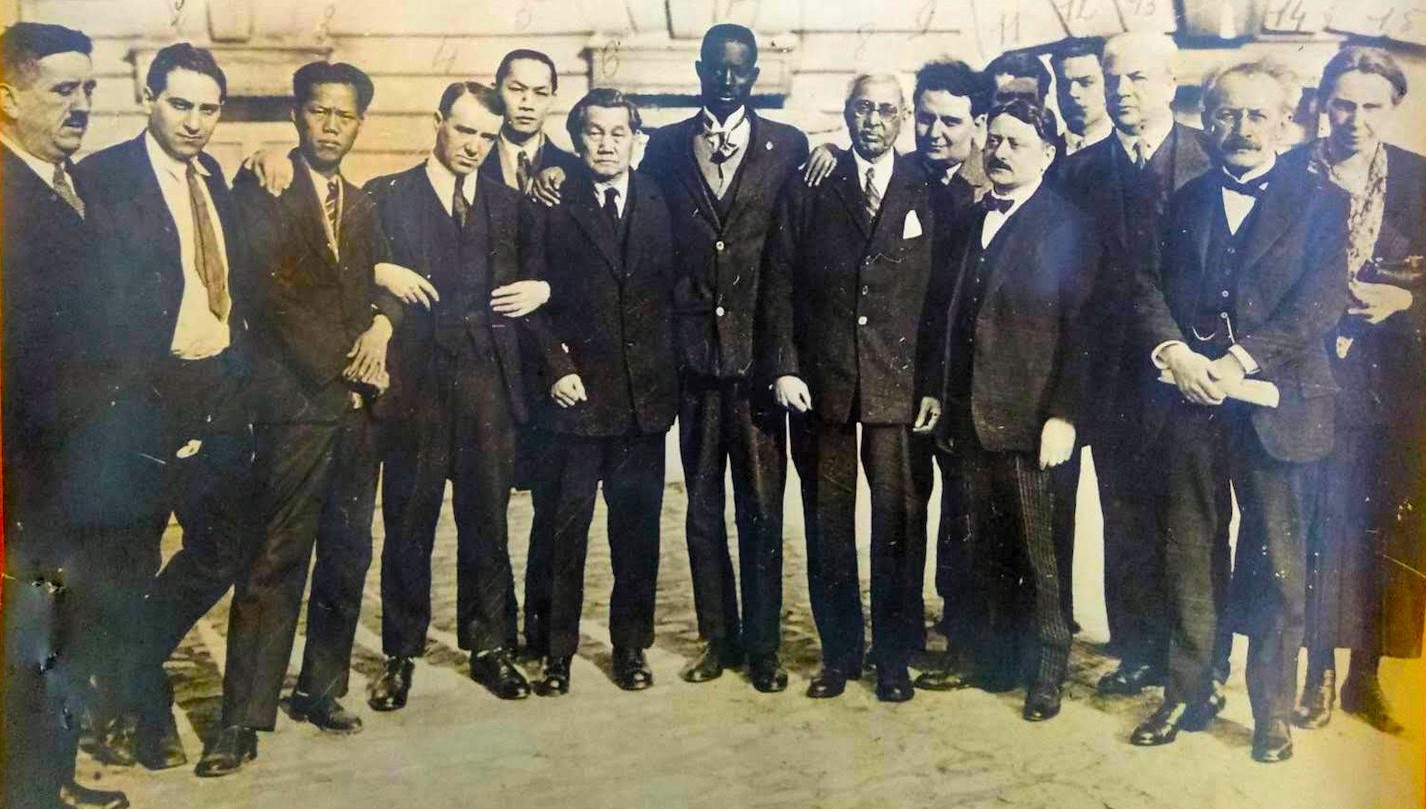
Writing short daily dispatches, Manuel Gomez, delegate from the All-American Anti-Imperialist League, with a week-long series from the founding conference of the League Against Imperialism held in Brussels in February, 1927. Called by the Communist International, the meeting gathered 175 delegates, the majority from the colonial world and its liberation movements, with representatives from the Kuomintang (soon to violently leave the alliance with the CCP), The Indian National Congress (including Nehru), the African National Congress (by its President, Josiah Tshangana Gumede), and Albert Einstein among others. While it would soon change character, as the national movements intensified and became much more internally class conflicted and the associated political line of the Third Period made the alliances of the first conference impossible. While the League never attained its aspirations and did not survive the Popular Front’s embrace of ‘democratic’ imperialism, its efforts, however, remain a milestone in the global anti-imperialist struggle. Charles Phillips took the name Manuel Gomez while living, and politically active, in Mexico as a draft-evading exile during World War One. He remained an important link between the U.S. Communist Party and the Spanish-speaking Americas through the 1920s, initiating the Pan-America Anti-Imperialist League in January, 1925 (changing the name shortly to “All-America”), a regional precursor to the the global League Against Imperialism, working closely with Cuba’s Julio Mella. Phillips was also a leader of the Foster-Cannon Faction and held a, valuable even today, years-long debate with Jay Lovestone on the political economy of U.S. imperialism.
‘The Brussels Congress Against Colonial Oppression and Imperialism’ by Manuel Gomez from The Daily Worker. Vol. 4 Nos. 48-54. March 10-16, 1927.
The article printed below is part of a series written by the delegate of the All-America Anti-Imperialist League to the Brussels Congress Against Colonial Oppression and Imperialism. The congress was made up of delegates from anti-imperialist organizations, peace societies and labor unions in the European, American arid other imperialist nations, from labor bodies and nationalist organizations in the colonial countries, and from subjugated races even in countries with full sovereignty. Important resolutions were passed, for the practical carrying on of the work of freeing conquered peoples from their slavery. A survey of the work of the congress and the personalities attending, which have made it one of the great events of this era, will be found in these articles.
I. Delegates from Subject Nations and Brussels Planned Freedom
BRUSSELS, Feb. 11. The long-hoped-for and long-dreaded coming together of oppressed peoples with workers of the oppressing nations has become a world-wide reality.
Upwards of 180 delegates—white, yellow, black and brown—from no less than 40 different countries, make up the first world congress against imperialism, which opened its sessions here last night in the Egmont Palace. The overwhelming majority of the delegates come from colonial and semi-colonial countries. Some have left the field of battle to be present here.
Invited Crowds.
Although admission was strictly by invitation, the great hall of the palace as crowded with spectators as S.O. Davies, of the executive committee of the Miners’ Federation of Great Britain, rose to call the congress to order. In the seats reserved for delegates the yellow race was especially in evidence, the impressive Chinese delegation of 30 being flanked on either side by the delegation from Korea and from French Indo-China. Behind them were the delegates from the Dutch Indies, Persia, the Riff, Holland, Germany and France. Across the aisle were the representatives from India, Egypt, Senegal, South Africa, Latin America, Great Britain, France and the United States.
Barbusse Greets Fighters.
After a brief welcome by Dr. Marteax of the Belgium Chamber of Deputies, Henry Barburse took the revolutionary floor amid a tremendous outburst of applause.
“In extending a fraternal salute,” began the famous French author, “to all those who have come here from the far corners of the earth, representing uncounted multitudes of human beings, I say to you: you are not men who come here only to fraternize with each other, to clasp hands; you are also fighters who come to organize for struggle. You are going to carry forward in the world the old cry of freedom, the cry of emancipation of all races, peoples and classes of the oppressed.”
Fight Imperialism.
Barbusse, who left his sick-bed to attend this congress, was applauded tumultuously throughout his long speech. He dwelt with particular emphasis upon the heroic struggle of the Chinese people against imperialism. The Chinese situation, indeed, sets the keynote for the entire congress. Telegrams of greeting were read from Mrs. Sun Yat Sen, from the central committee of the Kuo Min Tang party and from the Chinese revolutionary armies. Liao, the delegate of the Kuo Min Tang, then rose to speak.
Till Victory Comes.
Liao affirmed the determination of the Chinese people to fight until complete victory is won.
“The overthrow of imperialism,” he declared, “is a task to which all oppressed groups must set themselves. The significance of this congress is that it brings us together, enables us to pave the way for fruitful collaboration against our common enemy. I am especially glad to see represented here organizations of workers in the imperialist countries. If the workers are content to serve the aims of imperialism they will unconsciously, play into the hands of their own oppressors, for it is not the workers who rule in the imperialist countries but the enemies of the workers.
Protest Helps Chinese.
“I want to thank the European working class,” he went on, “for their magnificent campaigns of protest behalf of the Chinese people. I thank especially the workers of England and of Australia, and also the nationalist movement of India for its stand against the use of Indian troops in China. Lastly, I want to pay homage to the workers’ and peasants’ government of Soviet Russia, which has shown itself the true friend of oppressed peoples throughout the world.”
Oppressed Asia Speaks.
Other speakers included Jawahar Lal Nehru, representing the Indian National Congress; Sen Katayama, the famous Japanese revolutionist; Kin Fa Lin, of Korea; Carlos Quijano, representing the Revolutionary Nationalist Party of Venezuela, South America; and A. Fenner Brockway, secretary of the Independent Labor Party of Great Britain.
Brockway Promises New Policy.
Brockway, who spoke last, expressed discontent with the colonial policy of Great Britain during the MacDonald government and declared that large numbers of his party’s members are determined that when labor next comes to power in Britain it will follow a different policy. “I am particularly ashamed,” he said, “of the Bengal ordinances.” He stated explicitly that his party, which he is representing officially at this congress, is opposed to the British war maneuvers against China and is in favor of immediate recognition of the Cantonese government. In conclusion he pledged his party to insistence upon the immediate recall of British military forces from Shanghai, militant and unyielding opposition to any attempt at war and consistent support of the Chinese struggle for freedom. “If war breaks out,” he said, “we shall be on the side of China, and against England.” He shook hands with the Kuo Min Tang representative, Liao, greeting the entire congress in the name of the I.L.P.
It is expected that the congress will last four or five days. The agenda is as follows:
Agenda.
1. Opening addresses.
2. Imperialism and its consequences in the colonial and semi-colonial countries.
3. Imperialism and the danger of wars.
4. Co-operation between the national liberation movements in oppressed countries and the labor and the labor and anti-imperialist movements in the imperialist countries.
5. Co-ordination of the national emancipation movements with the labor movements of all countries, colonial as well as imperialist.
6. Establishment of a permanent world-wide organization linking up all forces against imperialism and colonial oppression.
Committees have been named to deal, respectively, with the problems of struggle against British, French, American and Japanese imperialism. Each of these committees includes representatives from the imperialist countries as well as from the colonies and semi-colonies.
The presiding committee of the congress, as finally selected, is made up as follows:
Honorary chairmen: George Lansbury, M.P.; Professor Albert Einstein, Romain Rolland and Mrs. Sun Yat Sen.
Chairman: Edo Fimmen, secretary of the International Federation of Transport Workers.
Committeemen: China–Liao, Kuo Min Tang; Chen Kuen, All-China Federation of Trade Unions. Mexico–Julio A. Mella, representing the National Peasants’ League; Ismael Martinez, Tampico central labor body. Porto Rico–Jose Vasconcelos (former Minister of Education in Mexico, who has credentials from the Nationalist Party of Porto Rico). Japan–Sen Katayama. Egypt–Mohammed Hafiz Ramadan Bey. South Africa–Daniel Colraine, vice-president of the South African Trade Union Congress. Dutch East Indies–Mohammed Hatta and Semaoen, of Srakat Rayat. India–J.I. Nehru. North Africa–Messali, of Algeria. Persia–Achmed Assadoff, of the Persian Revolutionary Republican Party. Korea–Kin Fa Ling. France–Madame Duchene, Women’s League for Peace and, Freedom; Albert Fournier. Senegal Lamine Senghor, Great Britain–S.O. Davies; A.F. Brockway; Harry Pollitt, of the Minority Movement; R. Bridgeman. United States– Roger Baldwin, representing the Urban League and the American Civil Liberties Union; Manuel Gomez, All-America Anti-Imperialist League, Germany–Prof. Theodor Lessing; Prof. Alfons Goldschmidt; George Ledebour; Willi Munzenberg; Dr. Helene Stocker. Italy–Verri; Miglioli. Holland Henrietta Roland-Holst. Czechoslovakia–Prof. Nejedly. Belgium–Georges Gerard; Dr. Marteax; P.H. Spaak.
II. Ledbdour at Brussels Congress Describes Fight on Colonialism
BRUSSELS, Feb. 12 (By mail, delayed)— Brilliant speeches by George Ledebour, one of the famous “old men” of the German socialist movement, and Harry Pollitt, leader of the minority movement in the British trade unions, featured the second day of the world congress against imperialism. The Senegalese Negro, Lamine Senghor, representative of the committee for the defense of the black race, also contributed valuable information in a colorful, graphic picture of crimes of French imperialism Central Africa.
Reporting on Imperialism and its Consequences for the Colonial and Peoples, Ledebour answered certain charges that the congress was Communist. He declared that he had fought against imperialism in Germany when it was at its height, before and during the war.
Lebedour Tells of Stuttgart Conference.
“Twenty years ago at Stuttgart,” he said, “we discussed much the same things as we are discussing now. There were two opinions represented among the leaders of the Second International assembled there. One was that we could elaborate a socialist imperial policy. Then there were also revolutionists who put forward much the same ideas as we have here. The Revisionists, who held the imperial view, were led by a well-known Dutch leader. I reported for the opposition. After a bitter struggle we succeeded in convincing the majority (127 to 108) that socialism and colonial policy have nothing more to do with each other than fire and water. Afterwards all national sections except the Dutch voted for us.
MacDonald’s Imperialist Debut.
“One on the English side who voted against our amendment was J. Ramsay MacDonald. But he lifted his hand later in favor of the general resolution against colonial policy. I feel like asking now: Ramsay MacDonald, have you forgotten your vote of 1907? MacDonald had a splendid chance to apply the socialist position but he completely failed.
“At Stuttgart only one delegate from the Far East was present. He was Katayama, from Japan, an imperialist country. Katayama has fought Japanese imperialism consistently from that day to this, and l say to you that as a man of character, as a socialist, as a fighter, he is far superior to MacDonald.
Oppressed Nations’ Delegates in Majority.
“Here at Brussels the delegates from the oppressed nations are in the majority. This represents a tremendous advance. Only by the closest co-operation of all elements can our ends be attained. We are for independence of all countries, including independence from mandates, old and new. (This last refers to Germany’s bid for a League of Nations mandate). But it is not enough to pass resolutions. We must act.
“I was glad to have heard Brockway’s words yesterday. I hope they express the present attitude of the Independent Labor party, and I hope also that the entire British Labor party can be won for it.
Transport Workers in Struggle
“I am glad we have in our midst, Edo Fimmeo, the most important figure of the International Federation of Transport Workers—for the transport workers are a vital point in the struggle against imperialism. We must popularize the idea of strikes against imperialist aggressions. We must prepare to go forward with them. The resolution which I shall present to you later asks the congress to approve of the general strike against imperialism.
“In England great strides have been made in the workers’ actions against imperialism. The American workers cannot be expected to do very much at the present stage. Europe offers better possibilities. Here we have a long tradition of working class political education under the Second International, whose secretary, Friedrich Adler, unfortunately attacks this congress as ‘Communist.’ I can only answer that I am sorry to see you, Friedrich Adler, in your present company.
Will Fight Alongside Communists.
“Now you know that I am not n Communist,—but I say that I shall fight side by side with the Communists whenever and wherever they take up revolutionary work. We can all be prepared to have labels put upon us. It does not matter. No one can afford to ignore the powerful groups represented here. No one, least of all the imperialists, can afford to dismiss this congress as of little importance for the liberation of down-trodden humanity. The basis of the congress is broad enough, its roots are deep enough, and its striking power impressive enough for us to go about our serious business confident of what we are doing.” Hafiz Kammadan Bey, member of the Egyptian Parliament and president of the Egyptian Nationalist party, who followed Ledebour, said that he believed more in evolution than in revolution, but that some joint action is nevertheless necessary. He pointed out that although Egypt is nominally an independent country the British army of occupation is still there. He put forward the idea of the internationalization of the Suez canal, a measure, which, he said, would cripple the British empire in its Indian policy.
Scores French Imperialism.
Senghor declared that we make war with phrases. “French imperialism,” he said, “as we know it in Africa, recognizes no arguments but might. I am sure that before we leave this congress we shall work out a concrete program of operations.” Pollitt told the congress that “all that we have heard here of oppression in the colonies is also true of the British working class.” He told of the unemployment and other fruits of capitalist-imperialism in Britain. “Imperialism today,” he went on, “has its basis in capitalism., The British workers are beginning to realize this more and more.
Must Fight British Imperialism.
“We cannot, however, be satisfied with declarations that when labor is again in power it will treat India differently than in the past. We must come out four-square for the right of India—and any other British colony—to separate from the empire at will, and we must help ail struggles in the colonies to that purpose. We cannot be satisfied with Hyde Park demonstrations against the sending of British troops to China, excellent enough as those demonstrations are. We must take steps to prevent the sending of troops. We may not succeed. But our fight will have important consequences.”
Pollitt, whose speech was frequently interrupted by applause, then presented a concrete program of work for Great Britain. It is embodied in a resolution which, it is understood, will be presented to the congress jointly by the British, Chinese and Indian delegations.

III. Kuomintang General Promises the Brussels Congress His Loyalty—The Red Front Fighters.
FRANKFORT, Germany. Delegates to the world congress against imperialism who were invited to address meetings in Germany following the close of the sessions at Brussels, are impressed by the uniformed, well-drilled proletarian battalions which stand guard at revolutionary working class gatherings throughout the country. These are the Red Front Fighters (“Rote Front Kaempfer”), 100,000 strong, formed to protect the labor movement from fascism and other forms of reaction on the heels of the setbacks of October, 1923.
Made up principally of non-party workers, left wing Social Democrats and Communists, the Red Front Fighters have earned the respect of all class-conscious workers. They are organized upon military lines, although they are of course without weapons. Their discipline and pride of organization are the envy of the fast-waning reactionary detachments. It is admitted on all sides that the Red Front Fighters may be destined to play an important role in the future struggles of the German working class.
Welcome Delegations.
A demonstration led by Red Front Fighters met Chung Ling Fu, of the general staff of the Cantonese army; B. Gumede, of the South African National Negro Congress, and myself upon our arrival at Frankfort. The huge crowds at our meetings here, and in Hannau, Berlin and Dresden, are indicative of the tremendous interest which the Brussels congress has awakened. The European press, with the exception of the English press (which apparently has its own reasons), devotes considerable space to the affairs of the congress even today, nearly two weeks after the sessions are closed.
Altogether I have addressed seven meetings in Germany–together with Gumede, Chung and others, including General Lin, second in command under Feng Yu Hsiang in north China; El Bakri, outstanding chief of the fighting nationalists in Syria; Matta, of the Riffian nationalists, and Daniel Colraine, vice president of the Trade Union Congress of South Africa. Other delegates have taken part in meetings at Hamburg, Cologne and other cities of northeastern Germany.
Real Warriors There.
BRUSSELS, Feb. 13. That the Brussels congress is no mere gathering of talkers was dramatically expressed yesterday with the arrival of two revolutionary nationalist leaders who have been facing the armies of imperialism on the field of battle.
These are General Lu Chung Lin, who commanded the Kuomintang forces of the north during Feng Yu Hsiang’s absence in Russia, and Mazhar Rey El-Bakri of Syira, foremost chief of the Syrian National Assembly. Both will return to the battle-front at the conclusion of the congress.
Remarkable Soldier.
General Lu, greeted with tumultuous applause, immediately took the floor. He talked in slow, measured tones for about fifteen minutes. He spoke without oratory and almost without gestures, but his speech was the most remarkable address that Europe has ever heard from the lips of a soldier.
“Comrades,” he began, “while you are gathered here a war is going on in China which involves the whole future of the human race. Peace is a great thing. I hate war. I am fighting to make it impossible. But it is childish to assume that there can be any peace under imperialism. I am a soldier and must remain one. I shall remain faithful to my conception of the tasks of a soldier, which is to fight against imperialist oppression, to combat militarism and to defend at all times and against all enemies, the interests of the workers and poor peasants.
“Military leaders have been the sustaining force of reaction. But I pledge my word here that, although a soldier, I shall never sell myself to the enemy of the workers and peasants, nor lend myself to the schemes of the imperialists. You are my leaders, you here in this congress. I endorse, without qualification, all the actions you have taken. I shall try to carry out your decisions in the future.”
After tracing the progress of the Chinese revolution, addressing special words of greeting to the working class representatives from the imperialist countries, to the other nationalist movements, and to the Union of Socialist Soviet Republics, he concluded with the words: “Long live the world revolution!”
Yesterday’s arrivals included W.J. Brown, secretary of the (Amsterdam) International Federation of Trade Unions, who addressed the congress in his own name, urging the union of the forces of labor against imperialism and capitalism. The British delegation was enlarged by the addition of Ellen Wilkinson, M.P., John Beckett, M.P., Helen Crawford of the International Workers’ Relief, and John Williams of the Young Communist League. George Lansbury, vice-president of the British Labor party, will be here tomorrow.
Edo Fimmen led the discussion on the fourth point of the agenda. Fimmen, besides being the leader of the International Federation of Transport Workers, has a credential from the Mexican Federation of Labor (C.R.O.M.). He called attention to the fact, revealed in the special trade union committee of the congress, that seventeen trade union organizations with 7,962,000 members of all races are officially represented and participating here.
These include such organizations a the Unitarian General Confederation of Labor of France (C.G.T.U.), the Minority Movement of Great Britain, the South African Trade Union Congress, the All-China Federation of Trade Unions and the C.R.O.M. of Mexico.
Fimmen was followed by Herclet, of the C.G.T.U.: Daniel Colraine, vice-president of the South African Trade Union Congress; Chen Kuen, of the Chinese Canton-Hongkong trike committee; Mohammed Hatta, of the Dutch East Indie, and Manuel Gomez, secretary of the All-America Anti-Imperialist League (United States Section).
IV. Latin Americans at the Brussels Conference form United Front.
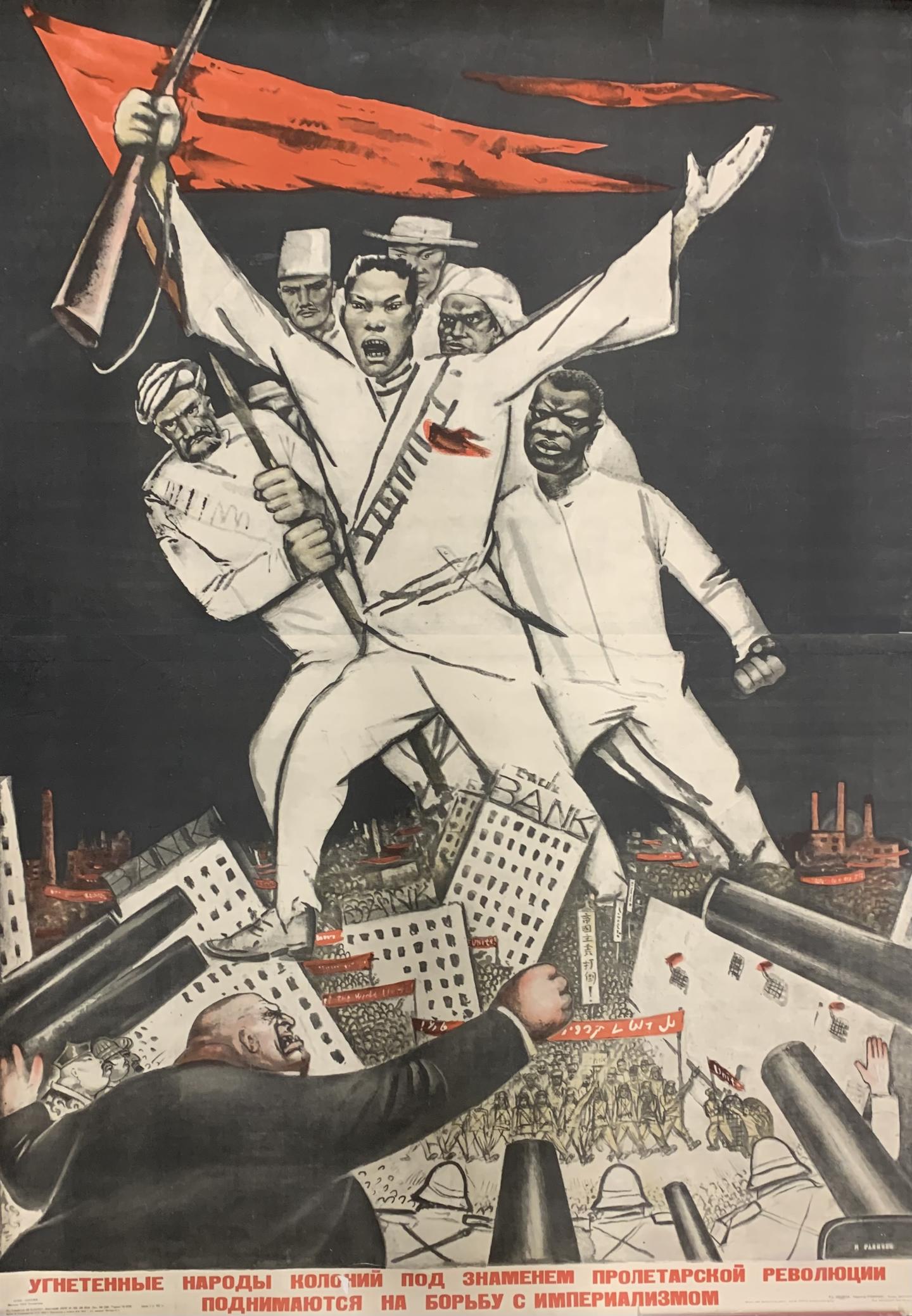
BRUSSELS, Feb. 14. Next to China and the British empire, the “American empire” is represented here by most delegations. No less than 32 organizations have sent delegates to the Brussels congress for the primary purpose of considering methods of common defense against the imperialistic aggressions of Wall Street and the U.S. department of state.
Latins Right There.
Marked attention is paid to the numerous delegations from Latin American countries–from the so-called “Monroe Doctrine zone” of American imperialism. These include the following organizations:
MEXICO–Mexican Confederation of Labor (CROM); National Peasants’ League; Associated Trade Unions of Tampico (the oil territory); Mexican Students’ Federation, and All America Anti-Imperialist League (Mexican section).
CUBA–Havana Federation of Labor; Students’ Federation; People’s University, and All-America Anti-Imperialist League (Cuban section).
HAITI–Union Patriotique.
PORTO RICO–Nationalist Party of Porto Rico.
CENTRAL AMERICA–All-America Anti-Imperialist League (Nicaraguan, Salvadorean and Panaman sub-sections).
VENEZUELA–Revolutionary Nationalist Party; Venezuelan Labor Union; All-America Anti-Imperialist League (Venezuelan section).
COLOMBIA–Revolutionary Socialist Party.
PERU–Unionist Party; Students’ Federation.
ARGENTINA—Labor Defense League; All-America Anti-Imperialist League (Argentine section). Ugarte Promises Support.
Manuel Ugarte, famous Argentine novelist and advocate of Latin-American unity against Wall Street, was prevented by illness from attending the congress, but a letter was received from him expressing hearty support.
The Pan-American Federation of Labor, the entire machinery of which is in the hands of the A. F. of L., was conspicuous by its absence. In view of this, special significance is attached to the presence of the CROM of Mexico, which has close to a million members and is the only important Latin American labor federation.
Latin-American Front.
The various Latin-American delegations have been holding joint meetings almost daily during the congress recesses. Joint meetings are also held with the delegates from the United States: Roger Baldwin, representing the American Civil Liberties, Union and the National Urban League; Richard Moore, with credentials from the Universal Negro Improvement Association (New York wing) and the American Negro Labo Congress, and Manuel Gomez, representing the All-America Anti-Imperialist League (U.S. section).
V. Delegates Meeting at Brussels Sign Sharp Criticism of U.S.
Find That Wall St. Conduct Campaign Over Two Continents for Predatory Domination
BRUSSELS, Feb. 14. Unanimous declaration regarding the tasks of American workers in the face of the U.S. imperialist policy has been made to the congress in the following joint document, signed by all members of the United States, Latin-American and Chinese delegations:
“We, the undersigned members of the U.S., Latin-American and Chinese delegations, declare it to be the task of all labor, farmer and other progressive forces in the United States:
“1. To fight side by side with the nationalists and national liberation movements of the countries under the heel of U.S. imperialist domination, for:
a. Immediate, complete and absolute independence for the Philippine Islands and Porto Rico; self-determination for all colonies and semi-colonies;
b. Abrogation of the unequal treaties making virtual protectorates of Panama, Cuba and the other countries of the Caribbean area:
c. Withdrawal of U.S. military and naval forces from Caribbean, Central and South American territory, and from China; yielding up of all extra-territorial and other I special privileges.
“(2) Opposition to all attempts to use coercive force against the Latin-American nations.
“(3) Exposure of the systematically imperialistic character of U.S. foreign policy, beneath democratic-pacifist pretenses.
“(4) Giving wide publicity to the outrages accompanying U.S. imperialism in Haiti, Santo Domingo and elsewhere.
“(5) Carrying on propaganda against imperialism not only among the civilian population of the United States but also among the military and naval forces called upon to do the bidding of imperialism.
“(6) To insist upon and support strike action against the sending of troops or munitions for repressive use in Latin-America and the Far East.
“(7) To support the tendency toward Latin-American unity against U.S. imperialism; to support an intimate relationship between the nationalist movement in the Philippine Islands and the Chinese nationalist revolutionary forces.
“In the face of the present U.S. aggressions against Mexico and Nicaragua, demands must be raised for:
“(1) With regard to Nicaragua: a. Immediate withdrawal of U.S. military and naval forces; b. Recognition of the popularly supported Sacasa government; c. Cancellation of the right-of-way privileges wrung from Nicaragua during a period of military occupation, for a U.S. owned canal across Nicaraguan territory; cancellation of the similarly secured leases of naval bases.
“(2) With regard to Mexico: a. Hands off Mexico; support of the national-revolutionary conquests of the Constitution of 1917; opposition to U.S. diplomatic and economic offensives undertaken in the interests of U.S. oil, mining and financial magnates against the efforts of the Mexican people to protect their resources from foreign monopolization; b. Affirmation of Mexico’s right and necessity to draw about her other countries of Latin-America against U.S. imperialism.
“We call upon the American Federation of Labor, with which the labor movements of Nicaragua and Mexico are associated, to initiate a movement looking toward concrete strike action by U.S. workers in the event that the military forces in Nicaragua are not withdrawn.”

VI. Anti-Imperialist Delegates Form Permanent Organization.
Brussels, Feb. 15. With the delegates of all nations and races singing, stamping and clasping hands, the first world congress against imperialism came to an end at 1:30 this morning. The congress leaves behind it a permanent organization embracing groups in 40 different countries, which will immediately proceed to take up the practical work of carrying out the decisions of the congress for the coordination and active prosecution of the joint struggle against world imperialism.
Historical Fact.
What direct consequences this congress will have for the liberation of oppressed people–how great a force has been created here at Brussels–it is too early to say, but that, as Edo Fimmen remarked before laying down his gavel, “this congress already belongs to history, cannot be doubted.” The “League Against Imperialism and Colonial Rule, and for National Independence,” which is the official name of the new organization, has on its general council representatives of the most important national-revolutionary organizations throughout the globe.
Has Active Committee.
Its active directing committee consists of J.L. Nehru (Indian National Congress); Liao (Kuomintang party of China); Mohammed Hatta (Saraket Rayat, Dutch East Indies); Lamine Senghor (Committee for the Defense of the Black Race, Central Africa); Manuel Ugarte (Argentine Republic); George Lansbury (Independent Labor Party of Great Britain); Edo Fimmen (International Federation of Transport Workers); H. Marteaux (Belgium), and Willi Munzenberger (Germany). Lansbury will be chairman, and Fimmen vice chairman. The headquarters of the league will be in Paris.
Alternates for the small directing committee are: Henri Barbusse (France); Roger Baldwin (United States); Robert Bridgeman (England) and H. Gibarti (Hungary).
High spots in the last days’ sessions were Munzenberg’s detailed report on organization and Lansbury’s speech against Great Britain’s present war moves in China. Other speakers at the closing session included Moore and Baldwin of the United States, and Ernst Toller, the well-known German poet and playwright.
For American Negro.
Moore pointed out that the Negroes in the United States represent a people, more than one-tenth of the total population, living in conditions of group-subjection comparable to those of many colonies and semi-colonies. He declares that, as a Negro, he was bound to consider that the fate of the Negro race was to a considerable extent bound up with the world struggle for the emancipation of all nations, races and classes.
Baldwin spoke very briefly, giving many little-known facts regarding U.S. imperialist rule in Samoa Guam and the Virgin Islands. He seconded the resolution introduced by the Latin-American delegation calling for uninterrupted struggle against American imperialism.
No less than 160 messages of greeting were received during the course of the congress. It was impossible to read more than three or four of them.
The Daily Worker began in 1924 and was published in New York City by the Communist Party US and its predecessor organizations. Among the most long-lasting and important left publications in US history, it had a circulation of 35,000 at its peak. The Daily Worker came from The Ohio Socialist, published by the Left Wing-dominated Socialist Party of Ohio in Cleveland from 1917 to November 1919, when it became became The Toiler, paper of the Communist Labor Party. In December 1921 the above-ground Workers Party of America merged the Toiler with the paper Workers Council to found The Worker, which became The Daily Worker beginning January 13, 1924.
 Revolution's Newsstand