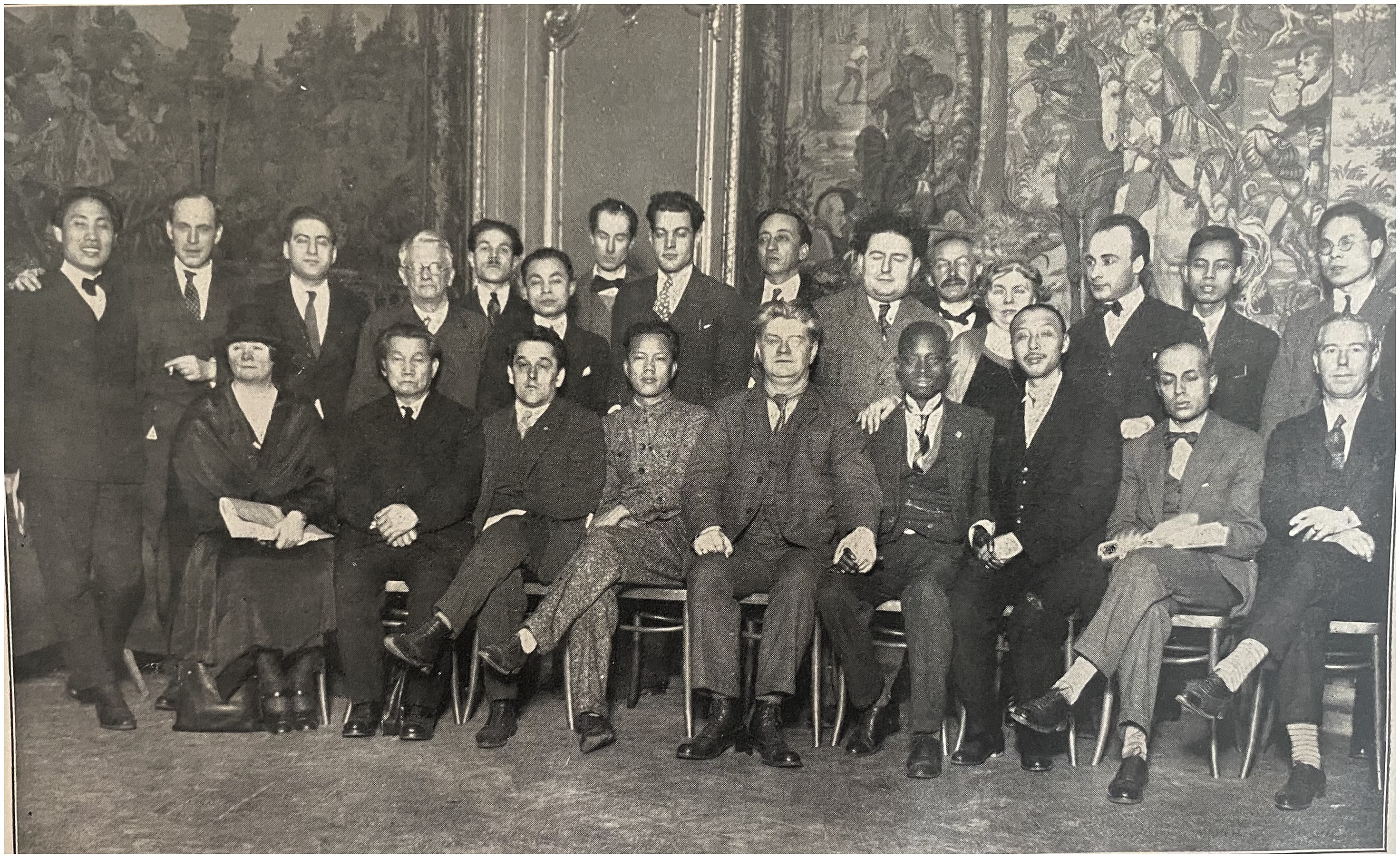
The speech of Manuel Gomez, delegate from the All-American Anti-Imperialist League and senior U.S. Communist at the first Congress of Oppressed Colonial Peoples and Anti-Imperialists held in Brussels in February, 1927.
‘The American Empire’ by Manuel Gomez from The Daily Worker. Vol. 4 Nos. 49-53. March 18-22, 1927.
Manuel Gomez represented the United States Section of the All-America Anti-Imperialist League at the Brussels Congress of Oppressed Colonial Peoples and Anti-Imperialists. His speech is an analysis of the present financial imperialism of Wall. Street and shows its roots in the exploitation of American and foreign workers.
Comrades of all nations and races:
Coming from the land of the dollar, and of dollar diplomacy, I present to you the American dollar empire as the common problem of all of us, because it is an empire which takes tribute from the whole world.
This newest imperialism of the United States speaks its own peculiar language, the language of democratic-pacifism, if you please. It is “the friend of China.” In contradiction to the British, Japanese and other vulgar imperialists, its policy in China is the “Open Door,” “equal opportunity for all.”
But my Chinese friends, I want you to bear in mind that our Uncle Sam, who can talk so eloquently on behalf of the “Open Door in China,” insists upon a closed door–closed, looked and bolted–in Latin America, whose territory the Monroe Doctrine treats as a special preserve of U.S. finance-capital. The democratic-pacifist method represents only one phase of American imperialist policy. It is inevitably succeeded by the phase of open, brutal aggression, such as the entire Caribbean and Central American populations of the Western Hemisphere are already familiar with.
Modern imperialism has been described here as imperialist capitalism–the present, final stage of that capitalism which now exploits whole populations abroad as well as millions of workers at home. Nowhere is this more obvious than in the United States. Some of you are familiar with the accompanying progressive development of expansionist foreign policy. Concentration and centralization of industry led to monopoly, which means that all the economic–and therefore political–power of the nation was concentrated in the hands of a small group of plutocrats centered in Wall Street.
In 1901 the United States Steel Corporation came into existence, bringing together the most powerful financial groups, such as the hitherto warring Rockefeller and Morgan interests.
***
At the same time that these developments were taking place the United States made its appearance upon the world imperialist stage. The Spanish-American War, entered into with the characteristic innocent declarations of libertarian purposes, was the initial move in a foreign policy which continues its consistent march to this day. Conquest of Cuba, Porto Rico served as the stepping stones from which American imperialism proceeded to Panama, Haiti and Santo Domingo, Central America–until the whole Caribbean area becomes “an American lake.” In the Far East, Guam and the Philippine Islands are the spearhead of U.S. imperialist policy with regard to Asia.
Developments during and since the World War brought the United States into the very front rank of imperialist powers. Industrial capacity was tremendously increased. Wall Street succeeded the City of London as the dominant center of world finance. The United States passed from a debtor to a creditor nation, with huge interests in Europe as well as in Latin America and Asia. Before the war the total foreign investments of American capitalism did not reach $2,500,000,000.
Now the amount exceeds $13,000,000,000.
To the lines of imperialist policy represented by the Monroe Doctrine and the “Open Door,” was added that of the Dawes Plan. Reaching full consciousness at last, American imperialism became everywhere aggressive. From the four corners of the earth, the super-profits of imperialism began to pour into the United States.
On the basis of the American dollar empire–which, as all Latin Americans know, is cemented not merely by dollars but also by the flesh and blood of human beings slain and tortured the so-called American standard of living is maintained in the United States.
Even the American working class shares to a certain extent in the profits of imperialism, and as a result is permeated with social-patriotic and imperialist ideology. I speak particularly of the skilled workers and, in general, of the dominant elements making up a large body of the membership of the American Federation of Labor. Recent economic developments in the United States furnishes no more striking phenomenon than the rapid growth of “business unionism” and what, for want of a better term, we call class collaboration.
Without going into detail regarding the rapidly multiplying forms of “class collaboration,” I need merely cite labor banking, labor insurance schemes, “company unionism” and the tendencies toward applying “company union” principles through the bona fide trade unions. Outstanding examples of the latter are the so-called “B. & O. Plan” and the machinery established under the recently adopted Watson-Parker Law.
So satisfactory have they been to American capitalism that some of these forms are being transplanted to Europe, as part of the program of “rationalization.” Thus we hear that Europe is, adopting “class collaboration” from America. We should not forget, however, those features which existed in Germany, for instance, long before the World War, and to which the name of “state socialism” was sometimes given.
“Class collaboration” is no new thing in Europe. It is as old as reformism!
It was not accidental that the reformist leaders of the Second International turned a deaf ear to the appeals of the colonial and semi-colonial peoples for national liberation. And it is not accidental either that the ruling bureaucracy of the American Federation of Labor is a “loyal supporter” of the U.S. State Department in foreign affairs. Criticism of imperialist policy is limited to inessentials, to isolated outrages, to “excesses.”
It is suggested that the state department has been inadvised here, that it has been subject to undue influence there. Such criticisms–which are similar to those sometimes indulged in by middle class “liberals” and pacifists–perform a real service to imperialism, because they make it seem that there is nothing fundamentally wrong.
Exploitation of Americans
To the shame of the American working class it must be confessed that the American Federation of Labor has neglected to take a clear-cut stand in the face of the brutal aggression of the United States government in Nicaragua; Nowhere does the A.F. of L. come out definitely for immediate, complete and absolute independence of the Philippine Islands and Porto Rico. It supports the Monroe Doctrine in Latin America, just as it furthers the discrimination against Negroes and other oppressed groups in the United States itself.
It is necessary for us to take note of these things and to understand the sinister economic relationship which underly them, if we are to proceed realistically in the struggle against American imperialism; and against imperialism in general. To that struggle, I take it, everyone present at this congress is irrevocably committed.
You may think I have painted a discouraging picture–a picture which shows American imperialism to be resting upon an unshakably secure base at home. But the truth is that, notwithstanding the claims of apologists for imperialism in labor’s ranks the term “class collaboration” must still be put in quotation marks. Properly speaking there is no such thing as class collaboration under capitalism. Privileged sections of the workers may have temporarily deserted to the enemy but the class struggle still goes on.
Every day we are confronted with the spectacle of company unions breaking down before a critical situation and institutions which were created for one purpose being converted into their very opposites. Only at great expense can the flames of discontent be kept down. We are seeing in Great Britain what happens when imperialism can no longer afford to share its loot in sufficient quantities.
Moreover, and this is something which our comrades do not sufficiently realize, there are great bodies of workers in the United States miners, steel workers, textile workers, the majority of the workers in machine industry, who are not in the privileged position of the American labor aristocracy. You hear that workers in certain sheltered trades receive as high as $75 and $80 a week but you do not know that the unskilled worker, even in the prosperous industries, does not earn more than $20 or $25 a week. In the textile mills of the South women receive from $8 to $15 a week, and the average wage for so-called male common labor is about 30 cents an hour, or $16.20 for a week of 54 hours. The figures I cite are from the summary of the report of industrial conditions in the United States which is soon to be published by the International Labor Office of the League of Nations.
Millions of workers in the United States do not participate in the “American standard of living.”
On the contrary they are exploited as unmercifully as workers in some colonial countries. The home structure of American imperialist capitalism is therefore torn across by a great contradiction. Not only have the workers referred to no interest in the imperialist ventures of Wall Street and Washington–fraught, incidentally, with the constant menace of wars–but they are themselves obliged to engage in desperate encounters with the ruling class. Examples are the various great struggles in the coal industry and the present long-drawn-out strike of the Passaic textile workers.
Even the masses of heavily exploited workers whom we have been considering are of course without real consciousness of their objectives. Most of them are unorganized, while the organized sections–notably the miners–are preyed upon by an officialdom which is rotten to the core. Nevertheless a militant left wing has sprung up and is spreading throughout the American Labor movement. The conscious left wing is still small but it is growing steadily and already it has a number of important successes to its credit.
***
We of the All-American Anti-Imperialist League, have received our chief support in the United States from the small left wing of the workers’ political and trade union movement. It has been a reliable support because it is based upon interests which are identical with those of the colonial and semi-colonial peoples oppressed by American imperialism. It does not limit itself to side-issues. It does not hesitate before consideration of loyalty to American capitalism. The nationalist and national-revolutionary movements in Latin America and the Far-East can reckon upon it and depend upon it, for it will not fail them.
We in the United States have no such achievements to record as those described by our comrade of the powerful Minority Movement of Great Britain. The degree of development of the American working class has not made that possible. But I want to remind you that it is not so long since the British workers were even more imperialistic than the privileged sections of the American working class are today. The crisis of British capitalism has revolutionized formerly imperialistic workers and has made them realize that their interests are with the oppressed nations of the British Empire. Attacked from the outside and from the inside, the whole structure of British imperialism is crumbling. Today millions of British workers extend their hands to the revolutionary Chinese nationalist movement and tell the Imperial War Office at London to go to hell.
Such is the historical line of development. It will be the same in the United States too. Once the oppressed peoples realize that modern imperialism is but a stage–the final stage–of capitalism, they will know that although their surest, most trustworthy allies in the United States today are limited to the relatively small left wing of the American Labor movement, they will one day include the great body of the labor movement, and the American working class as a whole.
Anti-Imperialism in America.
Considering the difficulties of the present situation, our accomplishments in America are far from negligible. We have established close working contact with the most active nationalist and national revolutionary elements throughout Latin America. The United States Section of the All-American Anti-Imperialist League is linked up with national sections established in eleven Latin-American countries. In the United States itself we have systematically raised the question of imperialism in the trade union.
On a continental scale we have participated in a rather long series of activities, ranging from successful demonstrations against sugar trust persecutions in Cuba to distribution of leaflets among the U.S. soldiers invading the city of Panama.
Yet we are only at the beginning of our work. Our program for the future is synthesized in the resolutions which the United States delegation, jointly with the delegations from the various Latin American countries, will lay before this congress. It is a program not merely of organization, nor even of organization and propaganda, but of concrete actions against imperialism.
The most powerful movements which American imperialism has thus far raised against itself are in the nations which it oppresses and menaces with new oppressions. Co-operation with these movements is the supreme test of any anti-imperialist movement in the United States.
I am sorry that the Philippine delegate, who I know is on the way here, has not yet arrived. In the Philippine Islands where there is a mighty, practically unanimous, movement for independence from the United States, the leaders have a tendency to base their policy on the assumption that the U.S. government will grant them independence voluntarily. That is a vain assumption. The dollar empire is not giving anything away at this stage of its career.
Instead of looking to Washington for emancipation the Philippine movement would do well to cast its eyes toward Revolutionary Canton, only 620 miles away. And in the United States trustworthy allies can be found only by trying to make contact with the dynamic factors of the American class struggle. It may be more pleasant for Philippine leaders to associate with “influential” politicians and college professors (whose influence, when it is a reality, is usually turned against the Filipino cause) than with radicals, left wing trade unionists and Communists. It certainly allows one to keep on being respectable. But respectability for representatives of a colonial country, means submission to the standards, conditions, conventions and legality of imperialism. It can be purchased only at the price of effective acceptance of imperialism. If any of the nationalist movements represented here should become respectable in the home country of imperialism it will be dead.
I think I voice the spirit of this congress when I say that our friends are not to be sought among the friends of imperialist capitalism. The fundamental basis of our strategy must be, in the words of the present point on our agenda: co-operation between the national liberation movement in oppressed countries and the labor and anti-imperialist movements in the imperialist countries. This is true for the struggle against American imperialism and imperialism everywhere.
The Daily Worker began in 1924 and was published in New York City by the Communist Party US and its predecessor organizations. Among the most long-lasting and important left publications in US history, it had a circulation of 35,000 at its peak. The Daily Worker came from The Ohio Socialist, published by the Left Wing-dominated Socialist Party of Ohio in Cleveland from 1917 to November 1919, when it became became The Toiler, paper of the Communist Labor Party. In December 1921 the above-ground Workers Party of America merged the Toiler with the paper Workers Council to found The Worker, which became The Daily Worker beginning January 13, 1924.
 Revolution's Newsstand