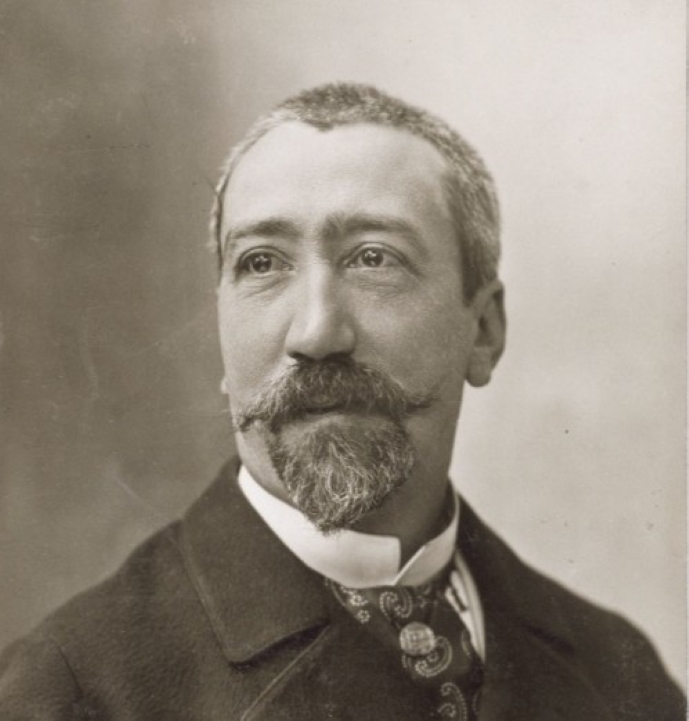
Brief, but rich, paragraphs from Rappoport in memory of his comrade and friend.
‘Anatole France—The Comrade’ by Charles Rappoport from The Daily Worker Magazine. Vol. 2 No. 204. November 15, 1924.
For the last ten years I was in close contact with him, and I can say with assurance that he considered himself a Communist. He only deplored that the progress of our ideas was altogether too slow and that he would not live to see the social upheaval.
When I left the congress in Tours, at which the split with the “war socialists” had been finally consummated, France congratulated me on the success of true socialism, now called Communism. Then I said: “Give us some sign, so that we may be able to boast openly that you are with us.”
“What shall I do?”
Since during the past few years he had been very niggardly of his writing, I suggested to the master that he make public thru the columns of “Humanite” his views of the Communist Party. He consented. “Humanite” was fortunate enough to be able to publish on its first page a notice of the membership of Anatole France, together with his picture. The press of the world took notice. France was an eager reader of “Humanite.” He took out his party membership card in Tours.
What was probably his last article was published in “Humanite.” He gave enthusiastic praise to the book written by his friend, Michael Corday, in which this gifted author laid bare with a relentless hand the capitalist basis of the war.
When they called upon him for a donation for the benefit of science in Russia, he suspected in this request an attack on the Communist regime. And this great man, whose extraordinary gifts were always at the service of every great cause, refuse this time to give a donation. He himself explained to me the ground for his unusual refusal.
“I did not want to make an attack on the only anti-imperialist government,” he said. In 1922, he wrote a personal letter to Lenin, in which he spoke of Lenin as the “greatest living statesman.”
I could quote from letters written to me, which would prove that France was a Communist. But to what purpose? Let people read his books carefully. They are just one long cutting satire directed against the money rule, against blood-stained capitalism. His book “L’Ile des Pengouins” is particularly noteworthy in this respect. He stigmatizes bourgeois democracy, bourgeois parliamentarism, which are directed by the money powers. We can compile from his books a brilliant volume of sound Communist propaganda.
The bourgeoisie made no mistake when it decried the gifted author, who flayed them unmercifully in their nakedness, as a “destroyer,” an “over-thrower.”
Yes, Anatole France, along with Jaures, was one of the greatest revolutionists of our time, even if these two men were not always in accord with us on questions of tactics. France hated the black reaction and believed–though not always–that the left wing is in a position to strike a fierce blow at rampant reaction.
As a close observer, France also knew our weaknesses. He advocated a united front of all working class groups, without interference in the particular nature of our party tactics. It is true that France lived outside of our everyday struggle. But he never failed to do us a service, or to strike a blow for our cause. We could mention countless elections in which he supported Communist candidates.
As a gifted observer, France was convinced that capitalist society was nearing its end. In the working class he saw the bearers of the future.
The Saturday Supplement, later changed to a Sunday Supplement, of the Daily Worker was a place for longer articles with debate, international focus, literature, and documents presented. The Daily Worker began in 1924 and was published in New York City by the Communist Party US and its predecessor organizations. Among the most long-lasting and important left publications in US history, it had a circulation of 35,000 at its peak. The Daily Worker came from The Ohio Socialist, published by the Left Wing-dominated Socialist Party of Ohio in Cleveland from 1917 to November 1919, when it became became The Toiler, paper of the Communist Labor Party. In December 1921 the above-ground Workers Party of America merged the Toiler with the paper Workers Council to found The Worker, which became The Daily Worker beginning January 13, 1924.
PDF of full issue: https://www.marxists.org/history/usa/pubs/dailyworker/1924/v02a-n204-supplement-nov-15-1924-DW-LOC.pdf
 Revolution's Newsstand