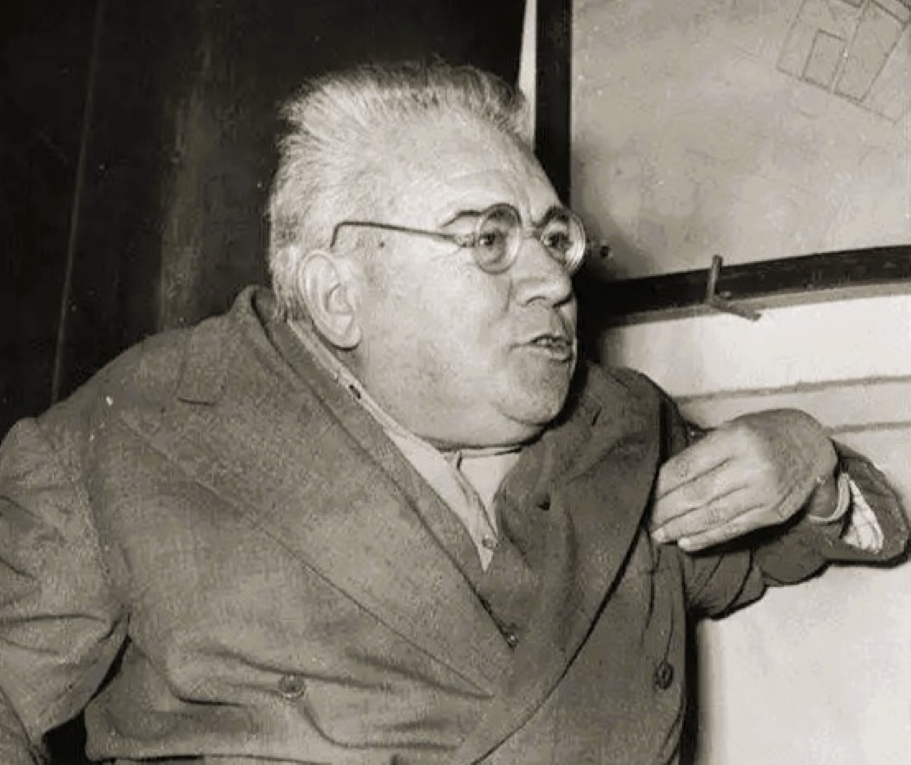
Bordiga returns the Fifth Comintern Congress with more insights, this time with the murder of Socialist activist Matteotti as background, two years after reporting on Fascism at the Fourth Congress just weeks after Mussolini seized power; the world’s first fascist regime. A ‘Left Communist,’ Amadeo Bordiga was a founder of both the Italian Communist Party and Third International, and a key figure in many of its early discussions and debates.
‘Bordiga Tells of Italian Workers’ Struggle’ from The Daily Worker. Vol. 2 No. 115. August 1, 1924.
MOSCOW, July 9. The twenty-third session of the Fifth Congress of the Comintern listened to reports on Fascism. One was delivered by Bordiga of Italy and the other by Freimuth of Germany. They showed that international Fascism, while presenting national differences, is still one of the most valuable weapons of the capitalist class in its struggle to beat back the rising revolution. For the workers it is of the utmost importance to find the methods by which Fascism can be met and overcome.
Bordiga said:
I presented to the Fourth Congress a report on the question of Fascism dealing with a very decisive period of the history of Fascism in Italy; that is to say, with the conquest of power by Mussolini. I must deal now with another phase of Fascist development which is connected, as you know, with the Matteotti affair.
Mentions Matteotti.
At this juncture it is of particular interest to study this important social and political phenomenon.
I am, of course, not going to repeat what I said about Fascism in my first report from the historical point of view. I will merely remind you of the fundamental criticism in connection with the phenomena now before us and with which I dealt in my first report.
It has been said that the development of the governmental crisis in Italy represented Fascism as the political negation of the period during which the liberal and democratic bourgeoisie of the left was in power in Italy. According to this point of view, Fascism came as a reaction against the concession post-war policy of Giolitti, etc. We think, on the contrary, that there is a dialectic connection between the two periods, and that the attitude which the Italian bourgeoisie adopted at first during the crisis which convulsed the state after the war was paving the way for Fascism.
Fascism From Farms.
Fascism began in the agricultural district. This is a characteristic fact. The attack on the positions of the red proletariat began in Italy in the agricultural districts. But if it is true that Fascism began its actions in the non-industrial districts, we must not imagine that it is purely a movement in the Interests of the agrarian bourgeoisie and of the big landowners. On the contrary, it is a movement which represents also the interests of the big industrial, financial and commercial bourgeoisie. It is an attempt at counter revolutionary unity of all the forces of the bourgeoisie. At the first glance, Fascism by its outward aspect does not seem to be an organization of the important social classes which we have just named. It rather appears as a movement of the middle classes, of war veterans, of bourgeois intellectuals and of all other sections which the proletariat could not bring over to its side.
Fascism is not a revolutionary movement. It is rather a movement for the preservation of what exists already, and it does not present us with a new program. It merely brings forward a new factor which was entirely lacking in the old parties, a formidable fighting organization, both political and military.
Anti-Proletarian.
What are the relations between Fascism and the proletariat?
Its name alone shows that it is an anti-socialist and therefore an anti-proletarian movement. From beginning to end it appears as the destroyer of even the smallest conquests of the working class. But even if Fascism is not the old extreme right reaction with its concomitant of martial law, terror, emergency legislation, and official prohibition of red and revolutionary organizations, it is something more than that. It is a more modern, cunning movement which endeavors at the same time to do propaganda among the masses, and even adopts the principles of trade union organization. It endeavors to form economic workers’ organizations. It is self-evident that we cannot compare these trade union organizations with the red trade unions. But we must admit that ais is a very strong theoretical argument against trade unions and even against revolutionary trade unionism, which maintains that the most effective weapon for the proletarian struggle is economic organization. Facts have shown us that this weapon can be very well used for counter-revolutionary purposes.
“Class Co-operation.”
In fact, Fascism has merely adopted, but in a new form, the old platform of left bourgeois parties and of the social democrats, namely, class co-operation. Fascism exploits also in the same fashion national and patriotic ideology.
Thereupon Bordiga dealt with the facts which characterized the Fascist conquest of power. We did not have armed action, but a mobilization of Fascism which threatened with a revolutionary seizure of power, and a sort of defensive mobilization by the state which even declared martial law at a certain moment. But this resistance did not materialize. Armed action did not take place; we have a compromise instead of it.
We absolutely denied that there is a question of revolution, as Fascism maintains. The Fascists say we can make this revolution whenever we like. But revolution is not a thing which can be done at will; neither is it at the disposal even of the boldest of political leaders, for even he cannot make events happen whenever he wills it.
Only Shift of Leaders.
Therefore, no revolution took place. There was a change in the leadership of the bourgeois class, but this change does not represent a change of the program of the Italian bourgeoisie neither from the economic and social nor from the home policy point of view.
It is true that there were persecutions against Communists, but the legal procedure was the ordinary procedure of the land and no emergency legislation was introduced. The old laws are very democratic and liberal, and this enabled us to come out of the trial with flying colors. This does not mean that there were no serious prosecutions against the proletariat, but what I want to say is that in this purely political lawsuit, which was supposed to deal a death blow to the revolutionary general staff, the new situation created by Fascism did not make any difference.
Bordiga reviewed the economic situation in Italy under the Fascist regime and showed that in reality it has become worse, for today the lira is lower than it ever was before. Mussolini’s contention is that it could have fallen lower still if it had not been for Fascism, an utterly worthless argument.
Middle-Class Awakening.
The Fascist government has not kept its promises, and there is great disillusionment in the class on whose support Fascism depended, namely, the middle class.
I want to deal now with the methods of the Fascist government towards the real proletariat. I have just told you that our trial showed the inefficiency of the official defensive legal means of the Fascist state. But the latter used many other methods against the proletariat, and these methods are very serious for us, for our comrades have been charged as common criminals for actions which were in reality sanguinary encounters between the Fascists and the proletariat, especially when the latter was represented by Communists.
Fascists enjoy complete immunity even if there is overwhelming evidence against them. But terrible sentences are passed on workers who dared to defend themselves against fascist attacks. There is an amnesty which acquits all those who committed crimes for a national purpose. This amnesty is, of course, extended to only fascists, while revolutionaries are kept in prison and recently are sentenced to 10 and 20 years.
Official “Freedom.”
We have in fact a government which uses the basest means of persecution against the working class which is driven to despair. Officially, all guarantees are honored. It is allowed to form Communist parties and to organize an anarchist movement, etc., but in reality there is coercion of a very formidable nature. Officially, there is freedom of the press, but the provincial perfects can issue the orders at any time to suspend papers.
As to the trade unions, great pressure is exercised by the fascist government which compelled workers to enter into fascist trade-unions by means of violence. The premises of red trade-unions were destroyed. Bat fascist activities in industrial organizations were not very successful. The fact is that the Italian proletariat is disorganized, instead of being organized, in fascist trade-unions. Sometimes there are workers’ demonstrations, under the official leadership of fascist trade-unions, because they are allowed to take action in defence of their demands.
Disorganizes Workers.
Then Bordiga dealt with the discontent of the middle class and of the small peasantry because of fascist governmental measures. The latter, who do not count as a political factor, are being gradually expropriated by the big peasantry. He then dealt with the conflicts between the extremists and revisionists of fascism. Fascism has not introduced anything new on the field of foreign policy. It is true, we had the de jure recognition of the Soviet Government but the Italian proletariat was not taken in by the machinations of the fascist press. Italian capitalism was interested in an understanding with Russia. The Italian proletariat interpreted this recognition not as a sign of weakness on the part of Soviet Russia but as a sign of weakness on the part of fascism.
Bordiga also spoke of the conditions of the Mussolini election, and explained the positions and the forces of the different parties. And emphasized the importance of the communist fight during this election and of the success achieved by Communist candidates.
Then he dealt with the Matteotti affair and spoke of the conditions under which the socialist defeat took place. The discontent which began to develop in the sections of the population deceived by fascism, spread after this event.
Proletariat Not Pacifist.
The discontent is great among the middle classes. But one must differentiate between this movement and the state of mind of the working class. It is by pacifist and legal means that the recently formed opposition against fascism hopes to bring about a change. But the proletariat knows full well that the excesses of the forces of the right must be met by force and that the situation can be stabilized only by long periods of struggle and by violent means and can be finally settled only by the establishment. of proletarian dictatorship.
Communists Sought Strike.
At the beginning, all the opposition parties, including even the Communist Party took part in parliamentary protests. But since then the Parties have divided. The parliamentary Communist fraction dissociated itself from the declarations made by the other Parties. All the other Parties, including even the maximalists, formed a joint committee of parliamentary opposition. In connection with this, a very peculiar thing happened. The Communist Party proposed the general strike as a protest against the assassination of Matteotti. Strikes had already broken out spontaneously. But all the other Parties were of course opposed to the proposal of the Communist Party, and advocated a 10 minutes’ strike. But even fascist and employers’ organizations were in favor of this proposal! Thereby this strike was deprived of all political and class importance. It is self-evident that the Communists alone proposed the right form of protest with which the assassination of Matteotti should have been met.
What is the present position of the Mussolini government and what is the general defeat which might lead to interesting developments. The situation can change much more rapidly than we expected before the Matteotti affair took place. It is clear that the position of the fascisti will be much more difficult in the future and that the possibility of anti-fascist action has taken place.
Communists Gain.
The problem which confronts the revolutionaries as follows: “How are we to use this situation and what is to be our attitude? The Party must insist on the autonomous role which was assigned to it. It must adopt the slogan of the liquidation of all anti-fascist oppositions, and must replace them by an open and direct action of the Communist movement. There are certain facts which have given prominence to our Party. Since the election and since other manifestations and demonstrations of the activity and vitality of our Party, our adversaries have adopted a different language toward us. The fascist press wants to enter into polemics with us almost daily in connection with the Matteotti affair, and this draws public attention to our Party and to its task which differs from all the other opposition movements.
The Communist Party is the only Party which offers to the masses means of action capable of putting an end to the present situation. We must carry out our task of agitation in opposition to the socialist end maximalist parties. This is the way in which we must use the situation which has arisen. We must naturally not depend only on politics, but must rally and unite the masses. It is only when we shall have achieved this unity of the masses that we shall have found the right foundation for the development of our struggle against fascism.
Arouse Masses.
Other means must be used than an attack led by a terrorist minority! We never had faith in such tactics, and if there is a political movement which by its critical and political attitude endeavors to liquidate the illusion of effective action by terrorist minorities, it is our Party.
We are convinced that revolutionary success can be achieved only by bringing into motion the masses, the working class and its allies–the peasants–which must be led by the Communist Party which must be the general Staff of the proletariat.
Bordiga spoke also of fascism as an international phenomenon and explained the conditions which gave rise to it. They existed in Italy where fascism had national and religious unity. But he said that these conditions were not as developed in other countries, for instance in Germany where fascism can evidently develop but under another form. He said that in Germany fascism will be rather of a petty-bourgeois character and will never achieve complete unity with the big bourgeoisie.
For the struggle against fascism abroad Italian Communists do not depend on the hypocritical support of the foreign bourgeoisie, on a moral campaign, but rather on the revolutionary solidarity of the workers of all countries in the struggle against bourgeois reaction and world fascism.
The Daily Worker began in 1924 and was published in New York City by the Communist Party US and its predecessor organizations. Among the most long-lasting and important left publications in US history, it had a circulation of 35,000 at its peak. The Daily Worker came from The Ohio Socialist, published by the Left Wing-dominated Socialist Party of Ohio in Cleveland from 1917 to November 1919, when it became became The Toiler, paper of the Communist Labor Party. In December 1921 the above-ground Workers Party of America merged the Toiler with the paper Workers Council to found The Worker, which became The Daily Worker beginning January 13, 1924.
PDF of full issue: https://www.marxists.org/history/usa/pubs/dailyworker/1924/v02a-n115-aug-01-1924-DW-LOC.pdf
 Revolution's Newsstand