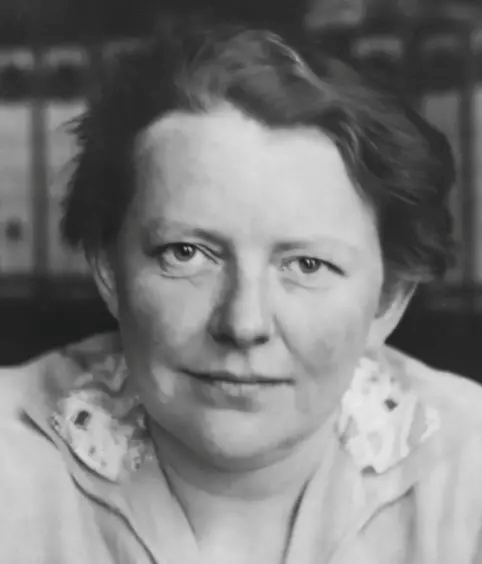
Helene Overlach, leader of the Roter Frauen und Mädchenbund, the women’s Red Front Fighters, on 1929’s observations. As Communist member of the Reichstag from Dusseldorf and leader of the Party’s Women’s Committee, Overlach was among the most prominent of Communist women and would pay for her politics spending much the decade following the Nazi takeover in jails and camps, somehow surviving the war.
‘The International Women’s Day 1929 in Germany’ by Lene Overlach from International Press Correspondence. Vol. 9 No. 11. March 1, 1929.
From the red banners, the streamers, and the placards carried by the working women and workers’ wives marching to their meetings and demonstrations, blaze the slogans of the International Women’s Day 1929:
War on imperialist war. Protect and defend the Soviet Union! Fight for wages and bread. For equal pay for equal work. Working men, fight side by side with your women fellow workers!
Solidarity with the fighting working women of all countries! Fight against the government of starvation and armoured cruisers!
Come to the conferences of the working women! Joint the C.P.G., read the communist press!
Manifold are the demands and fighting slogans of the working women at this year’s Women’s Day, as manifold as the methods employed by capital for exploiting and robbing the women of the proletariat and depriving them of their rights.
In view of the rapidly growing danger of war, this year’s Women’s Day is of extreme political importance. The serious preparations being made by imperialist Germany for active participation in the predatory war to be made on the Soviet Union are increasingly self-evident to any attentive observer. Besides the open war armaments armoured-cruiser building, re-equipment of obsolete ships, construction of great air bases on the coast and in the largest industrial centres secret armaments are being carried on with equal energy, as borne practical witness to by the shells and projectiles laid on the table of the Reichstag president, amidst the howls of rage of the bourgeois parties, including the Social Democratic Party of Germany.
The bourgeoisie realises even more clearly than the proletariat the decisive role which will be played by women in the coming war, and is therefore working feverishly to gain their allegiance, organising them with much skill in every description of Christian craft union, gathering them around the welfare organisations, and now even penetrating a vitally important point into the works and factories. Of late the work’s sport clubs have contrived to recruit tens of thousands of women workers. The report sent in by a woman worker delegated to the district conference of the R.F.M.B. (Red Women’s and Girls’ League) Berlin-Brandenburg states the alarming fact that in the factory sport club of the Singer’s sewing machine factory at Wittenberge the women workers practice shooting.
Our German proletarians still fail to realise that the tasks of the proletarian woman have long since gone beyond pots and pans and the knitting of stockings, or at most ambulance service in the workers’ struggles; that the badly paid working women and unskilled young workers are now playing a leading part in the process of production; and that in the coming war the women will be as subject to compulsory military service as the men.
When our working women and girls, following their sound proletarian instinct, strove to organise themselves in the Red Front Fighters League, they often encountered lack of understanding for their aims. When they gathered together in the Red Women’s and Girls’ League, and organised marches clad in the uniform clothing of the League, all they often earned was derision, and they had often to put up with cries of: “Get back to your cooking. Go home and darn stockings”, and the like. But in the meanwhile the bourgeoisie all over the world is proceeding systematically to work to militarise the women!
We must make a radical break with this petty bourgeois backwardness in the proletariat, this reformist failure to realise the importance of the part played by the working women. This backwardness is merely grist to the mill of the bourgeoisie, and means seriously endangering the success of our revolutionary struggles.
Hence one of the most important tasks of the International Women’s Day is to convince the proletarian of the necessity of including the working woman in the struggle. to convince the working men of the importance of winning over their women colleagues for the economic struggles, and to recruit the great masses of the working women for the struggle against imperialist war.
The role of the working women in the economic struggles is increasing along with their increasing participation in the process of production and their increasing revolutionization, resulting from the intensified exploitation.
Last year we witnessed frequent spontaneous strikes of the working women, for instance in the textile industry, although these ended in failure for the most part, owing to the treachery of trade union bureaucracy.
The women workers took an active part in the textile struggle on the left Lower Rhine until the day when this struggle was betrayed by the arbitration machinery. Indeed it was a factory employing female hands which was the first to enter the struggle against an attempted reduction of wages and to carry the fight to a successful finish.
In Thuringia and West Saxony the women textile workers have shown themselves especially courageous in the strike. They contrived to collect the money required for fares and expenses, and to send eight delegates, elected at their factory meetings, to a women textile workers conference for Ore Mountains Vogtland; this conference was well attended by non-party delegates. The women workers employed in the Munich-Bernsdorf (Thuringia) factories, however, mostly girls from the country, let themselves be persuaded by a written notice from the employers to return to work, and streamed back to the factories at the beginning of the week, thereby breaking the backbone of the strike.
The struggle expected in the textile industry of the Wupper valley (left bank of Lower Rhine) in reply to threatened wage-cuts to the extent of 82 per cent., did not break out. This struggle again was suppressed with the aid of trade union bureaucracy, by means of the appointment of a central board of arbitration. The women workers of the Wupper valley are still discouraged by the remembrance of former failures. They feel themselves indirectly threatened by the unemployed men and women textile workers standing outside the gates; they are sunk in want and misery by long years of short time at starvation wages.
A fresh wave of rationalisation is surging over Germany. The International Women’s Day must therefore call for the active self-defence of the proletariat, for the counter-offensive against the offensive of the employers. We must prevent hundreds of thousands of women workers from being the first to retreat before the pressure of the employers, from being the first to submit to the new rationalisation methods, and thereby to become the docile tools enabling the new war armaments to be made.
The Communist Party of Germany therefore finds itself faced with the enormous and responsible task of leading about 4 million working men and women, whose tariffs expire this spring, in their struggle for higher wages, for equal pay for equal work, and for the eight-hour maximum working day. The successful accomplishment of this task would make the first breach in the capitalist front and mean a severe blow dealt against the war plans of the bourgeoisie. The fight in the North West metal industry was already able to record the initial successes of the tactics including the unorganised workers in the struggle and of mobilising the masses of the working women. In the struggles here cited as examples success or failure depended chiefly on the extent of our previous systematic work, on the employment of trained organisers for the mobilisation of the masses, and to a very considerable degree on the activity or passivity of our opposition and our works councils.
This applies especially to the mobilisation of the working women. Where good work was done, good results were attained. Our staff of schooled functionaries is, however still very small. The task of mobilising the women workers this spring is one incumbent on the whole Party, for in many branches of industry success will depend on its accomplishment. In spite of the radicalisation of the masses of women workers, the danger still exists that if the women are left in the lurch, if no power comes to organise them and show them the way, this new wave of rationalisation will plunge them back into passivity; broken in spirit and body by redoubled exploitation.
The C.P.G. is realising the importance of this question more and more, and is working steadily for the fulfilment of its historical task. The most pliant tool for the making of wars must be torn from the hands of the bourgeoisie and converted into the most dangerous weapon in the hands of the proletariat, the most efficient aid for the overthrow of the bourgeoisie and for the establishment of the dictatorship of the proletariat!
During the International Women’s Week women’s demonstrations and meetings will be held in the most important industrial districts, and besides these eight conferences of working women, to which delegates will be sent by the workers in shop and factories, by the unemployed, and by the proletarian mass organisations. The conferences will discuss the position o working women and the threatening war danger and will resolve on united fighting measures. They will form the first steps towards the practical mobilisation and organisation of the masses of the proletarian women of Germany in the struggle against war. In the International Women’s Week our call must penetrate every great industrial undertaking:
Women, come forward to the fight in your millions! Follow the leadership of the Communist International and the Communist Party of Germany!
Join the C.P.G.; become active members!
The Women of Russia have thrown off their chains, follow their example!
Join hands with the working and peasant women of the Soviet Union!
The Soviet Union is the home of the oppressed; protect and defend the Soviet Union!
International Press Correspondence, widely known as”Inprecorr” was published by the Executive Committee of the Communist International (ECCI) regularly in German and English, occasionally in many other languages, beginning in 1921 and lasting in English until 1938. Inprecorr’s role was to supply translated articles to the English-speaking press of the International from the Comintern’s different sections, as well as news and statements from the ECCI. Many ‘Daily Worker’ and ‘Communist’ articles originated in Inprecorr, and it also published articles by American comrades for use in other countries. It was published at least weekly, and often thrice weekly.
PDF of full issue: https://www.marxists.org/history/international/comintern/inprecor/1929/v09n11-mar-01-1929-inprecor.pdf
 Revolution's Newsstand