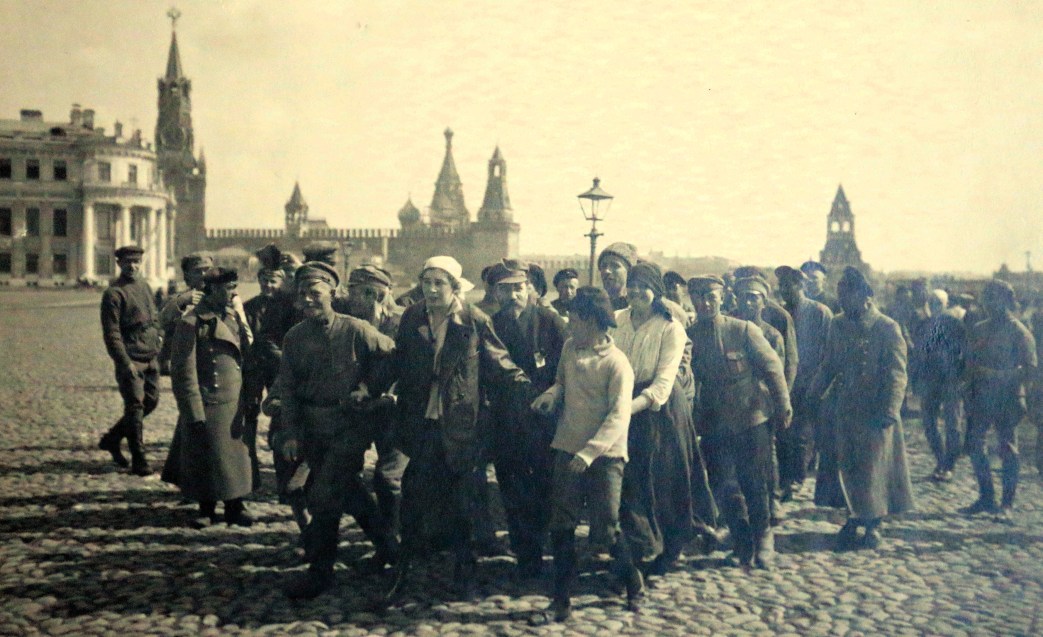
In this chapter, observations on clothing and style, beggars, and churches in a Moscow still at war. Also, as delegates begin arriving for the Second Comintern Congress, happening to be at the Opera with Trotsky, just returned from the Polish front.
‘Moscow in 1920. Chapter III’ by Dr. Alfons Goldschmidt from Soviet Russia (New York). Vol. 3 No. 16. October 16, 1920.
Clothing and Style
IN THE winter of 1919, during a lecture which I was giving at the Lessing College in Berlin, on various problems of Socialism, the question of dress under a socialist society came up. One lady asked anxiously: Would everybody dress alike? I reassured her. The fear of monotonous standardization is exaggerated, I told her. If she had no other objections against Socialism, she could become a Socialist today.
So far, there is no trace of a change in dress in Moscow. Of course, there is really no Socialism in Moscow; Socialism is only just beginning. Of Communism there is still less; there is a Communist Party, nothing more. But even in a finished Communist Society (if it could ever be called so) dress revolutions would hardly be characteristic. An extraordinary variety of color and style is even conceivable. However, the fate of the world will not depend on it.
At any rate, the Russian Revolution has not been a dress revolution, so far, although one of its results has been an increasing scarcity of clothing. For the army needs immense quantities of cloth, and there is a decided lack of tailors for civilian purposes. Cloth there is in abundance. One billion arshins are already on hand, and 700 million arshins could be finished in a short time. But the step from the yard to the finished suit is considerable. This problem is especially well-known to the Marxian student, who has tackled the Marxian theory of value. If the step from yard to suit were short and easy in Russia, the entire population could be dressed in new clothes.
I was told that the workers of Russia are better dressed now than they were in peace times. I had no means of comparison, as I did not see Moscow in peace time. I can bear witness, however, to the fact that the clothing of the workers whom I saw appeared to be far from hopeless. I never saw a single workman in rags. The workers in the factories, which I visited, were well dressed without exception. I saw immense numbers of workers in great organizations, especially meetings. Not one of them came in rags; neither did the women. The wife of a workman in Russia still wears the well-known head covering. She is dressed very simply, but her dress is neat and clean. The Revolution has accomplished a good deal in this respect.
The problem of clothing for the workers is first of all being taken care of by the system of clothing rations. In times of peace, the Moscow worker made an average daily wage of 79 kopecs. During the war the wage scale rose, prices rose also. The average was so insignificant, that good clothes were never even thought of. This was true also of living quarters with even the most rudimentary sanitary necessities. The average wage barely sufficed for the rent of a cellar, for some inferior bread, and a bit of vodka. Even in peace time, the price of a room in the heart of Moscow was at least fifteen to twenty rubles per month, and that of a cellar about three to five rubles. A worker hardly ever afforded himself the luxury of a room above ground. He was glad to be able to live in a factory tenement. Today the housing problem is practically solved for the worker. There are still a great many difficulties, but the worker’s housing troubles are a thing of the past. The contention that the worker has driven the bourgeois from his home is incorrect. As a rule families were allowed to remain in their homes, but were compelled to submit to the per capita housing regulation, and to take in their quota of homeless workers. I was in one “bourgeois” home in Moscow, whose space was entirely adequate. It was the old home of that particular family.
The wages of the Moscow workman of today (on an average of 6,000 to 7,000 rubles per month, without bonuses) would not cover the expense of new clothing. At least they would not suffice to acquire them in the open market where the price of a suit is about 50,000 to 60,000 rubles. The worker is dependent upon clothing rations. Of course, he is furnished with very few street clothes; working clothes must be the first concern in the official apportionment. These working clothes are made according to one standardized pattern. I saw several standard patterns in the Clothing Department of the Textile Trade in Moscow. But this is only a beginning. The official distribution is not universal as yet, by any means. The demands of the army eat up most of the necessities. For instance, when I was in Moscow I was told of a gigantic order of overcoats which had been filled for the army at the Polish front.
Clothing in the Soviet stores and bazaars is very cheap. But buying it is a troublesome affair. The way to such a piece of wearing apparel leads through miles of red tape, and even after a successful passage along this road one does not obtain the desired article at once. Women Soviet workers complained bitterly to me of the lack of clothing, and my women translators in Moscow begged me to give them clothing instead of money. Among other things, they took my bathrobe, which they intended to convert into flannel waists. They also suffered from a scarcity of stockings. One of my translators told me that she was forced to patch together two stockings to make one. Of course Russian women as a whole are extraordinarily clever with the needle. Most of them make their own clothes, and very often even their own shoes. To be sure, they are cloth shoes, the leather soles of which must be left to the shoemaker to supply.
The lack of knitted wear for hose, and the scarcity of dyes, has resulted in the most remarkable styles in some cases. For instance, many women wear white socks, which extend only a little way above the shoe tops. Otherwise the leg is naked.
This nakedness disturbs not a soul in Moscow, however, and occasions not the slightest erotic commotion, nor does it appear indecent. At first I though it to be an old custom due to the summer heat, but was informed later that it was due to the scarcity of knitting materials.
There was no sign of a clothing famine in Moscow. Although there are beggars in rags, as in other cities, Moscow is far from being in tatters. To be sure, the question of how it is possible for a city with at least one and a quarter million inhabitants to be so well dressed in times like these goes unanswered. Not even the Russians in Moscow are able to answer it. Or they say simply: Life helps itself. Just as Moscow eats and looks well nourished, so also does it clothe itself.
Dress distinction in Moscow continues to exist. There is still carelessness, simplicity and luxury of dress. Ladies continue to arrive at the theater amid the soft swishing of silken gowns, sweet fragrance still breathes from delicate blouses, young dandies swarm daintily as before in elegant tailors’ confections, or in bright Russian jackets. And as always, there are the industrious ones, unconcerned with raggedness or tatters. And there are the shabby and unambitious, who are neither pushing nor on the lookout for bargains, satisfied with anything. I saw unblushing trouser holes, unblushing coat fringes, and shoes from which the unblushing corns stared haughtily at an inquisitive world.
As for shoes; I have never seen in any other city such elegant foot gear as in Moscow; such elegant men’s shoes, high shoes reaching well up over the calf of the leg, and especially elegant ladies’ shoes, not quite so high. There is still much leather for uppers in Russia (I believe it is even permitted to export it), but there is a lack of sole leather, and yet these elegant shoes are well soled. I have seen most distracting Kirghiz boots, worn by ladies. I saw high shoes, low shoes, bright colored slippers, shoes with ribbons and shoes with rosettes, and patent leather shoes. The women of Moscow cannot complain of a shoe famine. Officially speaking, there is a serious lack of shoes, but the unofficial shoe situation is satisfactory. At least this was the case during my stay in Moscow. It goes without saying that there are exceptions, hardships and scarcities. Also I have seen shoes down at the heel and other shoe atrocities. But it cannot be said that Moscow is down at the heel any more than it is out at the elbow.
Beggars
One would think that a Socialist Society has no beggars, and that therefore begging would be unnecessary and prohibited. But Soviet Russia, the Soviet Russian people, are not a Socialist Society as yet. The Communist Party of Russia has done away with property rights in regard to the means of production, and has thus prepared the ground for Socialism. But it is a far cry from that point to an accomplished Socialism. That is why social insurance is not as successful as it should be, and even if it functioned successfully, there would still be beggars in Moscow. For beggars beg from sheer laziness as well as from poverty and need. There are whole beggar families, who inherit their street corner along with their profession from generation to generation, just as the Paris speculators inherit their profession with their seats on the Bourse. There are very wealthy beggar families, and whole beggar dynasties, as well as beggar princes, beggar dukes, and beggar kings. It is very often quite a profitable calling, and so long as the profitable business opportunities are not completely done away with, so long we will have beggars. Soviet Russia had hardly the rudiments of a practical policy before the November Revolution, and admired the German official model, which was after all so far from admirable. It is no small matter to steer a practical social course in Russia. The program of the Communist Party in Russia says: “The Soviets have legally full and complete social maintenance, in all cases of incapacity to work, or loss of work, for all workers who are not exploiting the labor of others.”
That is true, fundamentally true, and yet maintenance is not sufficient. For it is simply impossible so far to care for the workers as one would like. The maintenance will finally come up to the planned intention, but it cannot be done today. And even if it could be done, the beggars would not die out at once.
The beggars of Moscow are not like the beggars of other cities. At least not like the beggars of Western Europe. They are beggars with a semi-asiatic patience, at least. Beggars with a definite stand, who never leave their place; moving beggars, who weave back and forth between two fixed points, from morning till night; mandarin-beggars, who bow their heads before each passerby; religious beggars who cross themselves incessantly murmuring beggars, who whisper to themselves all day long, as though they were reciting an endless chapter of the Koran.
You sit in the Theater Square in Moscow. A beggar passes—a tall man, somewhat bent, a long, grey beard. His coat is shabby, torn, felt boots are on his feet, or only one foot is in a felt boot, the other in a dilapidated shoe. The right hand is missing. The stump of an arm is hidden by a sleeve. As he reaches your bench, he draws the sleeve back and holds the naked stump of an arm close to your face, mumbling the while. You give him a few Bolshevik rubles. He passes on, without changing his tempo, from bench to bench, everywhere mumbling and showing his stump of an arm. You think, now he is gone, for the day at least, finally gone. But you are wrong. A quarter of an hour, and he is back, repeating the same beggar performance. He never scolds, never becomes impatient if you give him nothing. He simply returns every quarter hour, and knows well that finally you will give him another ruble, or else the bench may have a new occupant.
A woman stands at the corner of the general post office, near the boulevard entrance, with her head sunk low upon her breast. Opposite stands a church with a green dome. She is singing softly to herself, and bows incessantly like an automaton. You think she is praying. Perhaps she really is praying to God to make those who pass generous. At any rate praying and begging are all one to her. So she stands, for many hours, slowly moves her bowed head up and down, and mechanically extends her hand. Many pass by without giving, but now and then there is one who leaves the great stream of passers-by in order to give.
Women, their heads monotonously moving up and down, stand in front of the Iberian madonna, who stands guard at the Red Square. Women with palms outstretched, not without fervor—beggar women. When several ruble notes have accumulated, they vanish into the skirt pocket. One or two ruble notes remain as a kind of bait. They stir the emotions. They say, these rubles notes: You see, there are some kind hearts still; won’t you be kind to us, too? They have stirred me again and again, these ruble notes, although my constant companion advised against it. For he was a rationalist, and a rationalist in Moscow gives nothing to beggars. Begging must be abolished, root and branch. If you give to beggars, they continue to beg, refuse to work while they are ablebodied, and when they are incapacitated, they will not take the trouble to obtain the necessary social insurance. I was acquainted with this theory from my university days. I used to defend it, I defend it still, but I violate my own principle. One should not violate one’s own principles. When you go to Moscow do not give to the beggars.
Furthermore, there is the genteel beggar, a kind of society mendicant. This form of begging is abominable. They are usually not beggars from poverty, but from sheer laziness. Helping those who are willing to work, but who are temporarily in need, is not supporting beggars, it is a duty. If society is not yet able to take care of its people, our fellow men must come to our assistance. For society, even a beginning socialist society, is a beast. Genteel begging, however, is disgusting laziness, is turning human compassion to a profit, full of hypocrisy and brazen insolence. Such beggars should be thrown out of the house and the dogs sent after them, even though they may come with diamonds on their fingers. For such beggars often wear diamonds. They can afford it.
But there are also beggars in Moscow who are beggars by conviction; proud beggars, people who have lost everything, who have nothing, and yet who will not submit. People who once were great figures, people of position, people of brilliance. Not tinsel brilliance, but brilliance of diligence and application, brilliance of family or of daring. They sell their last possessions, refuse to take advantage of the parasite allowance, scorn to play the role of the obsequious government clerk, and beg.
One evening I saw, in front of a well preserved old house on the boulevard, a tall and stately old man in uniform. He only spoke to the well dressed men and women. I inquired about this man, and was told that he was a former Czarist general turned beggar. Every one to whom he spoke must have given him no inconsiderable gift. I saw this man several weeks later, in the Theater Square. Again he only spoke to well dressed people. He did not address them with a servile air, with the air of a beggar. He begged just as one would exchange greetings with an acquaintance. He accepted the gift as a tribute, and always he received a gift. No one knew the exact details, but I thought to myself: Here is a man who begs, not from laziness, or from gentility, but from principle. A beggar from pride and from conviction. Many Czarist generals have put themselves at the disposal of the Soviet Government. Brussilov heads them all; he had been a kind of people’s general. I believe they did this from conviction; not perhaps from communist conviction, but from patriotic conviction, because they think that the Russian Communists will save the country. But this general this begging general, did not place himself at their disposal. He would rather beg.
I do not like people who are able to change front suddenly. I do not like dishonest people, opportunists, people with a turn-table heart. I know, too, what might be said against the begging general. But he struck me as a man.
Churches and Chapels
Moscow boasts forty times forty churches and chapels. Forty times forty says the Russian when he wants to signify a great number, when he would express their power, their variety, their teeming multitude. I do not know how many churches and chapels there are in Moscow. Perhaps there are more than 1,600—perhaps less. It really matters not at all. Every one who visits Moscow knows that it is a city of churches, a city bedomed and bespired, a city of a thousand church bells, a hundred thousand devotees, and ten thousand popes or more.
This is true even today. The churches and chapels are still standing. Many facades are crumbling. They lack the scrupulous care which they received under the Czarist papalism. Their walls have been gnawed a bit by the revolution. But still they stand, and few of them are closed. They stand in streets and earners, on stony hills, on city squares, surrounded by convent walls; they are everywhere. Their bells still call the faithful to prayer; here and there a devotee sits or stands on a roof, as on the roof of a minaret, semi-asiatic, careless and indolent, making an uncle of his God.
I saw chapels where prayers were said from morning till night; I saw churches which were empty during the day. There are still Eastern processions in Moscow, there are still churches and chapels where the images of the saints are fervently implored for miracles. There are still pictures and picture frames in these churches, heavy with gold and encrusted with many precious stones. No one knows exactly how these churches and their popes are being supported. But they are being supported, in spite of the state, which has washed its hands of them.
However, the state is not satisfied with the separation of the church from the state, and the separation of the school from the church, but is making every effort to sever “the connection between the exploiting classes and the organization of religious propaganda, by means of a widespread organization whose task it is to enlighten and finally free the working masses with the help of scientific and anti-religious propaganda. Great care must be taken to avoid any injury to the sensitive feelings of the faithful, as such injury would only result in a strengthening of religious fanaticism.” As may be seen, this is not tolerance, but a fight to the finish. It is not merely to be a separation from the church, but the church is to be fought tooth and nail. But the churches in Moscow seem to pay small heed to this fight, or to the posters of enlightenment, to the slurs against the old, decayed, pope-ridden regime, which so many Russians have fought long before the Bolsheviki; Leo Tolstoy first of all.
I have spoken of the Chapel of the Iberian Madonna in the Red Square. There the flickering light of candles, gold and precious stones mingle constantly, and prayers never cease, even at night. Here the most fervent miracle fetish of Moscow is centered, a fervor which reached a climax of religious jubilation when religious insignia on one of the towers of the Kremlin miraculously escaped the gunfire of the revolution. Often I have stood in front of this chapel with its small, time-worn, somewhat elevated, stone court, and its begging women standing guard. More people cross themselves in front of this chapel than anywhere in Moscow. Constantly one sees people passing these churches and crossing themselves, or standing still a moment and murmuring a prayer. The Revolution has not killed the church, or at least not yet. And there are a great many people in Moscow who predict a much longer life for the church than for the Revolution. There are still poor-boxes in these churches, by no means empty. The popes no longer strut confidently, it is no longer a majestic strutting, but they go about unmolested. I have seen laughing popes, popes praying in the streets, slinking popes, dirty popes, and even smartly dressed popes, priests such as the French novelists love to describe. I even saw a sort of Rasputin, a pope flaunting his peasant vigor, with high boots, immense black beard, and seductive eyes.
There is that wonderful Cathedral, with the great, golden dome, which absorbs the sun in the evening, and which expels it again during the day, which throws out fire that blinds and consumes. This church grows up out of a lovely landscape, its great square stones rising up free and powerful. It is a wonderful church, an inspiring church, even for those who do not worship the God of this church. When you walk along the wall of the Kremlin, look for this church; you will find it if you look for it in summer, on an evening full of the warm gold of the evening sun, and the glowing tints of a hot Moscow sky, an evening that makes the heart restless and yet strangely quiet.
But the great marvel, the real marvel is the church of St. Basil. It is not a church, it is a phantasy, a mosaic of domes, an undreamed fairy tale, a riot of colors, a color illusion. It is hard to believe that a man, an architect can have built this church. It changes constantly, in the morning it is different from the evening, afternoon different from noon. If you approach it from the Moskva bridge, it looks like a great ship with many bulbous mastheads. If you come upon it from the Red Square it is like a castle made of toy blocks. It has bewitching little windows, gratings and crumbling corners of incredible antique charm. It has really no symmetry, and yet it is an organism. It looks as though it were built piecemeal, and yet it is a harmonious whole. Sometimes it seems a massive heap, and again delicately scaled. Sometimes it looks large, sometimes small. It moves the soul, it charms, it shocks the eye, it is a delusion. It is the most wonderful thing that I have ever seen; the entire forest of domes of the eternal Kremlin fades out before this church. No one visited it, an old scaffolding embraced one of its towers, when I was in Moscow. I did not see the interior, and yet I saw it, because I saw the outside. It is an epic, a small lyric poem, a ballad, a toy, it is a mother and a fresh young girl, it is all that your heart desires. If you do not go to Moscow to look at the beginning of Socialism, go there and look at the church of St. Basil.
They say that an architect under Ivan the Terrible built this church and that the Terrible Ivan had killed the builder, to prevent his building another church of equal wonder and beauty. That is what they told me. I don’t know how true it is, but it is possible.
The Great Opera House
When the English delegation arrived in Moscow I received an invitation from the Bureau of the Third Internationale to attend the Grand Opera, an opera with ballet. They were giving Prince Igor, an opera whose music my friends praised very highly. All my friends tell me that I know nothing about music. For I hate opera, and I am quite frank in saying so to my friends. I wonder at those who can enjoy the opera, who are able to hear and to see at the same time. It is impossible for me to watch a dramatic performance, and at the same time hear the orchestra. I can not get over that conflict. There is only one opera whose music takes hold of me to such an extent that I can bear the dramatic action: Carmen. Read Tolstoy’s criticism of Wagner’s Rheingold. That is my criticism too. It leaves me untouched.
Hence the opera, Prince Igor, was of no importance whatever to me. It was the audience which drew me to the theatre. A new audience. The six gigantic rows up to the very top abundantly sprinkled with the proletariat. The parquet almost entirely filled with workers, in the boxes many workers. There was a sprinkling of Red soldiers. Also Soviet women secretaries, Soviet officials, women officials. Any one wishing to go to the theatre must be organized, else he receives no ticket. For instance, tickets are issued by trade unions. Of course, not all theatres in Moscow are city theatres or people’s theatres. The Korsh Theatre, for instance, where I saw a most horrible play, is still a kind of private theatre. In this theatre there is no trace of a proletarian influence. Nor in the Great Opera House, where the stage is still working with its old material, is a proletarian influence to be noticed, although it is patronized mainly by the proletariat. There is no trace so far of a new art, an art of the people, of a socialist art, or hardly a trace.
But the audience, such an audience! Today it is made up of proletarian children, thousands of children, dressed in white from tip to toe, from the parquet to the very topmost gallery. Childish awe, childish whispering and applause from little hands. A new world is in the making here. This is the nursing future, drinking its fill, this is flame and fire, the great hope of Russia.
Then again they are trades organizations, an audience still colored by the past. But always it is a public made up from the ranks below, a proletarian foundation, a proletarian majority, working men, working women.
Trotsky had arrived in Moscow from the Polish front, in order to receive the English, to attend to parades and to war affairs. The public was quieted with difficulty. It stood up, it shouted, it went mad with applause when Trotsky appeared in his box. He bowed as he seated himself near the railing, with Mrs. Snowden, the coldly intelligent, wet-blanket-like English woman, at his right, and the remaining English delegates ranged to the right and left. With a gallant bow to the English lady, who was only half a comrade, he took his seat. A gallant bow, for there are such things even in Soviet Russia. For almost a quarter hour the people continued their ovation to Trotsky.
The performance was sumptuous. It was the play of a bourgeois composer, played before red draperies and red minds. Enjoyed with enthusiasm and great applause. It was a touching flame to flare up for this opera, which has so little fire, which is so full of yearning, of melancholy and sentimental love. But it is Russian, and the artist, the singer, the actor is loved in Moscow still. He is called again and again, he beams, he needs applause. That is true everywhere, but especially is it true in Russia, it is more true than ever before. I believe that it is even more so in Soviet Russia than it was in Czarist Russia. For art finds new receptive grounds here, the most delicate appreciation, a promise of fruitfulness never dreamed of before. Unfortunately it is still the old art, representative art, academic art, silly art, and not an art of the people.
I did not come to see Prince Igor, I came to see the public, and the ballet. After a period of hard scientific work I wanted to see a Russian Ballet: Nizhinskis, Pavlovas, butterflies, yellow wagtails (a la Kerr), humming birds (a la Kerr). They gave us a savagely sumptuous women’s scene, with heavy animal skins, richly embroidered cushions, and inconceivably beautiful Russian costumes; with brocades, semi-oriental slippers, rug fantasies, tent mysteries. Katherine Geltzer appeared; she is forty-eight; forty-eight, and a vigorous fawn, fleet-limbed, with firm white flesh, unspeakably graceful. Wonderful muscles on the limbs of a Diana. Little covering. She appeared and the house stormed. She danced little. She made long bounding leaps like a setter, she crouched down like a shamefaced peasant girl, she strode majestically like a queen. She is madly beloved in Moscow. Every workman knows Katherine. She is fragrant with perfume, she wears rings, she is fashionable as always. She is a ballerina for the proletariat too. She dances happily, she grows happy with her dance, joy flings her high as if caught by the wind, she is a sprite, she turns her toe upon your heart, she whirls herself into your soul, she is a great artist, at forty-eight. A fawn—at forty-eight. With the years of a grandmother and yet a fawn.
It was fearfully hot in the theatre. But every one remained to the very last tone. And then came the wonder, the surprise, the thing that did not belong to the play at all, the proletarian thing. For now it was no longer the stage who was singing, it was not alone the orchestra, the people were singing. They stood singing, they left singing, they crowded singing through the exits. They marched down the stairs singing. The house sang from the gallery to the pit. The song rose up, the song grew, the song threatened, swore, pounded, that proletarian song, that song of humanity, the song made up of awkward words, that uncouth, that fighting song, that primitive, rallying, uniting song:
Arise ye pris’ners of starvation!
Arise ye wretched of the earth,
For justice thunders condemnation,
A better world’s in birth.
No more tradition’s chains shall bind us,
Arise, ye slaves! No more in thrall!
The earth shall rise on new foundations,
We have been naught, we shall be all.
Tis the final conflict,
Let each stand in his place,
The International Party
Shall be the Human Race.
Soviet Russia began in the summer of 1919, published by the Bureau of Information of Soviet Russia and replaced The Weekly Bulletin of the Bureau of Information of Soviet Russia. In lieu of an Embassy the Russian Soviet Government Bureau was the official voice of the Soviets in the US. Soviet Russia was published as the official organ of the RSGB until February 1922 when Soviet Russia became to the official organ of The Friends of Soviet Russia, becoming Soviet Russia Pictorial in 1923. There is no better US-published source for information on the Soviet state at this time, and includes official statements, articles by prominent Bolsheviks, data on the Soviet economy, weekly reports on the wars for survival the Soviets were engaged in, as well as efforts to in the US to lift the blockade and begin trade with the emerging Soviet Union.
PDF of full issue: https://www.marxists.org/history/usa/pubs/srp/v3n16-oct-16-1920-soviet-russia.pdf
 Revolution's Newsstand