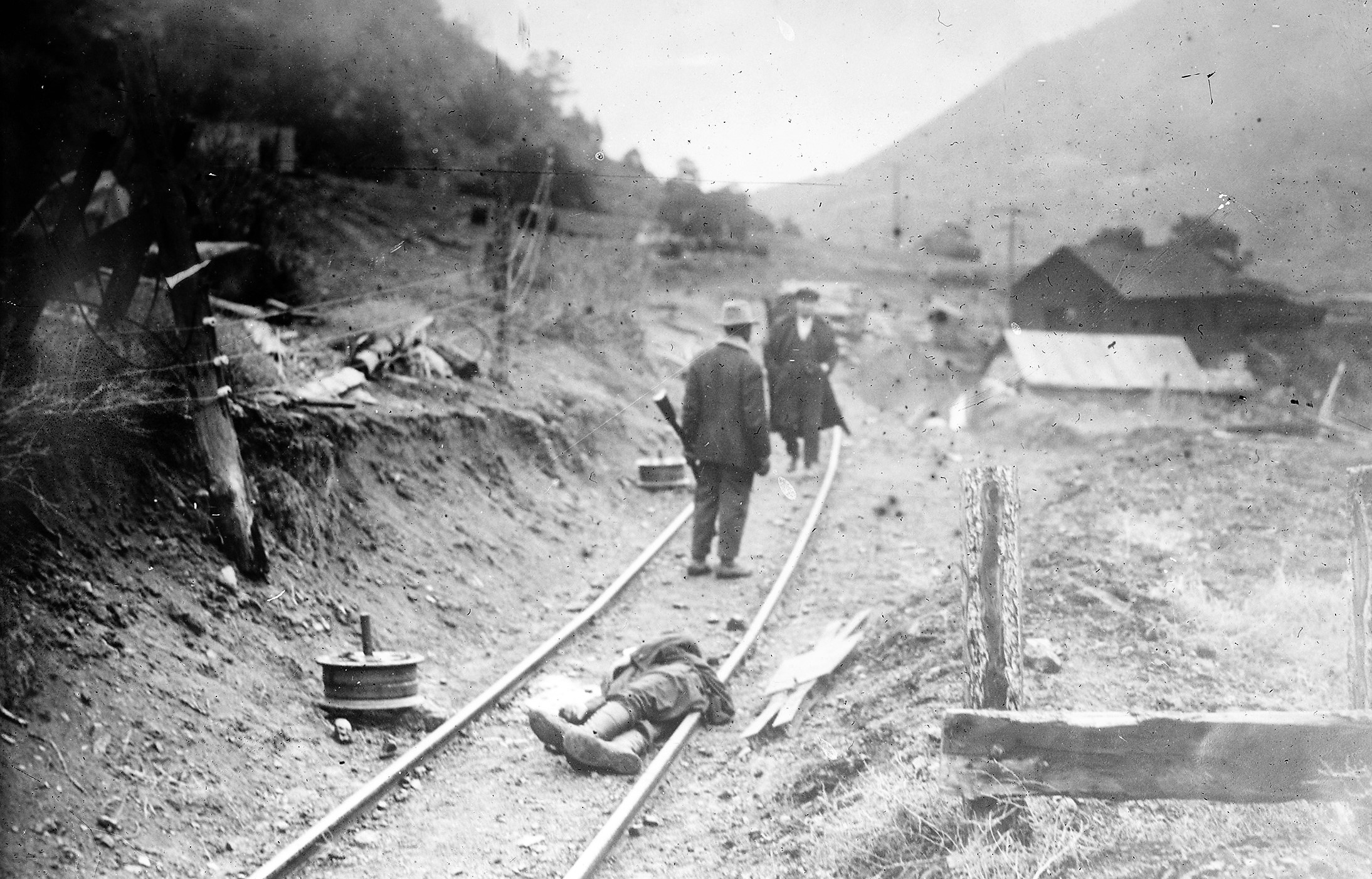
One of the most dramatic and consequential conflicts in U.S. class war history reaches its climax in the Ludlow Massacre and following Ten Day’s War. Frank Bohn is at his best writing from the field of battle with the recent conflagration’s smell of smoke still in the air.
‘The Colorado War’ by Frank Bohn from The National Ripsaw. Vol. 11 No. 4. June, 1914.
The history of “civilized” humanity contains no more frightful day than “Black Monday” at Ludlow, Colorado…I saw the stricken field first in the glare of the morning sunlight and longed for darkness to hide it. At night, wakened by the memory of it and shaken by bitter reflections, I longed for daylight.
In a hundred years pilgrims will come to this murderers’ hole in Southern Colorado and wonder. They will also plant there a monument and do honor to those whose broken lives, snuffed out by the power of greed, were thus sacrificed in the cause of freedom for the workers and for humanity.
The ruins of Ludlow Colony lie just east of the Colorado and Southern Railroad, fifteen miles north of Trinidad. They include perhaps five acres of unutterable desolation. Iron bed-frames by the score, burned, twisted, broken and perforated by bullets; stoves standing on their tops in mud-holes; charred bits of boards and furniture; these are strewn about everywhere. Here are the black, ash-begrimed pits in which four hundred wretched victims crouched and hid for eleven terror-cursed hours, and here is the smoke-blackened hole in which were trapped fifteen women and children, only two of whom survived, for thirteen of them, two women and eleven children, met their tragic death by suffocation. Pitiful was the scene when the poor corpses were removed. Roasted flesh fell from the limbs and oozed through the fingers of those who tenderly carried them to the surface.
How could it happen that fire reached into this pit?
It was carefully constructed by the miners who dug it. The top of the hole is four feet below the surface of the ground. Steps cut in the hard adobe soil lead through an opening through which an adult cannot walk erect. The pit was carefully timbered and roofed over with earth. There was no wooden covering to burn. The two living women who came out the next morning were not burned. Their five dead children had not been touched by the flames.
THERE CAN BE BUT ONE ANSWER TO THE QUESTION! OIL HAD BEEN LIBERALLY USED TO COMPLETE THE DESTRUCTION OF THE TENTS AND FURNITURE. OIL HAD UNDOUBTEDLY BEEN THROWN INTO THE HOLE AND SET AFIRE. But the hole was too small and too deep to support combustion. The oil probably blazed a few minutes, but not long enough to burn the bodies and the bed clothes on which the murdered children lay.
BLACK MONDAY
The destruction of the Ludlow tent colony Tuesday, April 20, was a carefully organized plot. Of this there is abundant proof. The colony occupied a strategic position. Ludlow station has been compared to the angle of the letter “K”, the perpendicular line is the Colorado and Southern Railroad. The two branch lines extend up to the most important coal mining valleys of Southern Colorado. On the southern branch lie Tabasco and Berwind. On the northern branch are Hastings and Delagua. Strike-breakers, deceived by corporation agents into thinking that they would be settled upon free land, were brought in. The strikers of Ludlow colony, by picketing the station and informing the new comers of the strike keep nearly all from going to the mines. If the strike was to be broken, Ludlow colony must be destroyed–reason enough. Again and again details of militia, or private thugs in militia uniforms, visited the colony and worked injury and insult upon its peaceful inhabitants. Pretending to search for arms, they would tear up the tent floors and break furniture. Their most customary trick was to search through the colony for some member who was supposed to be held against his will.
On March 19, a company of militia, with a machine gun, took position on the opposite side of the railroad and aimed their rifles at the colony, while a detail went through the tents with fixed bayonets. A careful attempt to provoke a riot was made on the day before the final attack. The women of the colony had organized a baseball team and were playing the married men’s team of the colony. The ball ground was two hundred yards from the tents. A militia detail of eight men, under a corporal, came under arms and took up a position on the field, interfering with the game. When one of the women asked them why they were so ungentlemanly, the reply was that “Four of us could wipe out the whole colony.” The argument continued, one of the soldiers retorting, “You are having your fun today, but we shall have ours tomorrow.”
“READY-AIM-FIRE”
The next morning at 8:30 a detail of three men was sent “to search for a non-union miner.” They were informed they could not enter the colony without a warrant. Half an hour after they returned to their quarters, Major Hamrock, in command of the militia, telephoned to Louis Tikas, the leader of the colony, and demanded information as to why his detail had been denied admission. Tikas replied that there was no one detained in the colony against his will, the man referred to having come and gone as he pleased. Tikas then agreed to meet the Major on neutral territory. They met at once at the railway station, midway between the two camps. While the conference was proceeding, Lieut. Lindefelt gave orders to a machine gun squad to open fire upon the colony. Three bombs, the militia signal to other camps for help, were exploded and the attack had commenced. On the first day of the court martial of Major Hamrock, Lieut. Benedict, present on the field, testified that the militia had fired the first shot.
Within the colony there was dismay and terror. Many children were still in their beds. Half-clothed persons rushed wildly about. Women and children rushed to the pits for protection, and when these were full, the remainder found refuge in the well at the Colorado and Southern pump station and in the arroya or ravine north of the colony.
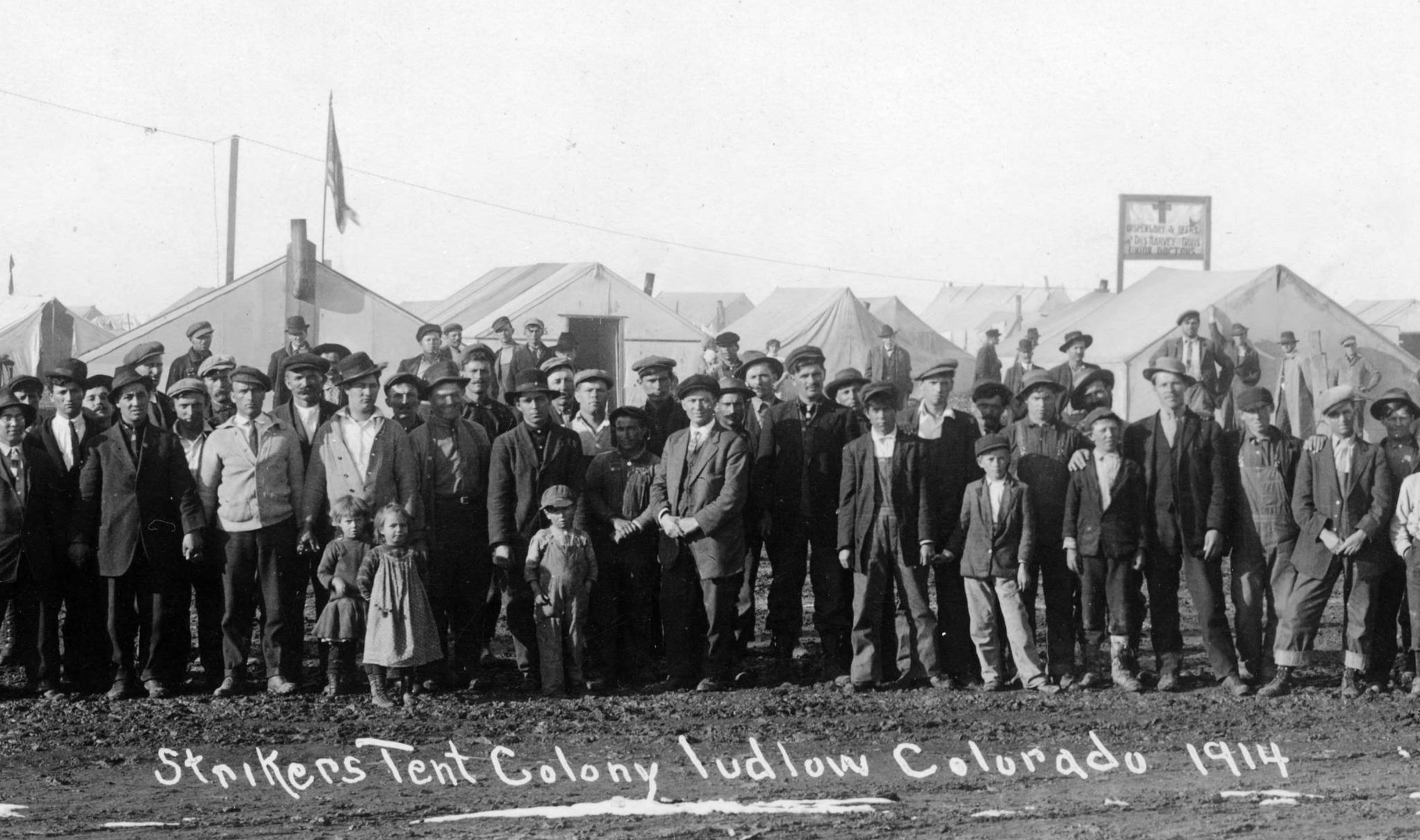
Six feet from the hole in which thirteen died lies a metal wash tub. In it I counted twenty-one bullet holes and indentures. The upper back part of a cooking range a few feet off had been perforated by eight bullets. Four hundred women and children in the colony had sought the shelter of the friendly earth, else not one could have remained alive under that terrible fire from the machine guns, which swept the tent city. There were, in the colony, exactly forty-one rifles. The owners of these, mostly men of experience in the Greek army, rushed out to take position where they could return the fire of the militia. About fifteen occupied the steel bridge of the Colorado and Southern railroad to the northwest of the colony. The remainder deployed under the protection of a deep cut through which runs the Denver and Rio Grande railroad, a quarter of a mile southeast of the colony. The story of the battle and the massacre is told elsewhere in this issue by the survivors. Their narratives leave little for us to recount here. At first, through courage and steadiness, gaining the advantage, the heroic miners were later forced back by the large reinforcements received by their enemies. To them help did not come until midnight. Desultory firing at long range continued on the Ludlow field for days, but after Tuesday, interest in the fighting shifts to other parts of the mine district.
THE LARGER CONFLICT
To understand “Black Monday,” the Ludlow massacre, one must understand conditions as yet peculiar to the mining districts of the Far West and of the South. The Colorado coal fields have practically no middle class. State, county and local governments are directly, absolutely and shamelessly corporation ruled. The empty forms of political democracy fool nobody. In the coal-mining districts there are three major companies operating: The Rocky Mountain Fuel Company, the Victor-American Fuel Company, and the Rockefeller Company (the Colorado Fuel and Iron Company). Of these the Rockefeller company is the most important, as it includes the city of Pueblo, the second city of the state. The three corporations dominate the counties of Las Animas and Huerfano, in which the southern coal fields are located.
GOOD-BYE, MIDDLE CLASS
In these counties there is the Rockefeller crowd on top, and an army of their enslaved workers at the bottom. Between these two, the paltry middle class is flattened out like an old newspaper between a steam roller and the pavement. At Ludlow an old-fashioned American citizen had a general store and rooming house. His place was worth probably ten thousand dollars. Being courageous, he dared sell goods to the strikers. On the day of the Ludlow massacre the Rockefeller militia wrecked his store. Every article in that store and rooming house was smashed, torn and piled in dirty heaps. The “brave” soldiers, finding a pig in the yard, cut off its front legs and left it to die. Bags of flour were cut open and scattered about. Trunks, clothing and everything else that seemed to be of value were carried off.
At Walsenburg the gunmen barricaded themselves in the company store and riddled every house in the vicinity with a machine gun, although there was not an armed man in sight. A store operated in competition with the company store by an old man and his son, was especially singled out for target work. THE SON WAS SHOT DEAD BY ROCKEFELLER’S GUNMEN WHILE WAITING ON CUSTOMERS. There is no room for a middle class above ground in the Colorado mining districts.
The Colorado war is thus a conflict between the trust and the industrial union of the mine workers. It is a war to the death of one or the other. This struggle presents a picture which portends the future. What is doing in Colorado today will be done everywhere in the United States within ten years, unless an organized and disciplined working class acts and votes to prevent it.
THE ABOLITION OF CIVIL RIGHTS
On the way to Hastings and Delagua I passed under a sign placed across the road, which reads, “the Company Property Begins Here.” FOR MILES THE ONLY HIGHWAY LEADING INTO LARGE TOWNS IS OWNED BY THE VICTOR-AMERICAN FUEL COMPANY. The post-office and the “public” school stand on the company land. In some towns the miners are taxed fifty cents each a month to pay for the school teacher. They pay a dollar a month each for hospital fees, whether or not they require such services. The limit of such contemptible exploitation is reached by the enforced payment in some towns of fifty cents a month each for the services of a Protestant clergyman, though most of the miners are R man Catholics. A school teacher, a girl in Delagua, sympathized with the strikers. The company guards ransacked her room, broke open her trunk, stole her private mail and dragged her to the mine, where they kept her a prisoner for days.
The miners live in “company houses”–pitiable shacks of two or three rooms each. The strike was called on September 23. BEFORE SUNDOWN OF THAT DAY THE WOMEN AND CHILDREN OF TOBASCO WERE THROWN OUT INTO A BLINDING SNOWSTORM AND TOLD TO GET OUT OF TOWN WITHIN AN HOUR. WAGONS WERE SENT FOR BY THE STRIKERS. WHEN THESE WAGONS, PAID FOR BY THE UNION, ARRIVED AT THE POINT WHERE THE ROAD BECOMES PROPERTY, THEY WERE STOPPED AND NOT ALLOWED TO PASS FOR TWO DAYS. In many cases in the Rockefeller towns the strikers were not permitted to get their furniture or go to the post office for their mail. The arrest of Mother Jones and her imprisonment for nine months without trial, hearing or recognition of the writ of habeas corpus, is too well known to require mention here. Two hundred miners were arrested by General Chase at one time and similarly held.
Such events might be recounted by the hundred. But the conclusion is already clear. Civil and political rights have been abolished in Colorado by the representatives of the Rockefeller and allied corporations. Not a vestige of them remains, wherever it clashes with the material interest or the usurped powers of the industrial overlords.
ROCKEFELLER’S PRIVATE ARMY
In Las Animas county alone the corporations’ sheriff deputized more than five hundred “supporters of law and order” in a single year. An army of gunmen imported from West Virginia and thugs from the slums of the great cities east and west thronged the mining camps. They murdered union organizers right and left and laughed in the face of the terrorized community. In General Chase, of the militia, and his officers, the gunmen found ready allies. During the winter these combined forces of the corporation invaded the various tent colonies again and again, killing and wounding men, women and children. On March 10, over forty miners were ordered to get out of the state within forty-eight hours. When they refused to go, their tents were wrecked and two babies died from exposure in the winter cold.
CORPORATIONS HIRE THE MILITIA
The Colorado war marks the beginning of an era in the history of our industrial oligarchy. For the first time the corporations enlisted their hordes of thugs into the state militia, paying them salaries directly. These salaries were over and above what these “soldiers” received from the state of Colorado, through loans which said corporations advanced to the state for the express purpose of paying the militia.
Then, during the latter part of March, most of the bona-fide militia left the strike region, because there was no more money in the state treasury to pay them. Following their withdrawal the corporations went “the limit.” They kept the uniforms, arms and ammunition and some of the officers of the militia. These uniforms they filled with more imported gunmen. Twenty ex-militia men from Denver were given $110 a month each as detectives. So the strange new army appeared in these United States of America–an army private in everything except its powers, which were public and military.
The industrial “state within a state” had at last thrown off its mask and appeared before the world as a political sovereignty.
THE WORKERS IN ARMS
The opposing or working class army was composed primarily of striking miners. To these were added perhaps a hundred volunteers. They were clad in garments ragged from long use and soiled by the mines, and were armed with whatever weapons they could pick up. They marched to battle and siege not to the sound of martial music, but in sombre silence. Fighting their fight in bitter despair of peace and in self defense, these heroic workers gave their comrades the world over a vision of heroism which can never be forgotten. For a week the working class forces controlled and policed Trinidad, a city of fourteen thousand people, the commercial center of southern Colorado and the county seat of Las Animas county. Their control extended, besides, over hundreds of square miles of surrounding territory. The population of this district was free from the rule of the notorious gunmen and the corporation owned politicians. The sheriff of Las Animas county and the mayor of Trinidad fled from the city. Within the lines of the workers’ forces, peace reigned and the lives and the property of non-combatants was sacredly guarded.
Once before in history has such an event transpired, that was during the Paris Commune of 1871.
THE RISING OF THE WORKERS
In Trinidad at least eighty per cent of the population were and are on the side of the strikers. Scores of persons ordinarily uninterested in the labor movement, but outraged in their sensibilities by the horrors of Ludlow, offered assistance. Though hundreds pressed forward to bear arms against the Rockefeller desperadoes, arms were hard to find. Perhaps a hundred men from Trinidad joined the besieged strikers in the Black Hills back of Ludlow. At Aguilar the miners quickly defeated the Rockefeller gunmen, driving them into the mine where they remained until the truce. When the strikers learned that there were women and children in the mine they offered them safe conduct to their homes. At Walsenburg the Rockefeller gunmen satisfied their blood lust by shooting up the homes of the unarmed and innocent persons, while the miners entrenched themselves in the hills nearby. When the militia arrived they were led to attack the miners by a surgeon, Major Lester. Lester was shot dead and his followers were driven back.
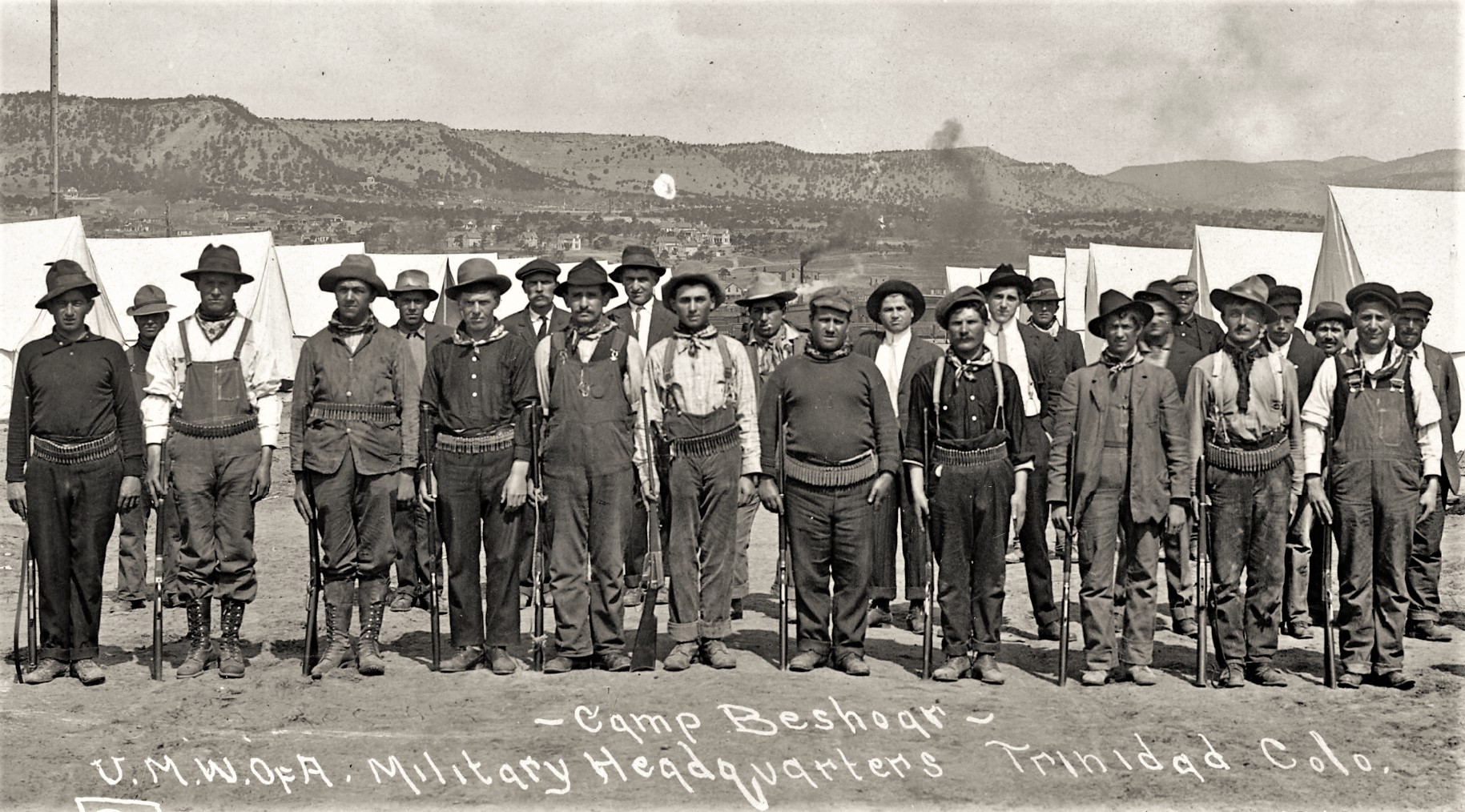
The fiercest battle of the campaign was fought at Forbes, where the workers had suffered so much and so long from the gunmen. A hundred and fifty miners marched in column from Trinidad, and, joining their comrades at Forbes, took possession of the hills about the town. From these vantage points they poured an effective fire upon the mine guards, killing nine, wounding many others and desstroying the mine Tipple and Camp Atterby with fire, with but slight loss to their own forces.
The first detachment of U.S. regulars arrived at Trinidad on April 30, whereupon the miners surrendered the town and turned to their homes.
THE OUTLOOK
Whatever the loss suffered by the workers, there has been one gigantic gain. The whole working class of the mining districts are bound together to a degree never before attained in America. Railroad men refused to transport militia or strikebreakers into the district. When some were laid off for this stand the men of the whole division threatened to strike. The rebels were immediately returned to work and paid for the time lost. When the time came to fight every worker in the district knew which class he belonged to. Unfortunate it is that workers must be murdered and their bodies burned before unity is reached, and that it takes a “Black Monday” to close up the ranks.
Whatever fears of defeat may have been entertained on the part of the miners before “Black Monday,” they are now pressing on toward victory with grim determination. This strike is going to be won. All can see that now. Yet in no conflict of the past has the united support of the working class been more needed. This is not a miners’ fight. It is a class fight. It is a battle of the working class throughout the land. Complete victory against Rockefeller and Rockefellerism will be the greatest and most lasting source of inspiration which the workers of America will have thus far attained.
Mass meetings of the workers should be held everywhere, and the message of the Colorado war driven home. The workers here are shouting to one another that Colorado must be carried by the Socialist party. The corporation gunmen must be driven out of this state. Are they to be welcomed and used by the capitalists of other states? Contact with the workers of Southern Colorado makes one firm in the belief that we are at the beginning of the final conflict of the social revolution. LET THE RESPONSE OF THE WORKERS EVERYWHERE EQUAL THE IMPORTANCE OF THE TREMENDOUS ISSUES INVOLVED!
The National Ripsaw, a Free-Thinking, Socialist magazine that, in the 1910s, included the O’Hare’s and Debs on its board. The paper under the O’Hare’s was a voice of the Party’s anti-war wing and became a main literary vehicle for Debs before it, like all of the anti-war Left press, was banned from the postal services. In it’s previous incarnation, The Rip-Saw was an openly racist, exclusionary “Socialist” magazine under editor Seth McCallen from 1903 until 1908 when the paper was taken over by Phil Wagner and the politicsand focus of the paper changed dramatically. Thereafter it was a leading anti-war voice, and one in which Debs would contribute much anti-militarist writings to, changing its name to Socialist Revolution before its banning by the Post Office at the U.S. entered World War One in 1917.
PDF of full issue: https://www.marxists.org/history/usa/pubs/national-ripsaw/140600-nationalripsaw-v11n04w124-DEFECTIVE.pdf
 Revolution's Newsstand