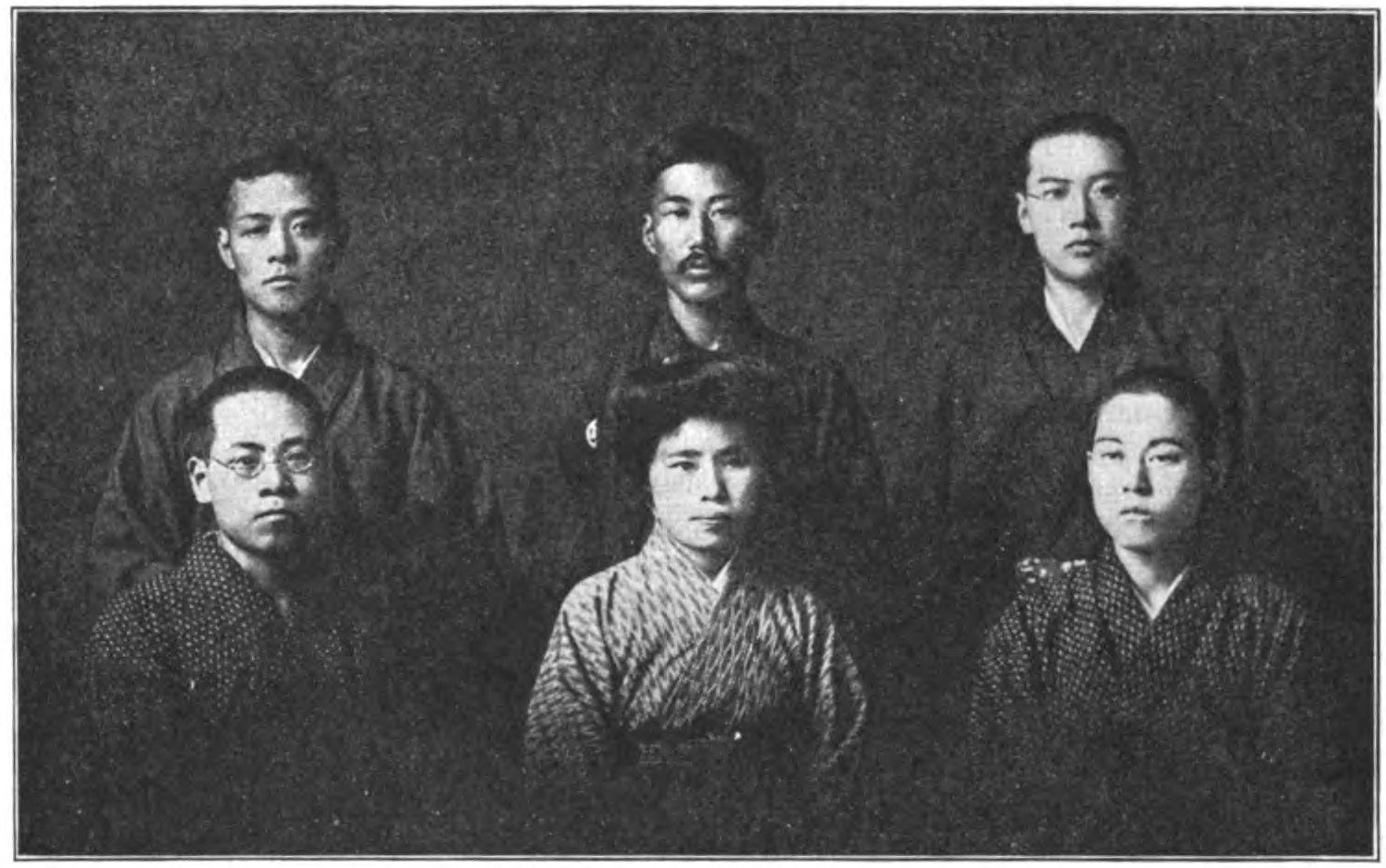
News of the conviction leading to the execution of Japanese revolutionaries Denjirō Kōtoku, Toshihiko Sakai, Sanshirō Ishikawa, Kōjiro Nishikawa, and their comrades by the Japanese imperial state on January 24, 1911.
‘The Japanese Revolutionists’ from International Socialist Review. Vol. 11 No. 9. March, 1911.
(The following article from Japan reaches us just as the Review goes to press. The manuscript was unsigned, and fortunately escaped government censorship.)
IT IS now eight months since the first Japanese was arrested of those tried and now awaiting a verdict. It is claimed by the nobility that these men and the one woman plotted against the life of the Emperor. Some have already received sentences of imprisonment while others are still awaiting trial in the jails of the country.
In the beginning over one hundred men and women were arrested, but I shall tell only the few facts I have been able to learn of twenty-six comrades. Nobody has been allowed to visit these men or the woman under any pretext whatsoever. No communications were allowed sent to them. They were permitted no messages to their friends. Everything was utterly secret. The newspapers in Japan dare not mention the trial nor the causes that led to it.
These comrades were tried under the 73rd clause of the Japanese criminal law, charged with the highest charge of conspiracy, because directed against the Imperial personages. Under this law it is not at all necessary to prove a plot or an ACT. He is condemned who conceives the thought or INTENTION, in his own MIND, against the Emperor.
All the comrades had regular and honorable occupations. All were extremely intelligent. Among them was a Bundist priest, a doctor of medicine, journalists, printers, iron workers, farmers—all were highly respected by their associates. Three comrades had been in America and Europe and spoke and wrote several languages. All were expressed Socialists, though some preferred to be called Kropotkin communists. We, of Japan, have been forbidden to DISCUSS the trial or the fate of our friends, so that still another difficulty is added to our efforts to get news of them. However, I am certain some of these comrades opposed parliamentary action and advocated direct action. But that does not matter. Some of us will always differ on points of tactics. Sufficient it is that twenty-six Socialist comrades were tried, according to the Japanese farce, in total darkness.
The Trial.
Dr. Kotoku and the other comrades were under the shadow of death from the beginning. To be accused of conspiracy against the Emperor is almost the same as the death sentence. I tried, with other comrades, to gain permission to attend the trial, but we were all refused. Upon one day, 150 persons were admitted to the court rooms. At least this was the report, but we found that these were detectives used to give the trial a semblance of fairness.
It was the splendid activities of our foreign comrades that caused the Imperial government to relent in severity a little. Only because of pressure from WITHOUT was the government made to feel how the civilized world looked upon secret trials of men of learning. Then a few relatives were admitted to speak to their loved ones, but always under strict guard, so that no word about the charges against them could be spoken.
Kotoku’s mother was at last permitted to see him. She was sixty years of age. Like a Roman mother she met him, full of words of love and courage, and then, straight and unbent, she left him to return to her home in the Tosa Island. Shortly afterward, we heard of her tragical death. While we cannot be certain, we have taken it as a brave suicide. We believe she took her own life to give courage to her son, that he might face the end, undaunted, like a man.
We know and have known of the splendid way the American comrades arose at the time of need to help your comrades—Haywood and Pettibone. This we longed to do for our own comrades but we were not strong enough yet to dare it. It is still a crime in Japan to help a man accused of crime.
Okumiya, one of the twenty-six, an old liberal, a revolutionist who worked with us only a few months ago, was among the last arrested. His wife was very ill and died during his incarceration, in extreme poverty. Nobody was allowed to aid her.
The Japanese government reports to the outside world that she is not persecuting radical, liberal men and women, nor Socialists. This is utterly untrue. We Socialists know well what persecution means. Not long ago, we formed educational clubs, whereby we hoped to get the working men and women to THINKING. Even our little clubs were stopped, while last month the Skakai Shimbau was suppressed merely because we REPORTED the International Socialist Congress at Copenhagen. It is because of the steady persecution of Socialists that occasionally men feel driven to other methods.
Many of us are being driven from good positions and forced to do meaner work, but we are keeping on. In November we held thirteen meetings, speaking on Socialist questions. We were forced to avoid all mention of strikes, trade unions, Socialism, etc. It is curious that we are usually permitted to criticize the existing government and their bad policies freely, but if we speak against the capitalists, advocate trade unionism or Socialism, our meetings are instantly stopped.
Still in December we held meetings. We have one planned for tonight and another for tomorrow night. At these meetings we charge 5 cents American money, to cover expenses. From 50 to 500 people usually attend.
Almost every known Socialist in the Empire is called upon twice daily by detectives, and is so closely watched that it is almost impossible to accomplish anything. Six years ago the government declared there were 3,000 Socialists in Japan. It now declares there are 210,000, over 2,000 constantly under police or detective surveillance.
This is a terrible struggle. Our comrades have been convicted of conspiracy. They are doomed. We cannot lift our hands to save them. But all know that where one bearer of the torch of liberty is cut down a hundred others will rise to take his place. Capitalism is breeding Socialists as fast as capitalism herself grows. We are still working for emancipation. We shall not stop till we have found it.
The International Socialist Review (ISR) was published monthly in Chicago from 1900 until 1918 by Charles H. Kerr and critically loyal to the Socialist Party of America. It is one of the essential publications in U.S. left history. During the editorship of A.M. Simons it was largely theoretical and moderate. In 1908, Charles H. Kerr took over as editor with strong influence from Mary E Marcy. The magazine became the foremost proponent of the SP’s left wing growing to tens of thousands of subscribers. It remained revolutionary in outlook and anti-militarist during World War One. It liberally used photographs and images, with news, theory, arts and organizing in its pages. It articles, reports and essays are an invaluable record of the U.S. class struggle and the development of Marxism in the decades before the Soviet experience. It was closed down in government repression in 1918.
PDF of full issue: https://www.marxists.org/history/usa/pubs/isr/v11n09-mar-1911-ISR-gog-Corn-OCR.pdf
 Revolution's Newsstand