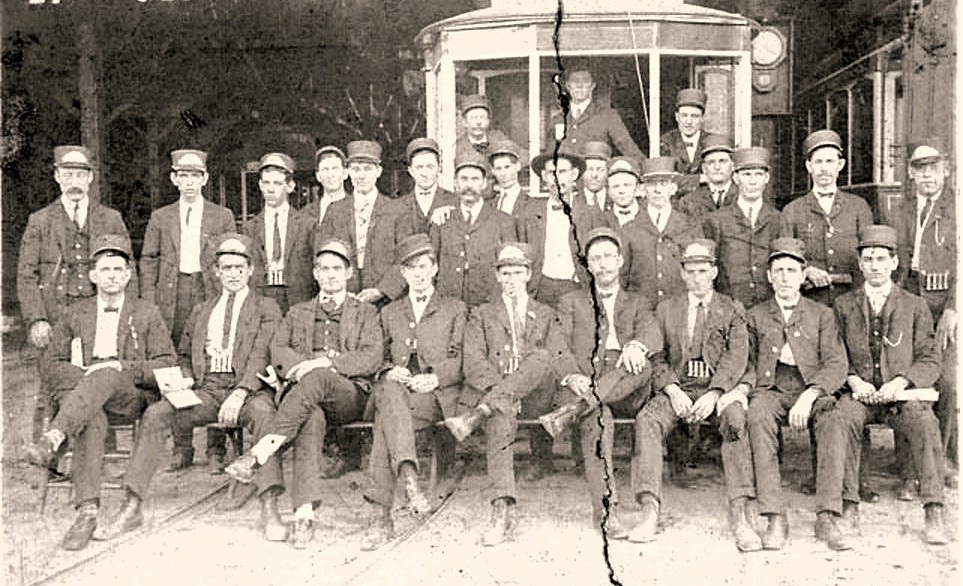
Nearly every town and city in the country had a street car strike, Louisville had several. Here, we follow a dogged comrade, a familiar figure then and now on the left, who tells of his interventions and frustrations in doing what militants do; try to push the situation forward and draw out its political lessons. Though a Southern city, Louisville, Kentucky had for many years a relatively string craft labor movement, thanks to its large German population and strength of industry.
‘The Louisville Car Strike’ by James H. Arnold from The Weekly People. Vol. 17 No. 5. April 27, 1907.
Louisville, April 1. One month ago today Louisville’s big street car strike was “settled.”
The strike began on Sunday morning, March 10, at 5 o’clock, and was ended at a meeting of the strikers on Thursday night, March 14th.
There was to open on the following Monday in Louisville’s big armory, “The Industrial Exposition.” This industrial exposition was advertised extensively, and the merchants and manufacturers had gone to heavy expense to install their exhibits of “goods made in Louisville.” The merchants, business men and manufacturers saw that, if the strike should continue during the time for which the exposition was advertised the show would be a miserable failure and immense sums of money lost. So business men and the merchants and the manufacturers brought pressure to bear on the street car officials to make some “concessions.”
At the same time the mayor was bringing pressure to bear on the striking employes, by having sworn in 100 extra policemen to protect scabs and armed professional strike-breakers, and thus render the street car company all the help he and his Democratic administration could render it to break the strike.
At the same time, the powers that be were in close touch with Governor Beckham, and it was announced in The Times in its issue of March 14th, the very day the strike was settled, that the Governor was preparing to take a hand in the strike; that the militia would likely be called out; that “rioting and disorder” must cease.
Again we have illustrated in the clearest manner the fact that the political powers are the tools of the economic powers. Again we see, if we are not hopelessly blind, that those who wield the scepter of industry also wield the scepter of government.
The men who shape and control the industrial, machine will also shape and control the political machine.
Political power is the offspring of economic power: Political government is the reflection of economic government. The workers who are able to see this and who possess backbone and grit will proceed to build and develop and perfect their economic organization.
On Monday morning, March 11, I visited the car barn at 32nd and Partland avenue to watch, developments, to talk to the men and glean information.
Seven policemen (I think that was the number) were on the sidewalk opposite the car barn. I went inside, where I found about a dozen motormen and conductors who had refused to join the strikers, still in their uniforms.
After a few words to men inside urging them not to crawfish now or show the white feather I went out. I was not at that moment aware that the men on the inside, in the office, were with and for the company. When I went out the car barn boss followed me, and approaching me on the sidewalk said: “I would rather you would not come into the office any more. The men inside don’t like your coercion methods.”
A crowd soon gathered of strikers and strike sympathizers, and a sore-eyed and mottle-faced policeman hurried across the street from the other side and said we couldn’t gather around there. The company has issued orders and we would have to keep away.” I asked him if the sidewalks belonged to the Louisville Railway company.
I took occasion then and there to observe to the men on strike: “You see where the police stand in this strike?” And this faithful and willing servant of the capitalist, political machine hinted that if I were not careful I might get a ride in the patrol wagon.
I asked many of the strikers during that Monday why they did not call out the powerhouse employes, the engineers, the firemen and other employes; and they explained that these men, the powerhouse employes, belonged to another union. One striker explained to me that they wanted to be fair in their strike. They didn’t want to call out the powerhouse employes if they could help it. I answered: “You want to fight with one hand tied behind you.”
Well, I visited the powerhouse myself and had an interview with the engineers, and tried to show them their duty to shut down the powerhouse in the interest of the men and women of their class. But I found them non-union men and apparently possessed of the notion that they belonged rather to the other class, the employers. At any rate they were loyal to “brother capital.”
The chief engineer was getting about $50.00 a week, and that fact explains in a measure his loyalty. I asked him if he were a Christian and he replied that he was, an Episcopalian Christian.
The first assistant and second assistant engineers were also “loyal” to the bosses.
On Monday morning, the second day of the strike, some trolley wires broke at 15th and Walnut streets, and “union” linemen repaired them.
Right next door to the car barn at 13th and Main streets, was a shed for the linemen’s wagon, and the linemen in charge of the repair wagon mingled right along with the striking motormen and conductors.
I visited them in company with a number of strikers and tried to convince them it was their plain duty to refuse to mend any broken wires during the strike, but I could not get them to make the promise, though they said they wanted the strikers to win.
Wednesday night, March 13th, I visited the electrical workers’ union at their meeting and urged them to notify Funk that they would refuse to mend any wires during the strike, and offered to bear the message to Funk myself if they would send it; but they did not let me have the message.
I got in this way an excellent opening to present to them in the most convincing way possible the necessity for the working class solidarity. I think the arguments went home, for the men were liberal with their applause.
Many ridiculous things, however, were said and done during the strike. On Sunday afternoon, the first day of the strike, a mass meeting was held in Germania Hall under the auspices of the A.F. of L. in the interest of the strikers,
At this meeting on the list of speakers was Mr. E.L. Cronk, an old time fakir, and, when his turn to speak came he seemed to realize the importance of his function of harmonizer and the necessity of maintaining his well-earned reputation as a server of the interests of both other capital and brother labor, for he spoke of “the love and esteem existing between capital and labor in other cities,” and thought such relations ought to exist in Louisville. He also took occasion to explain to the audience that he was no Socialist.
Cronk is the same man that in his paper, the “New Era,” thanked the Lord when the 1905 local election was over and it was found that the imported repeaters, domestic ballot-box stuffers, and election thieves under the protection of the police and the then mayor, Charles F. Granger, and Barth, the great friend of labor, had won out.
Cronk is the same man that wrote in his same paper during this same strike that Barth, the mayor, was only doing his duty in placing policemen on the cars, for, of course, law and order must be maintained.
We, the members of the Socialist Labor Party, will do our best to make the workers of this old town see and understand that the political government is there for the express purpose of protecting and preserving the interests of the employing, the master class; and that always in every struggle here and everywhere else the police, the militia, and the Federal soldiery are always ready at the beck and call of the capitalist class to aid in suppressing the struggles of the workers for better conditions or against worse conditions.
It ought also to be noted that the strike-breakers were put on the lines where the rich people live, viz., on Fourth avenue and Second street. It was known of course that the strikers would get little or no sympathy from the rich, and that there on those lines the scabs under the protection of strike-breaker Barth’s police would get more passengers, and would be harder to reach by strikers and their sympathizers. Even over these lines each strike-breaker, one on each end of the car was guarded by two of Barth’s policemen. And at the same time on Second street in addition to the four policemen on each the mayor also directed two mounted policemen to gallop along in advance of the car and clear the streets of people. It was an interesting sight to see two of the mayor’s “finest” mounted on big, magnificent Kentucky horses galloping on ahead of the car and, dispersing the people gathered on the sidewalk while along behind came the car in charge of six strike-breakers–four policemen and two scabs.
The pulse of the workers was beating high. And for the time the strike served to show the immense power the working class can wield when it is rightly organized, educated and disciplined.
This strike clearly showed that the latent power and capacity of the working class is there “to take and hold,” and all that is lacking is the necessary organization of educated, disciplined and determined workers.
The nucleus of that organization is already here and its frame work outlined in the Industrial Workers of the World.
But what did the strikers get? some may ask. Well, Funk said they might keep their union; they could have thirty minutes to eat; 22 cents an hour, platform time only: 25 cents an hour when required to work extra time. Yes, they got a few small concessions. But the fourteen men dismissed for their activity in organizing the union are still, so I have been told, out in the cold. And the open shop prevails, and numerous complaints are being made right along that the officials of the company are not living up to this agreement. The whip handle is still in the hands of the officials.
The right to separate the men from their jobs is still Funk’s and he is exercising it at his own discretion. The relation of industrial master and wage slave is still there.
But many of the men have some new ideas in their heads. A number of them are now readers of the Weekly. People and others of the Industrial Union Bulletin,
JAMES H. ARNOLD.
New York Labor News Company was the publishing house of the Socialist Labor Party and their paper The People. The People was the official paper of the Socialist Labor Party of America (SLP), established in New York City in 1891 as a weekly. The New York SLP, and The People, were dominated Daniel De Leon and his supporters, the dominant ideological leader of the SLP from the 1890s until the time of his death. The People became a daily in 1900. It’s first editor was the French socialist Lucien Sanial who was quickly replaced by De Leon who held the position until his death in 1914. Morris Hillquit and Henry Slobodin, future leaders of the Socialist Party of America were writers before their split from the SLP in 1899. For a while there were two SLPs and two Peoples, requiring a legal case to determine ownership. Eventual the anti-De Leonist produced what would become the New York Call and became the Social Democratic, later Socialist, Party. The De Leonist The People continued publishing until 2008.
PDF of issue: https://www.marxists.org/history/usa/pubs/the-people-slp/070427-weeklypeople-v17n05.pdf
 Revolution's Newsstand