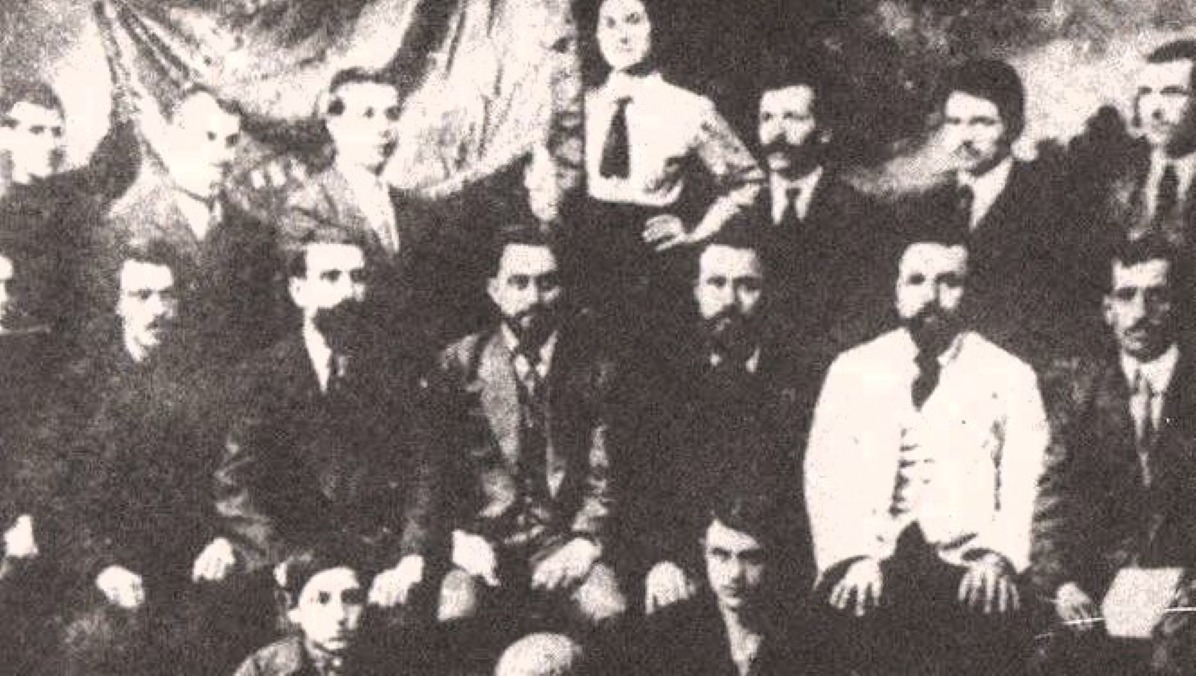
Reports from Young Communist Leagues in Bulgaria, Greece, Yugoslavia, and Romania operating in the most difficult and repressive of environments through several tumultuous years.
‘Young Communist Leagues of the Balkans’ from Activities Between the Fourth and Fifth Y.C.I. Congresses, 1924-1928. August, 1928.
The struggle between the bourgeoisie and proletariat of the Balkan States for influence on the young workers and peasant youth has become extremely sharp during the last four years. The attacks of the reaction against the Communist movement were mainly directed against the Communist youth. In this struggle our Balkan Leagues played a heroic part. In the struggle for the winning over of the young workers, the bourgeoisie not only set up its own organisations and formed neutral organisations, but endeavoured by physical means to exterminate the League. The Leagues in the Balkans suffered heavy losses; thousands of our comrades languish in prisons and hundreds have died in the struggle.
Despite these extremely difficult circumstances (strict illegality, white terror), and in spite of several defeats, the Balkan Leagues have not ceased their work. At the present moment they are somewhat weak numerically, but despite their slow growth, the Leagues have great influence among the young workers and peasants. Wide masses of young workers participated in the various campaigns conducted by the Leagues, such as the International Day of Youth, struggle against war on the Soviet Union (Greece and Rumania), campaign for the sending of a youth delegation to the Soviet Union (Greece, Bulgaria, and Jugo-Slavia). The political activity of the Balkan Leagues is to be found in their active participation in the political life of the Communist Parties. In inner Party questions the Leagues stood firm for the line of the Y.C.I. and the C.I.; in the struggle against opportunism and liquidatory elements (Greece), against Right Wing tendencies and fractional struggle (Jugo-Slavia), against all waverings and for complete acknowledgement of all errors, against legalism (limiting work within legal restrictions) and liquidation tendencies (Bulgaria and Rumania).
The Balkan Leagues have acquired a certain amount of experience in the sphere of legal forms of work.
Economic trade union work has been conducted somewhat poorly. Press agitation and propaganda was conducted satisfactorily only by the Greek League. The Jugo-Slavian League was the only League regularly to publish an illegal press. With the exception of the Bulgarian League, no work against our opponents has been conducted. Some activities in anti-militarist work was conducted by the Greek, and partially by the Bulgarian League. Fairly energetic work was carried out among the peasant youth.
The Greek League
The Greek League for some period worked under conditions of illegality, but after the fall of the dictatorship of Pangalos (from the end of 1926 to March, 1928), the League became legal. Up to the end of 1926 sectional tendencies were strongly developed within the Greek League, and generally speaking, the work of the Greek League was unsatisfactory. In February, 1927, the Greek League, with the aid of the C.C. of the Y.C.I., held its Congress, and from that time great successes can be recorded in all spheres of its work. The Greek League is one of the few sections of the Y.C.I. which can boast of a ceaseless influx of new members during the past year; during this period the League has increased to three times its previous membership. Owing to its active political work, the League at the present moment plays an important role in the Greek Labour Movement. It has also played a large part in the struggle against the liquidational tendencies within the Party and in the liquidation of the Party crisis. The Greek Y.C.L. is the only youth organisation of young workers in Greece. The League publishes a weekly paper with a sale of 9,000 copies, and a monthly journal for its leading members with a sale of 2,500 copies. Despite the great numerical growth, there still exists a great discrepancy between the organisational strength of the Greek League and its political influence. The League has conducted a number of mass campaigns. Nearly 30 per cent. of the League membership is organised in factory groups.
The League suffers from a lack of active workers. The task before the League at the moment is preparation for work under illegal conditions, and following on this the struggle for a legal League.
Apart from the afore-mentioned papers and journals, the League publishes a paper for students and “The Communist Library”; fifteen pamphlets have already been issued. The economic trade union work is unsatisfactory, although the League has great influence, for instance, among young tobacco workers. In Thrace and Macedonia the League led several strikes of adult workers. Youth sections exist in several trade unions. At the present moment the League is carrying out systematic propaganda for the organisation of youth sections in all trade unions. The number of organisations in the villages continuously increases, and several village conferences have been held.
The League founded the “Anti-Fascist Guard,” already by the end of 1927, which consisted of 700 young workers, half of whom were non-Party.
The League conducts a certain amount of work in the Workers’ Sports Movement; 1,200 young workers are members of workers’ clubs which are under League influence. At the present moment the League is carrying out a campaign for the formation of a Workers’ Sports League.
The Jugo-Slavian League
The Jugo-Slavian League began serious illegal work only after the break-up of the legal Workers’ League of Youth in 1925. While the former organisation existed legally the illegal activities of the Y.C.L. were very weak. Now the League fairly regularly (once in two months) publishes an illegal paper (“The Young Bolshevik”), issued in several thousand copies. Groups are organised in many factories. However, the inner life of the League organisations is very poor. The work of the nuclei is exceptionally weak. During the past two or three years the social composition of the League has improved.
In July, 1926, the Third League Congress was held. The previous activities of the League were criticised in a Bolshevik fashion and the main future tasks outlined. Up till the time of this Conference practically no trade union work had been conducted. A sectarian tendency exists within the League (Macedonia). The Congress considered very thoroughly all questions relating to mass League activities; work within the trade unions (youth sections), and amongst youth peasant organisations, and the youth of oppressed nationalities, questions of struggle against Fascism and work in the army, and also the questions of Communist educational work. Its influence among the young workers grew, and organisationally the League was strengthened. The League commenced work within the trade unions. The Jugo-Slavian League paid insufficient attention to the possibilities of legal activities. Up to the present only a small number of youth sections were organised within the trade unions. It is necessary to mention that in this work the League meets with opposition from the Conservative and Right Wing leaders of some of the trade unions.
The League has practically no organisations in the industrial regions–in Slovenia and partly in Voivodino–where there are large Party organisations, and also in various peasant districts of Croatia and Bosnia. Despite the existing danger of war, anti-militarist work is only in its elementary stage, and only in Dalmatia has it been conducted at all intensively. The work within peasant organisations and amongst the youth of the oppressed peoples was very weak. The technical apparatus of the League also leaves much to be desired.
During the last year the League has suffered many heavy losses in the struggle against reaction. During the past two years the leading cadres of the League, owing to the break-up of the League, have changed three or four times.
The League played an important part in the inner Party struggle, particularly in the fight against the right social democratic tendencies within the Party. With the exception of several slight waverings, the League in all questions carried out the line of the Y.C.I. and the C.I.
The Bulgarian League.
After the Fourth World Congress the Bulgarian League passed through three stages in its development: (1) The period before it was broken up in connection with the attack on the Sofia Cathedral (mass murder, mass arrests, many death sentences, and a number of long-term imprisonments); (2) period before the raids in September, 1926; (3) period from In all these three periods, September, 1926, to the present time the Y.C.L. struggled, in the face of unheard-of terror, the like of which has not been seen in any other country, to carry out active Communist work the among young workers.
The first period began immediately after the defeat of the September uprising in 1923. The League was soon able to bring together its forces and begin energetic illegal, as well as legal, activities. It showed great political activity, and organised wide mass demonstrations, in which young workers and peasants participated. At the beginning of 1925 it numbered 4,000 members; it was organised on a factory group basis, and conducted intensive work within the trade unions, and led various legal organisations (sports, cultural, etc.). Apart from the publication of regular legal and illegal papers, the League also issued leaflets, factory papers, and several pamphlets. The League was able successfully to conduct the United Front tactic. Within the League an intensive educational campaign took place for the purpose of training League members how to behave in the event of their appearing before the Fascist court.
The second period is characterised by the endeavour to get into touch with those organisations which were broken up as a result of the reaction which reigned after the Sofia events. This was effected within six months (middle of September, 1926). Despite the worsening objective conditions, the League was able to revive its organisations in the most important districts. After the Sofia events the bourgeoisie mobilised all its forces for the winning over of the youth. A number of bourgeois and neutral organisations were formed. Nevertheless, our League was able again to win the confidence of the young workers, cause crises to take place within various bourgeois organisations, and again to achieve leading roles within various legal organisations of working and peasant youth. In the sphere of its legal activities, the League committed a number of opportunist mistakes (tactic of United Front with the Socialist Youth League), which were, however, liquidated with the assistance of the Y.C.I.
In September, 1926, the C.C. and leading cadres of the important League organisations were broken up. Following on this came mass arrests, mass penal servitude sentences, terror, etc.
Again before the League stood the task of reviving its connections and organisation. In this connection much has been done, but at the present moment this task has not yet been completely fulfilled. The League energetically fought against liquidation tendencies which existed within the Bulgarian Party and against the desire to conduct its work only within legal limits. The League has to work under extremely difficult conditions: (1) The results of the last attack on the League have not yet been thoroughly liquidated; and (2) the necessity of energetic struggle against liquidation and opportunist tendencies. Reaction and the policy of the Fascist Government cause the growth of a mass movement of young workers and peasants. The Y.C.L., despite all difficulties, has been able to place itself at the head of this movement. The political activities of young workers and peasants develop under the slogans of the League. The young workers within the bourgeois and Fascist sport organisations are gradually moving leftwards.
The trade union work of the League is not very satisfactory, but great successes have been arrived at in the utilisation of legal possibilities. The League conducted several good campaigns; for amnesty of political prisoners, the sending of a youth delegation to the Soviet Union, 1st May Celebrations, etc.
Rumanian League.
After the World Congress the Rumanian League, despite the heavy blows of the reaction which at one time was able simultaneously to break up nearly all League organisations, had to fulfil three main tasks placed before it by the Fourth Congress (1) Uniting under the leadership of the C.C. five different Y.C.L. organisations, which up to 1924 had existed independently in various provinces; (2) take an active part in the political life of the Party (struggle for independence of Bessarabia, campaign in connection with the Tatar-Bunar case, participation in municipal and Parliamentary elections, winning over of young unemployed workers, strike of printing workers); active participation in Party work (struggle against liquidation tendencies, fight against Kristescu and against various other deviations).
The League actively participated in the revival of the Party organisation. As a result of innumerable attacks on the League it is organisationally very weak. The level of underground work is very low. At the present moment more than 500 members of the League are imprisoned.
The League conducts energetic trade union work, and has been successful in winning the leadership of several trade union organisations. Work amongst the peasant youth is improving, and several village groups are in existence. The anti-militarist work of the Rumanian League has been very weak.
The League publishes its organ, “The Young Leninist,” irregularly, in editions of 450-500, in Russian, Rumanian, Hungarian, and German.
PDF of full book: https://www.marxists.org/history/international/young-communist-international/cyi-4th-to-5th.pdf
 Revolution's Newsstand