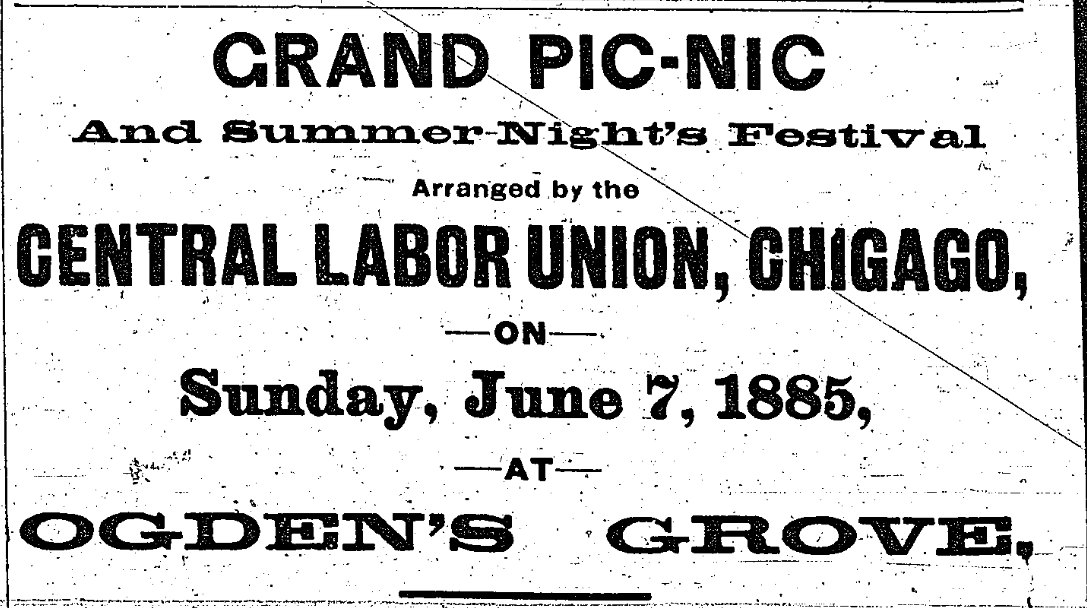
Albert Parson’s newspapers reports on the proletarian revelry in Chicago held under the auspices of Central Labor Union and the International Working People’s Association.
‘A Revolutionary Gathering’ from The Alarm (Chicago). Vol. 1 No. 24. June 13, 1885.
THE CENTRAL LABOR UNION—TRADES UNIONS MARCH BENEATH THE RED FLAG TO THE PICNIC IN OGDEN’S GROVE.
The Military and Police Authorities Held Under Arms.
SPEECHES, MUSIC, DANCING AND SOCIAL COMMUNION THE ORDER OF THE DAY.
A Revolutionary Gathering.
The Chicago Central Labor Union is a central body composed of delegates from the butchers, metal workers, cigar makers progressive, carpenters and joiners, furniture workers, fresco painters, tassel makers, hand laborers and other trades unions, which holds its sessions semi-monthly at their hall, No. 54 West Lake street. On last Sunday a grand demonstration and picnic was given under the auspices of the Central Lapor Union, participated in by the above Unions and the International Working People’s Association. The weather was all that could bel desired. About 10 o’clock the line formed on Market street, between Randolph and Madison, and to the inspiriting music of three bands, the 2,000 workingmen moved east on Madison street. The Stars and Stripes headed the column, followed by twenty-three red flags of Solidarity, which were carried by the different organizations comprising the procession. At Clark street the line moved north to Kinzie, thence to Wells, north to Division, thence to Larrabee and Clybourn avenue, and thence to the grove.
Inscribed on the banners were these mottos “Poverty is a Crime,” “Exploitation is Legal Theft,” “Workingmen Organize,” “Wages is Slavery,” “Liberty Without Equality is a Lie,” “All Workmen have Identical Interests,” “Workingmen of the World Unite,” “The Priesthood Subserves the Exploiters of Labor,” “Anarchy,” “No Rights With out Duties; no Duties Without Rights.”
After reaching the grove the throng dispersed under the cooling shade of the trees and in the booths which abound there. The large dancing platform was occupied by the dancers till 4 o’clock, when the bugle sound assembled those present, who numbered, by this time between 3,000 and 4,000 The chairman introduced comrade Samuel Fielden to the audience. He said that they had assembled to snatch a moment’s recreation from their daily round of toil, and also to make a manifestation of their discontent with the existing order of things. When labor becomes its own master picnics would not be an exception but the rule, and life would cease to be a burden and become a pleasure. Today the children of the poor were born under conditions wherein there was nothing better than for them to become criminals and slaves. Those children of labor were sacrificed to that demon, the Beast of Property who robbed the poor of the necessaries of life. Capital in private hands became the instrument of labor’s enslavement. It was by this means that the producer was made and kept poor. Producers had a natural right to control their product, and the law of self-preservation demanded the exercise of that right. Capital must become common property which each and all could freely use without let or hindrance. In this way each person would be compelled to work in order to live, and no one could live upon the earnings, or deprive another. They must organize and take their rights by force, or submit like slaves to misery and death. Armed resistance was not possible while capital controlled all the elements of military warfare, but dynamite, and those destructive explosives which science had placed within the reach of the oppressed could be used with effect. It was the duty of the despoiled workers to become familiar with the use of these insidious little messengers which startle tyrants by their shock. Gen. Phil. Sheridan had told us that these missives could be carried around in one’s pocket with perfect safety to themselves, and used in such a manner that whole armies and cities could be destroyed. It was necessary to organize against the government, the authorities, for governments were only needed to bolster up privileges and perpetuate the domination of class rule. Government was for slaves. Anarchy alone gave freedom to all. Shall those who suffer tolerate its existence? No person should be permitted to own private property, but every one should have a perfect right to the whole world. In this struggle between the wage slave and his master it is better to die fighting for liberty, fraternity, equality for all mankind than to slink off and perish of hunger, want, anxiety and slow, miserable disease. Workmen of the world, unite. You have nothing but your chains to lose; you have a world to win!
The speech was cheered throughout. After he had finished Comrade Michael Schwab addressed them in German, at the conclusion of which the band played the “Marsellaise,” and with prolonged cheers for the “Social Revolution,” the vast throng dispersed amid the grove. Dancing, social converse, and basket lunches ended a day which will long be remembered as one of the most pleasant of the year. Let it be recorded that on this day another firm resolve was made by the workers to achieve their economic freedom or die in the attempt,
It transpires that in the early morning, groups of policemen and militiamen were kept in secluded places along North Wells street to watch the movements of these revolutionary workingmen. After the passage of the procession they were withdrawn and dispersed to their homes. Has it come to that pass in Chicago that the wage slaves of this city are constantly kept under the shadow of the bayonets of the labor exploiters?
The Alarm was an extremely important paper at a momentous moment in the history of the US and international workers’ movement. The Alarm was the paper of the International Working People’s Association produced weekly in Chicago and edited by Albert Parsons. The IWPA was formed by anarchists and social revolutionists who left the Socialist Labor Party in 1883 led by Johann Most who had recently arrived in the States. The SLP was then dominated by German-speaking Lassalleans focused on electoral work, and a smaller group of Marxists largely focused on craft unions. In the immigrant slums of proletarian Chicago, neither were as appealing as the city’s Lehr-und-Wehr Vereine (Education and Defense Societies) which armed and trained themselves for the class war. With 5000 members by the mid-1880s, the IWPA quickly far outgrew the SLP, and signified the larger dominance of anarchism on radical thought in that decade. The Alarm first appeared on October 4, 1884, one of eight IWPA papers that formed, but the only one in English. Parsons was formerly the assistant-editor of the SLP’s ‘People’ newspaper and a pioneer member of the American Typographical Union. By early 1886 Alarm claimed a run of 3000, while the other Chicago IWPA papers, the daily German Arbeiter-Zeitung (Workers’ Newspaper) edited by August Spies and weeklies Der Vorbote (The Harbinger) had between 7-8000 each, while the weekly Der Fackel (The Torch) ran 12000 copies an issue. A Czech-language weekly Budoucnost (The Future) was also produced. Parsons, assisted by Lizzie Holmes and his wife Lucy Parsons, issued a militant working-class paper. The Alarm was incendiary in its language, literally. Along with openly advocating the use of force, The Alarm published bomb-making instructions. Suppressed immediately after May 4, 1886, the last issue edited by Parson was April 24. On November 5, 1887, one week before Parson’s execution, The Alarm was relaunched by Dyer Lum but only lasted half a year. Restarted again in 1888, The Alarm finally ended in February 1889. The Alarm is a crucial resource to understanding the rise of anarchism in the US and the world of Haymarket and one of the most radical eras in US working class history.
PDF of full issue: https://dds.crl.edu/item/54012
 Revolution's Newsstand