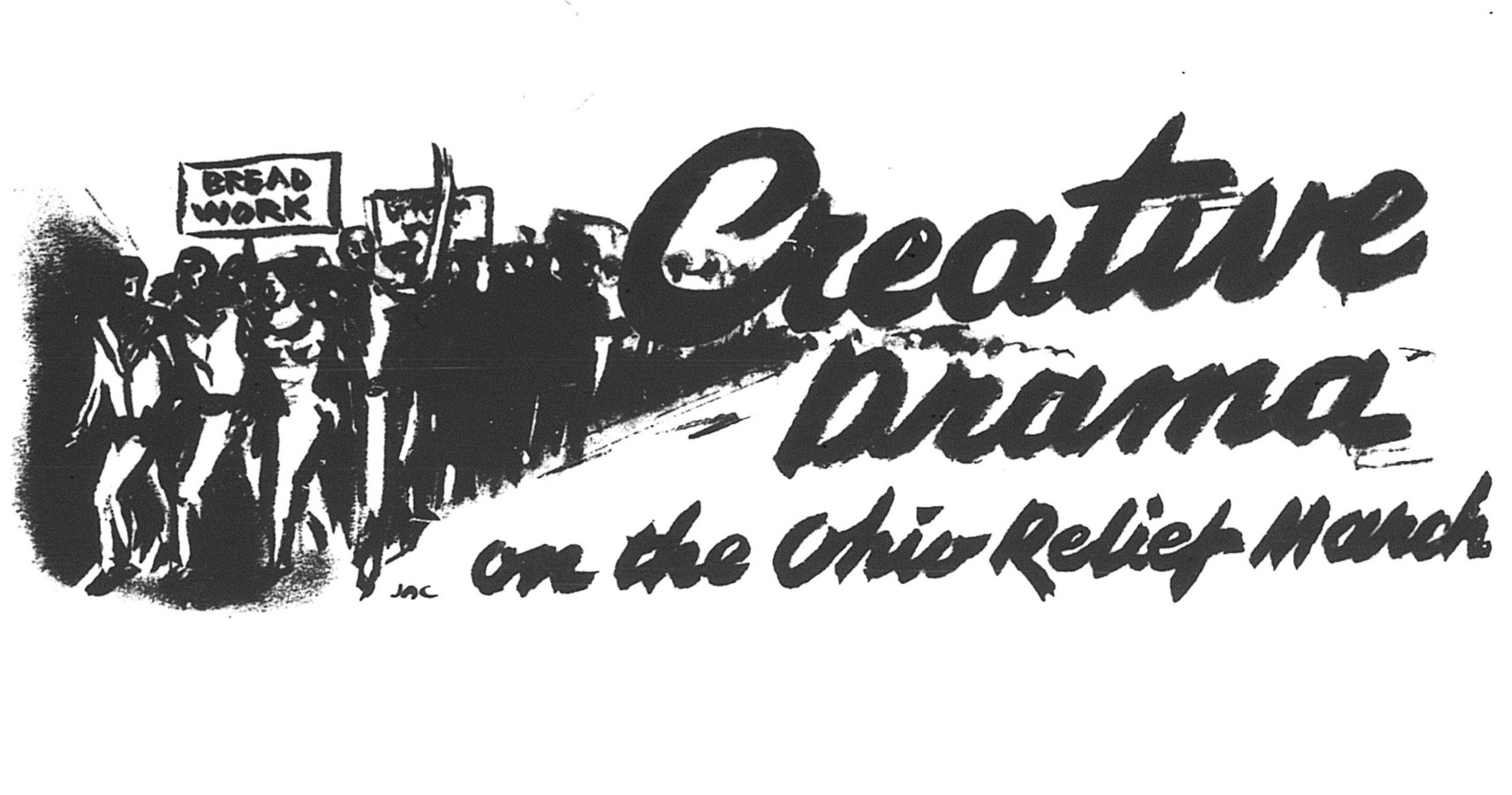
The experience of theater troupe accompanying an Ohio Hunger march during the Depression, performing plays and skits each night as they go.
‘Creative Drama on the Ohio Relief March’ by David Hilberman and Henry Mitchell from New Theatre. Vol. 1 No. 1. September, 1933.
Two of us, members of the John Reed Club and the Cleveland Section of the League of Workers Theatres joined the Ohio Relief March to Columbus. The march was an action to win relief for the unemployed from the state government. Our plans were vague. We thought theoretically of “spontaneous” drama, of evening entertainments. In Massillon, where we met the marchers encamped, we were placed on the Education Committee, and the question of activities became urgent. We looked over our plays. This was not a narrow sectarian march. The only two nearly appropriate plays we had been able to find in Cleveland were “Charity” and “Mr. Morgan goes Calling”. Full of young regrets and misgivings, we went to sleep in the frigid open pavilion, on the hard cement floor, the only shelter the marchers could get (and that secretly and without permission) in this city of the “liberal” Farmer-Laborite, Mayor James Coxey, himself once a hunger marcher. There had been dissension among the marchers all day; quarrels and kicks about the food.
Then the next day reality swooped down on us. We were eating our lunch on the road to New Philadelphia, when an army of empty trucks drew up alongside us, and from all directions, cops and deputies and sheriffs and police chiefs, the entire blue-coat force of three counties, leapt out upon us. They lined up, loaded to the ears with cocked rifles and sawed-off shot guns and machine guns and riot-guns, and a tall burly guy yelled out to us:
“Who’s your leader?”
Our leader stepped forward and was grimly told that the marchers would have to get the hell on to the trucks, and quick too!
“You ain’t stopping anywheres near New Philadelphia tonight! We’re taking you right across the county line!”
Our leader nodded ostensibly, said he would have to make the announcement officially to the marchers. This was the wise tactic. He leapt on a truck, and asked the massed marchers, two-hundred of them, for their voice:
“We accept the ride, but they take us where we planned to go! And no armed men on the trucks! All those in favor–The usual sign…”
And the marchers raised their clenched fists and let out a roar of militant decision. The rest was easy. We had it our way then. We turned back to a changed line-up; guns had been suddenly lowered or ducked out of sight. The sheriff of the county himself had disappeared He had to be called, to make the decision of the marchers known to him.
“All then….all right, that’ll be all right, then…”
So the marchers were taxied at county expense to the farm of a sympathizer, a couple of miles from New Philadelphia. All were in high fettle. The sheriff was as smooth as oil now, and out of this first successful action, the plan for the first play arose whole and ready for performance. About a dozen of the youth were gathered up, and all making contributions, an uproarious playlet was knitted together in quick time. The plot-line completed, roles were assigned, and three running rehearsals held right there. One more after supper–and the program was on. No speeches or dialogues were memorized, no cues, the participants were speaking fresh out of their own bowels! The stage was a cleared space with a rope tied between two boxes; the spotlights of two autos were thrown from the sides; no props or scenery or effects, of course, except the natural ones out of which the play had sprung. It was a great success. It struck the marchers in the face. Why, what was this? It was themselves acting! It was just a minute ago was it a play already! It was like reading something in a newspaper just a few minutes after witnessing the event. Real working class art-service this–attaining and surpassing the capitalist!
The workers also undoubtedly learned from this something about the “mysteries” of creation, from which they had always been made to feel so terribly aloof!
Next stop was Coshocton. The echo of the victory at New Philadelphia, was like a carpet of welcome to us. We were given the county fair grounds and food for a two-day stay. In the big dining-hall, we rigged the heavy tables together and formed an excellent stage. Circus seats along the sides for the marchers, and park benches from outside for workers from the city who visited us by hundreds. Each night we were here we gave dandy two-hour programs: music, chalk-talks, stirring appeals hot from action bidding the unorganized to organize, humor and plays. One play each night.
The first night we gave “Mr. Morgan”. Though we had many hours to rehearse it, “Mr. Morgan” was somehow stiff and cold on the boars that night. The marchers felt it distant from them too; the Coshocton workers reacted more warmly to it than they; after all, they hadn’t bucked a police terror of 50 armed thugs!
Next day, we thought of means of correcting this. But revolutionary plays are not squeezed out of the mind or will of individuals it springs naturally from the fighting experience of the revolutionary masses. The best we could do, after all, was take “Charity” and make it over, to serve as an educational feature for our visitors. Education within and without was the chief objective of our march. If we could demonstrate to the unorganized workers of Coshocton the living conditions out of which real mass action can rise, we would be performing an important task. We left the first part of “Charity” as it was: we carried the individual worker to a pessimistic conclusion, after he had depended upon the beneficence of capitalist charity; Then we smashed in on his pessimism and indicated concretely the fighting way out of his misery, the way of mass action, the way of the Unemployed Councils.
Nevertheless, the play did not attain the effect of the New Philadelphia one. The players and marchers felt only a partial relationship to the action. And we realized at this time that perhaps there was a certain type of drama that could really live only for the short moment and under the stress of the peculiar conditions and events in which it had been created, still warm from the birth-giving action, and shared by a mass of workers who had been welded together by a common fighting goal, and who had personally partaken of this action. This seemed to indicate certain possibilities, besides: of plays derived directly from actions like this–from strikes, from marches on relief agencies, from eviction resistances, from demonstrations–summarization of the silent features–and presented within an hour, if need be, or at evening entertainments, to and by the workers who had engaged. In this way, art becomes a medium hardly differentiated from reality and nevertheless assumes a form which is broad enough to include a full education: drama, humor, satire, clarification of political errors, insistence on correct action, etc.
But further down the road toward Columbus, where the reputation of the marchers had already dimmed, there was more attacks of the armed “authorities” and more militant resistance by the marchers. These entered into the living issue of our two last play, which were the best and most successful of those given on our march. The workers got to love these plays, and many of them would approach us throughout the day asking if we would have another that night. What disappointment if we said no, and what pleasure if we said yes! Workers’ drama had quickly become a part of their lives how easy it would really be for them to work themselves all the way into true proletarian culture! Unfortunately, this march was merely an isolated period of their lives; but it was nonetheless an exciting promise of what can be done in more permanent ways.
The New Theater continued Workers Theater. Workers Theater began in New York City in 1931 as the publication of The Workers Laboratory Theater collective, an agitprop group associated with Workers International Relief, becoming the League of Workers Theaters, section of the International Union of Revolutionary Theater of the Comintern. The rough production values of the first years were replaced by a color magazine as it became primarily associated with the New Theater. It contains a wealth of left cultural history and ideas. Published roughly monthly were Workers Theater from April 1931-July/Aug 1933, New Theater from Sept/Oct 1933-November 1937, New Theater and Film from April and March of 1937, (only two issues).
PDF of full issue: https://www.marxists.org/history/usa/pubs/workers-theatre/v1n01-sep-oct-1933-New-Theatre-NYPL-mfilm.pdf
 Revolution's Newsstand