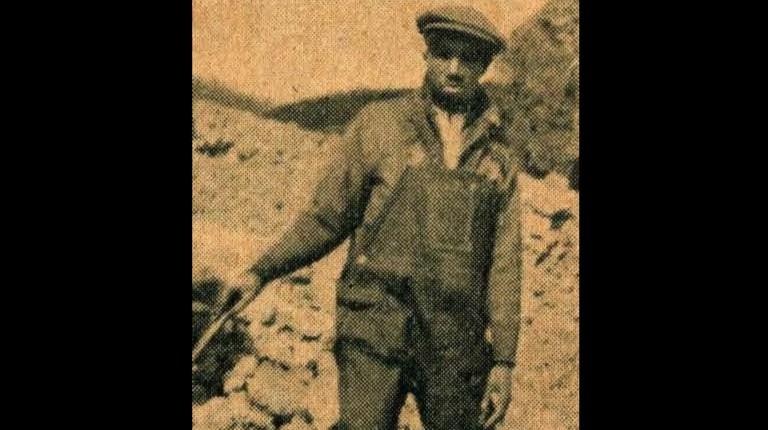
The story of one long, dangerous night of organizing from the brief, but consequential life of Gilbert Lewis. Originally from New Orleans and born in 1904, Lewis left school young to life as a migratory worker. Ending up in New York City as window cleaner, he soon became active in union organizing among his fellow workers, which led him into the Communist Party and began writing for the Daily Worker. In early 1930, Lewis went back down south as an organizer for the Trade Union Unity League; a potentially deadly assignment. Jailed, he contracted tuberculosis and after his release traveled to the Soviet Union for medical treatment where suffered a further relapse and tragically died in a Yalta sanatorium on June 1, 1931 at just 26.
‘In a Southern Mill Town’ by Gilbert Lewis from New Masses. Vol. 6 No. 2. July, 1930.
It was the night of May first. We held a fine protest meeting during the afternoon at the very steps of the City Hall, and were now sitting in the rear of the small store, where we usually met, discussing plans for future work. Suddenly the telephone rang. It was a long distance call…two of our comrades speaking from a Georgia mill town.
Trouble was brewing; the outlook was bad. Mary, organizer for the National Textile Workers Union, (now facing a possible death sentence in Atlanta on charges of distributing “insurrectionary” literature), a mere kid of 19, militant, fearless, was speaking:
“It looks tough, Gil. We distributed leaflets calling a meeting for tonight. Now we just learned that the mill bosses are planning to attack the meeting…they’ve got together some 75 thugs armed to the ears. Now, listen Gil, grab a car and get down there as quick as you can. They won’t attack until after the meeting…It may be possible to avoid trouble by getting away from there right after … A cotton mill worker with a car?…don’t be a damn fool. Borrow some comrade’s car. But be careful…”
We immediately got in touch with two comrades who owned cars. Both were out of order. We called a taxi station…a Negro taxi station. He agreed to take us for twenty-five dollars cash. Absolutely the best he could do.
We began canvassing comrades and sympathizers for the money. We had little difficulty in making them appreciate the situation and soon had the required amount…but not before eight-thirty.
Eight-thirty. We had to be there by ten o’clock at the latest. The town was seventy miles away. We would have to drive like hell. The driver promised us he would make it…
He did. We got there at ten-five on the dot. The meeting, if there had been one, was over. Not a soul in sight. The place seemed strangely quiet. We got out of the car and, having no matches, began to crawl around on the ground searching for leaflets, mute evidence that the meeting had at least begun.
We found several, thoroughly crumpled and trampled. It didn’t look so good. We began to feel pretty bad…and pretty vicious. If those bastards had pulled any rough stuff…
We crawled back into the big Cadillac. The comrade who was with me remembered the address of a worker, member of the union. We drove to his house. He was in bed but we dragged him out…
No, nothing serious had happened. The bosses had made an effort to start something but it seemed they had heard of Gastonia. They came armed, alright. But when they saw we were prepared for them, they sent out for six dozen rotten eggs and began hurling them at the speakers. No…they couldn’t smash the meeting. It was a success. Yes…he knew where we could find the organizers…
After assuring ourselves that our comrades were OK we started home. As we struck the main road, a small roadster, occupied by two bourgeois rounders, pulled in front of us. Our driver sounded his horn several times, but they refused to give him the right of way. Picking’ an advantage at an unusually wide place in the road, our driver sped past him. It was close but unavoidable.
A second or so later, the roadster darted past us and once again slowed down in the center of the road. Again our driver sounded his horn; again they refused to give him the right of way. Our driver stopped sounding his horn and waited to guess their motives. Finally the roadster stopped and the rounders got out and came back to our car.
They accused our driver of not blowing his horn and attempting to run them into a ditch. Our driver denied the accusations. Suddenly the bourgeois rat, who previously had been blinded by the light, recognized the color of our driver’s skin.
“Say! You’re a N***r, ain’t you!” he screamed. “Well, you black son of a bi…” He snatched at the door of the car. It gave just in time to let our driver’s fist pass out. It landed square on the rat’s chin, sending him spinning from the running board into the street. Almost simultaneously our driver pressed his foot on the accelerator. The big Cadillac quivered, heaved and plunged forward…The rat jumped and dashed for his own car.
Our driver took the road at seventy miles an hour. The highway was deserted and well-paved, lending itself to fast driving. The big “cad” hissed and sputtered and gripped the asphalt like car wheels grip the rails. The rat, however, also had a fast car…
This speed kept up for about twenty-five miles, with the rat steadily gaining ground. Then suddenly we struck a sharp, very sharp, curve. The big Cadillac swayed and quivered and for a few seconds we thought we were headed straight into space. The driver kept his head, gripped hard on the steering wheel and pressed on the accelerator. We made it by a hair’s breadth.
We sat up, drew a deep breath and looked back for the rat. He was just making the turn. We could see the reflection of his lights far out in the woods to the right of us. Then suddenly, they disappeared. We never saw them again.
I watched the Georgia papers for a week, but saw no account of the accident. Maybe I was wrong. But I would give almost anything to know what caused him to change his mind so suddenly.
It was 3:30 A.M. when I got home. I fell across the bed and slept like a top.
The New Masses was the continuation of Workers Monthly which began publishing in 1924 as a merger of the ‘Liberator’, the Trade Union Educational League magazine ‘Labor Herald’, and Friends of Soviet Russia’s monthly ‘Soviet Russia Pictorial’ as an explicitly Communist Party publication, but drawing in a wide range of contributors and sympathizers. In 1927 Workers Monthly ceased and The New Masses began. A major left cultural magazine of the late 1920s and early 1940s, the early editors of The New Masses included Hugo Gellert, John F. Sloan, Max Eastman, Mike Gold, and Joseph Freeman. Writers included William Carlos Williams, Theodore Dreiser, John Dos Passos, Upton Sinclair, Richard Wright, Ralph Ellison, Dorothy Parker, Dorothy Day, John Breecher, Langston Hughes, Eugene O’Neill, Rex Stout and Ernest Hemingway. Artists included Hugo Gellert, Stuart Davis, Boardman Robinson, Wanda Gag, William Gropper and Otto Soglow. Over time, the New Masses became narrower politically and the articles more commentary than comment. However, particularly in it first years, New Masses was the epitome of the era’s finest revolutionary cultural and artistic traditions.
PDF of full issue: https://www.marxists.org/history/usa/pubs/new-masses/1930/v06n02-jul-1930-New%20Masses.pdf
 Revolution's Newsstand