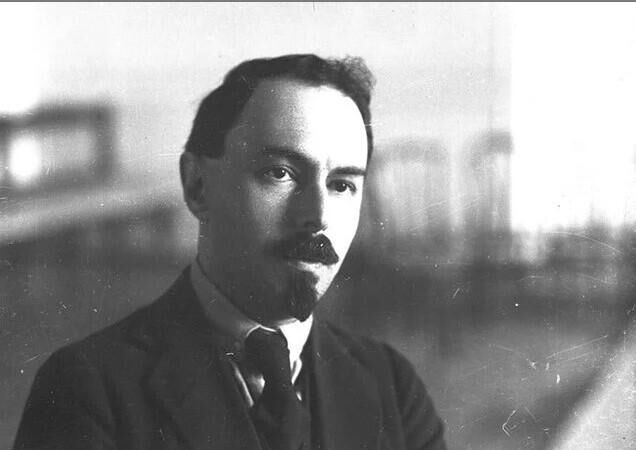
The leading Communist economist reviews the progress of the New Economic Policy and gives an outlook for the next year in this report from the People’s Commissar for Finance given at the All Russian Central Executive Committee on July 3, 1923. A Bolshevik since 1905, with a doctorate in economy from the Sorbonne after escaping from Siberian exile, was on the Central Committee after 1917 and directed the nationalization of banks after the Revolution. A Red Army commissar in the Civil War, Sokolnikov served as Commissar of Finance from 1922-1926. With Krupskaya, Kamanev, and Zinoviev, he was a leading member of 1925’s New Opposition, and like many oppositionists was moved to the diplomatic corp, becoming Ambassador to Britain. A victim of the purges, he was arrested in 1936, broke and became a chief accuser of Bukharin. Which did not save him from being murdered in prison on May 21, 1939.
‘The Financial Policy of Soviet Russia’ by Grigory Sokolnikov from International Press Correspondence. Vol. 3 No. 54. August 7, 1923.
On the road to health.
The two main questions of our financial policy, the limitation of the issue of banknotes, and the financing of industry, are closely bound up with one another.
In order to grasp the connection between the two, we must divide our information budget for the year 1922/23 into two parts. One part, the regular budget, represents the whole of our current revenues and expenditure. The second part, the extraordinary budget, would contain our extraordinary expenditure for the reconstruction of our economy. The proportions would then be such, in a budget totaling about 1400 million gold roubles, that 1050 millions would be required for the regular expenditure (state apparatus, state defence, cultural needs, etc.), whilst 350 millions of gold roubles would represent the extraordinary budget, the sums required to cover the deficit in the transport service and industry, and for aiding agriculture.
If we were to divide our revenues in a similar manner, we should arrive at the following result: Our revenues from taxes in cash and in kind amount to about 1050 gold roubles from state undertakings and credit operations. The amount of our deficit not covered by credit operations amounts to about 350 million gold roubles; this can only be covered by the issue of banknotes. Thus the 350 million gold roubles, estimated in the extraordinary budget for extraordinary expenditure, would have to be set against the extraordinary revenues of approximately the same value.
It will be seen from these figures that during the current year our state has been operating on a more or less firm financial foundation with regard to its normal expenditure.
This has, of course, only been possible by the severest restriction of all state expenditure, and the general level of our state existence is still exceedingly low. But our state has a fairly secure position, at this level, which could not have been maintained a year ago, when our state economy was being operated on a still more modest scale.
This comparison of ordinary and extraordinary expenditure logically points out our task: in what manner can we wipe out the deficit in our industry and transport, and in what manner can we find taxes and means of revenue enabling us to cover this decreasing deficit by normal taxation and income, not by the inadmissible means of issuing fresh banknotes of depreciating value.
Financial economy and industry.
During the current year, transport, industry, and agriculture have been subsidised at the expense of the state by a total amount of about 350 million gold roubles, of which industry alone has received about 140 to 150 million gold roubles for replacing its fixed capital and supplementing its circulating capital. State orders have also contributed to improving the situation of industry. The deficit is very great in the transport service. This year it exceeds 140 million gold roubles. But of this a great part is employed in paying for consignments ordered by state industry. If we take all the factors into consideration, we may say that our state is no longer living at the expense of its industry. New life flows from the state reserves to industry and transport, rendering their restoration and revival possible. At one time state industry and state finance were not separated at all. Everything which belonged to industry was equally at the disposal of the state, and everything belonging to the state belonged equally to industry. The result of this system was that, as industry was still in possession of old reserves, and could use up its fixed and circulating capital, and as, on the other hand, the state had but scanty cash reserves in its treasury, the state existed on the fixed and circulating capital of industry. All this lasted until the beginning of the year 1922. At the beginning of 1922 it was decided to pass from the so-called fixed budget (which was accepted at the end of 1921 and was only three months in force) to the provisional budget, on the principle that everything supplied by industry to the state was to be paid for by the latter. State power and state industry were juridically separated. It was, however, not possible to carry this measure through completely everywhere. But, by the end of the summer, thanks to the improvement in the Soviet finances, due to the development of the taxation apparatus and to the success of the bread loan, this defect was, to a great extent, remedied.
In the autumn of 1922 our taxation revenues and the establishment of a sound economic basis began to assume definite shape, and we were successful in accomplishing the transition to the system of paying the real cost prices.
It is, in any case, an abnormal phenomenon for industry and transport to be nourished at the expense of the budget, that is, by means of resort to the revenues of taxation, paid in the main by the peasantry. There is no doubt whatever but that we must aid industry and transport by state subsidies, if they are to make the progress which it is necessary that they should make. And this we shall have to do not only for the current year, but for several years to come. We must make it clear to the masses of the peasantry that such a policy is not only in the interest of industry, but at the same time in the interest of our economy as a whole, as no real improvement in the agricultural situation is possible without a revival in industry and transport.
It is probable that the amounts to be expended by the state for replacing fixed and circulating capital in industrial undertakings will be less next year than this. It is possible that next year we shall not yet be able to reduce the very considerable subsidy allotted to the Don basin. But with regard to naphtha production we may confidently reckon upon not being again obliged, next year, to expend 30 millions, as this year it was necessary to supply supplementary capital.
The metallurgical industry, which received 35 million gold roubles in the current year, will not need any very extensive financial aid next year; it will probably suffice if we confine ourselves to orders.
The prospects for next year, thus viewed, are more or less optimistic. The current year (1922/23) represents an exceptional year in respect to the great sacrifices which the state has been obliged to make for the support of industry.
With respect to electrification, we must draw up the pro- gram of technical revolution for Russia, and must also carry out this program; but at the same time we have to realize that the execution of the program is only possible to a certain extent.
State credits to industry.
A year ago industrial credits did not yet play any extensive part. The situation was changed by the decree imparting to the state bank the right of issuing banknotes. In order to give an idea of the extent of the credit operations of the state bank, I may mention that between May 1. and the middle of June trade and industry received credits from the state bank to the value of about 60 million gold marks. If the granting of credits continues at this rate, it would signify half a milliard gold roubles for a single year.
We see that the debt owed by industry to the state bank amounts to something less than 100 million gold roubles. At the same time, industry owes something more than 10 million gold roubles to the other bank, the industrial bank. These figures are in themselves, of course, very insignificant in comparison with pre-war figures. But in comparison with the figures of a few months ago, or of a year ago, they signify a great step forward in the direction of facilitating loan operations for industry.
When the question of the establishment of a special industrial bank was raised about a year ago, the financial commissariat took up an attitude unfavorable to this proposition, maintaining that so long as industry was working with a deficit, it is incapable of itself raising the means for supplying its own credits. On the other hand, until the banknote operations of the state bank have developed to a point enabling it to take over the functions of a central bank for the banks, no firm basis exists upon which to establish a special bank. At that time we pointed out that as soon as the banknote operations of the state bank had developed to this point, then the problem of creating an industrial bank would become urgent.
We may now assert that this point has already been reached. The banknote operations have become exceedingly extensive, so that the granting of credits to industry has to be carried out, to a certain extent, through a special industrial bank. This involves a fresh task, the fulfilment of which we are not attempting this year, but which will doubtless confront us next year. Last year we succeeded in raising capital for the sate bank at the cost of heavy sacrifices, and now we are faced with the task of aiding the industrial bank to increase its capital. This task will be partially accomplished next year.
Thus, thanks to the improvement of our financial position and of the measures granting credits, relations have been established between Soviet state and Soviet industry which approach more and more to normal healthy relations.
The limitation of the right to issue banknotes.
I regard the limitation of the right to issue banknotes as Imperatively necessary. The Council of People’s Commissaries resolved to limit the right of issue possessed by the Financial Commissariat to 30 million gold roubles monthly, according to the rate of exchange obtaining on the 1st of each month, and commissioned us to make further suggestions regarding the limitation of this right. We propose that from August 1. onwards the issue of banknotes be limited to 15 million gold roubles monthly. I have no doubt whatever but that the whole of the bourgeoisies abroad will be of the opinion that this is beyond our powers; that we are not in a position to alter the financial circumstances in which we have been living of recent years, that is, existence at the price of issuing banknotes, constant depreciation of our currency, rising prices, etc. If this were the case, it would signify that we can only exist for a few years more, that we have proved incapable of building up our Soviet state. It might be said that there are other states where the currency depreciates in value, but which go on existing nevertheless.
Yes, they go on existing. But how? Let us take Germany, for instance. Last year the German mark depreciated much more rapidly than our rouble. On July 1. of last year the dollar cost M. 400, now it costs M. 150,000. The depreciation is about 400 fold, whilst our money has depreciated 25 times, at most, during the same time. We can manage without limiting the issue of paper money, if we care to proceed on German lines. Germany has lost her political and financial independence, and her existence as a state is a mere shadow. In Poland the currency also depreciates in value, but Poland also is an independent state in appearance only. Austria’s rate of exchange is also worse than ours. Austria is becoming transformed into a country ruled by the agents of the Entente.
Our prospects.
In my opinion, we require another year, at most one and a half years, to emerge from the shaky financial position in which we are at present. Naturally, we shall not attain the ideal stabilized currency within this period–this will not be possible until our economic conditions, our real prices, have been stabilized but, in any case, a year will suffice to place us in a financial position incomparably better than that of this year, to say nothing of last year.
What means must we adopt for the attainment of economic health?
In the first place we must put our budget in order. The sole budget which can serve as a basis for our financial policy is one determining revenue and expenditure. For the current year the budget totals about 1400 million gold roubles, and this is more than last year, when our budget amounted to 1100 million gold roubles. We hope to be able to fix the amount of next year’s budget at 1650 millions.
Up to January there was scarcely any money tax in Russia. Since January a fresh tax has appeared almost every month. This gives the impression, especially to the peasantry, that these taxes will never come to an end. We can, however, categorically declare that this period has come to an end, that the system of taxation as now existing is a fixed one, and that not a single fresh tax will be introduced during the whole of the forthcoming economic year 1923/24.
The question of the restoration of our monetary standard is bound up with that of the limitation of the right to issue paper money. The most important measure taken was that we granted the state bank the right to issue banknotes, the so-called Tscherwonetz. By this we accepted the system of the so-called parallel rates of exchange. This parallel system is to be maintained in Russia for a time. Our banknote issue is to be internationally recognized. This is possible when the banknote possesses a fixed value in comparison with the issue money. Thus the task of our exchange policy consists in maintaining the gold value, the gold parity of the banknotes as compared with foreign currencies. Actual practice has shown that the task of maintaining the parity of the Tscherwonetz as compared to the English pound, or to the dollar, has so far been fulfilled, and that today we have, as at the beginning of operations in January, a convergence of parity between the Tscherwonetz and the pound sterling, actually somewhat in favor of the Tscherwonetz.
We recommend to the All-Russian Central Executive Committee that the proposal to limit from August, of this year, the right to issue paper money, to 15 million gold roubles, be accepted, with the reservation that in future still further limitations are to be imposed.
PDF of full issue: https://www.marxists.org/history/international/comintern/inprecor/1923/v03n54[32]-aug-02-1923-Inprecor-loc.pdf
 Revolution's Newsstand