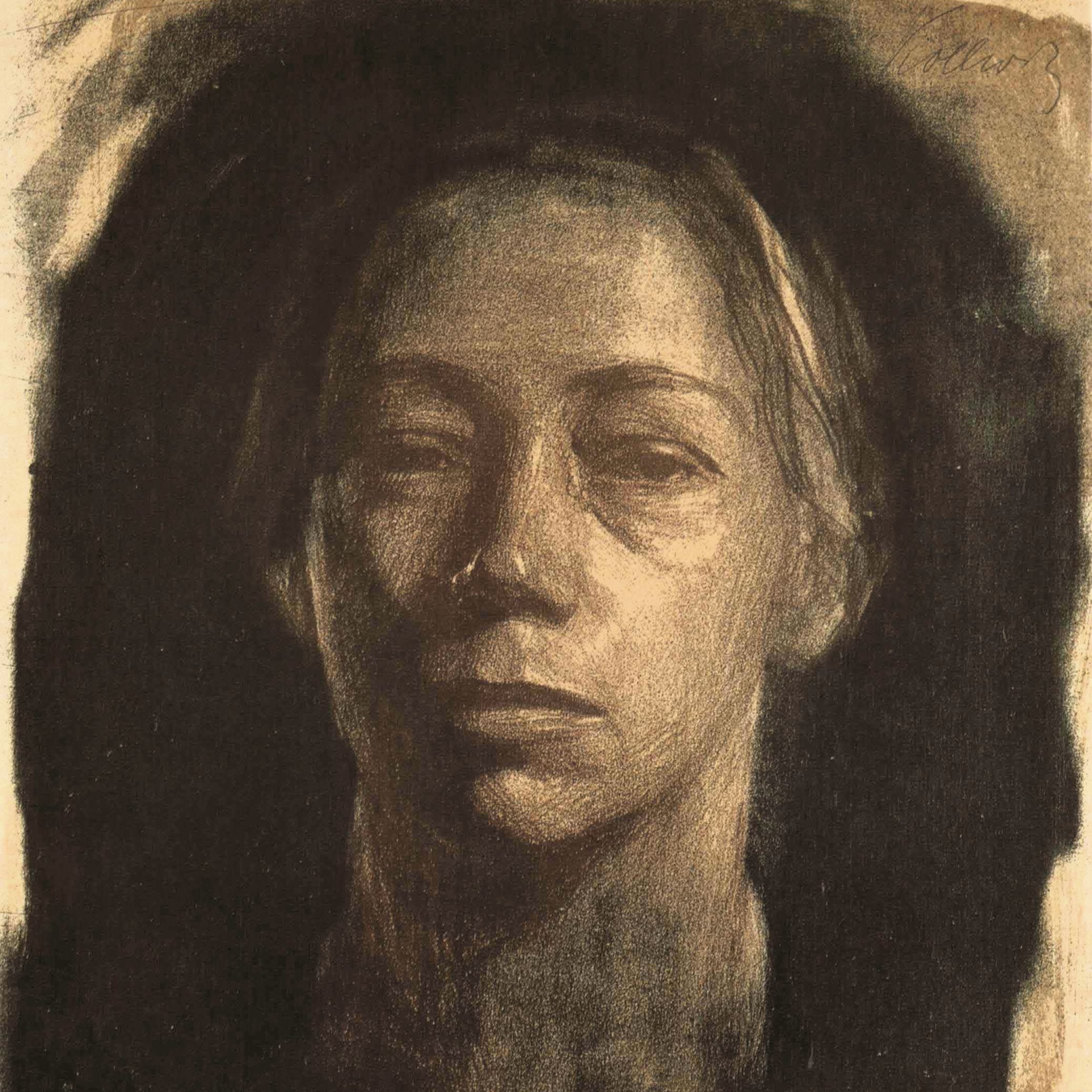
A 1940 showing at New York’s Galerie St. Etienne, founded by refugees from fascism, was one of her first in the U.S., and came when she was in her mid-70s and living in something like house arrest in Berlin. It brought Kollwitz, among the finest artists of her generation, to broader attention in the States than she had received before. The gallery still shows many of her works to this day.
‘Kaethe Kollwitz: Artist as Warrior’ by Isabel Cooper from New Masses. Vol. 38 No. 8. February 11, 1941.
“Greatest poem of her age in Germany” Romain Rolland called her work. “Nie Wieder Krieg” her posters shouted in 1924. Her drawings inspire a new generation of fighting artists.
KAETHE KOLLWITZ, whose work was on exhibition in New York until several days ago, is contemporary art’s living tradition. By values inherent in her work and by practical influence on cartoonists of the progressive press and on the younger Chinese graphic artists, she demonstrates how art may deal with reality and be a powerful weapon for social change, yet lose no esthetic merit.
“Greatest poem of her age in Germany,” Romain Rolland called Kollwitz’s work. It is a poem of protest, militant against suffering. Kollwitz did not turn her face away from life from the poverty-stricken sick at her husband’s Berlin clinic, starving children in Germany and Austria. Her world widened from literary statement and historic memory of past oppression–the Weavers’ Cycle and the Peasants’ War–into realities of the crisis of our time. Her graphic art is a monument to the struggles of a moribund order.
Kaethe Kollwitz is seventy-four. She still lives in Berlin, tolerated by a regime which does not dare destroy her, though it has silenced her protest. At fifty she was honored (even in wartime) by a retrospective exhibition of her work in Berlin. At sixty, she found her birthday celebrated by publication of a supplement to the catalogue of her graphic art. Similar honors might have been expected on the anniversary of her seventieth year, or the oncoming seventy-fifth. But no: Kaethe Kollwitz cannot use her art as a weapon, as she did in the early social cycles or in the post-war posters.
Kollwitz’s evolution as a creative worker apparently never suffered from the inhibitions which have blocked many intellectuals of a later generation. The taboos “social content,” “propaganda,” “proletarian art,” even tags like “universal” and “human,” did not frighten her away from the reality she daily saw. Her first great work–the series of etchings based on Gerhard Hauptmann’s Weavers–had human roots as well as esthetic; her father had forsaken the ministry to work as a weaver. The ethical impulse which prompted this decision came naturally. In the bleak Koenigsberg of her youth, haunted by the shade of Kant, idealism was a native inheritance. In the series on the Peasants’ War, she moved back into history, as Engels had done a quarter of a century earlier. Here were revolutionary themes, the oppressed rising against their oppressors.
The next step in her growth as a social realist was toward what was not then called proletarian art. Living in a Berlin working class quarter, she daily saw the ravages of poverty, hunger, and overwork. The ethical impulse became translated into a practical humanitarianism, in which Kollwitz lent the aid of her pencil to agitation for better working conditions, playgrounds for children, better medical care for women and children. But the major effect of her protest in this pre-war decade was that her graphic work recreates her subjects, makes the beholder realize them as human beings capable of the same sorrows and agonies as himself.
After the relatively silent years of the first world war, she could speak again–and she spoke with passionate indignation. “Nie Wieder Krieg,” she shouts in the great peace poster of 1924; here youth stands up and states its will, a mood far beyond even the fine flagellating fury of “Wien Stirbt! Rettet seine Kinder!”
During these years, Kollwitz wrote the elegy of a defeated nation in magnificent wood cuts, notably the series Krieg. War’s human consequences are her subject–the mother whose son volunteers, the son who dies, the parents who mourn. More and more in the decade before Hitler’s assumption of power, Kollwitz turned to these universal human themes of bereavement and grief. In the Soldatenfriedhof, her monumental sculpture in memory of the son killed in 1914, she found enduring plastic form for emotions. which had preoccupied almost her whole working life. The bowed figures of sorrowing mother and father (herself and her husband) become universal symbols of humanity weighed down by loss, by needless pain, by the slow death of harassed daily life.
The great virtue of art like Kollwitz’s (aside from its usefulness as a weapon) is that it gives a particular face and form to what might otherwise be an abstract slogan of exploitation and poverty. It makes the truth of social injustice inescapably real. It arouses cleansing pity and terror. It is a cry of agony ringing through history. Once it is heard, those who hear must act to stop its pain.
After major values like these, it is ridiculous to harp on “esthetics,” that last refuge of cowards in our day. But if we define esthetics as a complete harmony between the meaning of the artist and his expression, possibly the word can be redeemed-always assuming, of course, that his meaning is in itself important and progressive. Kaethe Kollwitz’s esthetic achievement was based first of all on sound draughtsmanship, which combined economy of line and tone with sensitivity to black and white values. Her progress from metal plate mediums, in which she ceaselessly experimented, to lithography was a fortunate development; for the character of lithographic crayon suited her broad simplifications and sweeping line.
With the delicacy of her tonalities, which is amazing in some of the lithographs and particularly in her drawings, she fused strong, graphic form, so that even when her prints were reproduced by mass production methods they preserved their bold, powerful statement. The explanation lies in her plastic sense, fully revealed in the sculptures she began to do about ten years ago as failing eyesight made close graphic work too difficult, but evident even in the etchings of the nineties.
Her compositional form has always tended toward the monumental; duty, reality, social conscience, were her guides. In esthetics, the equivalent is the solid, architectural form of her drawing. Nothing can break off, the superfluous has been discarded, only the ultimate indestructible human essence remains, enduring even in suffering. It might be said that the high pitch of Kollwitz’s emotional communication is to be found in the wood cuts, which at first glance may seem too black, too schematic in treatment. The emphasis is deliberate; there are no grays in the defeated Germany she pictures.
I do not intend to trace an odyssey of defeat and despair as Kollwitz’s contribution to living art. She has been the faithful mirror of her time; she has added to her record her comment on the age’s inequity and paradox. The work she created is incentive to remove causes of the suffering she sets down.
The New Masses was the continuation of Workers Monthly which began publishing in 1924 as a merger of the ‘Liberator’, the Trade Union Educational League magazine ‘Labor Herald’, and Friends of Soviet Russia’s monthly ‘Soviet Russia Pictorial’ as an explicitly Communist Party publication, but drawing in a wide range of contributors and sympathizers. In 1927 Workers Monthly ceased and The New Masses began. A major left cultural magazine of the late 1920s and early 1940s, the early editors of The New Masses included Hugo Gellert, John F. Sloan, Max Eastman, Mike Gold, and Joseph Freeman. Writers included William Carlos Williams, Theodore Dreiser, John Dos Passos, Upton Sinclair, Richard Wright, Ralph Ellison, Dorothy Parker, Dorothy Day, John Breecher, Langston Hughes, Eugene O’Neill, Rex Stout and Ernest Hemingway. Artists included Hugo Gellert, Stuart Davis, Boardman Robinson, Wanda Gag, William Gropper and Otto Soglow. Over time, the New Masses became narrower politically and the articles more commentary than comment. However, particularly in it first years, New Masses was the epitome of the era’s finest revolutionary cultural and artistic traditions.
PDF of full issue: https://www.marxists.org/history/usa/pubs/new-masses/1941/v38n08-feb-11-1941-NM-rev2.pdf
 Revolution's Newsstand