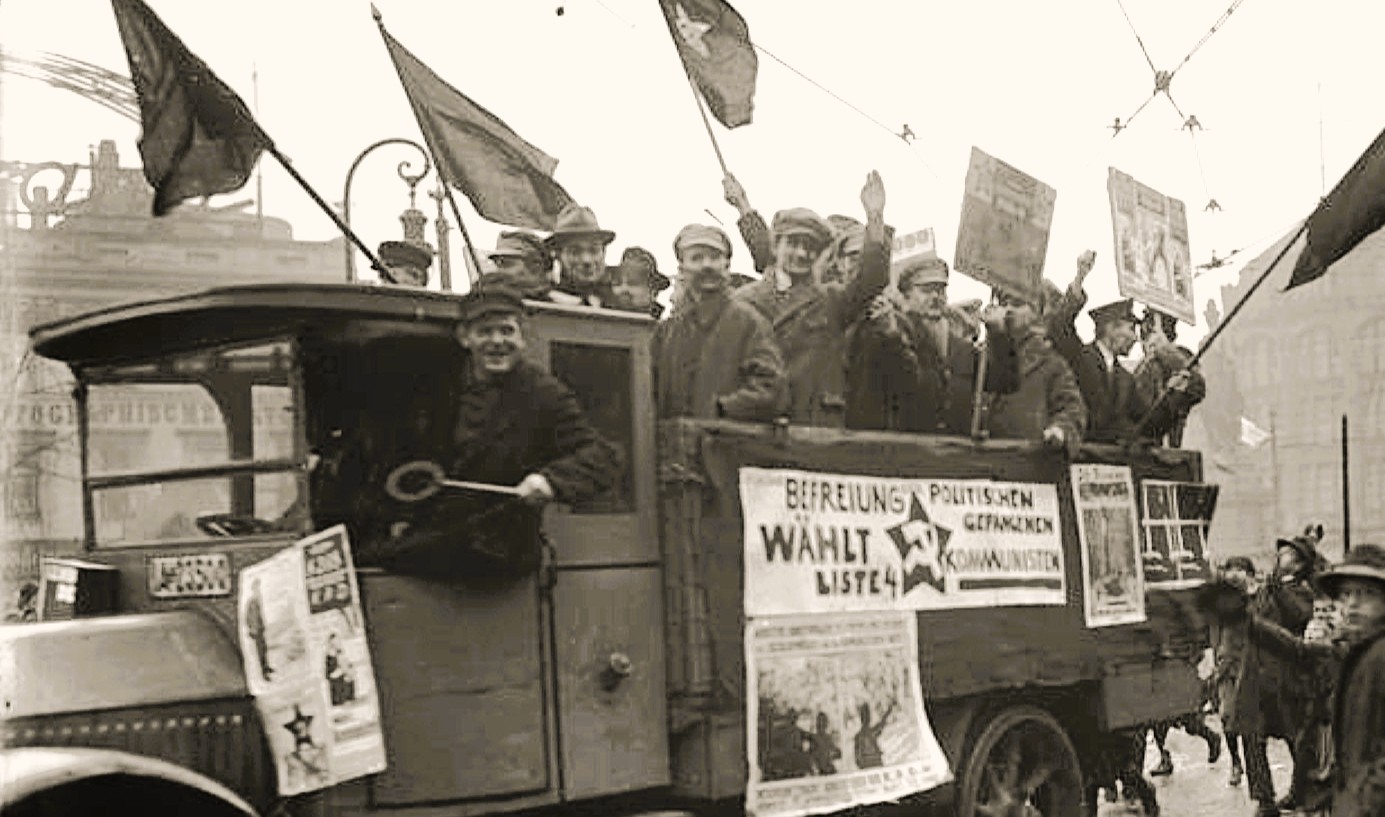
The German Communist Party of the later 1920s was, even with all its disputes and problems, a genuine mass revolutionary Communist party. With 125,00 members, tens of thousands more sympathizers in unions, neighborhoods, and non-party organizations; hundreds of national, factory, and local periodicals covering all manner of life and interests; hundreds of local governments positions and dozens of seats in the Reichstag; it was a party that could potentially vie for power in a unsettled nation where collapse and revolution were often seen to be imminent. It is fair to say none of us have been in a party anything like it. The Party’s official report to the Sixth Comintern Congress with a look at the economic and political situation in the country, the state of its bourgeois parties, the labor movement and other Left groups, and the organization and activities of the C.P.
‘The Communist Party of Germany’ from The Communist International between the 5th and the 6th Congresses, 1924-28.
ECONOMIC AND POLITICAL SITUATION.
AT the beginning of 1926 German Industry was still in the midst of an acute and partly catastrophic production and credit crisis. An improvement set in during the summer of 1926, and developed into a steady and lasting boom. It is the biggest and most lasting boom since the end of the world war, and is an eloquent expression of the success of the stabilisation of the currency and the rationalisation of production, which was undertaken at the end of 1923 with the help of the bourgeoisie of the “victorious countries.”
The starting point of Germany’s upward trend was the British coal dispute. Rationalisation led to intensive centralisation and concentration, with the result that to-day almost all branches of production are controlled by powerful monopolist trusts and cartels. This concentration on a national scale was partly supplemented by international cartels and agreements in which German capital played an important role (e.g., the European pig-iron cartel). Other features of rationalisation were: The closing down of unprofitable enterprises, the introduction of technically improved means of production, and, above all, unprecedented intensification of labour, reduction in real wages, abolition of the eight-hour day, attack on “non-productive expenditure,” such as unemployment doles, and a standing industrial army reserve of over one million unemployed.
In almost all branches of German production the boom was fed by foreign loans. In the period from the introduction of the Dawes’ plan to the end of 1927, Germany has received in round figures 5 billion marks in foreign loans. The interest payable on this sum amounts approximately to 500 million marks; in addition, there are the Dawes’ payments of 24 billion marks a year (1928). This means that every year 3 billion marks are sent abroad apart from the amortisation of the loans.
The favourable economic situation is largely due to the fact that the internal market is closed to foreign competition by high industrial and agrarian tariffs. However, the internal market will be unable for any length of time to cope with the existing productive capacity. This, and above all, the obligations of the Dawes’ Plan, compel German capitalism to look for markets abroad. There is, however, little prospect of German capital being able to succeed within a short space of time in transforming its trade balance (the sore point in Germany economy) from a passive into an active balance.
Rationalisation has proved extremely profitable to German capital. The total value of German industrial securities quoted on the Berlin Stock Exchange amounted at the close of 1925 to about 7 billion gold marks, and in January, 1928, it rose to 17.3 billions. In the course of 1926, the German industrial companies paid about 800 million marks in dividends, besides considerable interest on preferential shares and debentures, procuring thereby a revenue of about 1 billion marks. The anticipated income for 1927 is about 2 billion marks. To this should also be added enormous sums of money set aside for reserve funds, etc. The capital investments in German industry in 1927, according to estimates by the Imperial Credit Association, amounted to 7.6 billion marks. The “Frankfurter Zeitung” even estimates this figure at 9 billion.
There has been no increase in real wages in the last two years equal to the increases gained in 1924 and 1925. In 1926 the real wages of skilled workers formed about 92 per cent. of the pre-war real wages, and now they amount to 92.5 per cent.
As against the slight growth in nominal wages, there is a steady rise in the cost of living. In January, 1927, the prices of manufactured commodities stood at 50.9 per cent. above the pre-war prices. In February the increase had reached 58.2 per cent., in September 55.8 per cent., and at the close of January, 1928, 72.2 per cent.
Agriculture.
Under the slogan of “Agricultural Distress,” the “Landbund”—the most powerful organisation of German agriculture, acting entirely under the influence of the big landowners—has recently succeeded in inducing the peasants throughout Germany to participate in tremendous demonstrations. The objects of these demonstrations were: (1) To obtain State subsidies for the big landowners; (2) to exercise pressure in connection with the negotiations for a commercial treaty with Poland in order to establish reciprocity in the import of pigs and potatoes; (3) to stop all importation of foodstuffs; (4) to reduce the taxes on capital and on landed property.
Nevertheless, it would be wrong to speak of a crisis and over-indebtedness of agriculture as a whole, as it is mainly individual enterprises which are heavily in debt. The chief cause of this phenomenon should be looked for in the technical backwardness of the big agricultural enterprises.
The present state of affairs leaves the small and middle farms in a serious position, due on the one hand to the prices of their products having fallen, whilst, on the other, they have to pay higher prices for forage and other necessaries. These conditions were not altered by the measures carried out by the Government for restoring the economic basis of the country, and thus the lower and middle elements of the rural population which are called upon to bear the burden of the restoration of the encumbered large estates are being slowly and steadily impoverished.
The economic recovery of capitalist Germany has led to an extension of its external political influence. The Locarno Treaty, the admission of Germany to the League of Nations, the Thoiry negotiations, the return of confiscated German war property in America–and, with some reservations, the Berlin Treaty with the Soviet Union—constitute the essential stages in the progress of German imperialism towards shaking off the fetters of the Treaty of Versailles which have hampered its free development.
FOREIGN POLICY.
The external policy of German finance capital is at present directed towards the realisation of the following aims:—Evacuation of the Rhine, revision of the Dawes’ Plan, removal of the military restrictions, and complete liberty in the matter of military preparations; revision of the eastern frontiers, i.e., the restoration of eastern Upper Silesia, Danzig and the Polish Corridor, and, finally, the acquisition of colonial mandates. Yet even the granting of these demands is considered by the German bourgeoisie merely as a stage in their struggle for the repudiation of the Treaty of Versailles. At the same time German imperialism is trying to break its way through by taking advantage of the antagonisms among the imperialist powers of the West, and of their joint antagonism towards the Soviet Union. This has been demonstrated with particular clearness by Germany’s attitude in the meetings of the League of Nations.
By its leaning towards British imperialism, which has been frequently shown of late, German financial capital hopes to quicken the achievement of its aims. It is prepared to proceed at any price with the westward orientation inaugurated by the Locarno Treaty and its admission to the League of Nations, and is willing to join the capitalist bloc being formed under the leadership of England for armed intervention in the Soviet Union.
INTERNAL POLITICS.
(*This was written before the General Election of May, 1928.)
In the field of Internal Politics the recovery of capitalist Germany has resulted in the formation of the bourgeois Coalition Government. The leading elements of the German bourgeoisie are now working systematically and deliberately to strengthen their class dictatorship, for which they have prepared during the seven years of coalition policy with the Social-Democrats. The fact that those representing finance capital in Germany no longer require the aid of the Social-Democrats and the Trade Union Reformists in the Government is not only the expression of the growing power of the bourgeoisie, but also shows that along with the development of the new German imperialism the antagonism between the German Nationalists and the other elements of the German bourgeoisie—which was very evident in connection with Locarno, agrarian protection tariffs, and the question of “republic” versus “monarchy”—has been considerably weakened, and even partly eliminated. The understanding between the leading bourgeois parties—chiefly the Centre Party—and the German nationalists, who represent the forces of the extreme counter-revolution, was necessary in order to “Locarno-ise” the Reichswehr, and to transform the military associations, the Courts of Justice, and the administration, in which the nationalists play the leading role, from an element hindering foreign policy, into the protagonist of the new German imperialism. Yet whilst the economic contradictions between the industrial bourgeoisie and agrarian capital, represented by the German Nationalists, cannot be entirely eliminated, a mutual bargain has been struck in the interest of the struggle against the common enemy.
The bourgeois Coalition Government is, however, only the first fruits of the efforts of the big bourgeoisie towards concentrating the whole of the political power in its hands. The attempts to weaken the power of the small peasantry in the State is still greatly hindered by the direct influence exercised by the petty bourgeois and Social-Democratic Parties upon the policies of the country. For this and for many other reasons propaganda is being conducted for the creation of a single Reich, i.e., for the amalgamation of the existing 18 federal republics. This should lead to the complete domination of the State machine by the economic groups of big capital. At the same time it is anticipated to effect thereby a slight economy in the expenditure of the State.
THE SITUATION IN THE BOURGEOIS PARTIES.
The Centre Party, which receives extensive support—to the extent of 50 per cent.—from the workers, is strongly affected by the leftward tendency among the masses of the workers. This party, which wants to unite all classes and elements on common religious basis, has been undergoing a severe crisis for a number of years; this has been still further enhanced by the effects of the policy of the bourgeois Coalition Government in which it has played a leading part. The proletarian masses, and even the petty bourgeois elements and the middle peasants in this party, are strongly opposed to the leading wing of big industrialists in the party, without being able to assert themselves. In order to counteract the leftward tendencies among the workers enrolled in the Centre Party, the Christian trade union leaders appear under a mask of Radicalism and take up a “sharp oppositional attitude.” They are trying to play the same role with regard to the workers as was played for many years by the former Imperial Chancellor Wirth with regard to the petty bourgeoisie of this party. At the same time the Christian trade union leaders take advantage of the discontent of the proletarian wing to consolidate their own influence in the Centre Party.
The Christian Socialist National Party, a left branch of the Centre Party, which made common cause with the Social-Democrats in the plebiscite on the compensation of the ex-ruling houses and in the Toilers’ Congress, has remained a small party, but it nevertheless constitutes a constant menace to the Centre Party.
The Volkspartei (The People’s Party) is the party of the leading elements of the big bourgeoisie, and its numerical strength in the Parliaments in no way corresponds to its influence. It is anxious to preserve its following among the “black-white-and-red” electors. In spite of the fact that the Stresemann policy is supported by the German nationalists, the latter is a formidable competition of the Volkspartet.
In the German National Party, the “State Political” wing has substantially overcome the opposition of the “Volkist” wing upon the essential questions of foreign policy, which was expressed in the participation of this party in the bourgeois Coalition Government. The Free Conservative group has seceded. This party claims the following of large numbers of disappointed elements of the petty bourgeoisie which have broken away from the traditional bourgeois parties. In its policy it is still strongly tied to its German Conservative group and to its “Volkist” wing, the latter exercising strong influence doer the “Steel Helmet” and other militarist associations. The “Steel Helmet” is waging an intensified campaign against German Parliamentarism in its present form, and demands “the introduction of the rule of responsible leading personalities” into political life, and consequently “enlarged powers for the Reichs president.” For some time it has been trying, by the establishment of Fascist nuclei in the factories, to win support among elements of the working class.

The “Reichs-Landbund,” the dominant organisation of the agrarians, is politically associated quite closely with the German National Volkspartei. Among its small peasant members particularly, oppositional currents and growing discontent are becoming noticeable, leading more and more frequently to splits. Attempts are made to meet this by forming new organisations which sail under the flag of neutrality.
The Parties of Petty Bourgeois Fascism, which have broken away from the Volkist Bloc and formed themselves into a whole series of small parties, really exercise no influence whatever, since with the consolidation of the power of the German bourgeoisie, Fascism has lost its importance to that class, even if it meets with temporary success in some local elections from time to time.
The Democratic Party, which stands in “opposition” to the bourgeois bloc, is distinctly a retrogressive movement. It is not in a position to check the leftward development of the petty bourgeoisie which is largely to the advantage of the newly-formed petty bourgeois economic and middle-class parties.
THE SITUATION IN THE SOCIAL DEMOCRATIC PARTY.
The Social-Democratic Party in Germany, after the setbacks during the period of the revolutionary wave, entered upon a period of stabilisation and of partial growth of its organisational forces, accompanied by the elaboration of a consistent programme of coalition with the bourgeois parties, and with the official acceptance by the party conference at Kiel of the Hilferding theory concerning the attitude towards the State, rationalisation, etc. By these means the final theoretical transformation of Social-Democracy was accomplished.
The Left wing within the party, whose spokesmen are the intellectuals grouped around organs like Paul Levi’s “Sozialistische Politik,” and, lately, also the review “Klassenkampf,” is ideologically under the leadership of the Austra-Marxians; one section stands closer to Otto Bauer, while another section sympathises with the pseudo-Radicalism of Max Adler. Although this tendency controls two important party newspapers (“The Leipziger Volkszeitung” and “The Volksstimme” of Chemnitz), nevertheless it is justly considered by the official party leadership as constituting no serious menace. This view was fully vindicated by its attitude at the Kiel Conference. Its traditional task is to check the leftward development of the workers.
On question of international policy the attitude of German Social-Democracy is in line with that of the rest of the Second International; recognition of and collaboration with the League of Nations, and bitter denunciation of the Soviet Union. German Social-Democracy represents the “Western orientation,” and it takes advantage of every opportunity to extend the cleavage between the Soviet Union and Germany. A particularly striking example of this was furnished by the attitude of the German Social-Democrats during the so-called “grenade campaign,” and more recently in connection with the arrests of the German engineers in the Donetz mining district, when the Social-Democrats resorted to the most venomous attacks.
The leftward development, which affects also sections of the petty bourgeoisie, naturally brings new recruits to Social-Democracy. These elements lend strength to the Right wing of the party, and hence the possibility arises of conflicts between the leftward moving workers and the newly-enrolled elements of the party who endorse the policy pursued by the party leadership.
The most dangerous aspect of the policy of the Social-Democratic Party is that of the question of a Coalition Government. In order to avoid conflicts upon this question, about which a considerable portion of the membership disagrees with the leadership, the Social-Democratic Party refrained from holding any party conference this year; so that, after the elections, it could confront the membership with the accomplished fact of the Social-Democratic Party taking part in the Coalition Government which will eventually be formed.
The Social-Democratic Party has about 860,000 members, of whom 73.14 per cent. are workers. Thus, on the basis of comparative figures furnished by the Social-Democrats, the percentage of workers in the party has decreased 15 per cent. as compared with 1908. Of this membership about 73 per cent. consists of older workers (over 35 years of age).
THE SITUATION IN THE TRADE UNIONS.
The Free Trade Unions have overcome the state of stagnation in membership, and since the beginning of 1927 they have been slowly but steadily growing. The A.D.G.B. (General Federation of Trade Unions) Unions had:
October 1st, 1927 3,933,000 members.
April 1st, 1927 4,003,000
July 1st, 1927 4,145,000
January 1st, 1928 4,291,000
The Reformist trade union leaders continue to act as the useful tools of the bourgeoisie for keeping the masses in subjection, whilst the radicalisation of the masses compels these leaders to put up a sham opposition. In the struggle against the Communists, whose influence is growing, they repeatedly resort to the most drastic means, such as expulsion, wholesale “cleansing’s,” postponement of elections, and so forth. At the same time they do not shrink from breaking up individual organisations that are dominated by Communists. In many cases the Reformists resort to open Social-Democratic fractional activity against the Communists.
They use the theory of economic democracy to support capitalist rationalisation, and to defend the State arbitration machinery and the sanctity of the wages agreements. Their participation in the workers’ struggle is confined to keeping them within the capitalist system of society, whilst comforting the workers with the promise of great results from the coming elections.
THE LEFTWARD DEVELOPMENT OF THE WORKING CLASS.
The situation in the trade unions and in the parties, as well as in the whole domain of internal politics, is largely determined by the strong general leftward development. This leftward development was revealed with particular force in the course of numerous national and municipal elections which have taken place in recent months. This leftward development takes the form of the desertion of large numbers of petty bourgeois voters from the German Nationalists to the Social-Democrats, and of a similar move towards the Left of the working class elements, who eventually go over to the C.P. In the course of the elections in Hamburg, Kénigsberg, Hessen, Anhalt, etc., and lately in the Saar district, there was to be observed in the proletarian centres the partial transfer of voters from the S.D.P. to the C.P., which nevertheless did not always find expression in the final count of the ballot, since the S.D.P. losses in proletarian votes were almost invariably compensated for by the gaining of votes from the German nationalists and other bourgeois parties.
The growth of Communist votes in the trade union elections is also quite substantial. In the Freethinkers’ organisation of Berlin, in March, 1927, the C.P. received for the first time a majority of 43,000 votes. This election was particularly remarkable since over 80,000 members of the Freethinkers’ organisation took part in it, whereas in previous years only a few thousands had taken part in the elections. Similar phenomena have been observed in the workers’ sports organisations.
Finally, the increased leftward development of the working class is shown by the steadily growing activity in the course of the fights conducted by the workers.
THE DEVELOPMENT AND ACTIVITY OF THE C.P.
The Communist Party has practically overcome the prolonged difficulties with the ultra-Lefts, which have frequently crippled the whole of the party activity. Among the important results of the Eleventh Party Conference (1927) should be mentioned the closing of the internal party discussion. The Maslow-Urbahns group, the German branch of the Trotskyist opposition, has completely collapsed ideologically. This group has completely fulfilled the prediction made by the Essen Conference; it has become the main support of the German bourgeoisie and its Social-Democratic lackeys in the struggle against the C.P. in Germany, against the Comintern, and the Soviet Union. Its “official organs,” the daily “Volkswille,” published at Suhl, as well as the “Fahne des Kommunismus,” provide the arsenal from which all the enemies of the proletarian revolution borrow their poisoned weapons. The total collapse of the Trotsky opposition in the C.P.S.U. has deprived this group of its ideological basis, and it is already turning towards the Social-Democracy. The loss of the Parliamentary seats in the coming elections, in spite of a vigorous election campaign for its own list of candidates, should deprive it of any vestige of importance. This is the only reason for the formation of its new party, the “Leninbund.” Where they still have a following of valuable proletarian elements, e.g., in the Suhl and Pfalz districts, the party has succeeded, by persistent and untiring activity, in winning back these elements.
The Essen Conference had also to fight against Right deviations. A group of comrades had set its face against the thesis adopted by the conference to the effect that the “Left” leaders in the S.D.P. were the chief enemy. These comrades demanded an improvement in the tactics in the trade union struggle, the elaboration of a programme of action, and a centralised struggle against trustified capital under the transitional slogan of “control over production.” Their proposals were rejected by the Party Conference, particularly the slogan of “control over production” which was denounced as Left wing opportunism in the actual circumstances. The article of Comrade Brandler in the “C.I.” on a programme of action, and, above all, the activities of this group in some organs of the party against the decisions of the Essen Conference somewhat hampered party activity, and, finally, the remnants of fractions, as well as a series of grave opportunistic mistakes, have prompted the party to devote greater attention to the dangers of the Right wing.
Nevertheless, the Eleventh Party Conference did not spend too much time to the discussion of the ultra-Lefts, but applied itself from the very outset mainly to practical work. The reports contained relentless self-criticism, and in the discussions the problems of practical party work were put in the foreground of the speeches.
For the first time the Essen Conference of the C.P. dealt fully with the problem of winning the workers from the Centre Party and of combating the Centre Party.
The following tasks were set down by the conference as essential to the party: The campaign against the war menace (supporting the proletarian dictatorship in the Soviet Union, the Chinese revolution, and the international revolutionary movement); the struggle against the capitalist offensive and the cutting of wages; the struggle against the Government of the bourgeois bloc, against the reaction and Fascism; the struggle against Social-Democracy; the formation and consolidation of a Left wing in the German Labour movement; the strengthening of activity in the trade unions; the revival of the factory council movement; the conduct of the struggle of the unemployed; the alliance with all toiling elements; the strengthening of the sympathising proletarian mass organisations; increased activity among the proletarian youth and among the proletarian women. Further tasks are: The struggle against the petty bourgeois deviations in the party; inner party consolidation, raising the level of theoretical knowledge in the party; and increasing revolutionary mass activity.
The Campaigns.
Outwardly, of course, the activity of the party was most strongly demonstrated in the big campaigns. Each of these campaigns continued for several weeks, culminating in an intensified campaign on a given day (the C.P. campaign in connection with the Toilers’ Congress; the campaign in favour of the Soviet Union on November 7th, etc.), and were conducted upon the broadest basis. The campaigns were supported by the Press, preliminary action was taken in Parliament, meetings were held, demonstrations were organised, house-to-house agitation was carried on, and so forth. Nevertheless, all the big campaigns of the C.P. were handicapped by one drawback: at the height of each campaign, which meant also its close, it disappeared entirely from the Press and from the party activity. The party did not sufficiently realise how important it was to follow up the big campaigns by further party activity, and still less how important it was to link up the numerous campaigns.
Thus it happened that most of the campaigns in which the party had mobilised large masses under its slogans, e.g., in the plebiscite on the compensation of the ex-ruling houses, or, in connection with the Toilers’ Congress, the party failed to take advantage of the situation to draw large numbers of workers into the party organisations. All these defects were revealed with particular clearness in the campaign for winning large masses by the application of the tactics of the united front. In this connection there were revealed many other defects, with which the party has also to contend in its regular Parliamentary and trade union activity. These defects may be summarised as follows:
Defects in Campaigns.
1. The party had too little knowledge of the movements within the S.P., in the trade unions, and in the factories. Therefore the agitation was too abstract. Instead of the application of the united front tactics according to different districts, they were automatically transferred from one district to another.
2. In the application of the united front tactics the party organisation was lacking in elasticity, particularly in the trade unions.
3. The line of demarcation from the Social-Democracy was not always distinctly and clearly drawn, leading to numerous opportunist deviations in connection with municipal and national elections.
It must be observed that since the Essen Conference a great deal of improvement has been effected in these respects.
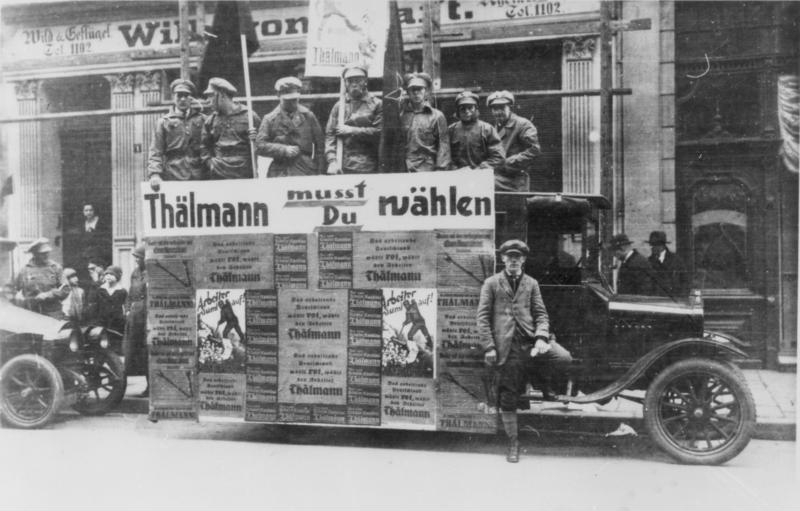
The tactics of the united front were successfully applied by the C.P. in connection with the plebiscite on the compensation of the ex-ruling houses. In order to continue this united front of 14 ½ million people, in order to deepen and develop it into a united front for the struggle against capitalist stabilisation, the plebiscite movement was utilised by the C.P. to mobilise the masses for the national Toilers’ Congress. The weakness of the Toilers’ Congress movement was that the party did not succeeded in mobilising for the Congress any big trade unions and big factories of note. A further drawback was that the majority of the delegates came from little towns and localities, whilst the large towns were not stirred by the movement to the extent that was desirable. The chief defect, however, consisted in the fact that immediately after the conclusion of the Congress, the party gave up the campaign and the Congress was insufficiently utilised for agitational purposes. Thus the party was unable to bring the large masses which had been mobilised by the movement into close contact with the party.
The Elections, May Day and China.
Campaigns were conducted by the C.P. in the numerous national and municipal elections which took place during last year in nearly all parts of Germany. Naturally these electoral campaigns developed largely into big mass campaigns against Social-Democracy. In nearly all these elections the C.P. succceded in considerably increasing its votes, bringing them nearly to the level of the poll obtained in the May elections of 1924.
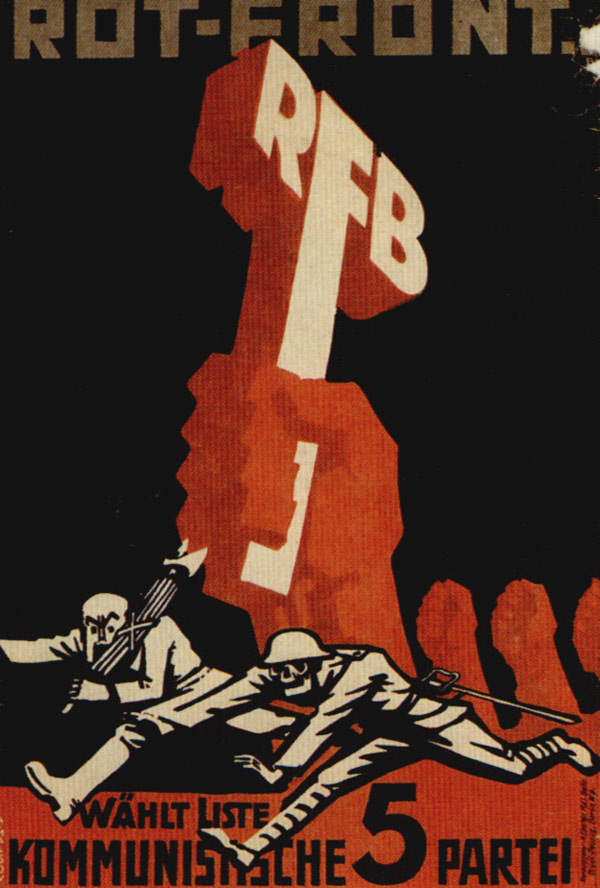
The party campaign in connection with the Reichstag election was carried out in full force. In connection with the order issued by the War Ministry against the Red Front League a vigorous campaign was launched by the party, in the course of which great masses have been attracted to the defence of the R.F.L. in connection with the forthcoming electoral campaign.
In connection with the May Day celebration this year the party carried on a unity campaign from below, for the joint celebration of the May festival. In some districts the pressure from the factories and the union locals was so strong that the local S.D. leaders were forced to negotiate with the C.P. for a joint May Day celebration. Particular importance was attached to this fact, since the May Day of 1928 is bound to be an important factor in the electoral campaign.
A considerable part of the activity of the C.P. has been devoted to the prolonged campaigns against the war menace and for the Soviet Union, for revolutionary China, and against the League of Nations.
The campaign in connection with China was chiefly conducted in the Press, and at special meetings organised after the Brussels Conference. Nearly all the demonstrations organised by the party were at the same time conducted under the slogan of “Hands Off China.” Nevertheless, it ought to be noted that the campaign on China was not always given the prominence in the party’s activity which its importance merited. Thus, after the fall of Shanghai and the massacre of Nanking, as well as after the Canton upheaval, the party organised neither demonstrations nor public meetings.
For the Soviet Union.
In the campaign against the danger of war and for the Soviet Union, the party went over from the defensive, to which it had confined itself since the beginning of the Social-Democratic “grenade campaign,” to the offensive, in the course of which the role of Social-Democracy as the inciter of war against the Soviet Union was exposed in the Press and at public meetings. On the Tenth Anniversary of the October Revolution the party organised mass demonstrations throughout the country. The workers’ delegations and the delegations to the Congress of Friends of the Soviet Union have served as important factors in this campaign. On the Tenth Anniversary of the Red Army the party organised mass demonstrations and meetings jointly with the Red Front League. By a continual flow of articles in the Press, which have considerably improved of late, but which are not yet adequate in furnishing information on the building of Socialism in the Soviet Union, the campaign has been steadily extended. It must further be observed that the activities of the Trotskyist opposition in the Soviet Union and in Germany proved a handicap in this movement, as well as in party activity generally.
The Fight against the Bourgeois Bloc.
The chief slogan of the party, since the formation of the bourgeois bloc, is that of “The Fight Against the Bourgeois Bloc.” All the campaigns of the party in the field of both internal and external politics are at the same time campaigns against the bourgeois bloc. This is particularly so in regard to internal political campaigns, such as the campaigns for the amnesty, against Fascism, against the Centre Party, against Social-Democracy, against the taxation policy of the bourgeois bloc, for State aid to the small peasants, for the demands of the tenants, for the unemployed, and, above all, against the employers’ offensive. All these campaigns were conducted in close collaboration with the Parliamentary fractions of the party, which inaugurated these campaigns supporting them by the introduction of motions in Parliament, but not always to a sufficient extent.
The Industrial Struggles.
In recent months the party has increased its campaigns in support of social demands, realising that the mobilisation of the masses under these slogans constitutes at the same time the most effective mobilisation against the bourgeois bloc. For this reason the party has devoted its chief attention to the big industrial struggles.
In the development of these industrial struggles the following phases should be noted in recent years: up to the beginning of 1927 the workers were relatively passive. In May of that year a strong revival set in, and wage demands were made by ever larger masses of the workers. The employers began to organise “mutual insurance” schemes to guard against the danger of strikes. By August, 1927, the workers commenced to advance on a wide front, making demands for higher wages, and, to a lesser extent, for general amelioration of conditions. The number of labour struggles rapidly increased. At the close of April, 1928, there were over 4 million workers involved in wage movements, including the basic industrial groups, like mining, chemical works, railways, etc. The employers put up the greatest resistance to the smallest demands made by the workers.
The influence of the C.P. in the strikes, etc., has grown in recent months. For example, the handing in of notices by the Miners’ Union affiliated to the Free Trade Unions took place “under pressure from the Communist side.” It is a well-known fact that at the last big conference of the old Miners’ Union at Bochum a big role was played by the demands raised in the Communist paper, “Ruhr-Echo.” Even the “Kélnische Zeitung” (February 19th, 1928) was forced to report that a large number of representatives from the locals had taken sides with the Radicals, so that the original Husemann programme had be modified.
The Reformists are trying the neutralise the pressure of the masses by clever manoeuvring and by conducting isolated strikes. In this connection the comment of the “Kélnische Zeitung” on February 22nd, 1928, is of interest:
“It cannot be gainsaid that the tactics of the largest body of workers involved, the German Metal Workers’ Union, have been almost completely determined by the tension which exists between the Moderates and the Radical Communist wing.”
Owing to the concerted attacks levelled by the Reformists against the party in view of its growing influence, the party frequently finds itself in a very difficult situation. Confronted with the problem of carrying out the most important demands in the teeth of unscrupulous sabotage by the Reformists, a great many party members are inclined to the idea that no movement should be started against the Reformists, since this would lead to expulsions.
A considerable handicap in the party’s activity in the struggles is the fact that the leading organ in this field of activity, the Trade Union Department of the C.C., has hitherto been lacking in unity. The party was also without a clear unanimous policy in many of the big fights, such as the fight of the smelting workers in Rhenish-Westphalia and the metal workers’ and miners’ strikes in Middle Germany. The Communist press, too, has failed to take up a clear, and, above all, a unanimous standpoint in connection with most of the industrial fights. To this it should be added that large masses of the party members do not yet sufficiently realise the tremendous importance attached to industrial fights in Germany at the present time, with the result that an insufficient number of party members, and of the workers generally are mobilised to take part in these fights.
Party Organisation.
To a large extent these defects are due also to organisational weaknesses. Thus, it was established by a national investigation that towards the middle of 1927 there were only 61.67 per cent. of the party members organised in the trade unions, whilst 1.13 per cent. had been expelled from the unions, and 21.60 per cent. of the members were unemployed. It was further established by the investigation that over one-half of the C.P. members who were organised in the trade unions already belonged to the unions before 1914, and three-fourths had belonged before 1920. This shows that the C.P. possesses a stalwart body of trade unionists with whose aid, and by the use of whose influence among the workers, the party might have entrenched itself far more strongly in the factories and in the trade unions than it has hitherto done. The investigation referred to also showed that the large majority of the C.P. members are in small and medium-sized factories; 70.5 per cent. of all the party members are employed in factories with less than 500 employees, 22 per cent. in factories with 500—3,000 employees, and only 7.5 per cent. in factories with more than 3,000 employees. In some of the large factories the C.P. has no influence whatever. Naturally these organisational weaknesses become intensified and extremely noticeable in connection with the mobilisation of the masses for big industrial struggles.
In the field of organisational work the C.P. has made considerable progress in its trade union activities. Fractions have been formed both in the districts and local organisations of nearly all the trade unions, and fractional activity is again being systematically and successfully carried on. In the course of the trade union elections in the spring of 1928 the party succeeded not only in increasing its vote, but also in capturing important trade union organisations.
The Agitprop Department.
In recent years the Agitprop Apparatus has been organised in the district, sub-district and local groups, as well as in the nuclei. Naturally, there are still many defects in the apparatus, especially in the lower units of organisation. The propaganda work still shows many weak points. Nevertheless, the good work and the agitational efficiency of the Agitprop apparatus was demonstrated in the course of the big campaigns of last year, such as the campaigns in connection with the compensation of the ex-ruling houses, the Toilers’ Congress, the workers’ delegations to the Soviet Union, as well as in the mass demonstrations, e.g., in connection with the “Steel Helmet” Day on May 8th, 1927, in Berlin.
During the last two years a network of party schools has been built up. The elementary training of large masses of the membership has been organised in such a manner that, in connection with all the big campaigns and after each Plenum of the E.C.C.I., as well as after each important conference of the party, elementary courses are organised in conformity with plans worked out by the Agitprop of the C.C. Thus, after the Essen Conference, a wide campaign was organised on the building up of Socialism in the Soviet Union and on the trade union movement, and a number of courses on the decisions of the Party Conference and of the Seventh Plenum. In the winter of 1927-28 the Berlin-Brandenburg district showed remarkable initiative in drawing up a comprehensive plan of popularising the slogan: “More political education, fewer newspapers.” The educational plan comprised elementary courses, advanced courses (second-grade elementary courses), and courses for officials, all of them centrally organised.
Particular value was attached to drawing up the curriculum on the economic doctrines of Marxism, which has so far been neglected in most of the party courses. The training of officials was undertaken in 1926-27 in nearly all districts. Besides various special courses on different practical questions, there were also general district schools organised for officials at Chemnitz, Berlin, Hamburg, and elsewhere. A Central Party school, with about 30 pupils and with a school term of two months, was held with good results in 1927, and a second school of this type in the spring of 1928.
Self-educational work. A new aspect of party educational work has only lately started in the form of the publication of “Self-Educational Corners” in the party press and of syllabuses and questionnaires. Leading organs for this work (self-education bureau) have not been organised as yet, this being largely due to the lack of success in the self-educational work. The “Little Library” of the “Parteiarbeiter” began the publication of booklets dealing with self-education.
To meet the great demand for textbooks in connection with party training work, the Agitprop of the C.C. undertook to compile from its own resources “Elementary Books on the Class Struggle.”
Lately, the Agitprop has endeavoured to increase the influence of the party in the Workers’ Educational Movement. On the one hand, fractional activity by Communists was organised in the Reformist workers’ schools and trade union schools, and, on the other hand, the party founded its own schools, e.g., the “Workers’ School of Marxism” in Berlin.
Factory Papers and Worker Correspondents.
On the whole, the factory newspapers have developed fairly well during the last year, and their contents given a more live character, their importance as political organs as well as their role in industrial fights and in the organisational activity of the party has increased.
The worker-correspondents have developed more in the provincial press than in the central organ. The “Ruhr Echo,” the “Kampfer” of Chemnitz, the “Klassenkamff” of Halle, and the “Hamburger Volkszeitung” have had their well-trained staffs of worker-correspondents for years, and these are being continually enlarged. Systematic work in this respect has been taken up only lately by “Rote Fahne.”
Co-operative Work.
The activity and influence of the party in the Co-operatives is still rather weak on the whole. One of the reasons for this is the underestimation of the importance of this work which still persists among a good many comrades and officials in the party. There is also a lack of a sufficient number of experienced and trained party officials in this field of work. The Cooperative Department of the C.C. has carried on systematic and intensive activity in this respect; nevertheless, owing to the circumstances referred to, the work is slow in bearing fruit.
During the period when the party leadership was dominated by the ultra-Left tendency, there was even an appreciable retrogression in the general activity in the co-operatives, whilst the organisational structure and methods of this work were severely impaired. During the period which followed the “Open Letter” a slow but steady improvement took place. The party apparatus for work in the co-operatives has been strengthened, both centrally and in the districts; substantial progress has been made in the activity of the fractions and in their structure, even if the present state of affairs is still far from satisfactory. Since the beginning of 1927 there has existed a national fractional leadership which co-ordinates this work throughout the country, and has already proved very useful in working out concrete instructions for this line of work. A beginning has also been made with systematic educational activities (courses and instructive conferences). The party press, and particularly the central organ, have generally devoted too little attention to co-operative questions.
The improved activity in the last two years has resulted in the party regaining most of the positions lost to the Reformists in past years. New positions have been won, and the old positions extended and consolidated. At the same time there has been a tremendous growth of the aggressive attitude of the co-operative bureaucrats towards the Communists. At the present time the Communists dominate 30 middle and small co-operative societies with a total membership of 100,000, whilst the central association has a membership of 3,000,000. At the last Co-operative Congress the Communist fraction had 51 delegates out of a total of 933. So far there has been little success in getting large masses of revolutionary co-operative members to rally around the Communist fractions as sympathisers.
Work Among the Peasants.
Rural activity is no longer considered by the party as a side issue, but rather as part and parcel of the general party activity. Nevertheless, the influence of the party among the peasants is still relatively weak.
In the big peasant demonstrations in the spring of 1928 the C.P. was the only party whose activity was generally lacking in the districts, although in 1926-27 some peasant demonstrations of this kind had already taken place, and the party had then realised its mistake in not having taken part in them. It ought to be noted that a great many of these demonstrations have passed almost before the very gates of Berlin. In some districts the party distributed leaflets which were eagerly read by the peasants. The peasant organisations friendly to the party did not take part in these movements.
An intensive campaign was conducted by the party in the various Parliaments, under the slogan of “Alliance between the working peasants and the working class,” and “Workers’ and peasants’ government.” There were also resolutions moved in favour of the peasants by the C.P. fractions in regard to taxes, credits, mortgages, land tenure, and colonisation. In connection with the campaign in connection with the property of the ex-ruling houses, excellent work was carried on by the party throughout the country. It also organised campaigns on the bad harvest and floods, which led to conferences with the victims and to the establishment of connections with peasants of all political tendencies.
In this connection there were established auxiliary committees of peasants, which are still functioning very well in conjunction with some of the Landtag fractions. Sympathising peasants are attracted and induced to take part in the meetings of the fractions irrespective of their political and trade affiliations, and current legislation is jointly discussed with them and reported upon before meetings in their respective localities.
The party has also established contact with the rural youth movement, which is of tremendous importance.
At the Wirzburg Conference of Communist Parliamentarians on March 12-13th, 1927, the party decided on the line of policy to be followed in Parliament in regard to the peasant question, and with regard to the Parliamentary demands to be made on behalf of agricultural workers. These decisions are to be published in a special booklet, entitled “Parliamentary Policy of the C.P.”
The “Rote Fahne” now gives more space to agrarian and peasant questions. It is to be regretted that not all the provincial newspapers have as yet introduced peasant supplements. in the Brandenburg province a special “Village Newspaper” is published, which has met with a good reception.
Non-Party Organisations.
Party work in the different mass organisations was increased by the extension of the party fractions. | Great importance attaches to the Red Front League and its companion organisations, the Red Women’s and Girls’ League. Both are mass Organisations with more than one-half of their membership made up of non-party elements. The attempts of the German Trotskyists to carry their fight against the party and against the Soviet Union into these organisations were frustrated by the party. Both of these organisations take an active part in all the big campaigns of the party.
An abortive attempt has also been made by the ultra-lefts in Germany to destroy the International Red Aid (I.C.W.P.A.). The International Red Aid has been very active, particularly in the amnesty campaign, whilst the Workers’ International Relief was largely responsible for organising the intellectuals’ delegations to the Soviet Union on the Tenth Anniversary, and in many strikes it rendered aid to the strikers by the distribution of foodstuffs. The “Hands Off China” campaign, particularly the International meetings, was jointly conducted with the Anti-Imperialist League.
The party has to record considerable progress also in the other mass organisations. Thus, it has succeeded in capturing important local and district organisations of the Freethinkers, and generally to increase its influence among them. The same can be said about the workers’ sports organisations, which have aided the party in its fight against the yellow sports movement.
Work Among Women.
After the almost complete cessation of activity among the women under the Maslow-Fischer regime in the C.C., the Women’s Section of the C.C. was strengthened in 1926 by the attraction to this work of a body of regular women workers. The women’s sections in the districts and in important local branches were revived again, whilst in the sub-districts, notably in Berlin, new groups of women officials were trained, particularly among the circles of working women in the factories. In the second half of 1926 the first women’s delegate meetings were organised at Berlin, Chemnitz, Stuttgart, Hamburg, and in the Ruhr district, by which the party extended and consolidated its connections with the working women in the factories. Finally, in November, 1926, the party succeeded in publishing a new paper for working women in place of the “Kommunistin,” which had ceased publication. The “Kampferin,” in the six months since its publication, has, by its close contact with the life of the working woman, grown into a valuable weapon for drawing working women to the Left wing of the trade union movement.
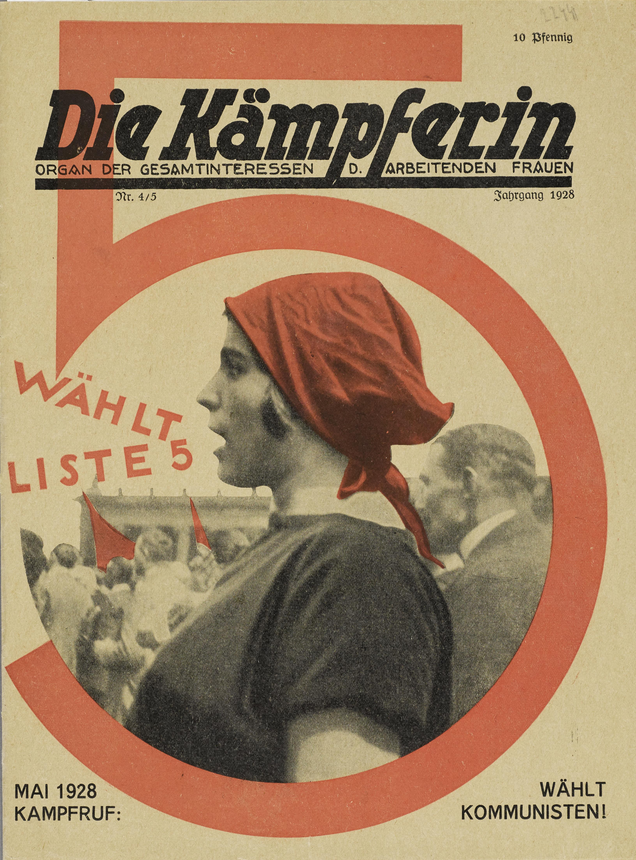
At the close of 1925 the “Red Women’s and Girls’ League” was formed, which grew rapidly in the first year of its existence under Communist leadership. This was, unfortunately, attained largely at the cost of the women’s sections of the party, since, in consequence of a lack of ideological clarity, the tasks of the party in its activity among the women and the role of the R.W.G.L. as a subsidiary organisation of the party were misunderstood by many. Lately, a certain stagnation has set in in the R.W.G.L.
After the Essen Conference an attempt was made by the C.C. to strengthen political activity among the women. Nevertheless the old deep-rooted weaknesses of party activity among the women have been so far only slightly overcome. The political importance of activity among the women has not yet been fully realised by the party as a whale, nor by the central organs.
Typical in this respect is the attitude of “Rote Fahne,” which persists in practically ignoring the masses of working women, at a time when in Berlin alone there are tens of thousands of working women playing an active role in strikes. Equally unsatisfactory is the activity in the factories and the trade unions, despite some progress which has been made. The women’s delegate movement is generally at a standstill throughout the country. The experience of systematic activity in Berlin seems to indicate that the women’s delegate meetings can be successful only when organised in close connection with activity in the trade unions. In its trade union activity the party has gained considerable influence among the women during the various strikes capturing important positions in the unions and attracting considerable numbers of working women into the unions, above al. in the textile, metal, and footwear industries. The party has begun the formation of women’s trade union commissions in the unions which are led by the Left wing, and also the organisations of Left wing conferences of working women for the preparation and conduct of fights.
General Organisation.
In the field of organisation the C.P. of Germany is among the strongest sections of the C.I. It was among the first to take up the re-organisation of its ranks upon the basis of factory nuclei. By 1927 this transformation had been completed. Nevertheless, among the members of the C.P. of Germany there are still a good many workers who do not belong to the existing factory nuclei, while it is also frequently the case that members of factory nuclei merely attend the nuclei meetings to pay their dues, doing their party work in their residential districts. Another defect in the organisation of the C.P. in Germany is the weakness of the organisations in the large factories. However, the elimination of this defect constitutes the central task of organisational activity. The statistical data given above in the chapter dealing with trade union activity goes to show that (in 1927) out of a total of 124,729 party members there were 58 per cent. factory workers, but only 8 per cent. in the large factories. In order to grasp the significance of these figures one must bear in mind the tremendous difficulties which hamper the activity of the C.P. in the large factories, the extremely well-organised system of espionage as well as the class-collaboration of Social-Democracy in the process of weeding out the Communists from the factories. Lately the reactionaries have conducted a bitter campaign against newspapers published by the factory nuclei.
In the period between the Fifth and Sixth World Congress the numerical strength of the C.P. membership in Germany fluctuated as follows:
In 1924 there were 121,394 members, in 1925—122,755, in 1926—134,348, and in 1927—124,729 members. At the time of the Party Conference of 1926 there were 145,009 members. The figures for 1926-27 show 20 per cent. less than the real strength of the membership in the C.P. of Germany, the reason being that only members in good standing were included; but even with this reservation the figures show during this period the membership of the C.P. of Germany has practically remained at a standstill. At the same time it should be noted that there has been a steady growth in the number of votes given to Communist candidates in various elections.
The circulation of the party press is twice as large as the strength of the party membership. The number of regular readers of the party press is estimated by the C.C. at 280,000. The question of the organisational consolidation of the influence of the C.P. in the trade union organisations is a particularly acute one. The weakest point in the whole organisational activity of the C.P. in Germany is the activity of the trade union fractions of the C.P. The German party has accomplished a big task in organising the party apparatus in conformity with the model statutes worked out by the First International Organisation Conference. Among all the Communist Parties in the capitalist countries, the C.P. of Germany has the best and strongest apparatus. The work of this apparatus has still many serious defects, e.g., the insufficient guidance of the activity of the nuclei and of the trade union fractions by the local party leadership; but the C.P. in Germany is systematically and persistently removing all these defects and rectifying the errors which have been committed.
 Revolution's Newsstand