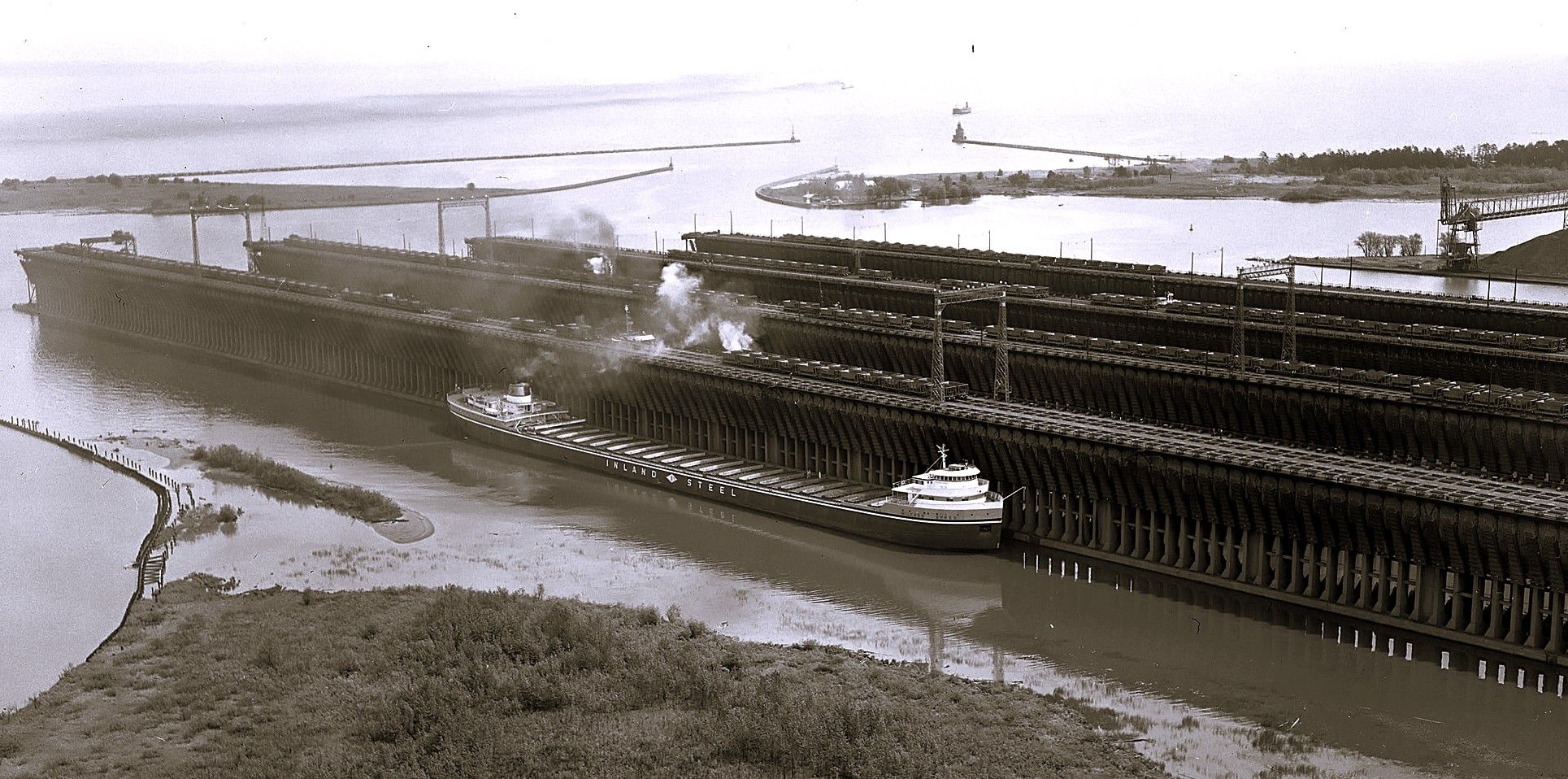
The massive Lake Superior docks where iron mined on the Mesaba Range was collected for shipment to steel the producing regions Detroit, Chicago, and Cleveland saw a strike during the First World War with mass arrests, anti-Finnish prejudices inflamed, and the Feds brought in to police their politics.
‘The Strike of the Allouez Ore Dock Workers’ by Arvid Nelson from Truth (Duluth). Vol. 2 No. 32. August 9, 1918.
The most serious labor controversy that Superior has experienced for a long time occurred last week, after a strike had broken out at the Great Northern Railway Company’s ore docks in Allouez. Another occurrence of special interest took place in connection with this strike and for which there is no precedent in the history of this locality, namely, the fact that over one hundred absolutely peaceful strikers were arrested at their homes and thrown in jail. All this occurred for the simple reason that these strikers had dared to go on a strike, which right the workers of this or any other country have not surrendered even in the present situation.
No one has charged that the workers were guilty of any disturbance and no such complaint has been presented against the strikers. That the Finnish strikers had intimidated and coerced strikers of other nationalities, that too was only “wind” of which the best proof is the fact that all such charges also fell through before even an attempt was made to prove them
That there was no other reason for the arrest of the strikers—Finnish as well as other nationalities—than the fact that they had gone on a strike, that is proven above all by the fact that they were all released at the end of the week without a regular trial of any kind. Only a few men were still held Saturday “for further investigation.” Neither did the railroad company have anything to fear on account of the strikers. Was not one condition of the release that the men return to their former places of employment?
It has been stated in newspaper reports that the loyalty of the arrested men has been questioned and that that phase of the matter has been investigated. But no support has been found for the suspicions. It may be argued with good cause that these ore dock workers have been more loyal than many other workmen, for they have been satisfied with working long hours for a lower scale of per hour than is paid in many other lines of employment at the present time. They have been satisfied with working ten hour days for 40 cents an hour on the day shift and 42 1/2 cents an hour on the night shift while common labor in the shipyards has had the basic eight hour day, better wages and working conditions ordered by the government for some.
While considering wages of the ore dock workers it must also be taken into consideration that their work is seasonal and lasts only seven months in the year at the most. The shipping of ore commences usually about the middle of April in the spring and closes during the end of November or the beginning of December, so that the dock workers must seek other employment for the winter months. But in spite of the poor wages a new record in the shipment of ore has been attained on the Allouez ore docks this summer, and that record has been attained by the workers employed there. It is admitted that the shipment of ore under existing conditions is necessary war work, but it can not be denied that the Great Northern Railway Company is still shipping ore in order to earn profits, even though its railroads and docks are under government control on account of the war situation.
The wage demand of the ore dock workers was very reasonable when the present high cost of living is taken into consideration. Their demand was to receive 10 cts. an hour increase in wages and did not include any demand for a shorter working day nor additional pay for overtime, as they admittedly were entitled to demand. They were loyal and did not desire to cause any cessation of work nor delay the shipment of ore. They decided to present their employers a demand which they expected their employers could accept without a dispute.
But that was not the case. A committee appointed by the workers presented their demands to the company officials on the ore docks on Saturday morning, July 27th. The strikers contend that the officials did not give any definite reply to their demands; they were only given the understanding that the officials could not grant an increase in wages because the docks were under government control, and no definite statement was made whether the company was willing to grant an increase in if it receives the approval of the government officials, and whether the company was willing to take the matter up with the proper government representatives.
Over five-hundred ore dock workers therefore remained off the docks voluntarily on the afternoon of the same date. It is false to contend that the strike was caused wholly by the Finns, for the Finns were in a minority among the strikers. There was not over two-hundred Finlanders among the strikers while the total number of other nationalities was over three-hundred.
And as the workers were unorganized they, as individuals, were not under the rules, of discipline or orders of any organized body, therefore the strike in this case was created by each worker on his own free will and was not forced by the decision of any organized group.
The strikers held a meeting on the Allouez ball grounds on the forenoon of the following Monday. The County Council of Defense had then taken a hand in the matter and its chairman, Solon L. Perrin, among others, had arrived in the meeting of the strikers to urge them to return to work. A vote was taken on this occasion, the purpose being to see how many of the strikers were willing to comply with the request. The vote was taken by having those who wished to continue the strike move into another group, while those who opposed remained where they were. The majority at this time were for continuing the strike until some definite reply was given to the demand for an increase in wages. It was decided to hold another meeting on the afternoon of the following day.
But the strikers did not get an opportunity to hold their meeting on Tuesday, for the city police and county officials with a number of deputies arrived in Allouez about noon and commenced the indiscriminate arrest of Finnish strikers. The police and their deputies searched through the boarding-houses and the dwellings of the Finlanders in Allouez, looking under beds and into all possible corners where men might possibly take refuge. Even men were taken along and locked up who had not been working on the docks for months. The round-up of the strikers continued all Tuesday afternoon and far into the night. Noticing that the drive was on many men fled from the city and it is unknown whether they will ever dare to return. A total of 139 men was taken in charge by the officials during the day. All were compelled to spend a couple of nights in the close city jail of Superior which is renowned for its filthiness As many as twenty men are stated to have been locked up in a common two-man cell for whole night, so that most of them were compelled to stand through the long hours on their feet, not to speak the “atmosphere” that existed in these cells. It reminds one of the “Black Hole of Calcutta,”
The situation in the police headquarters was relieved after the men had been arraigned in municipal court on Wednesday, when each one was held for a hearing on August 7th under $500 bonds. Over twenty men were then taken to the county jail at East End and 75 were transferred to the county work farm at Rockmont.
Not taking into consideration the few that were held for further investigation, all the arrested strikers, however, were released on Friday. The release took place on the recommendation of the conciliation committee composed of representatives of the strikers, the railway company and the government railroad administration. This same committee also decided to recommend that the wage increase demanded by the strikers be granted and this recommendation is now in the hands of the federal railroad administrator in the Great Lakes district for approval. Nearly all of the strikers have returned to work with the understanding that they are now working for the increased scale of wages, so that the controversy ended in a complete victory for the workers as far as this side of the affair is concerned.
While the Finnish strikers were in jail, it was stated that the county officials were endeavoring to urge the representatives of the federal department of justice to take an interest in the case, presumably on the ground that the strikers had violated some of the provisions of the espionage law now in effect, but apparently they did not succeed for it is evident that the representatives of the department of justice are not connected with the case. The newspapers informed the world at the same time that the deportation of the “undesirable” alien strikers was being planned, which perhaps had no basis in fact whatever.
Local newspapers have also endeavored to credit O.J. Larson, a Duluth lawyer, whom the arrested men had engaged as their attorney in this case, with the release of the jailed strikers. But these same papers have not mentioned that lawyer Larson collected $20 per man, a total of nearly $3,000, from these strikers for the few days services that he rendered them. What lawyer would not have jumped at such a haul!
If the workers had been organized they could have acted in this. They could have instructed their own officers to carry on these negotiations with the employers and the officials. They could have saved the large sum of money that they now paid to an attorney who is known to look after the interests of the employers.
At the same time, if the strikers had been organized, they would naturally have been represented in the central council of organized labor and they would have had the support of other labor organizations in their struggle. They would not, have been compelled to carry on their struggle against the exploiters of labor without any support at all of any kind.
The newspapers have also stated in connection with this case that other nationalities at the ore docks would have been willing to organize, but that the Finns have opposed it. The Finnish strikers on their part insist that they have been willing to organize, but that the workers of other nationalities have not agreed to it. It is generally known that employers continually stir up race hatred among workers of different nationalities in order to prevent them from organizing. The Great Northern Railway Company undoubtedly is no exception in this case and it is certain that it has taken advantage of other means to obstruct the organization of the workers in its employ.
In every case the moral of this struggle is once more that the interest of all unorganized workers demands that they organize into an economic organization.
Truth emerged from the The Duluth Labor Leader, a weekly English language publication of the Scandinavian local of the Socialist Party in Duluth, Minnesota and began on May Day, 1917 as a Left Wing alternative to the Duluth Labor World. The paper was aligned to both the SP and the I.W.W. leading to the paper being closed down in the first big anti-I.W.W. raids in September, 1917. The paper was reborn as Truth, with the Duluth Scandinavian Socialists joining the Communist Labor Party of America in 1919. Shortly after the editor, Jack Carney, was arrested and convicted of espionage in 1920. Truth continued to publish with a new editor J.O. Bentall until 1923 as an unofficial paper of the C.P.
Access to full paper: https://www.mnhs.org/newspapers/lccn/sn89081142/1918-08-09/ed-1/seq-2
 Revolution's Newsstand