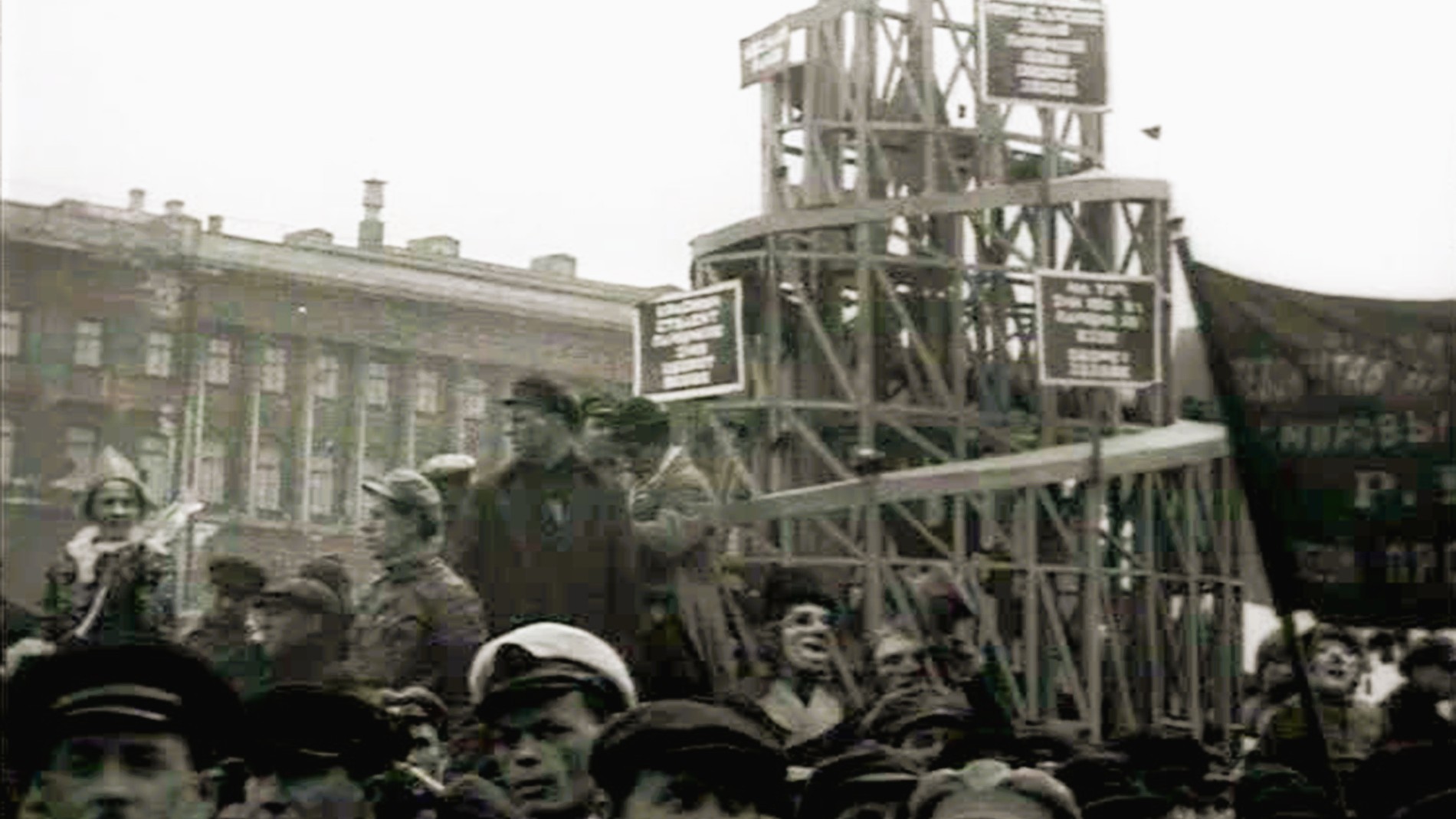
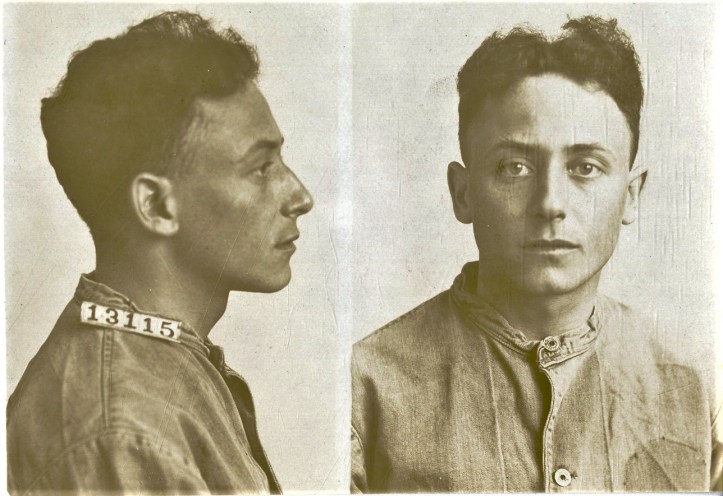
Fantastic writing from an obviously overwhelmed Charles Ashleigh describing Red Petrograd festooned during a blustery November for the Fourth Comintern Congress. British-born Socialist, wobbly organizer, political prisoner, and founding Communist, Charles Ashleigh was a working-class poet, openly (as much as comrades were then) gay, lover of Claude McKay for much of the 1920s, and a victim of deportation. A gifted writer, below he vividly tells of his experience of the U.S. through its prisons. Arriving in the U.S. in 1912, he participated in Socialist Party and then I.W.W. organizing, becoming nationally known as leader of the Everett Defense. Arrested in the 1917 sweep of I.W.W. leaders and found guilty of seditious conspiracy, Ashleigh was sentenced to ten years in Leavenworth. Released in the December, 1921 amnesty, Ashleigh traveled to New York City where he first met McKay. Deported in April, 1922 he would meet McKay at the 4th World Congress of the Comintern, who would send him to India. Deported from India back to Britain, he would be active with the Profintern throughout the 1920s and remained an activist his whole life. Charles Ashleigh died in Brighton on December 25, 1974.
‘Red Petrograd’ by Charles Ashleigh from The Worker. Vol. 4 No. 258. January 20, 1923.
EDITOR’S NOTE: This is the first of two articles just received by “THE WORKER” from Charles Ashleigh, who is in Soviet Russia. This first article tells of the thrilling events incidental to the opening of the Fourth World Congress of the Communist International at Red Petrograd. Ashleigh was sentenced to Leavenworth Prison, Leavenworth Kans., during the war, with the Industrial Workers of the World, He was released about a year ago and deported to England. Later he tried to go to India to investigate conditions there, but was prevented by the British government, He is now in Russia. Next week he will tell about “A Day with the Red Navy.” This week’s article follows:
Five years of the Revolution. Five years of the Soviet Republic. We knew that the Revolution had lived five years; we knew that this was the Red Week, the anniversary of the Bolshevist Revolution of November, 1917. We knew it because everywhere, in store windows in great red signs against the fronts of houses, and upon the walls of public buildings the fact was blazoned. Wherever you went, there was the great red “V” standing for the five years of struggle, under the hammer and sickle. It was all over Moscow before we left in the long special train, for Petrograd, where the opening celebration of the Communist International was to be held, on November 7th, the anniversary of the birth of the Workers’ Republic.
We knew it, because wherever our train stopped, the stations were hung with evergreens and red bunting; and working men and women and Red Guards stood on the platform, with their band, to greet us. Ours was a Red Train. In fact, there were two trains: we were too many for one. It was a first-class train, because honor must be paid to representatives of the workers from other lands. The only people on our special were delegates to the Communist Congress, the Congress of the Red International of Labor Unions, the Congress of the Young Communist International, Party workers and Labor journalists.
Nobody slept on the long night’s journey to Petrograd. Nobody ever seems to sleep in Russia. You attend Congress all day and committees half the night. You get supper at about eleven, then you write an article and some letters and then discuss matters with other delegates until about five. Then you go to the room you share with four others and do some more talking. And then you have to get breakfast and go to the Kremlin for the morning session. Perhaps you sleep a little, some where in between all these things, if you are lucky. Probably you don’t. But you don’t mind it a bit.
***
From the station in Petrograd we went to Smolny. Smolny, the dynamo station of the Petrograd uprising. The late genteel finishing school for young ladies had been rudely jolted from its accustomed routine, when, the Workers’, Peasants’, Soldiers’ and Sailors’ Deputies began tramping its long corridors in their heavy high boots, and the machine guns and armed lorries rumbled up its prim lawn to guard it against the soldiers of Kerensky. But it seemed now quite resigned, and as if it had been all its life a centre where rudely clad rebels worked sixteen hours a day at making a revolution.
The great hall of Smolny was where we dined. Then are names were called out from the presidium. Two hundred meetings were to be held that evening, in factories, in workshops, in governmental offices, barracks, universities, and naval stations. As their names were called, delegates went up to the platform, were formed into little parties under the care of an interpreter, and dispatched from Smolny in motor cars. I went with Albert Rhys Williams, who has written a jolly good book about Russia, and Jack Johnstone, of the Chicago Federation of Labor, and a Czecho-Slovak and two Turks, to Stesoresk, thirty miles away from Petrograd, where we had a most wonderful time. And we all had splendid meetings; and those who got back in time went to the opera; and some of us may have gone to bed. And the morning of the next day was The Seventh of November.
***
Red Petrograd. Womb of the Revolution–heroic city of conflict and achievement. There was a stir early next morning in Petrograd. The workers were assembling. Red banners came down the streets, bowing and lifting over moving masses of men. Bands came, and flags, and ever more flags, and long lines of workers, converging from a hundred different points into one great stream.
The rain came down upon the banners, and wet them so that they looked as though they had been soaked in blood. The snow began to melt, and we stood in the slush, ankle-deep, in the grey, keen morning. The unevenly cobbles streets began to run with streams of water, they flowed over our frozen feet; and the rain and the hail beat down upon us, as we stood, for an hour, waiting for the start as tributary processions poured in to join our main parade. For we weren’t riding in motor cars today, we honored foreign visitors. We walked with the other workers on the feast day of the Red City of Petrograd. No one suggested we should ride, of course, but God help the man who had done so!
We started, walking in rows of twelve, in the center of the street. All traffic was stopped on our route. As far back as you could see, there were banners; and as far forward as you could see.
We came to the great Uritsky Square, where the review was to be held. The delegates were hurried ahead of the procession, so that they might gain the reviewing-stand on the Square, past which the workers would march. But first we stopped at the Place of the Dead. Here, at this mound, covered with flowers and red banners and ribbons, where were buried the Petrograd workers who had died in the revolution, we stopped to pay our tribute. The jests and comradely chaff died upon, our lips. We stood there for a few minutes in complete silence. And then the bands played the Revolutionary Funeral Hymn.
Oh, Petrograd, your dead lived that day. They lived in our hearts and in our wills. Oh, Petrograd your dead are immortal. Not in the trashy immortality of a priestly heaven, but in the dynamic impulse of man to shatter, and to create. The guns of Petrograd saluted one hundred and one times. Red banners crowded the dark sky and bands sobbed out thick mourning music. The rain fell on our uncovered heads as we stood at the place where you lie, oh fallen comrades of ours. And your dust lived again, and was our flesh; your words became our words; and your will was renewed in us who will carry forward your fight until that for which you died has conquered the world. Dead workers of Petrograd, heroes of poverty, we salute you, brother; and go on to fight as you have fought, that the workers may all be free, and that we may be worthy of you and your deeds. Farewell warrior comrades, we go to battle and if we die, may our end be as yours!
***
In the gigantic Uritsky Square, a stand had been erected for the delegates. We took our places, and the march-past began.
They came in at one end of the square, marched past the stand and left at the other end. As they passed us, they saluted and cheered. We stood there, our hats in our hands, receiving the greetings of the Petrograd proletariat. who had come out, on their national revolutionary anniversary, to salute their comrades of the Communist International.

Wave after wave, thousands, came on. Bands and banners. The Internationale throbbing through the air. Communist Party branches, labor unions, factories, mills, schools, universities, workers, men and women workers, workers, workers…They had been up since about five in the morning getting everything ready. They were soaked to the skin. They had stood in the puddles of slush for hours. But they were laughing, and cheering, and singing. These men and women and children poorly dressed, toil-stained and haggard with the suffering of five years blockade—they sang, and they marched erect, and hope was in their faces, and courage; and their march was a march of victory, And I remembered how Bill Haywood used to quote the words, “Beware of an army that sings.” Yes, beware, you well fed ladies and gentlemen in other countries, smug and secure in your palaces and parks; for their songs are sung not only in Russia, but are echoing round the world.
They passed on and on, for hours. And their faces were raised towards us, as they passed, and ever they cheered. And we cheered back. We were hoarse and cold. Our arms were so tired with waving back at them that we could hardly raise them. And, after a while, I no longer saw the individuals in the crowd, I saw only the crowd. Their identities melted, fused into one. They were no longer proletarians, they were “The Proletariat.” They were the mass become conscious and creative. They were Solidarity, one and indivisible, precursors of a new state of consciousness which shall one day be realized as the final fruit of accomplished Revolution; mass consciousness, articulate and self-realizing.
***
From the Square we went to the hotel for a hurried meal and then to the opening session of the Congress.
The Great Hall was full. We sat there for some time, waiting. Then, suddenly everyone stood up and cheered, and the band played the Internationale. Zinoviev came in and took his place at the red-covered table of the Presidium. And then Clara Zetkin, the white haired heroine of the German workers. One after the other, the leaders in the world class struggle took their places. Then there was silence. Zinoviev rose. Keen and sensitive, he stood for a moment, facing the immense audience, then:
“The Fourth World Congress of the Communist International is opened,” he said simply; and took his place again.
There were no discussions at this opening session. This was the fraterisation of the working classes of the world, thru their representatives, Speaker after speaker rose and delivered the message of the workers of his country to the workers, peasants, soldiers and sailors of Red Russia.
“We are with you, comrades of Russia,” we said. “We are doing all we can to help you, and we are doing all we can that the workers of our own lands may overthrow capitalism as you have done.”
Some speakers had tales to tell of persecution, of imprisonment, and the White Terror. Some had news of victories, of the organization of great Communist Parties, others told how the movement, in the land from which they came, was still small but the comrades were loyal and working hard to win the workers from the errors inculcated by treacherous leaders.
All mentioned the great capitalist offensive, which swept all countries. But they sounded the note of hope. Revolution came to Russia, and the workers were freed. Revolution was possible. Working-class revolution was no longer a Utopian dream but a definite thing to which the world, shattered by the great war, was inevitably tending. And, already the workers were rallying from their post-war defeats, and were forming ranks to face the capitalist attack. The subject peoples of the East were arousing, and were preparing to enter upon a struggle with Imperialism on a greater and more vigorous scale than ever before. Large numbers of organized workers, in many countries, had lost faith in their compromising union leaders, and were rallying to the Red International of Labor Unions. In Czecho-Slovakia and Germany, great advances had been made along this line; and Great Britain and America were also securing gains.
It was a meeting of the General Staff of militant Labour. One after the other the representatives stood up, and gave the report of their sector of the world-wide fighting front. And they did not speak as mawkish sentimentalists, whining their cheap sympathy for the sufferings of the poor, nor as romantic dreamers, uttering pale longings for a vague Utopia, nor as smug politicians, bartering rhetoric for votes–but they spoke as soldiers in the midst of war, who had come to deliberate the next strategies in a conflict which would be hard and long enough, indeed, but of whose final victory they were assured.
The next day, the military parade. A long fleet of automobiles stood outside the hotel–the Hotel Europe, which was reserved entirely for us. This hotel, by the way, was leased from the State by its workers. It was run by the waiters, clerks, elevator boys, cooks and chambermaids. And when they were asked by the Comintern as to whether they would put us up, they agreed, and promptly gave their guests–speculators, bourgeois, foreign and native–respectful notice to quit within 24 hours.
I saw car after car leave, full of delegates, for the Uritsky Square. I did not know what was coming, so I wondered why we did not go by tram. My turn came. I climbed into a seat next to the chauffeur. Four comrades got in behind me, and we started. How shall I describe that ride–that breath-taking cruise around the shores of an army?
Picture to yourselves the enormous Uritsky Square. Trafalgar Square would look like a backyard next to it, and Union Square would be lost in it. It was a great oblong, and in the middle of one of the long sides was the reviewing stand. And drawn up on the other three sides were soldiers. But soldiers were not just in the Square. In the boulevards which led from the Square there were more soldiers; so that the machine entered the Square, skirted the three sides, left by one boulevard, passed by a cross street into the other boulevard, and so back to the Square and to the stand.
That was what we had to face. As we got near the Square our driver motioned to us to stand up . We did so, but did not know why. We saw the comrades on the car in front of us also stand and take off their hats as they entered the Square. But we did not know why. We soon knew. We were to receive the salute of the Red Army.
Our car ran into the Square. We went on at an easy run, passing soldiers drawn up in perfect order, their officers standing at the salute. And as we passed each unit they cheered. And so a great deep-throated cheer rolled on from battalion to battalion, regiment to regiment, with us as we went. Infantry, artillery with their machine and heavy guns, cavalry with their lances fluttering with crimson bannerettes, armoured cars, tanks, mounted infantry, aerial corps, sailors, soldiers of every branch of the service–in their well-made, well-fitting and perfectly clean and new-looking uniforms, red flags to each company, and great red banners to each regiment–an ocean of brown, picked out with red. And still we went on, past half-a-mile of brown-clad youths, cheering, smiling–different from all other soldiers I had ever seen: not cowed nor stiff and lifeless like automatons, but, with all their strict formation, like a lot of jolly boys, enjoying what they were doing, and knowing they were free men. They had their representatives on all the local Soviets, these free soldiers, and on the Pan-Russian Soviet; they had a voice and a vote in matters military, and in the general running of their country. And they knew that they were fighting for Communism; and they knew that we were fighting for Communism. And so they liked us, and let us know it.
Their faces were not expressionlessly rigid, like capitalism’s conscripts, or the poor professional mercenaries of imperialism, for they looked up at us, as we went by, smiling broadly, with a youthful and exuberant friendliness. And their cheering was real cheering. Out of the Square, along the boulevard, and past more soldiers.
And the great cheer rolling on with us, dying as the car ahead of us passed, and then swelling again as we came by. Here was the young army, an army born in the struggle, and a young army in every sense, for there did not seem to be a soldier above twenty-five, and most were about twenty. And they were ours I They were for the defence of the people, and not of kings; they fought for the workers, and not for profits. Their hundred thousand bayonets were not made to conquer markets, but to free oppressed peoples. They were the new Crusaders, with armour and lance, who would wrest from the swinish rulers the New Jerusalem and establish it forever.
They were our army–and I loved them! They were youth, smiling, gallant and gay, and ready to go through Hell for the revolution. They were guarding Russia, while the workers built her up. They stood on guard with their lives, while the workers built the new world. They, and the surging shabby parade of the day before, were one great army–they were part of the new, cleansing wonder in the world, which is revolution. They were the Armed Proletariat, the word of power made flesh.
I felt awfully ashamed of myself. I was standing up in full view of these thousands. I was trying to smile back at them, but it must have been the rush of the wind which brought water to my eyes. It was very embarrassing. At a m1litary parade one would look rather martial, I should think, when rece1ving a salute; and, at least, one should appear cheerful with all these smiling persons gazing at one. But then I was only a poor worker, tramp, sailor, reporter, who had been knocked on the head more than once and slammed into jail here and there, so I wasn’t used to military reviewing–and then the wind was pretty strong. I looked at the auto ahead of ours. I could see my pal Harry, from England.
He was standing up, of course, but was acting in a most unmilitary way. He held his hat in his left hand, and, with his right held stiffly to his forehead, was saluting! This was terribly wrong.
One simply mustn’t salute with one’s hat off. But then Harry was probably perfectly unaware that he was saluting, or that his hat was off, or both. I know how he felt. I looked round at the fellows in my car. There was a young Turk there I had often chatted with. He was crying, openly and unashamedly. With a sense of relief I gave up trying to look martial.
And then we got back to the reviewing stand, and stood there for hour after hour, while the boys marched past. That evening we became part of a legislative assembly. In other words, we had a joint session with the Petrograd Soviet.
We marched into the hall, with its semi-circular rows of seats and desks, and mixed up with the members of the Soviet. The Soviet Presidium and the Comintem Presidium sat at the scarlet-draped table. The inscribed red banner of the Petrograd Soviet was held by a Red Guardsman, who stood with fixed bayonet. Workers, soldiers, peasants and sailors–deputies of the people–sat with us, fraternizing.
Speakers exchanged greetings. Soviet members told us of the value of that organ of power, the Soviet, the means by which the proletariat exercises its political will. We told them of the struggle of the workers in our countries, and that, one day, we hoped to see the representatives of the Russian workers received by the Soviets of our lands.
Then Clara Zetkin stood up and presented to the Petrograd Soviet a banner made by the Communist women of Leipzig. The long, scroll-like banner was unfurled, and, during the rest of the session, two Red soldiers stood below the Presidium holding, so that all might see, this flag which German working women had made with such love in the scanty time spared from factory and housework for the working class of far-away Petrograd.
We received presents from the workers of Petrograd, boxes of cigarettes–“Workers of the world, unite!” on the box in four languages–and useful notebooks for our work at the Congress. “We have not much ourselves, and cannot give fine presents,” said the trade union speakers of Petrograd. ” But what we can give, we give with love.” And they spoke truth, for, through all, there shone that strong spirit of simple comradeship–that affection which somewhat puzzles me, for I cannot quite decide whether it is a distinctly Russian trait, or whether it is a thing which the revolution will produce in all peoples.
And, then, from the Soviet session to the train for Moscow, where great doings were to be held next day.
Good-bye to Petrograd: the journey to the station in red-festooned street cars. The cheering workers at the station and the Red Guards’ band playing the Internationale as our two trains steamed out.
Good-bye to Petrograd, flaming with red bunting, battle-scarred, suffering yet from hunger, deprived of so much by blockade, yet working heroically.
Good-bye to Petrograd, where your sacred dead lie sleeping in a red-flowered grave; and where your valorous living are workers, with scarred hands and shining eyes, to build a world in which we shall one day live, prouder than kings, wiser than grey teachers, and as simply gay as young children.
The Daily Worker began in 1924 and was published in New York City by the Communist Party US and its predecessor organizations. Among the most long-lasting and important left publications in US history, it had a circulation of 35,000 at its peak. The Daily Worker came from The Ohio Socialist, published by the Left Wing-dominated Socialist Party of Ohio in Cleveland from 1917 to November 1919, when it became became The Toiler, paper of the Communist Labor Party. In December 1921 the above-ground Workers Party of America merged the Toiler with the paper Workers Council to found The Worker, which became The Daily Worker beginning January 13, 1924. National and City (New York and environs) editions exist.
PDF of full issue: https://www.marxists.org/history/usa/pubs/theworker/v4n258-jan-20-1923-Worker.pdf
 Revolution's Newsstand