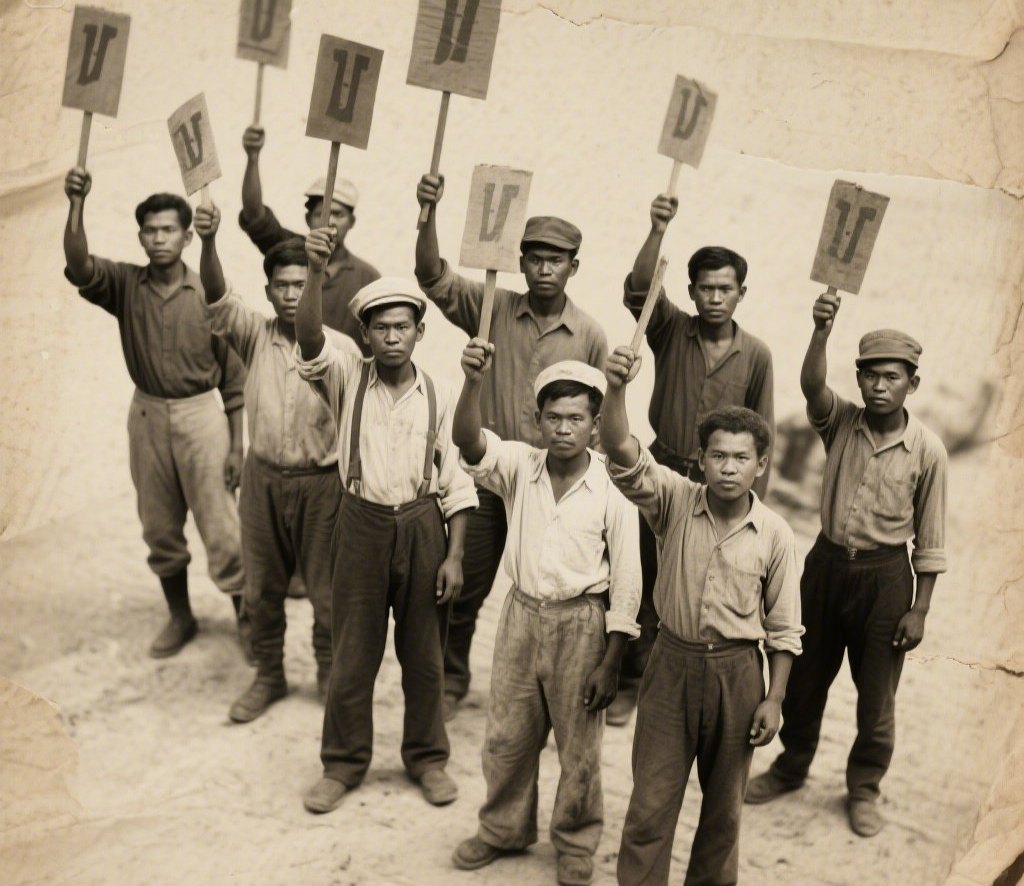
A valuable short introduction to the organizations and political tendencies that made up the early Filipino labor movement.
‘The Labour Movement in the Philippines’ by Alvarez from International Press Correspondence. Vol. 9 No. 37. August 2, 1929.
The labour movement first arose in the Philippines about thirty years ago under the direct influence of the National Revolution of 1898 which led to the formation of the First Republic in the Far East. During this revolution the lading role went over spontaneously to the proletarian elements in the towns and to the poor strata of the population in the rural districts–a movement that was headed by Andres Bonifacio against the landowning bourgeois clique who, seriously alarmed at losing their lands, riches and other privileges, hastened to capitulate to the Americans and thus betrayed the Rebellion. Subsequently, the Americans defeated the Spaniards (for the revolution in the Philippines was directed primarily against Spanish domination) and commenced to suppress the emancipatory movement of the people. It was only after three years of bitter struggle that the U.S.A. finally got full control of the Islands.
The small labour unions that arose in Manila, the capital of the Islands, around about 1901-02 were inspired chiefly by a group of prominent intellectuals who had received their education and knowledge of the labour movement in Spain. And we find the Spanish labour movement of that time, with its craft organisations, formed chiefly to render mutual aid, uniting a spirit of co-operation between master and man, thus taken as a model for the labour movement of the Philippines. The predominance of small-scale and handicraft industry greatly facilitated the growth of these forms of the movement and to this day have a strong hold on the Islands. Despite the peaceful outlook observed throughout the movement generally, several strikes occurred during the early days movement thanks to the intolerable position of the workers–the result of the high cost of living that followed the acted war and the economic policy of the Americans (with Americans in control the trade turn-over rose from [number missing] peso in 1895 to 132,000,000 peso in 1903 a growth that was only possible by enhancing the exploitation of the peasantry).
The repressions directed by the American authorities against strikers and their leaders strengthened the peaceful tendency in the labour movement, the more so, since at that time labour organisations were not purely proletarian in character, there being many small shop-keepers, handicraftsmen and others among the membership.
The bitter struggle between the labour leaders (the majority of whom were not workers at all) to use the labour organizations as a means of getting parliamentary seats, started running the first election campaign (1907) when the Parliament the Philippines was first established after the Americans had “pacified” the country, extremely weakened the labour organizations. It was universally recognised at that time that the labour movement would have to gather its forces together and reorganize itself–a task that was undertaken by the Printers’ Union–the most progressive labour union at that time. Several new unions catering for the tobacco workers, seamen, carpenters, sailors, boot and shoe operatives and others were organised on new basis which made it impossible for any of the masters employing class to become members. By the first of May 1913, all these organisations had met and formed the Philippine Labour Congress the largest National Labour Federation in the Islands.
The bitter struggle that arose again between the politicians and the Congress leaders–seriously retarded the work of the Congress and in 1916 a group of unions headed by one Balmori broke away. This group formed the so-called Federation of Labour which subsequently became the extreme Right Wing of labour movement, zealously supporting class collaboration. This Federation is still the loyal agent of the capitalists in the labour movement of the Philippines.
At the present time the percentage of workers organised in Philippines is very high indeed. In 1927, of about 300,000 workers employed in industry, transport and trade (including lumberers and fishermen working for hire), there were 92,000 organised, of whom 66,137 belong to the Labour Congress (not including the agricultural workers); 3,268 belong to the Federation of Labour, while 22,786 were lined up in the Independent Unions. The Peasant and Agricultural Workers’ Confederation affiliated to the Labour Congress, likewise became a very strong factor in the labour movement. However, the percentage organised among the agricultural workers is altogether negligible. The Confederation has less than 15,000 workers lined up, although there are more than 2,000,000 workers employed the agricultural trades of the Philippines.
The growth of the numerical strength of the workers’ organisations was especially apparent during the post-war period beginning with 1917, went hand in hand with the rapid growth industry. At that time many new large-scale enterprises arose, equipped on the latest engineering lines, employing large numbers of workers. There was also a marked increase in the number of transport workers as the railways were extended and her transport facilities introduced.
Despite the fact that a large number of the workers were organised in the trade unions, the mutual aid societies and other organisations, the whole labour movement of the Philippines in to recent years was still characterised by its marked vision, as seen in the early period of its development and a craft outlook. (For example, in Manila, alone there were eleven organizations catering for the tobacco workers. Some of the organisations could not boast of any members outside a given factory. There were five unions for the seamen, and so on.) The idea class peace still had a strong hold on the workers, there were no militant leaders; neither were there many active trade unionists. It was the organisational structure of the Labour Congress, which is a loose federation of various organisations and the fact that no paper was published and no dues fixed. etc., that prevented the Congress from becoming a real organ uniting and leading the labour movement. And, finally, it must be said, the weakest side of the labour movement in the Philippines was its complete isolation from the International Labour Movement.
Besides this, the absence of an independent labour party seriously weakened the unit weight of the labour organisations in the political life of the country, Prior to the formation of the Labour Party of the Philippines in 1928, the workers were mainly influenced by the political views of their leaders who usually belonged to one of the two bourgeois parties. For example, in the struggle for national independence such a vital question for the working masses of the Philippines–the workers followed the lead of the national bourgeoisie.
But the last year or two marks a new era in the labour movement of the Philippines. It was ushered in by the tempestuous growth of the revolutionary movement in China and the fact that the Philippines were drawn into the orbit of the international revolutionary labour movement when the Labour Congress affiliated to the Pan-Pacific Trade Union Secretariat (affiliation was made in the middle of 1927 immediately after the Pan-Pacific T.U. Conference had been held). Thanks to the fine work carried out by the most progressive and revolutionary section of the labour movement in the Philippines to strengthen the unions, to reconstruct them on the industrial principle, to get T.U. activities going at the factories and plants, to strengthen unity and propagate the idea of international working class solidarity, urging an implacable class lead, and the strengthened strike movement of the last period, the successes already achieved in the trade union field have certainly been remarkable. For example, Philippine workers and Chinese workers came out together; Chinese and Philippine boot and shoe operatives struck for more than four months; the recent woodworkers’ strike should also be noted. The Chinese workers in the Islands are united in the so-called Philippine-Chinese Labourers’ Association which has set up close contact with the Labour Congress, despite the efforts of the native bourgeoisie to foster a spirit of national antagonism. Several strikes that arose at the end of 1928 and the beginning of 1929 were remarkable for the solidarity shown by the workers and the large numbers involved. The growth of the militancy and solidarity of the workers was seen especially during the strike of last December, when 10,000 workers came out to protest against the arrest of one of the tobacco workers’ leaders (who had struck a scab).
The conservative elements, however, have been furiously. resisting the continued radicalisation of the labour movement. (In the Philippines the Right Wing of the labour movement is nicknamed the Conservatives; the Left Wing the Radicals.) At the outset this resistance was seen in the internal struggle in the Council of the Labour Congress and in the way the organisations controlled by the Right Wing leaders sabotaged the new policy.
Subsequently, the intensification of the struggle between the two tendencies led to a split in the Labour Congress at the Annual Congress held at the beginning of last May in Manila and a new Labour Congress of the Philippines, known as the Proletarian Labour Congress was formed. Where the so-called conservatives are leading the labour movement is seen from the declarations made by their leaders (Tehadi and others) after the split had taken place, which state, among other things, that the Labour Movement of the Philippines must now strengthen contact with the Labour Bureau (a Government body), and resist all outside interference in the labour movement and national life of the Philippines (which means there must be no contact with the international revolutionary labour movement). That the services of these gentlemen have been recognised is seen by the sympathetic way in which the bourgeois press support all their efforts, while rabidly attacking all militant elements and inciting the reactionary forces in the country to persecute the Left Wing.
The recent developments and the increased opposition between the opportunist and revolutionary tendencies make it imperative for the Left Wing to stand together solidly and give a clear lead in carrying out its policy, reinforcing achievements already gained and struggling actively to unify the labour movement on the basis of the class struggle, urging an eight-hour day, increased pay, recognition for the unions, protection of female and child labour, both in town and village, against the inhuman exploitation of the agricultural workers and the poor peasantry, thus extending their influence among the workers (news to hand shows that half of the organised workers have already affiliated to the new Labour Congress), organising the unorganised and taking up their place in the vanguard of the struggle for independence.
Unquestionably, the Pan-Pacific Trade Union Congress to be convened in the very near future will strengthen the Revolutionary Wing in the labour movement of the Philippines, will reinforce its connections and bring to its aid the support of 15,000,000 organised workers in the Pacific countries.
International Press Correspondence, widely known as”Inprecorr” was published by the Executive Committee of the Communist International (ECCI) regularly in German and English, occasionally in many other languages, beginning in 1921 and lasting in English until 1938. Inprecorr’s role was to supply translated articles to the English-speaking press of the International from the Comintern’s different sections, as well as news and statements from the ECCI. Many ‘Daily Worker’ and ‘Communist’ articles originated in Inprecorr, and it also published articles by American comrades for use in other countries. It was published at least weekly, and often thrice weekly.
PDF of full issue: https://www.marxists.org/history/international/comintern/inprecor/1929/v09n37-aug-02-1929-inprecor.pdf
 Revolution's Newsstand