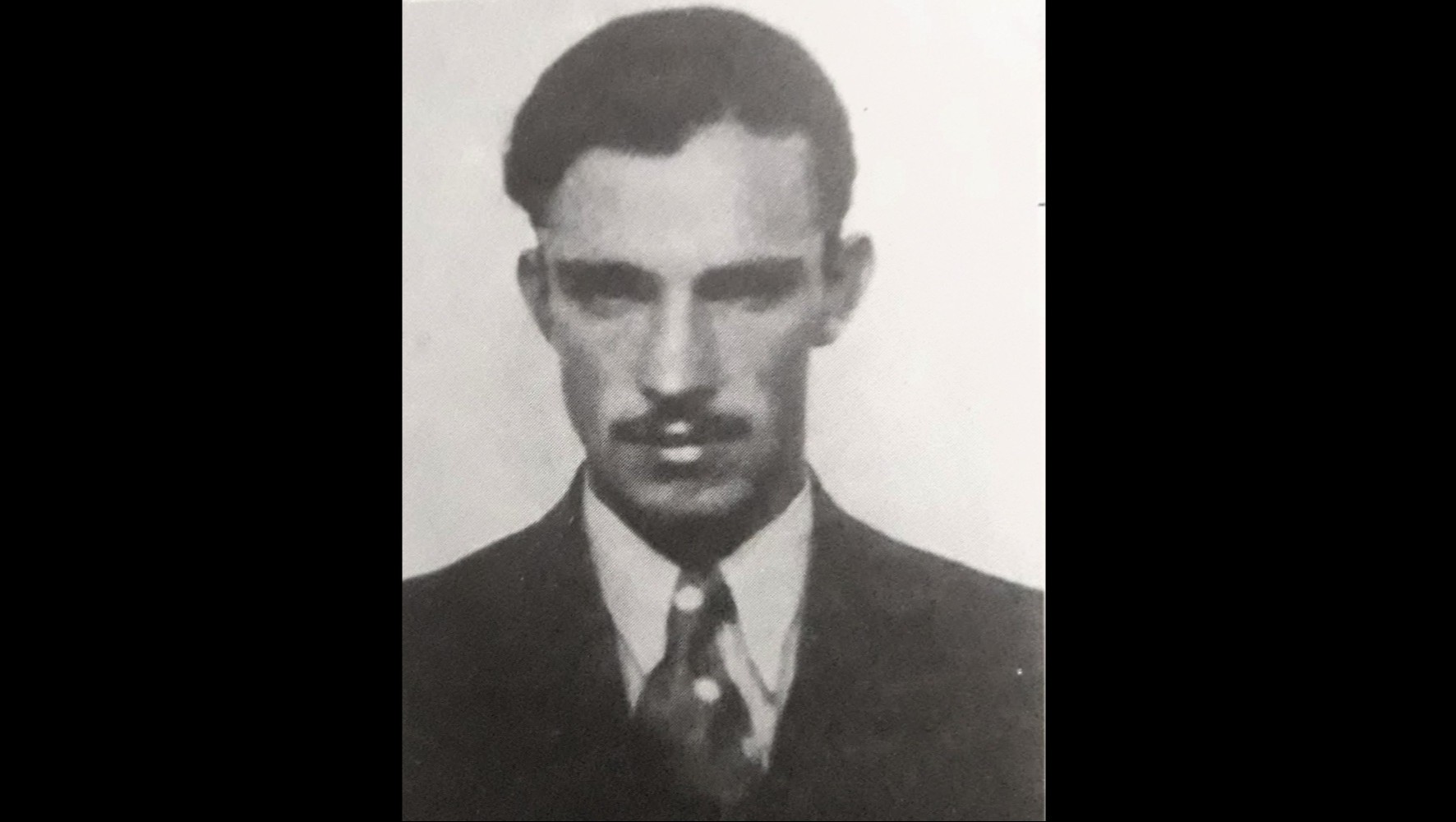
Harrison George reacts to the murder of his son, with the barest of information yet available. George’s son, Victor Allen Barron, was himself a Communist activist and sent by the Comintern to assist the Brazilian Communist Party in setting up radio communications in 1935. While there the rebellion against the dictatorship of Getúlio Vargas led by Communist militant Luiz Carlos Prestes broke out. Barron, also a driver for Prestes, was arrested, tortured and, on March 5, 1936, murdered. It was claimed he committed suicide, a lie. The police also claimed that the 26-year-old Barron had given information leading to Prestes arrest, also a lie. Harrison was a central voice of the Communist movement in its first two decades who began as something of an anarchist, then into syndicalism, and in 1919 a founder of the Communist Labor Party, joining while in Leavenworth as an I.W.W. prisoner. A prolific writer, eventually being the editor of the People’s Weekly World, and long on the leadership of the Party, he was also a Profintern official and organizer for the Pan-Pacific Trade Union Secretariat. He was among those expelled at the end of World War Two, wanting to return to a more confrontational class politics, for ‘ultra-leftism.’
‘They Killed My Son’ by Harrison George from New Masses. Vol. 18 No. 13. March 24, 1936.
IT WAS night before I read the terrible news. How, that morning, in Rio de Janeiro, Luis Carlos Prestes had been seized by the white terror. The bestial police assassins of Getulio Vargas. My son, Victor Barron, dead. My own son, regardless of some idiotic court that, when still a child, gave him another name. That lost him from me for long years.
But not forever. Out of the West, from the skid-road of Seattle, he came to me in 1931. A lanky lad. A real proletarian. A lumber-jack at sixteen. Doing a man’s work for a boy’s wage. Unable, finally, to find such a job, Conscious of the bitter wrongs suffered by his class. A brilliant mind thirsty for knowledge of the way out. Demanding answers to countless questions. Devouring books with eager passion. But, again the mutations of life. Again, separation. Now, he is dead. Murdered by the Brazilian police, Of course, the police tale is that my son “committed suicide.” Political prisoners in Brazil always “commit suicide” or are “killed by their followers.” In that same Police Headquarters where my son met death, a man named Niemeyer “committed suicide” some time ago. When popular outcry at long last forced an open hearing, it was proven that the police murdered him. In the case of my son, the tale of “suicide” served a double aim: to cover up his murder by the police and to conceal—by accusing the murdered boy—the real police informer who disclosed Prestes to the police.
Would you have corroborative evidence from impeccable authority? Then scan the following excerpts from the speech of Abel Chermont, member of the Federal Senate of Brazil from the State of Parana, delivered to that body under the shelter of parliamentary immunity and printed in The Imparcial of Rio de Janeiro dated March 4, 1936:
“The Captain Jose de Medeiros, after arrest by the police, has been found dead in the Vista Chineza [in the heart of Rio]. His body filled with bullets. His hands and feet broken and crushed, with 23 wounds of different degrees. His body was found in the same place where, some time ago, was also found dead the unfortunate student, Tobias Warschawski—a few days previously arrested by the police. As it happened in the Warschawski case, the police have issued a statement declaring that Captain Medeiros was killed by his followers…Captain Medeiros, the soldier Absguardo Martins; two crimes, two assassinations under the State of Siege, for which assassinations I accuse the police in whose hands they were.”
In the hands of these police assassins now is Luis Carlos Prestes, adding to the 17,000 persons already thrown into prison under the State of Siege. A magnificent personality for whom there is no comparison in American history, a soldier who rebelled against command to oppress the people, Prestes became the idol of the masses when, from 1924 to 1926, he led the famed “Prestes Column” of mutinous troops in an armed campaign for popular rights. He is a legendary figure that led his command now here, now there, throughout Brazil’s vast dimensions. Finally forced to flee across the frontier, Prestes remained the “Knight of Hope” to the millions of his oppressed countrymen.
In those years Brazil was ruled by “President” Washington Luis, a puppet of British imperialism, with vast plantations, railways and other interests in Brazil which reach the sum of 287,306,750 pounds sterling, Against the British, seeking political influence, trade favors and vast concessions, American imperialism, with some $500,000,000 invested, intrigues with corrupt Brazilian political cliques. The big Wall Street investors are: The Electric Bond and Share Company, the Standard Oil of New Jersey, the Texas Corporation, the United States Steel (controlling important manganese mines), the American Smelting Company, Armour and Company with great packing houses.
Henry Ford holds a vast concession—for rubber—a feudal realm called “Fordlandia” of 3,700,000 acres on the Tapajos river, with extra-territorial rights of sovereignty for Ford which excludes the operation of Brazilian law within his domain. There, for luckless thousands of Negroes and Indians, “Ford wages” means a top wage of 12 cents per day, from which they must buy supplies at company stores. Under such imperialist exploiters, whose rule is enforced with the police whip and military bayonet of this or that Brazilian tyrant who can seize the title of “President of the Republic,” live the great majority of 43,000,000 people. The Department of Overseas Trade of Great Britain, never accused of sentimentality, in a report on Economic Conditions in Brazil, has said: “The inhabitants are living, in many cases, in a serfdom not differing much from that of medieval times.”
In 1920, the present “President,” Getulio Vargas and the present Brazilian Ambassador to Washington, Oswaldo Aranha, organized the successful coup d’etat which, with armed force, established the present regime. At that time, both Vargas and Aranha were denounced as “Moscow agitators” in the name of the old regime and by the same Serapham Braga whom they now use as their chief of the “Social Section” of the police.
Vargas had been defeated for the presidency in the elections. His program had included many reforms which he has since wholly ignored. These same reforms are today supported by people whom Vargas now orders to death through the same police bloodhound, Seraphim Braga.
DISILLUSIONED, angered by the exposed demagogy and treachery of Vargas, the people have been repeatedly driven to armed rising. Already, at the end of 1930, the workers of the Ford Concession rose against the brutality and exploitation they suffered from the Emperor of Detroit. Ford’s private army, aided by the Varga police sent from Para, drowned the revolt in blood. Hundreds were shot down like wild beasts. Such indignation was roused throughout the country that the Vargas government took the most drastic measures of censorship to prevent even a reference to it from appearing in the press of America and Europe.
The present “State of Siege” is the third since Vargas seized power. It was declared by him on December 17 last, to give legal face to illegal brutalities against the people: the martial law, expressly forbidden by the Brazilian Constitution except when there exists a state of war with a foreign power. The situation, said the Vargas decree, is “similar to a state of war with a foreign power.”
This situation, however characterized, arose from the fact that the great majority of the Brazilian people were rallying to the banner of the National Liberation Alliance. All social strata support this Alliance, as do the trade unions and a large section of the army. This national Liberation Alliance includes, among its organized affiliates, the Tenientistas, the Socialist and the Communist parties and has won the support of the big majority of the people with its militant struggles for the rights of the masses and its program which is simple, clear and altogether just:
1. Disbandment of the fascist organization, the “Integralists.”
2. Nationalization of foreign-owned enterprises, banks, etc.
3. An eight-hour working day, with one day of rest in seven.
4. Equal pay for men and women doing the same work.
5. A minimum-wage law.
6. Unemployment insurance and old-age pensions.
7. People’s Committees to see that social laws are enforced.
It is this organization, with this program, that the Vargas regime terms a “creature of Moscow.” It is this organization, at whose head stood the heroic Luis Carlos Prestes, leading the struggle, hunted day and night by the police bloodhounds and now fallen into their murderous hands.
At the beginning of 1935, negotiations were started between the Vargas regime and the American State Department. For Brazil, Vargas himself claimed the exclusive right to speak, illegally excluding even his own cabinet members, the Customs Director and Superior Council of Tariffs. For the United States, Ambassador Gibson, supervised from Washington by the Chief of the Latin-American Section of the State Department, Sumner Wells, he of the dark record of supporting the bloody regime of Machado in Cuba.
The terms of this Commercial Treaty are so brazen–going beyond the “most favored nation” clause approved by Brazilian law–that a tremendous popular outcry against selling the country to Wall Street began. The National Liberation Alliance, headed by Luis Carlos Prestes, led the masses in a continuous national mass protest demonstration. In press and parliament echoed the mass cry to reject it. Without stifling this outcry, without silencing the people with martial law, Vargas did not dare sign this enslaving “treaty.”
In April, 1935, the National Liberation Alliance, the trade unions and other organizations were decreed illegal. On the very same day, the fascist Integralistas, led by one Plinio Salgado who is associated with German Nazis, and one Matarazzo, a millionaire Italian associated with Mussolini, were given full freedom of action and organization and encouraged in their attacks on strikers and anti-Vargas demonstrators. On November 24, 1935, even the Catholic Church and many progressive groups joined the Alliance in the demand to disband the fascists. But in vain.
Vargas provoked an armed rising on November 26 by a “purge” of liberal elements of the army, together with intense violence by the fascists against the masses. The rising, mainly limited to the far Northeast area, was supported in Rio de Janeiro by a large section of troops who refused to be ordered against the people. Overwhelming and savage force suppressed the rising. The cities of Pernambuco and Natal were indiscriminately bombed from the air. Artillery was used against the people.

And–under the shade of thousands of bayonets–Vargas signed the “commercial treaty” with the United States on December 2. The legalizing of martial law and of white terror was followed by the decree of December 17. No one has counted them, but hundreds were killed. Some 17,000 are in prison. Civil courts replaced by courts-martial and all constitutional rights abolished.
The list of prisoners include many of the most prominent and respected citizens of Brazil: among them, Nelson Coutinho, Secretary of Justice and well known as novelist and journalist; Caio Prado, outstanding economist and historian; Cabral Filho, prominent engineer; Francisco Mangabeira, son of the former Minister of Foreign Affairs; Captain Agildo Barata, a liberal officer beloved by the army and a long list of such notables.
On December 26, the police arrested a German, an anti-Nazi refugee from Hitler, Arthur Ewart and his wife. Concerning the brutal treatment of Ewart since arrest, the Brazilian senator, Abel Chermont, above quoted, said in the Senate:
“This man, Senhor President, suffers so much torture and so many brutal beatings, that, in spite of his rugged physique, his ribs have been broken by his torturers in the headquarters of the police, and he has had to be placed in the hospital.” [From Imparcial, March 4, 1936.]
Some time in January, the writer’s son, an Victor Barron, was arrested, charged variously with “driving automobile for Prestes” and “operating a radio.” He met death in police headquarters in Rio de Janeiro. He “gasped out his last breath,” said the Associated Press dispatch of March 5, “without fulfilling a promise he had made to United States Embassy officials that he would reveal the secrets of the Communist International’s activities in Brazil.” I cannot credit the tale that such “secrets” exist, or that my son knew them, much less that he promised “to reveal” them.
By chance, on the day of the boy’s death, a group of three prominent British citizens, consisting of Viscountess Hastings, Lady Cameron and the novelist Richard Curtis Gavin Freeman were in Rio. Freeman was arrested when, as The N.Y. Times reported on March 8, he “apparently disregarded the police instructions and attempted to visit the police emergency hospital to ask questions.” All three, representing the Anti-Slavery League, were deported on March 8.
Prestes will most certainly be murdered, illegally by the police, or with due legal form by the courts-martial, unless an avalanche of protest pours into Rio de Janeiro from all individuals and organizations that support even the most elemental of human rights. To the Brazilian people, Prestes represents a precious, anti-fascist and anti-imperialist leader. Getulio Vargas represents fascist terror, American and other foreign imperialism and the reactionary landowners. “Our present task,” said the Vargas organ, on December 18, “is to wipe out the organizations of the workers.
The cry “Release Prestes!” and “Release Ewart!” must become familiar to every Brazilian consul in the United States. The demand for amnesty for all political prisoners, an end to martial law and resumption of constitutional rights, must be heard in Brazil.
Likewise, investigation of the malodorous conduct of U.S. Ambassador Gibson in the detention, torture and death of Victor Barron and the making public of the State Department instructions on his case and reports on the carrying out of those instructions, are the deserving demands of all Americans upon the Washington administration, the “Good Neighbor” of the assassin Getulio Vargas.- THE EDITORS.]
The New Masses was the continuation of Workers Monthly which began publishing in 1924 as a merger of the ‘Liberator’, the Trade Union Educational League magazine ‘Labor Herald’, and Friends of Soviet Russia’s monthly ‘Soviet Russia Pictorial’ as an explicitly Communist Party publication, but drawing in a wide range of contributors and sympathizers. In 1927 Workers Monthly ceased and The New Masses began. A major left cultural magazine of the late 1920s and early 1940s, the early editors of The New Masses included Hugo Gellert, John F. Sloan, Max Eastman, Mike Gold, and Joseph Freeman. Writers included William Carlos Williams, Theodore Dreiser, John Dos Passos, Upton Sinclair, Richard Wright, Ralph Ellison, Dorothy Parker, Dorothy Day, John Breecher, Langston Hughes, Eugene O’Neill, Rex Stout and Ernest Hemingway. Artists included Hugo Gellert, Stuart Davis, Boardman Robinson, Wanda Gag, William Gropper and Otto Soglow. Over time, the New Masses became narrower politically and the articles more commentary than comment. However, particularly in it first years, New Masses was the epitome of the era’s finest revolutionary cultural and artistic traditions.
PDF of full issue: https://www.marxists.org/history/usa/pubs/new-masses/1936/v18n13-mar-24-1936-NM.pdf
 Revolution's Newsstand