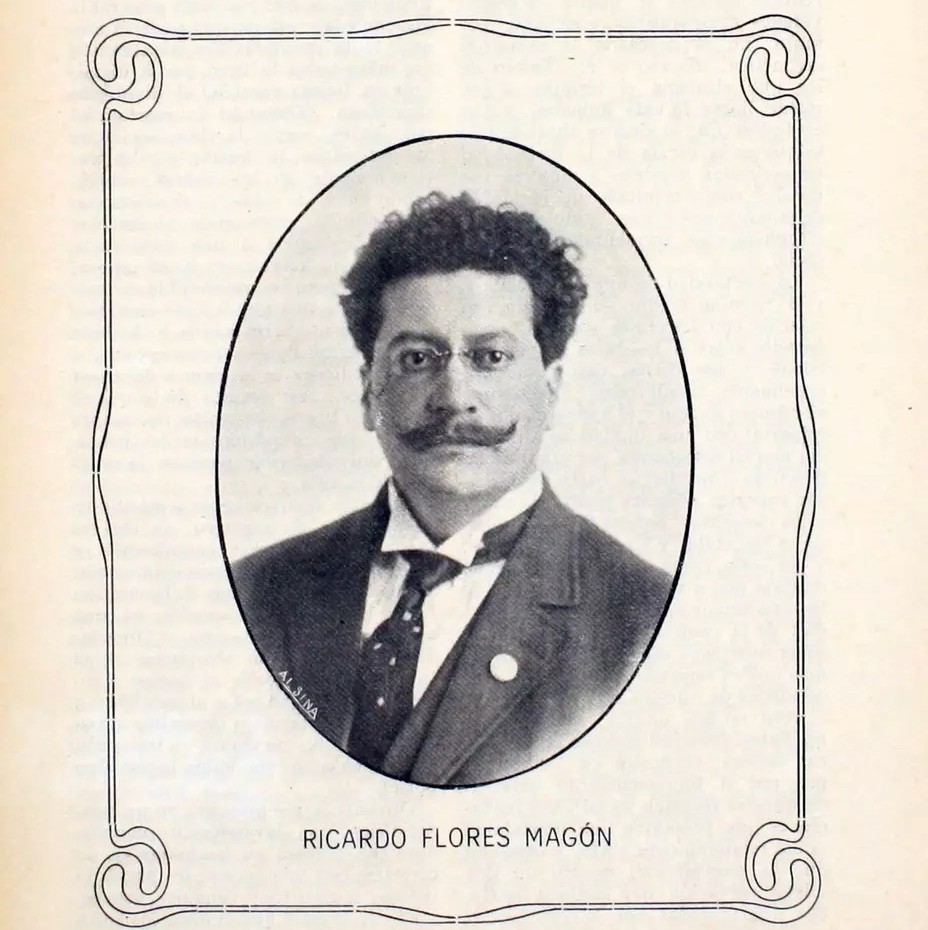
Magon remembers his youth and rebellion against the dictatorship of Pofirio Diaz which led to a day of violence in Mexico city, and the young revolutionary’s first arrest.
‘An Early Revolutionary Effort’ by Ricardo Flores Magon from The New York Daily Call. Vol. 2 No. 23. January 27, 1909.
At the request of an American friend, who wished to have the people of America know something about the inception of the movement he represents, the following article, was written for The Evening Call by Ricardo Flores Magon, President of the Liberal party of Mexico, who, with his two comrades, Antonio I. Villarreal and Librado Rivera, has been for sixteen months a prisoner in the Los Angeles County jail, after being arrested at the instigation of the Mexican government, charged with conspiring to set on foot a military expedition from the territory of Arizona to invade Mexico.
A few days after the article was written and handed to the friend, the United States District Attorney gave an order placing the men “incommunicado,” which has been in effect ever since. Editor.)
Signs of Revolt.
Something strange occurred in the City of Mexico at the beginning of the spring season of 1892. The people were restless, agitated, as if with the coming of the season the organization of Mexican society would be suppressed. Juvenile shouts were heard through the city. The sordid neighborhoods where the poor people rotted physically and morally were burning in an atmosphere of protest. The schools were clubs where the studious youths spoke of man’s rights, of liberty, equality and fraternity. In the corridors of the theaters, plazas, saloons, streets and street cars could be heard thunderous protests against the government. The citizens would glance severely at the gendarmes. The secret police were designated by loud voices amid the mockery of the students. In loud tones could be heard spicy anecdotes of Pofirio Diaz and his young wife. Everything indicated that the authorities had lost their prestige.
Sixteen years before a niggardly revolt had placed Pofirio Diaz at the head of the destinies of the Mexican nation and since then he had governed without interruption, though Manuel Gonzales had been President between 1881 and 1884. Gonzales, during that time, was the instrument of Diaz.
Diaz was preparing his second reelection, in the year of 1893, and the Intelligent citizens were disposed to interfere by the simple exercise of their voting privileges. This was the cause of the uproar in the City of Mexico at that time. Up to that day Diaz had been the direct cause of enormous bloodshed. Heads that had dared raise themselves above the moral degradation had fallen by scores and hundreds at the bidding of Diaz. The foreheads of travelers at night would strike against the cold feet of men who were hanging from the trees in the roads. In the valleya and dales fermented the flesh of the despot’s victims. The rurales (armed horsemen) would cross the country in all directions killing as they went.
Reign of Terror.
The opposition press had been silenced. The offices of the newspapers had been invaded by the force of the government and some of them, like that of “El Republican,” had been transformed into a theater of death. In “El Republican” the furniture was destroyed, the printing press broken, the type thrown on the floor and the typesetters assassinated. Before the spring season of 1892 no one spoke a word. The lips of the people were mute. They would press them so as to not let escape the protests that their breasts could not contain. In the shadows and dark places the spies would strain their ears to listen to hear one word or phrase or syllable indicating revolt. Should a perron be caught uttering seditious thoughts, torture and death in dark cells would be the punishment. To silence a crime was a virtue and to apologize for it was a virtue generously rewarded.
Men of the lowest morality occupied the highest positions in the government. The vilest breasts were adorned with decorations and insignias of all kinds. To be a general, minister, judge, governor or deputy one had to despise valor, learning, talent, character, and the most necessary things for success were the possession of a lovely wife or a backbone of bamboo. Torn with the saber were the wings of moral force, and to rise it was necessary to drag one’s self. The schools, governed by the government, furnished the nation with eunuchs instead of citizens. The presence of a judge or a gendarme was dreaded more than the meeting of an outlaw or a bandit. Justice broke the sword, and covered herself with Messalina’s mantle. The people’s rights were unknown. Jurisprudence was condensed in Pofirio Diaz’ sword. The codes were moth-eaten in the dust of the libraries. Political tyranny had weakened the characters and consumed the bodies of men. If a starving man stole an ear of corn he was shot instantly. If a public official, with a round stomach, stole the public revenue, he was considered worthy of any office, in the nation.
The crime of petty larceny was punished by hanging, but for the commission of a big theft the reward was badges, medals and decorations.
Such was the situation at that time; such is the situation today.
Citizens Took Heart.
This is the reason for the agitation in the City of Mexico at the beginning of the spring season of 1893. Papers announcing meetings of the students and laborers to denounce Diaz were distributed in the streets. Three or four independent papers had been permitted to exist on account of their ambiguous attitude, but at this time, because of the popular agitation, they published many articles in criticism of the government. Fear being left aside, the “human herd” dreamt of freedom. Persons who could read were filled with the episodes of the French revolution. It was considered a good thing to adopt the manners of the “sanculottes,” and not a few added the word “citizen” to their salutations. The withered countenanced of the masses shone with joy. The faded foreheads of the people turned to meet every heroic breeze. In the rooms of the students the chorus of the “Marseillaise” could be heard, while in the plazas and streets various persons strode in imitation of Robespierre and Marat.
Thus many weeks passed in a sweet revolutionary dream, although no one thought of a serious revolutionary plan. The idea seemed to be to oppose by peaceful agitation a government sustained by 40,000 bayonets. The anti-re-election clubs of students and laborers were filled with citizens eager to listen to the words of a Mirabeau or a Danton, whore memories were revived everywhere throughout Mexico.
Oh, had there been a Desmoulins! The clubs organized a great public demonstration against the re-election of Diaz, and a demonstration was decided for the morning of May 16. The place selected for it was the Jardin de San Fernando. Since early in the day the spacious plaza had been filled with multitudes, and in the northeastern angle, where reposed the bodies of Guerra, Saragoza, Benito Juarez and other great men of our nation the people pressed thick.
The people were speaking at the tops of their voices they could feel the necessity of speaking aloud after years of sepulchral silence. The sun, the fair sun of Mexico, gave its rays of light and warmth. The faces of the multitudes were frequently turned toward the place where our heroes slept, as if to bring life back to that place where reigned death. A great confidence and faith filled the breasts of the people. The standards of the laborers and students mingled their colors above. Below, the heads of the crowds were agitated as if by an epic breeze. Above the aggerates of the trees were balancing at the kiss of May.
A Great Demonstration.
After order was restored the crowd began to march. From the balconies rained flowers. All Mexico was enthusiastic over the demonstration. Hurrahs for liberty and “down with tyranny” came from every throat. The badges glistened in the sun and the bands of music thrilled the people with their heroic tunes. On each curbstone or car or in any place that could serve as a tribune, an orator was speaking. Some of them were dressed in frock coats, others in blouses, some were tidy and others were rough as a tempest. The blue heaven burned with the brightness of the sun of May.
More than 15,000 persons formed the crowds that led their way toward the populous neighborhood of La Merced. At its greatest strength the crowd was composed of more than 65,000 persons. The most energetic and virile of Mexico marched along the streets of the rejuvenated city, affirming its demand for liberty and justice. The terrorized dictator did not dare to shoot the multitude, which did not carry arms.
Oh, had there been a Desmoulins! During a few hours the slaves, intoxicated with citizenship, thought themselves free. In twenty-four hours the myrmidons of the government were demonstrating that the disarmed citizen is impotent to meet armed despotism. This is what happened: May 17 was announced by the employes of the government as the day on which to accomplish the re-election of Diaz. Anticipating such, the delegates of the dictator had been to all the towns of the federal district, including the haciendas, to send their peons to the capital in order to outvote the opposition. The peons were taken to the capital by force. They were not given any food and were awakened early. Without a sip of water or a morsel of food the peons were watched by the police so they could not escape. Persons who know anything about Mexico know that the peons of the camps are slaves. Those slaves and lackeys of Pofirio Diaz were the citizens that “spontaneously”–so said the Diaz press–were going to demonstrate their loyalty to the Nero of Mexico. La Alexandria was the place chosen to unite this mob. The marching was started and a mournful spectacle it was. The employes of the government marched at the head and the peons followed the employes. To see them, taciturn and dumb, one would suspect that they were on their way to the scaffold.
A Shameful Comedy.
The people were laughing on the sidewalks, and epigrams filled the air at sight of the farce. Some wanted to flee, to go where they could hide their shame, but there were the gendarmes to stop the desertion of the “spontaneous” demonstrators. Some students had the happy idea to buy large loaves of bread, and a rain of cheap bread hit the faces, backs and breasts of the demonstrators while the people were laughing and making merry. From the balconies stale omelets, left over from the kitchen, were thrown among the marching peons and government employes. The peons were seen to stoop and pick up the bread and carry it to their mouths, believing that the bread had been thrown to them to eat and not in sport. The miserable slaves were hungry, and they satisfied their hunger.
Then speakers appeared among the people. The marching of the peons was a comedy that constituted an insult to the people by the government protests against such exhibitions of despotism were in the air when a force of myrmidons fell upon the people with blows and rough words. I was starting to speak to the people, a speech of protest against the dictator. When two revolvers held by clasped hands touched my breast ready to fire at my least movement. Stopping [unreadable word] made another attempt to speak. Surrounded by myrmidons I was conducted to the roof of the municipal palace, where I found a dozen school comrades detained. I was at that time sixteen years old, and in the fifth grade in the national preparatory school. My comrades informed me that my brother, Jesus, was also arrested and taken like many others to one of the police stations. The sun was pouring fire on the roof. Our thirst was creating a fever, but our physical feeling was quieted by our enthusiasm. We dreamt though in a loud voice.
They did not hide from us the fact that they could shoot us like many others, but we were young, and death did not clutch at our hearts with its cold fingers. Burly policemen on horseback left their horses in the yard of the building and came to the roof to examine us. They told us that at night they would give us water. The Mexican despots by a cruel euphonism, when they want to kill, say to their hirelings, “Give him his water.”
The unclouded sky was shining brightly. The old and solid cathedral loomed up against the blue dome. Far away Popocatepetl and Ixthacihault lifted their snows to the sky. as if to prevent the crimes of man from staining its whiteners.
The Massacre.
Something like the murmur of the ocean shook our bodies, dispelling our dreams and leaving us like white butterflies. It was the town that was shaking. At that time we, the students, were the idols of the town. Without communication of any kind we all had the same thought–to run to the edge of the roof and look to see what it was. The spectacle was awful. The great plaza was a human river. The news of the students being arrested and perhaps killed in the middle of the night aroused every person like an electric current. The people ran to save us with nothing but their firm hearts and with their uncovered generous breasts.
Quick as lightning the sabers fell upon that sea of flesh. The confusion was spontaneous. The defenseless multitude disbanded. Muscular arms dragged us to dark garrets, where we were left like sacks of flour. Again at night we listened to the noise of the people who were coming to our rescue. The multitude dispersed in the morning had armed themselves with knives and sticks and stones, and came by night to take us away. We heard the rolling of the cannons ready to fire upon the town. With saber in hand the horsemen galloped toward the turbulent neighborhood and the barracks where the schools were located. The citizens had left the Plaza de la Constitucion, and in their places were parked arms and artillery. The people were stabbing at the gendarmes. The soldiers were killing the people with bayonet and sabers, but fresh victims replaced those who fell, and the blood of the oppressed and that of the agents of the oppressors ran and mingled in the streets.
They did not give us our “water” that night. The protests of the multitude saved us, making the dictator comprehend that the people would not tolerate the killing of the students. But just the same we were handled most roughly. We were not given a cover or a bed, and we had to satisfy our physical necessities in the same black garret where we were kept. The next day about 1 P.M. we were taken by a back door not frequently used, and made to go two by two into some closed carriages that were waiting for us, and, with guns leveled at our breasts, we were taken to Belem jail.
I had never seen the inside of the horrible place that in after years was such a familiar scene. After riding through dark alleys and ascending and descending dirty staircases we found ourselves in a long hall, the celling of which we touched. I touched my hands against the wall and took them away astonished: bloody sputum decorated the wall. We had been taken to the same apartment where we kept beggars and person afflicted with leprosy, syphilis and ulcerous sores. The walls stank with the odor of tainted flesh and dripped with blood and matter. The consumptives were coughing, the files were buzzing, and a thick, fetid vapor uprose that made the stoutest stomach sick. The nerves of men were shattered in that parlor of death. Tired of seeing one form of disease the eye would turn only to catch sight of some other form. Not to see the wan face of a consumptive it was necessary to turn one’s back toward it, and then one would face the corrupting nose of a syphilitic or the horrible countenance of an idiot.
Hell on Earth.
Flesh fermented before our eyes, it would disjoint. it would turn into bloody matter and grow altogether corrupt before being taken to its burial place. I was in one sense worse off than the blind. They, poor devils, could not see the horrible sights about them. The scorpions were sizzling in the cracks of the celling, the spiders made their webs in the corners while the men scratched their scabby skins to get rid of the fleas and bedbugs which, by the million, crawled on us and the dirty rage that were our beds. At night we were conducted to the detention police department. The atmosphere was thick here also, but we were at least relieved of the horrible spectacle of the living carrion.
Our bodies were nearly dead with hunger. We had not had anything to eat as nobody had offered us a piece of bread and the jailkeepers had taken the meals which our mothers had sent us. We lay down on some rags. More than 800 men were around us coughing and cursing and groaning in the vast gallery. The heat was unbearable. The bugs, bedbugs, and fleas were eating our flesh. We could not sleep. We had been told that the convicts outraged the youths, and we prepared to fight against such an outrage at any moment, but when the prisoners, found that we were students, instead of hurting us, they treated us like sons.
Before 5 o’clock in the morning the pounding of the thick canes on the pavement, near the prisoners’ heads, awakened us. The eyes of the prisoners could barely distinguish anything in the shadows, and we could hardly see by the lamp that blinked in the center of the room. The prisoners would spit on the floor and then lie down in it side by side. Some bats that had entered during the night were trying to escape, and while flying in the air would make weird figures.
It began to dawn, and we could see our faces, livid and pinched by the two nights of hunger and sleeplessness. We knew that there were more than sixty political prisoners in different departments of the jail, and many hundreds in the police stations. We also knew that during the night there had been various uprising in different neighborhoods of the capital city. Many laborers had been shot down by the soldiers.
Thus ended the plans that might have been the starting of a revolutionary movement, but which in reality, were only the shaking of a body that had given itself up to rest. Presently a movement much better conducted will shake the body that now seems dead. The next time it will not be empty hands that will dispute the victory with the armed bands of the dictator. The sabers of the Cossacks will not fall with impunity on the heads of the citizens. The cannon of the soldiers of the Caesar will be answered by the rifles of the soldiers of the nation. The people now know that violence must be resisted with violence.
The New York Call was the first English-language Socialist daily paper in New York City and the second in the US after the Chicago Daily Socialist. The paper was the center-right of the Socialist Party and under the influence of Morris Hillquit. The paper is an invaluable resource for information on the city’s workers movement and history, it is one of the most important socialist papers in US history. The Call ran from 1908 until 1923, when the Socialist Party’s membership was in deep decline and the Communist movement became predominate.
PDF of full issue: https://www.marxists.org/history/usa/pubs/the-new-york-call/1909/090127-newyorkcall-v02n023.pdf
 Revolution's Newsstand