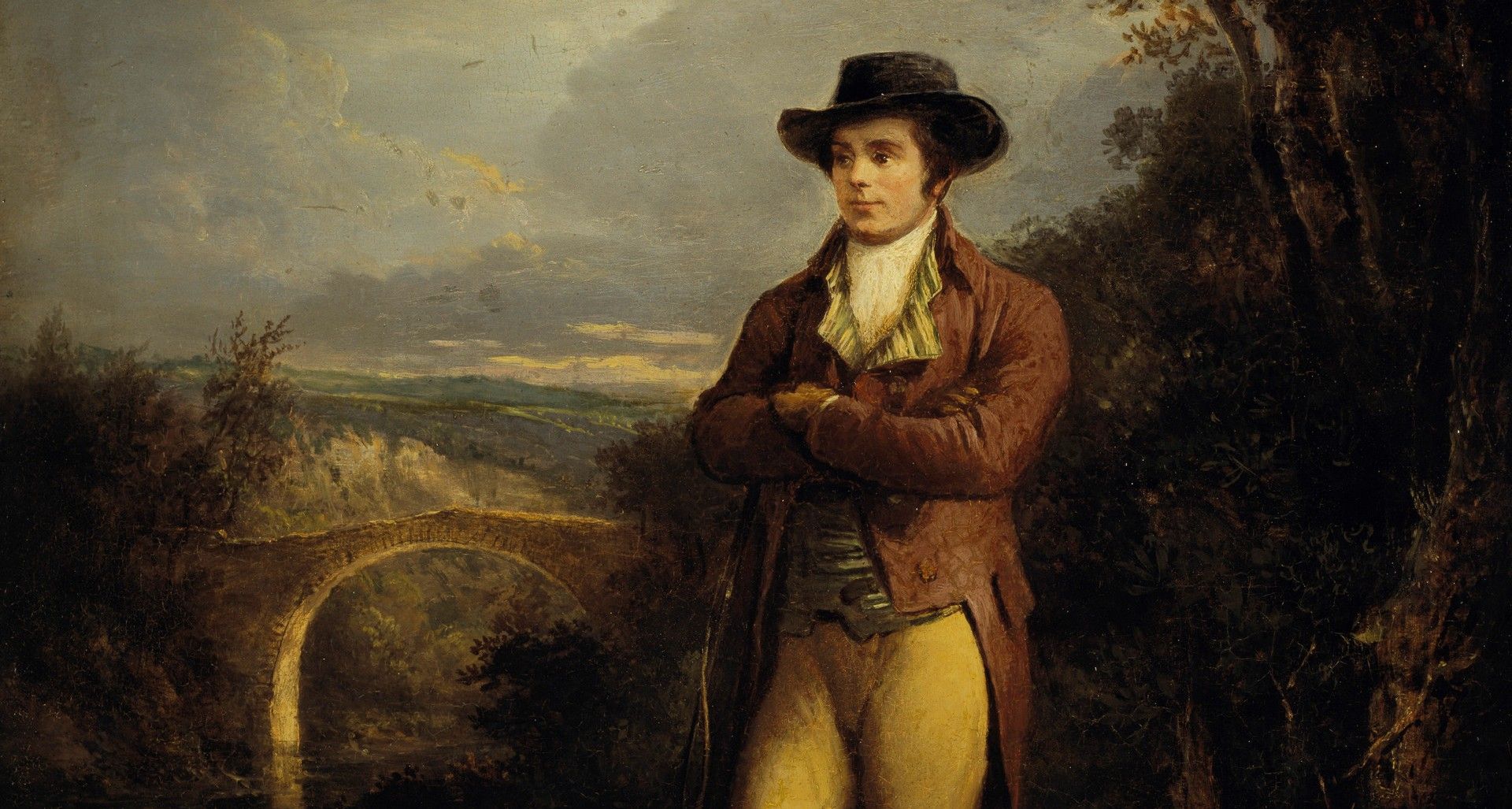
A comrade sings the praises of the great Scottish poet, claiming him for the insurgent proletariat.
‘Burns’ Celebration’ by H.S.K from The Weekly People. Vol. 17. No. 45. February 1, 1908.
On Jan. 25 all over the English speaking world celebrations were held in honor of the 140th anniversary of the birth of Robert Burns the poet. Smirking preachers, who really hate the poet’s name, made speeches; and propertied men, whose kind the poet in his day castigated, extolled the merits of the man whose name lives as poet of the people. Many and varied were the speeches, toasts and tributes paid to the unquestioned genius of Burns by these sycophants of to-day. One can in imagination hear their glib talk about his passionate utterances, his tenderness, and of the love-lit fancy and truth of nature that make the songs of Burns unexcelled; all of which is true enough, for without doubt Robert Burns stands high in the ranks of lyric poets.
But Burns was more than an “inspired rustic” “flinging his wood notes wild”–he was a man, with a man’s work to do–the work of freeing his countrymen from superstition. And it is just this work that the preachers and other orators in speaking passed by with little or no reference to it, except perhaps the attempts to explain it away as an idiosyncrasy to be expected of a man of genius.
In his revolt against the power and conventionalities that held him and his fellows in bondage, Burns’ first tilt was with the Church. Of all the creeds of the Reformation the Calvinism of the Presbyterian Church was the most logical, merciless and blasphemous. That it got a footing in the affection of the people is to he explained only on the theory that the bitter fight made against it by the Roman Catholics and the Protestant Episcopals endeared the Presbyterian creed to the people. It was only after one hundred years of fierce and bloody contention that Calvinism triumphed and became the established religion of Scotland. The struggle bred a fanaticism worse, if anything, than any that had gone before. The Westminster Catechism became a school-book; the Proverbs of Solomon and the rest of the Old, as well as the New Testament, in their turn became school text-books, until in the end the whole public and private life of the people became subjected to the authority of the book which sets forth Jewish mythology, folk-lore and the ethics of barbarism.
The revolt from Roman Catholicism was so extreme that it proved fatal to the fine arts. Because Rome had elaborate musical service, Presbyterians cut out music entirely. In fact, a studied, effort was made to frame everything connected with their worship in distinct opposition, in all things, to the methods of the Church of Rome. And worse than the Roman priests whom they sup planted were the long-faced ministers of the Calvin-Knox persuasion. Laughter and joy became sins; long faces and groans were evidences of future happiness; belief in the devil was strong; hell, devil and damnation were droned out Sunday after Sunday until the minds of men and women became affected by oppressive fears, by dread that paralyzed mind and limb. Under the damnable superstition and ignorance thus engendered, the people quietly submitted to the rule of laird and minister. The preacher taught that the heavenly king had delegated to the laird the temporal power and to himself the spiritual power. The people, without much questioning, accepted this and by continual toil and privation provided for the two branches of the Lord’s anointed. “Tis God’s Will,” said they, echoing the preacher’s cant.
Luckily, here and there could be found “agents of the devil” who didn’t swallow all of the sermonizings. These were brave spirits, for under Calvinism an “infidel” could get into the fire long before he reached hell. This is no exaggeration, for Calvinism, like most of the other Christian bodies, has burnt its thousands.
In the time of Burns, these superstitions, while not so implicitly believed in, were perhaps all the stronger as institutions, just as at present we see less faith in courts of law and yet a greater exercise of power by them. Great mental darkness prevailed when Burns turned the keen searchlight of his satire into the deep recesses of holy gloom, and so well did he light those caverns of superstition that mask it as they may, the preachers of this day hate the name of Burns much as they hate the name of Thomas Paine.
The poet was in his twenty-sixth year when he had his first tilt with the Church, and the warfare only ended with his death. “The Holy Fair,” depicting the sensuous revel that took place at the administration of the sacrament, took the country by storm. On these occasions relays of preachers were on hand to stir up the people, and Burns took the opportunity to hit the bunch collectively as well as showing up each one’s characteristics separately.
“Holy Willie’s Prayer” is another of the sarcastic and “too daring” of the poems of Burns. “Holy Willie” was a member of the church by which Burns had been censured for “immorality.” “Willie” was a “professing Christian” who made free with the money of the poor of the parish, and he who had censured the poet was found drunk and died in a ditch. In this poem the prayer of the Pharisee in the parable is outdone, and in addition Burns makes us laugh at the hypocrite and the Church which he typified.
The celebrated “Tam o’ Shanter” is another poem in which the poet launches the shafts of his satire at superstitions that prevailed in his day. “The inimitable tale” Scott calls this poem. In it are grouped all the things in which the orthodox expressed belief: devils, witches, warlocks, and it was the supreme stroke of genius to marshal all these hosts of the nether world in a church–the one place alone responsible for the malignant belief.
That Burns did not have any greater respect for the temporal power of the laird than he had for the spiritual power of the preacher is abundantly shown in his works.
In “Man Was Made to Mourn,” we read the lines:
See yonder poor, o’erlabor’d wight,
So abject, mean and vile,
Who begs a brother of the earth
To give him leave to toil;
And see his lordly fellow-worm
The poor petition spurn,
Unmindful, though a weeping wife
And helpless offspring mourn.
Again, in a “Winter Night,” the smothering snow is told that not all its rage and chill is equal to the injustice that man on brother-man bestows and continues:
See stern oppression’s iron grip,
Or mad ambition’s gory hand,
Sending, like bloodhounds from the
slip,
Woe, want and murder o’er a land.
In “The Jolly Beggars” is the rollicking chorus:
A fig for those by law protected!
Liberty’s a glorious feast!
Courts for cowards were erected,
Churches built to please the priest.
In “The Twa Dogs” Burns shows that he was a keen observer of the social conditions of his time. This poem is a talk between a rich man’s imported dog and a poor man’s collie–the one kept for pleasure, the other has duties to perform. Landlordism crushed the cotter, who, as before stated, accepted his condition as God-ordained. The only commentary on this poem in my copy of the poet’s works says the picture of the collie is particularly true to life, but there are other lines in the poem not descriptive of collies, but showing how the factor exacted the last penny from the cotters while they had to stand it “wi’ aspect humble.”
Despite all that preachers and the class of the lairds may say against Burns, we gladly join in the refrain of his song:
For a’ that, and a’ that,
It’s comin’ yet for a’ that,
When man to man, the warld o’er,
Shall brithers be for a’ that!
H.S.K.
New York Labor News Company was the publishing house of the Socialist Labor Party and their paper The People. The People was the official paper of the Socialist Labor Party of America (SLP), established in New York City in 1891 as a weekly. The New York SLP, and The People, were dominated Daniel De Leon and his supporters, the dominant ideological leader of the SLP from the 1890s until the time of his death. The People became a daily in 1900. It’s first editor was the French socialist Lucien Sanial who was quickly replaced by De Leon who held the position until his death in 1914. Morris Hillquit and Henry Slobodin, future leaders of the Socialist Party of America were writers before their split from the SLP in 1899. For a while there were two SLPs and two Peoples, requiring a legal case to determine ownership. Eventual the anti-De Leonist produced what would become the New York Call and became the Social Democratic, later Socialist, Party. The De Leonist The People continued publishing until 2008.
PDF of issue: https://www.marxists.org/history/usa/pubs/the-people-slp/080201-weeklypeople-v17n45.pdf
 Revolution's Newsstand