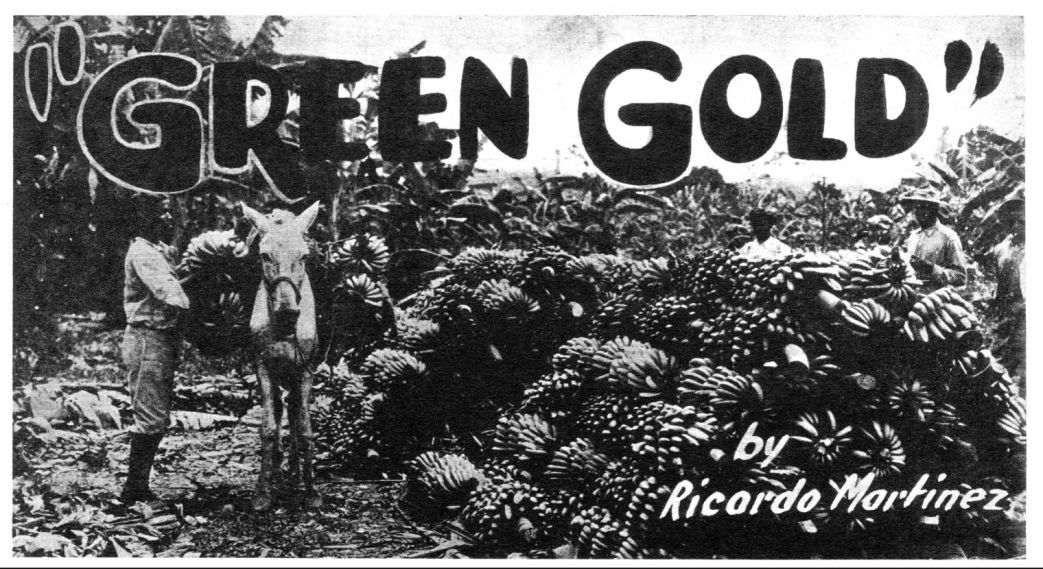
When our class finally closes the account with United Fruit…Martinez, an exiled Venezuelan arrivied in New York in 1919, and soon associated himself with radical exile Mariano Fortoul and the U.S. Communist movement, where he would help organize and lead the exiled offices of the Venezuelan Workers Union. A delegate to the 4th Profintern Congress and associated 6th Comintern Congress held over the summer 1928, he was central to the new Caribbean Bureau of the C.I. He returned to the Americas in 1929, eventually moving to Chile and acting as a key member of their Communist Party there before returning to Venezuela in 1941.
‘Green Gold’ by Ricardo Martinez from Labor Defender. Vol. 5 No 7. July, 1930.
ΤHROUGHOUT nine countries in the Antilles and Central America the United Fruit Co., one of the most hated tentacle of American imperialism is called “The Company,” and the huge industry which it controls: “Green Gold.” In other Latin American countries American imperialism exerts its control, and carries on its criminal exploitation under a varied collection of masks, but “The Company” has no intermediaries, no native lackeys with whom to cover up their crimes. In the region where it has its plantation it rules, in some places, as in Honduras where bananas are 80% of its foreign exports, the capitol is located where the Central Office of the United Fruit Company is located.
On December 31, 1928, “The Company” had a capital stock and surplus of $181,029,000. Among its fixed assets there were: total improved acreage of 405,773; 1,642 miles of railways; 600 miles of tramways; sugar mills; steamship lines. The total export of bananas in 1928 was 71,666,426 bunches with a fixed value of $68,438,000. These figures cover seven countries: Honduras, Guatemala, Costa Rica, Nicaragua, Panama, Jamaica, Colombia and Cuba, where it exploits 92,047 acres of sugar land.
Honduras is the best example of how the “blessings” of imperialism transform the economy of a country, and make it fully dependent on a single industry. This country is wholly dependent on the exploitation of bananas, 80% of its commerce is banana, the national puppet government lives in the capital (Tegucigalpa), but the ruling power is in Tela, where the United Fruit Company has its main office. Twenty years ago it was a country dependent on agriculture for its life, but it was a varied dependence coffee, cattle, bananas, ivory nuts, wood, etc. These industries were the property of big landowners, who exploited the workers as much as “The Company,” but the character of the industries did not make the lot of the workers as miserable as the present mechanized and centralized exploitation of bananas. There was a large number of small peasants, which the company has transformed into peons. On a coffee plantation where there was an abundance of uncultivated land, the workers had patches of land where they could grow some corn, raise a few chickens and pigs, but today the only difference between mining camp in Pennsylvania and the United Fruit Company plantations, is that in Pennsylvania they “have no bananas,” nor malaria fever.
This huge industry has under its sway about 150,000 workers herded in malaria-infected shacks living under conditions of semi-slavery, because blacklisting by “The Company” makes it impossible for you to get even a house in which to starve. The workers live in shacks in the most congested manner, contagious diseases are the property of all. The main task of the company doctors is to keep the workers’ hospital. It is the hardest thing to get into the hospital, and the doctor’s job is to see they do not remain there long. All sickness is treated with big doses of quinine, because they take for granted that the sickness is malaria, otherwise they get detestable laxants. A worker came to the dispensary one day with a fish bone in his throat and the “doctor” was going to treat him with quinine. He had to wait one day and walk miles to have it out.
Wages vary according to work, but never exceed more than $1.50 a day. Every kind of work has a different form of payment to make it harder for the workers to work out uniform demands. Those who dig for irrigation get pay by cubic meter, and it is the contractor who does the measuring; on road building the workers are paid by the square meter; the cutter and loaders per each bunch. The company only deals with workers when it comes to payment, in all other activities the contractor acts as intermediary.
Payments come once a month. This is done in order to force the workers to get loans from the company, which are made in company coupons, which are accepted only in the company stores, and which further reduce the wages of the workers. But the company has many other tricks: the smallest coupon is two dollars, and it take two days to make that much, so the skilled contractor is there to see that work is distributed in such a manner that the workers do not make that much in a day, for which they cannot even be paid for in a coupon at the end of the month. Any worker who dares demand payment in money before pay day is blacklisted for three months.
A very large number of Negroes have been brought to work in these large “banana factories.” This large immigration of Negroes serves two purposes: it delays the organization of the workers because the Negro workers are from Jamaica and do not know Spanish. The company creates intense prejudices among the native workers giving the Negro workers certain privileges such as the newest shacks, and if there happen to be any shacks with mosquito netting, they go to the Negro worker, foremen, contractor. The best paid jobs go to the most servile Negroes. On the other hand, the Negro who is better adapted to the work set the tempo of exploitation, speeding up the native workers to the point of exhaustion. This is particularly acute in the loading of steamers which is done with a conveyor, and the working day is measured by the number of hours it takes to load the ship, which is never below sixteen hours of steady work.
The labor movement is limited to the petty industries in the towns. Communist Parties are in their infancies handicapped also by their local composition without any mass contact with the workers in the imperialist enterprises and the agricultural workers in general.
The American revolutionary movement has tremendous obligations to these workers. The task is made easier by the fact that in these regions there is a large English speaking population and the work must be carried on simultaneously in English and Spanish. The LABOR DEFENDER is eagerly sought by the workers and even in places where they cannot read it they get a great kick out of the many interesting pictures. An effective distribution of the American literature will not only help our comrades but will also serve to demonstrate to the comrades the growth of the class struggle in the United States.
Labor Defender was published monthly from 1926 until 1937 by the International Labor Defense (ILD), a Workers Party of America, and later Communist Party-led, non-partisan defense organization founded by James Cannon and William Haywood while in Moscow, 1925 to support prisoners of the class war, victims of racism and imperialism, and the struggle against fascism. It included, poetry, letters from prisoners, and was heavily illustrated with photos, images, and cartoons. Labor Defender was the central organ of the Scottsboro and Sacco and Vanzetti defense campaigns. Editors included T. J. O’ Flaherty, Max Shactman, Karl Reeve, J. Louis Engdahl, William L. Patterson, Sasha Small, and Sender Garlin.
PDF of full issue: https://www.marxists.org/history/usa/pubs/labordefender/1930/v05n07-jul-1930-LD.pdf
 Revolution's Newsstand