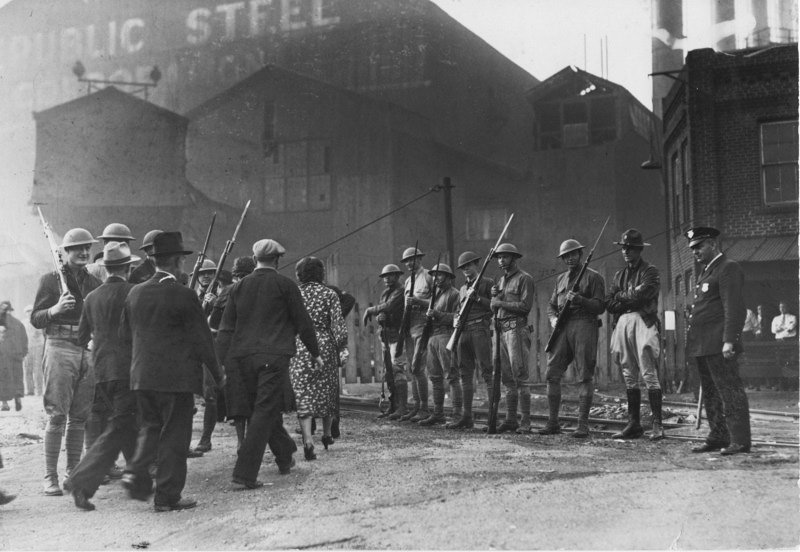
Very few class battles in U.S. history have ever reached the scale, breadth, an intensity of 1919’s mass steel strike involving 100s of thousands of workers, many unorganized, in an attempt to organize U.S. Steel. Dozens were killed in the failed effort which brought William Z. Foster to national prominence. Below a look at the police state that descended on the steel centers.
‘Reign of Terror in the Steel Districts’ from Justice (I.L.G.W.U.). Vol. 1 No. 38. October 4, 1919.
Pennsylvania presents all the aspects of war, with the exception that only one side is equipped with the implements of war.
If the underdog ever excited sympathy, the striking steel workers certainly deserve it now in Western Pennsylvania. Never has the greed of capitalism gone as far as in the present instance to suppress the fundamental rights of the workers.
From Pittsburgh to Clairton is a distance of some 15 miles, and on each side of the Monongahela River can be found many of the largest steel mills in the country. All are surrounded by newly uniformed and recently deputized gunmen, carrying heavy rifles, wide cartridge belts, pockets bulging with blackjacks, and the butt of a heavy revolver protruding significantly from its leather holster fastened to each well-groomed body.
At the several entrances of each steel mill are mounted from one to a half-dozen machine guns, and around these stand from a dozen to a hundred bosses, some with a police cap on their heads, others with a blue coat, still others without any sign of authority in their apparel. But all have a deputy sheriff’s star there are more than 10,000 in the section referred to. Many new men have also been appointed to the police forces of each of the boroughs and cities along the River.
In addition to all this there is a large force of the unspeakable state constabulary in the district, clothed with blanket police authority, ride horseback without a particle of warning down the sidewalks of the small steel communities swinging their vicious clubs and shooting right and left. Men were terribly beaten, women and children were mercilessly trampled under the feet of the horses, the American flag which was torn down and then and shortly afterwards more than two score were arrested and charged with inciting to riot, hurried to the county jail in Pittsburgh, 20 miles away and each held in $2,000 bail.
One man had a blackjack thrust into his pocket by one of the state cossacks, whereupon he was immediately charged with carrying concealed weapons. After he was in jail the same people confiscated his automobile, and thus they have secured another monster for riding down the helpless and terror-stricken workers.
In McKeesport, on the same day, where for several weeks meetings have been suppressed, arrangements had been made to hold one on some lots that had been bought outside the city. A monster crowd had assembled when the state constabulary rode roughshod into the crowd. In this instance, many of the people were standing on the edge of an embankment, which they were obliged to drive over to escape being run down by the cossacks.
On September 24th, when another gathering had assembled in the same place, they again appeared, slugged a dozen men into insensibility, arrested 36, and, in their reckless disregard for the rights of anyone, ran down and very seriously injured the chief of police of Glassport, who was there to see that order was preserved at the meeting, it being held within the limits of the Borough of Glassport.
In Duquesne, where it has been impossible to hold a single meeting during the whole organizing campaign in this district, these state cossacks go to the private homes of the men, arrest anyone found out of work, take them to jail, fine them heavily and threaten them with further arrests unless they return to the mills.
To illustrate the methods employed by the city authorities in Duquesne: A steel worker named Joe Yuha was arrested on Sept. 8th for being a spectator at an attempted meeting that some of the organizers of the American Federation of Labor planned on holding. On this occasion this man was fined $10, and costs, which he paid under protest, taking an appeal to the superior court and giving bond to guarantee his appearance. The case was set for Sept. 23rd. On the 23rd, when he left his home in Duquesne early in the morning to appear in court in Pittsburgh, he was arrested, placed in jail, refused bail and on the following morning fined $25 and costs. Jolin Yuha, his brother, had exactly the same experience. Both forfeited their bond when they failed to appear in court when their cases were called. In addition to this, they were obliged to pay two fines
A peaceful parade of striking steel workers held in Monessen and Donora was ridden down by the state cossacks, the parade broken up, and many arrested.
Jails are being filled, men are being clubbed, mounted cossacks are riding up and down the country terrorizing women and children, and company gunmen and deputy sheriffs are everywhere.
Yet with all these odds against them, the men are standing firm. New men not possible to reach in the rush of the campaign are joining the ranks of the strikers daily. Nearly 350,000 men are out at this writing, and probably before the end of the week a half million will be involved, presenting a strike the magnitude of which is without a parallel in the history of the country.
Already so great has become the alarm at the spread of the strike a senatorial investigation has been ordered, and the committee is due to visit Pittsburgh next week. Efforts are being made to get Frank P. Walsh to come into Pittsburgh to take hold of the legal end of the fight. Many, many cases have been appealed from the tyrannical decisions of the police courts of the smaller towns, during the past two or more months. In not a single instance, with the exception of one that was against the workers, has the court handed down a ruling. All cases when tried are taken “under advisement,” and nothing further has so far been heard from them.
Railroad men in many places are refusing to switch cars in or out of the steel mills, the sailors on the Great Lakes have all left their boats, which are engaged in carrying ore to the steel mills.
The brutality of usurped authority by the steel puppets in political office in Western Pennsylvania is rousing the workers everywhere to a deep resentment that before long bids fair to soon be translated into action.
The assault upon the rights of the workers in the state of Pennsylvania presents a grave danger to the whole labor movement; the merest novice can see the menace to freedom the country over if the steel barons can get away with the high-handed program they are following in the steel centers of the Monongahela Valley.
Frantic efforts of steel magnates to stampede the strikers back to work on Monday morning before the Senate Committee can continue its investigation resulted in failure, Page advertisements in the daily papers of Pittsburgh for the latter part of last week failed to have the desired effect, and, instead, the counter efforts of the unions have resulted in the stopping of mills that it had been impossible to reach before.
Monday was regarded as the day when the acid test would occur. The workers have stood the propaganda of the newspapers, the bulldozing of the courts, the brutality of the police, gunmen and cossacks, and have instead of depleted ranks, additions of many thousands from the Bethlehem Steel plants in Bethlehem, Steelton, Sparrows Point and Lebanon. The Jones & Laughlin plant in Pittsburgh is badly crippled and it required the strenuous efforts of every boss in the works to keep the smoke coming from the stacks, and this smoke represents the last stand of this tyrannical corporation to maintain its savage grip on its thousands of workers. All this has given the workers new courage. They are beginning to feel confidence in themselves.
The one outstanding horror in this strike has been the relentless cruelty of the barbarous cossacks. They have ridden down women and children, beaten men nearly to death, completely over-ridden every right the workers have of free speech and free assembly. Imagine a situation such as exists in McKeesport, which is duplicated in many other places. Meetings in halls have not been allowed for more than a month, due to the refusal of the Mayor to give permits. To meet this situation, the organizations bought some lots outside the limits of the city. Meetings on these lots were ridden by the cossacks, scores of men were beaten up and jailed and held in terribly excessive bail, distribution of literature even was forbidden and crowds of two or more were ruthlessly broken up by the cossacks, and organizers who attempted to circulate among the men were immediately thrown into jail. Thus, there was not a single means by which the men could be communicated with. They were newly organized men. Yet, in spite of all, they are sticking, and the Labor Movement in days to come ought not soon to forget the debt it owes to these sorely oppressed men, who are up holding its banner under the most oppressive and trying conditions existing perhaps in the whole country.
The weekly newspaper of the International Ladies Garment Workers Union, Justice began in 1909 would sometimes be published in Yiddish, Spanish, Italian, and English, ran until 1995. As one of the most important unions in U.S. labor history, the paper is important. But as the I.L.G.W.U. also had a large left wing membership, and sometimes leadership, with nearly all the Socialist and Communist formations represented, the newspaper, especially in its earlier years, is also an important left paper with editors often coming straight from the ranks radical organizations. Given that the union had a large female membership, and was multi-lingual and multi-racial, the paper also addressed concerns not often raised in other parts of the labor movement, particularly in the American Federation of Labor.
PDF of full issue: https://www.marxists.org/history/usa/pubs/justice/1919/v01n38-oct-04-1919-justice.pdf
 Revolution's Newsstand