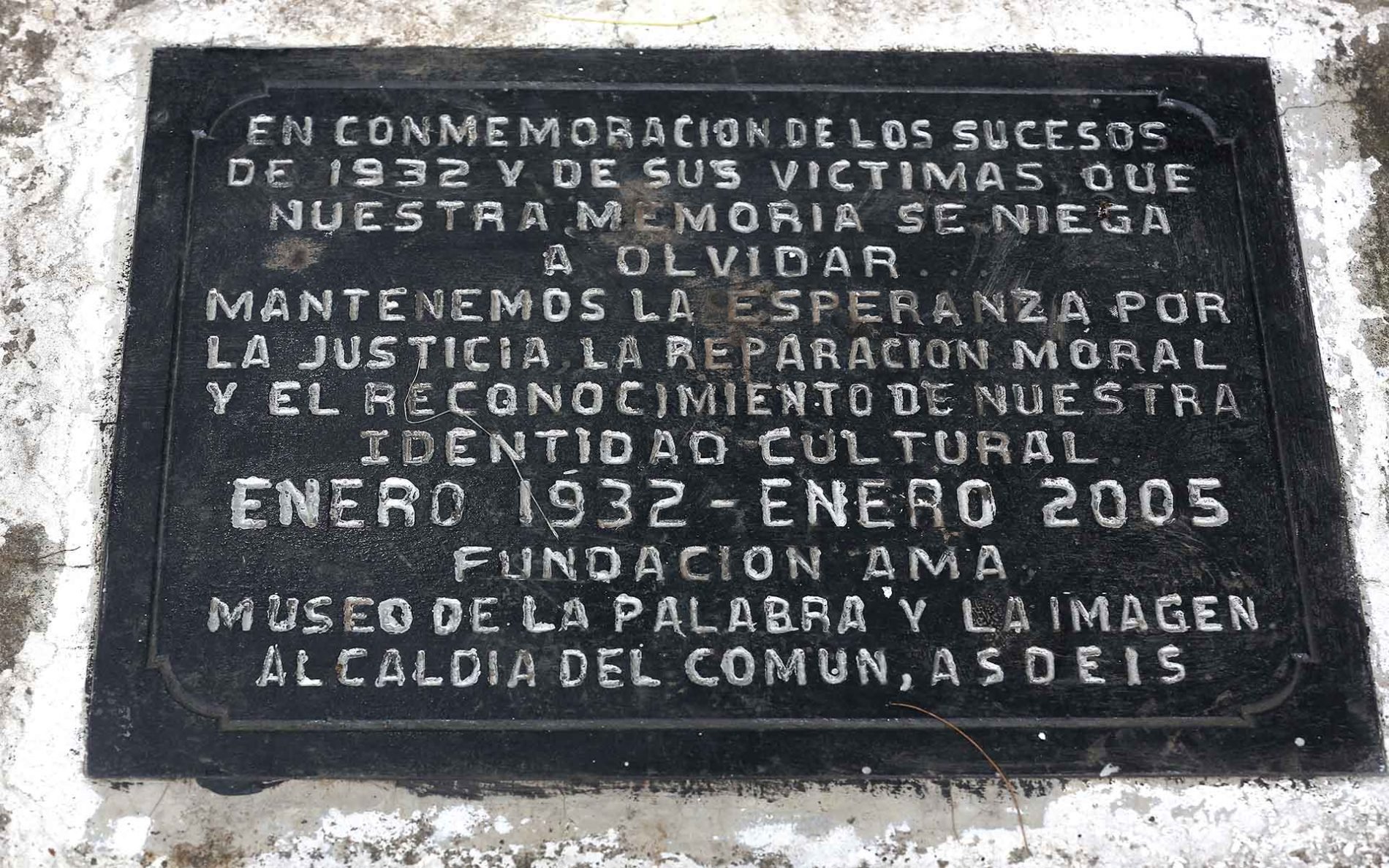
A rising against its imperialist-backed military dictatorship, led in part by the young Communist Party of El Salvador sees 10s of thousands killed in reprisals, including Farabundo Martí, La Matanza–The Massacre.
‘The Iron Heel in El Salvador’ by Leon Vivaldi from Labor Defender. Vol. 8 No. 3. March, 1932.
At the south of Mexico and Guatemala, with its coast line bordering the Pacific Ocean, lies El Salvador, the smallest country of Central America; the only one without a coast line in the Caribbean Sea. El Salvador’s territory ends at the north of the Fonseca Gulf, a very important strategic point for naval as well as military defense. In width it averages about 60 miles, and the coast line is 160 miles long; with an area about the same as Maryland.
El Salvador is a one-crop country. Her economic life depends exclusively on the crop of 150,000 acres of coffee plantations controlled by the imperialist force of Wall Street. Most of the properties are in the hands of a very small group of national bourgeoisie and land-owners. Being an agricultural country with semi-feudal production methods, there is an agricultural and industrial proletariat of more than 200,000 of a total population of 2,000,000 inhabitants. The last census of October 15, 1929, showed that in San Salvador (the capital city), of 95,692 inhabitants, there were only 4,698 who own property.
The coffee pickers receive a payment of six cents for every basket they pick. At the beginning of the picking season they are able to pick 5 and six baskets daily, but toward the end of the season they can pick only one-half or one basket a day. Those who work for a daily salary receive an average payment of 19 cents for a full day of work from 7 A.M. until 6 P.M. and during the summer time up to 8 P.M.
Besides the exploitation of the agricultural masses, there is no chance to get a job in the cities; unemployment is spread all over the country, and especially in the most important cities, in a monstrous way. At the beginning of 1930, of 90,000 inhabitants in San Salvador City, there were 15,000 unemployed workers. There were more than 100,000 workers without a job in the republic.
Workers and peasants were massacred in Santa Teole, December 21, 1930. In Sonsonate, May 17, 1931, and in Asuchillo, September 22, 1931, the results were 25 deaths, 60 wounded and 160 arrested. But the worker and peasant masses were not cowed; on the contrary, with every attack of terror there was an increase of forces into the movement, and the revolutionary mass organizations grew. After the Asuchillo massacre, in that department alone (Department of La Libertad) 500 new members joined the International Red Aid. The military coup d’etat of December 5, 1931, that overthrew President Araujo and put General Martinez at the head of the government, took place amid most violent agitation, mass struggle against hunger and the terror. A few days after the coup d’etat, at the end of December, great strikes started throughout the coffee plantations. In the Department of La Libertad there were 12 important strikes of which 10 were won immediately.
The masses started their armed struggle on the 23rd of January against the system of oppression and murder, of hunger and terror. Three days before the 23rd a state of siege had been declared, and martial law applied in the departments of Santa Ana, Sonsonate, Ahuachapan, La Libertad, Chalatenango, and San Salvador. There measures were taken in order to prevent the revolutionary movement of the masses, and soon were applied all over the country. The reactionary Martinez government mobilized all the troops and organized armed fascist bands in order to attack the rebellious masses. The reactionary government issued an appeal in the following wire:
“The government is calling upon all the true patriots who have interests to defend, to take up arms as authentic soldiers of the country, which is today in danger.” (My emphasis.) The imperialist powers of the United States, England and Canada immediately sent their warships to the ports of El Salvador in order to help the Martinez regime to crush the mass movement.
The most violent measures of repression were taken; the most unspeakable crimes, mass murders, the firing squad, and every other form of terror was used by the puppet Martinez government and by his supporters–the native the imperialist forces, ready to land at the exploiters and the bourgeoisie backed up by first call of Martinez, in order to check and crush the revolutionary struggle of the oppressed masses. But the masses answered with courage and heroism and in a struggle marked by many sacrifices they faced the joint attack of the reactionary forces and fascist bands. More than 3,000 workers and peasants have been murdered, three of their leaders, Marti, Zapata and Luna, faced the firing squad and were executed.
The guns of the imperialist warships and the rifles of their landing troops, backed up and give an impetus to the wave of crimes and murders. Although the imperialist powers did not lend any troops, although their warships have gone from the El Salvador ports; their presence there for some time has shown once more the intention of the imperialist governments to use armed intervention in the colonial and semi-colonial countries in order to insure their investments and the further exploitation of the colonial masses, as they did yesterday in Haiti and Mexico, as they do today in Nicaragua, in China and El Salvador.
In this movement of hard struggles the workers and peasants of El Salvador must not be left alone under the blows of the reaction and the white terror wave. The widest possible international class solidarity must be developed in order to back up the revolutionary class struggle. The proletariat of the capitalist countries as well as the masses of the colonies must respond to this revolutionary duty immediately.
Labor Defender was published monthly from 1926 until 1937 by the International Labor Defense (ILD), a Workers Party of America, and later Communist Party-led, non-partisan defense organization founded by James Cannon and William Haywood while in Moscow, 1925 to support prisoners of the class war, victims of racism and imperialism, and the struggle against fascism. It included, poetry, letters from prisoners, and was heavily illustrated with photos, images, and cartoons. Labor Defender was the central organ of the Scottsboro and Sacco and Vanzetti defense campaigns. Editors included T. J. O’ Flaherty, Max Shactman, Karl Reeve, J. Louis Engdahl, William L. Patterson, Sasha Small, and Sender Garlin.
PDF of full issue: https://www.marxists.org/history/usa/pubs/labordefender/1932/v08n03-mar-1932-LD.pdf
 Revolution's Newsstand