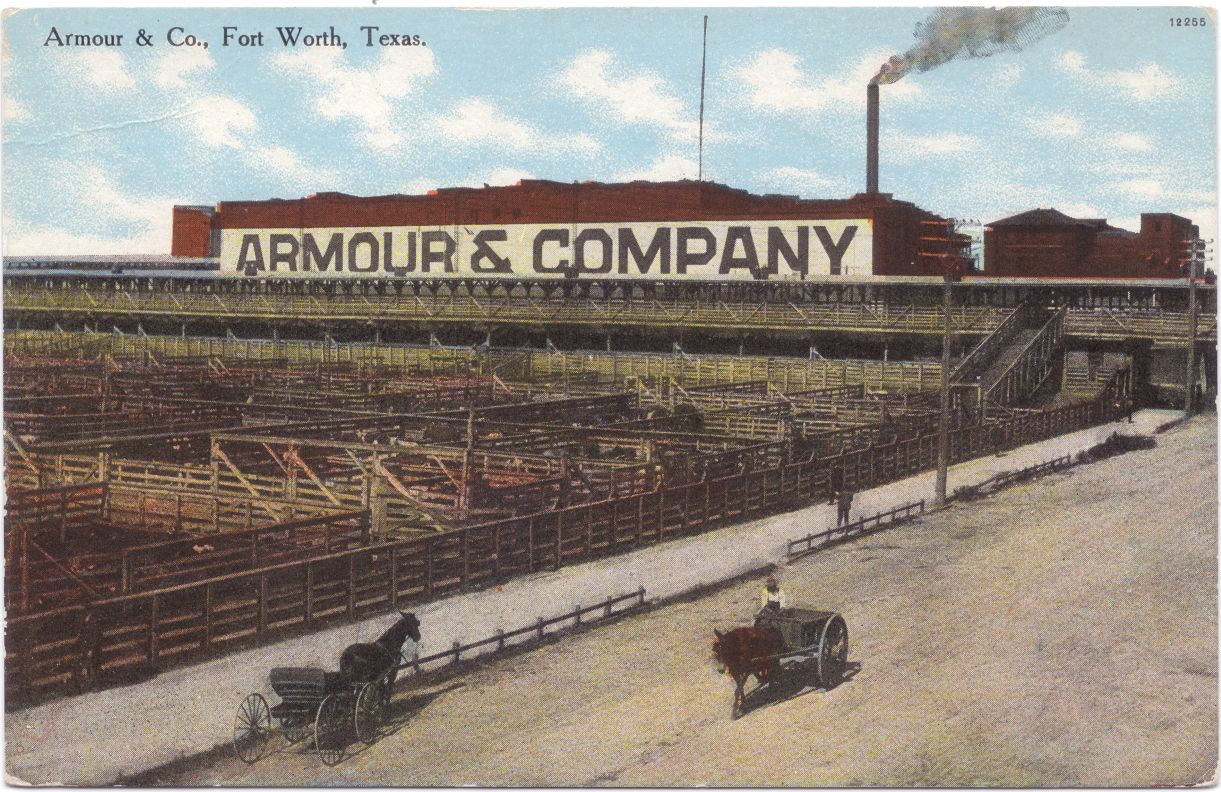
The banality of evil; how the Chase National Bank took over the once-“private” Armour Corporation and made the way for the meat-packing “Big Four” monopoly we are still living with. In 1983 Armour was sold to ConAgra.
‘Wall Street in the Packing Industry’ by J. Ramírez (Charles Phillips) from Voice of Labor. Vol. 11 No. 591. March 23, 1923.
Lots of people are more popular in Packingtown than J. Ogden Armour. In the 22 years that this insolent grain speculator was president of Armour & Co. he is known to have had three or four ideas, about the meat packing business, and all of them are summed up in the conception that fat profits are derived from the combination of fat hogs and thin workers. Wages, he regarded as an inevitable but unjustifiable deduction from the income nis father had turned over to him, and every effort on the part of the workers to obtain a decent wage was fiercely resisted. Unions were not to be tolerated. Several years ago Mr. Armour moved his headquarters to the office of the Armour Grain Co. in the Continental & Commercial Bank building on La Salle street; he seldom found time to visit the stock yards, but when he did bring himself to brave the smell and go, his visits were invariably fraught with trouble for the workers.
And now J. Ogden Armour has hit the toboggan. He is not exactly broke–P.D. Armour left too much money for that, but he has at least been obliged to close down one of his beautiful “residence farm and discharge some nineteen or twenty servants to curtail expenses. What is more to the point, he has had to relinquish control of Armour & Co. The working stiffs out in Packingtown are not to be expected to look upon the event as an occasion for anything more sorrowful than three cheers. Nevertheless, they will hardly be enthusiastic about their new boss. The new boss is a composite, a voting trust. It is a committee of three well-known bankers, to whom J. Ogden Armour has handed over 51 per cent of the common stock of Armour & Co. of Illinois for a period of five years. Aside from drawing down salaries of $100,000 a year each, these three bankers, are to have complete control of the company. They will not give up their present connections and they will not work actively in the packing industry, but they will be boss, J. Ogden Armour is out and they are in.
What has banking to do with meat packing? Who are these three men who have suddenly appeared on the scene to take over the destinies of Armour, & Co.? How did it all come about? What does it mean? Read further.
Armour & Co. is one of the outstanding examples of the industrial capitalism that has sprung up in comparatively recent years in the West. It is an enormous concern, one of the largest meat packing enterprises in the world, with a stock capitalization totaling more than $150,000,000 and a profit and loss surplus of $63,500,000. Besides its many packing houses and cold-storage plants, the company owns the Armour Car Lines, Armour Fertilizer Works and numerous other subsidiaries, manufacturing everything from thyroid to sand paper. Sales of all affiliated companies in the single year 1919 amounted to over a billion dollars. It is not often realized how important a factor Armour & Co. is in the whole industrial life of the West. Clinton B. Evans, financial expert, said in the Chicago Herald-Examiner the other day: “The banking interest throughout the West has been largely built, up around this packing business.” As the business of Armour & Co. grew, Mr. Armour found it necessary to have a great deal to do with bankers the real bankers, the financial kings whose power is centered in Wall Street. His principal friends among the banking fraternity and his chief financial advisers were Samuel McRoberts and Arthur Reynolds. Mr. Reynolds is president of the Continental & Commercial National Bank of Chicago. Mr. McRoberts, who until two years ago was a vice president of the National City Bank, is now chiefly known as president of the Metropolitan Trust Company and vice president of the Chase Securities Company, both controlled by the powerful Chase National Bank of New York.
Immense sums of money had to be borrowed, bond issues had to be floated, re-organizations had to be put through. Mr. Armour’s natural proclivities as a speculator made him commit excesses which obliged him to depend more and more on the co-operation of the banking interests. At one time it was even necessary for him to “take in” his friend Mr. McRoberts temporarily as treasurer of Armour & Co.
Bankers first get into a business like Armour & Co. Then they get in further. Then they get the old boss out. Today the bankers are in control of Armour & Co. J. Ogden and his nephews will probably be allowed to remain on the board of directors after the next meeting, but they will not do any directing.
Perhaps you are laboring under the belief that J. Ogden Armour gave up control of the company of his own free will–that he wanted to do it. That is the opinion J. Ogden himself tried to create. He gave out a public statement in which he said something unintelligible about “making Armour & Co. a public rather than a private family-corporation,” adding that “the only arrangements contemplated with respect to the voting of the stock are for the purpose of facilitating the carrying out of Mr. Armour’s plan and are to continue only so long as such of the stock as he may desire to dispose of to officers of the company and to the public remains to be disposed of.”
It might be maintained that this statement of Mr. Armour’s is so transparent that it scarcely needs comment–but that is not the reason why capitalist newspapers refrained from commenting upon it. Incidentally, the statement is typical, in its glib disregard of truth, of the general run of publicity concerning big business and what we have come to know as “high finance.”
Indeed, up to the very last minute before the end, there was a general conspiracy on foot, in which Mr. Armour, his associates and the afore-mentioned bankers participated, to build up an impression that the finances of Armour & Co. were in an unusually healthy condition. A flood of propaganda was loosed, under the guise of important financial news. No mention was made of an impending crisis in the affairs of the company; nothing abnormal was even hinted at. Instead, the public was given quite a different tonic. In spired “news items” concerning the big packing firm began to appear in the daily newspapers, in the releases of subsidized press services, in the columns of the so-called financial journals, on the ticker tape, all of these “news items” carrying a single tale, and the burden of the tale was that Armour & Co. was greater and stronger and more substantial than ever. All the familiar rumors were spread, as well as two or three not so familiar. The prize story of all–the one that was played up most effectively and that was most depended upon to make the Armour concern look prosperous was the Armour-Morris story, a cumulative repetition of details concerning the alleged negotiations for the absorption of Morris & Co., one of the three largest packing houses in America. Morris & Co. was to be acquired from the sum of $30,000,000. Nelson and Ira Morris were to pledge themselves never to engage in the packing business again, etc., etc., etc.
The purpose of all this hot air was to create the proper atmosphere in which there could be unloaded upon the public $110,000,000 of new securities before the true condition of Armour & Co. should be known. The stock and bond issues were floated early in January, in the midst of excited merger talk and repeated trips to Washington on the part of J. Ogden Armour, “presumably in connection with the purchase of Morris & Co.” For the purpose of the financing a new company, “Armour & Co. of Delaware,” was formed, subsidiary to Armour & Co. of Illinois, and $60,000,000 of the Delaware corporation’s preferred stock and $50,00,000 of its 30-year gold bonds were placed upon the market. The headline of the Chicago Tribune’s news story announcing the security issue was as follows: “Armour Forms New Concern to Buy Out Morris.” Egged on by the expert advice of hankers and security dealers, the public took the bait eagerly.
For a few days bond houses were deluged with buying orders for Armour stocks and bonds.
Shortly afterward one of the leading financial journals was remarking innocently: “Due to the fact that for many months there has been talk of various mergers in the packing industry, the public has apparently jumped to the conclusion that this financing is a part of a coming merger. The fact is that Armour & Co. are taking measures looking toward the adjustment of their own financial structures, steps which would be “desirable regardless of any merger that may take place.”
In accordance with general custom, the publicity campaign in connection with the marketing of the Armour securities was directed by the under writing bankers, the original underwriters being the ever present Chase Security Company and the Continental National Bahk, through the Continental & Commercial Securities Company.
The money realized for the sale of the stocks and bonds of “Armour & Co. of Delaware” was used, not to purchase Morris & Co., but to pay off about $65,000,000 short term notes and to reduce current indebtedness. The truth was that Armour & Co. was in a critical condition; it had to have cash at all costs. According to B.C. Forbes, “Mr. Armour had personally supplied a portion of the money to pay the dividends on the preferred stock of Armour & Co. of Illinois, and it is known that some extra financing was necessary to comply with a provision in some of the notes that quick assets to the amount of 150 per cent of their face value should be constantly on hand.” Mr. Armour could not continue to pay dividends out of his own cupboard because the cup-board was bare. At the time of the recapitalization of Armour & Co., he himself had just negotiated, not without considerable difficulty, a $20,000,000 one-year 6 per cent personal loan. The loan was underwritten “by Chicago and New York banks” and Mr. Armour deposited as collateral approximately $23,000,000 of listed securities and a block of Armour & Co. stock. Sometime between now and the date of maturity, J. Ogden Armour is to take up half of the loan by turning over to “Armour & Co.” $10,000,000 in shares of Armour common stock. What this means is that Mr. Armour cannot repay the loan and must give up his collateral.
This suggests the process by which Mr. Armour, who only a short time ago possessed 80 per cent of the common stock of Armour & Co., has already been obliged to part with 51 per cent of it.
The three bankers who compose the voting trust now in control of Armour & Co., are Samuel McRoberts (chairman), Arthur Reynolds and Albert H. Wiggin. The first two we have had occasion to mention before in the course of this article, but the third is better known than either of the others. He is president of the Chase National Bank. Thus the Chase National Bank has two men on the voting trust while the Continental & Commercial National Bank has one. No great amount of detective work is necessary to discover that the Chase National Bank controls Armour & Co.
With capital and surplus of $41. 503,000 and resources of $480,000,000 the Chase National Bank is one of the seven or eight banks in New York through which the power of Wall Street is primarily brought to bear in the industrial and commercial life of the nation. Chase is one of the pet banks of “the insiders.” It is a Morgan bank, and is typical of what is meant when we speak of the money trust.
Under its present management it is possible that Armour & Co. may puchase Mors & Co. after all, but if the merger does take place it will be in the interest of the money trust, not of Mr. J. Ogden Armour. The money trust already controls Wilson & Co., through a voting trust of which Charles H. Sabin, chairman of the Guaranty Trust Company, is head. Controlling directly Armour. Morris and Wilson, Wall Street would have a strangle held on the parking industry–and this means not Woh packing industry alone, but the head of affiliated and dependent industries throughout the West. As far as credit facilities are concerned, it is interesting to remark that the First National Bank of Chicago is a Morris & Co. bank. The Illinois Trust & Savings Bank is at present controlled by the Chase National Bank. The First National, the Continental & Commercial, and the Illinois Trust & Savings control every other bank in Chicago.
Much has been said of late about modern industrial capital as a rival to modern finance capital, but the basis of discussion is misleading. Except for Standard Oil, whose financial interests are only slightly less important than its industrial interests, there is not a single aggregation of industrial capitalists in America which could afford to remain independent of the banking interests Armour & Co. presents an example of the independent industrialism of the West falling with a crash. In the end, all capital tends to become finance capital. That is the way in which capitalism totters toward the grave.
The Voice of Labor was a regional paper published in Chicago by the Workers (Communist) Party as the “The American Labor Educational Society” (with false printing and volume information to get around censorship laws of the time) and was focused on building the nascent Farmer-Labor Party while fighting for leadership with the Chicago Federation of Labor. It was produced mostly as a weekly in 1923-1924 and contains enormous detail on the activity of the Party in the city of those years.
PDF of full issue: https://www.marxists.org/history/usa/pubs/vol/v11n591-mar-23-1923-VOL.pdf
 Revolution's Newsstand