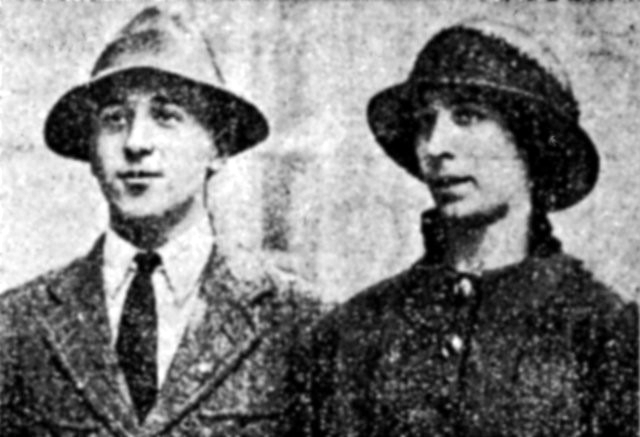
Rose Witcop as delegate to the Comintern of Guy Aldred’s Anti-Parliamentary Communist Federation which had refused to join the C.P.G.B. with Sylvia Pankhurst’s group. Both would leave the Comintern shortly after the Third Congress, rejecting the United Front with Social Democrats and parliamentarism advocated at the Congress.
‘Women in England’ by Rose Witcop from Moscow. No. 11. June 5, 1921.
Editor of “The Spur”
It is impossible to deal with woman’s social and economic position in England at the present day without turning back to the period preceding the war the days of woman’s struggle for the vote.
That movement was largely middle class and composed of professional and business women who needed other channels of self-expression, than had hitherto been open to them.
Their fight was not so much for liberty as for their recognition of woman’s equality in law with man. It did not mean that woman demanded absolute freedom from the bonds of wage slavery, but that she had arrived at a certain stage of development in which she required to be recognised as mans social equal either as worker or exploiter.
This truth was established by the fact that at the outbreak of war the leaders of the suffrage movement laid aside their hammers, their banners and their opposition toward their own rulers, and became impassioned by one desire of defending their country.
Mrs. Pankhurst, who, in the year 1913 was prevented by the police from holding a meeting at St. Andrew’s Hall, Glasgow, in favour of the vote, spoke from the same platform a year later, to an enthusiastic audience, in favour of recruiting. This time, after having received a royal welcome from the Mayor of the City! It was, of course, a part of our work as Communists to criticise this movement: to point out that if women would be free they must organise industrially and change their mental outlook and economic conditions. These things being of greater value than all statute equality.
We have far to go yet in England before we attain that level of mental and economic freedom of our Russian sisters, whose strength and ability will have proven an inspiration to many in the struggle for liberty. For, in no other country on earth does women occupy the position she does in Russia.
The position of the English working-women is harder to define. The war has at least disposed of the argument that she is “inferior” to man. Without previous experience she has worked so well and so thoroughly in all the industries that had formerly been exclusively man’s own that her severest critics were compelled to silence. Today, she is again being forced back into her pre-war occupations, because the men returned from the war claim their work back. There is little resistance to this claim, but there is resentment. After having once tasted the sweets of independence it will be impossible to confine women within the narrow precincts of home life or domestic service again. So that, although there is not at present a strongly organised party-body to organise working-women in England, there is visibly, a distinct change in woman’s psychology and strong tendency in the direction of advanced though, and new activities.
Economically, woman are slightly better paid today, than in the days before the war. The discrepancy between the wages of men and women are not obvious although there is still a difference in most occupations in favor of man.
The position of the married working- woman is not an enviable one in England. Since the introduction of the Insurance Act women are entitled to receive a sum of thirty shillings for every child, that is born to her. If she is also engaged in some work outside the home she will receive weekly an additional sum amounting to about a fourth part of her usual weekly earnings, as sick benefit. It is well to point out in this connection that the physician’s fee alone in cases where women are able to afford one, amounts to three pounds (sixty shillings).
No special attention is paid to the pregnant woman, who is often compelled to work up to the very last moment before childbirth and resume work as soon as she is able to walk.
Respecting the care of women Russia has set an example which the countries of Western Europe and America would do well to emulate, for in those countries motherhood is not a joy but a thankless ordeal.
In matters of sex knowledge the women are probably neither better nor worse than the women of other countries. They know very little, and even that little has to be learned in secret. No respectable mother would ever dream of talking to her children on the subject of sex although marriage is always encouraged and talked about and girls are taught to regard it as the great end for which they must strive.
Since the prosecution of Annie Besant about a quarter of a century ago, the dissemination of sex knowledge has been a very risky undertaking. The Neo-Malthusian League, which has supplied birth-control methods to those married or about to be married when applied to, has been permitted to conduct its work. It has not been aggressive. Others who attempt to give information on sexual hygiene or birth control directly to the people are constantly being prosecuted of obscenity, notwithstanding the fact charge that the cry of the women is always for knowledge and more knowledge.
These are the questions in which women are becoming vitally interested.
She has already partly awakened to the realisation that economically her interests are identical with the interests of her brothers and it is for that reason that apart from the Women’s Co-operative Guilds and the Woman’s International League (a feminist organisation)–there is no distinct economic or political women’s organisation in England. Every advanced working-class organisation permits women to work within its ranks–only the economic conditions, under which woman always finds herself more enslaved than man, keep her from playing a more active and important part in the methods and tactics, which will help to educate the working-women to active communists.
Her sympathies are with us, however. She has taken most kindly to the ideals of freedom. She is an apt pupil.
When the hour for fighting arrives, she will fight and work with us wholeheartedly. All we of the advanced guard of England require is the means to set the revolutionary machinery into motion and the odds are that the women will not be behind their brothers in making sacrifices and showing endurance.
Moscow was the English-language newspapers of the Communist International’s Third Congress held in Moscow during 1921. Edited by T. L. Axelrod, the paper began on May 25, a month before the Congress, to July 12.
PDF of full issue: https://www.marxists.org/history/international/comintern/3rd-congress/moscow/Moscow%20issue%2011.pdf
 Revolution's Newsstand