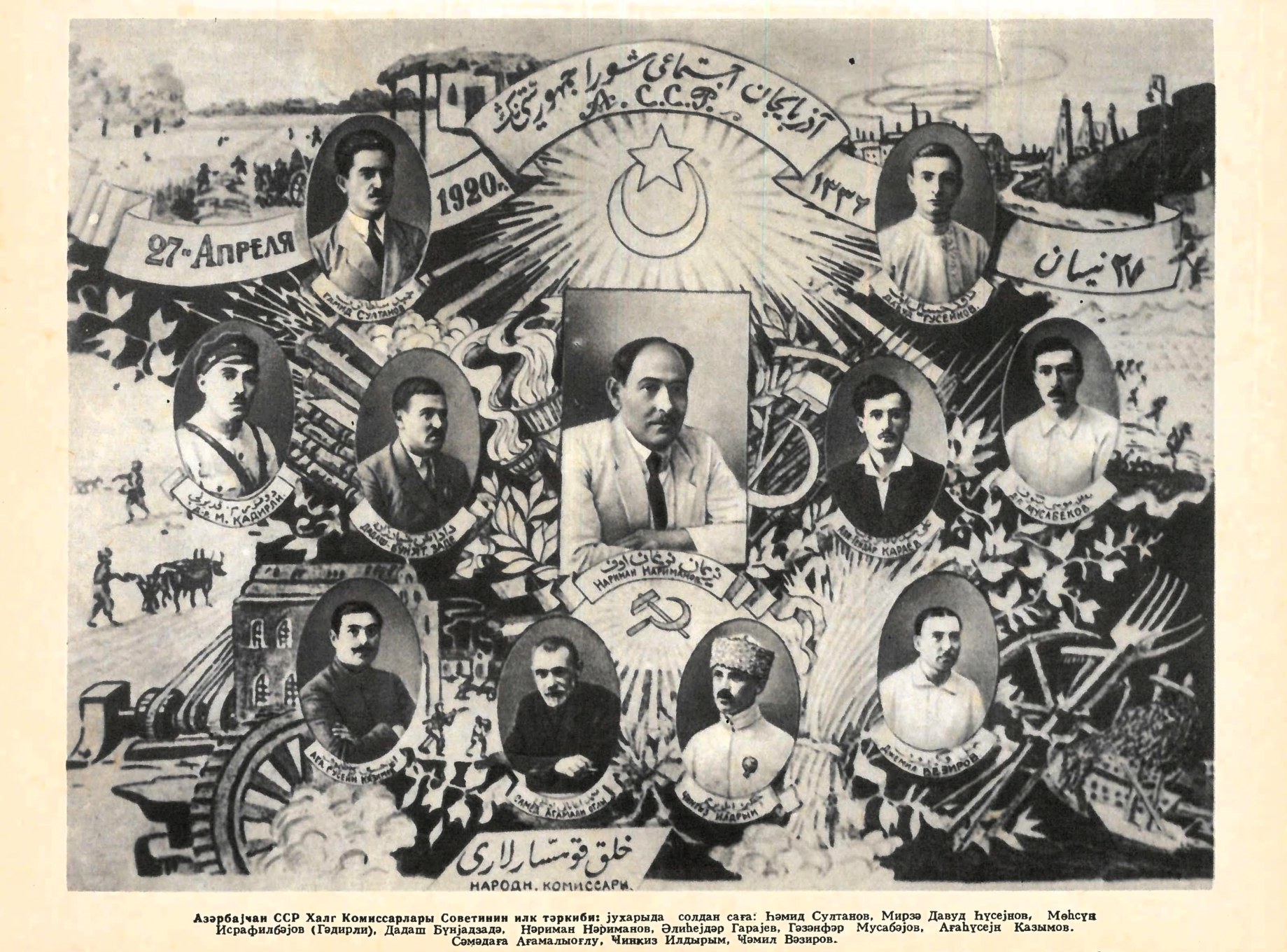
As part of the ‘Russian Civil War’, in reality an Empire-wide rebellion and counter-rebellion fighting for supremacy over the ruins of Tsarism, was 1918-1920’s war between Armenian and Azerbaijani nationalists–and outside supporting powers–in the splintered and contested former Caucasus Viceroyalty. The war ended with the Red Army’s invasion in support of April 1920s Communist uprising in Baku. leading figure of Turkic speaking Caucasian workers, Dadash Bunyadzade was part of the rebellion in Russia’s Empire, a working class leader in Baku, a blacksmith involved in the revolutionary movement since 1905, he would become a leading Commissar in the new Trans-Caucasian and later Azerbaijani SSR, for which he he would serve as Chairman from 1930 to 1932. In an attempt to overcome one of the major sources of conflict was 1923’s creation of the Nagorno-Karabakh Autonomous Region of the Azeri S.S.R., for which Buntadzade played a key role, and explains below. He continued to serve in leading positions in the Republic until his arrest and subsequent execution on April 21, 1938 during the purges. Mussowats were the party of Turkic nationalists and the Dashnaks, Amerian nationalists.
‘Azerbaijan Workers Keep Flag of Internationalism Flying High’ by Buniat Zade from The Negro Worker. Vol. 3 No. 7. May 1, 1930.
One of the most bitter legacies of the Mussowat system was the National hatred and fratricidal strife fostered by the Mussowat and Dashnakzutiun Parties.
But they only found a common tongue and “National Peace” when they had to suppress the revolutionary movement of the toilers of Azerbadjan and Armenia.
The upshot was the massacres between Turks (Azarbedjan Tartars) and Armenians, which later led to a war between the toilers of both republics. Being egged on to attack each other, the toilers of both these races defended the “honour” of their nation destroying and razing to the ground everything before them–people, towns, villages, crops and forests, while behind their backs the leaders of the Mussowats and the Dashnaks were rubbing their hands in high glee. Wasn’t this National Peace?!
Towns, villages and flourishing districts were turned into ruins. Fertile fields were turned into wastes. Thousands upon thousands of people lost their lives in a sea of blood, rapine and murder. Such were some of the horrible “achievements” of the Dashnaks and the Mussowats while they were in power.
THE FIRST THING THAT THE AZERBARDJAN REVOLUTIONARY COMMITTEE DID AFTER IT TOOK POWER, WAS TO PUT A STOP TO THE FRATRICIDAL WAR BETWEEN THE TOILERS OF THE TURK AND ARMENIAN TRIBES.
The toilers of both republics decided to settle the question of the power and the national question in their own way, for with the establishment of the SOVIETS IN BOTH THE REPUBLICS, A STOP WAS PUT TO NATIONAL HATRED AND INTERNAL STRIFE.
From then onwards all the toilers, whether Armenians, Turks or Russians, have been building up a new life, riving scope to their initiative and creative construction work.
EQUALITY BETWEEN ALL THE NATIONALITIES WAS GUARANTEED BY THE SOVIET POWER. ALL THE TOILERS WERE GIVEN THE RIGHT TO USE THEIR OWN NATIONAL LANGUAGE FOR ALL EDUCATIONAL AND CULTURAL PURPOSES.
The fact that Nagorny Karabach has now been turned into an autonomous district, illustrates still more clearly how correct has been the solution of the national problem here. Indeed, the fact that a collective farm has been organised in Karabach of Armenian and Turk workers, which is certainly an example and international-education of those who cannot believe that members of these two races can work together let alone live together in one place, in one village, completely refutes all the misrepresentation circulated by our class enemies about the national problem.
How the national question has been solved by the Soviet authorities under the leadership of the Communist party has not even been dreamed of yet by the other socialist parties. One of the chief national minorities in the country is the toiling population of Armenia. They have been granted political freedom by the Soviet Government, how that an autonomous district has been set up in Nagorny Karabach where the population have every facility of developing and flourishing, of being educated and administrating the whole of their country in their own native language.
This is how the Soviet Power has solved the national question in Azerbedjan, which shows the difference, between the massacres of the Armenians and Turks in the past and the joint collective farms of these two races, of the present.
The establishment of the Trans-Caucasian Federation is at once a triumph of the first ten years of the power of the workers and peasants on the one hand and marks the political death of the Trans-Caucasian National Parties of the Mussawats and Dashnaks and the Georgia Mensheviks. This is the reason why these jackals of the Trans-Caucasian bourgeoisie raised such a wild howl, and this is the cause for a still great amount of lies and slander being spread in the columns of the emigrant press.
However, the toiling masses of Trans-Caucasia and their vanguard–the Baku proletariat, under the leadership of the Communist Party, untiringly and indefatigably, having established a powerful oil-giving station which keeps driving the oil through the channels of the whole of Trans-Caucasia, and giving in place of it the steel horse-tractors! for the agricultural industry of Trans-Caucasia.
Armenians, Georgians, Turks and Russians, no matter of whet nationality, are building up a new, international life and culture.
Being a part of the Great Soviet Union, the toilers of Trans-Caucasia are carrying out the great work of Socialist Construction, are fulfilling the testament of V.I. Lenin, who, in his letters to the Communists of Georgia, Azerbedjan, Armenia, Dagestan and the Gorsky Republic, expressed his sincere hope, that “their close union will set an example of national peace, unprecedented in bourgeois States, and impossible under bourgeois rule.”
We can, indeed, proudly declare, that during the course of the 10 years since the workers and peasants of Azerbedjan have held power, we have not only proved a sample of National Peace, but also created an International Fraternal Union of the Working Masses of Trans-Caucasia, really unprecedented in bourgeois States and impossible under bourgeois rule.
BUNIAT ZADE.
(Chairman of Soviet People’s Commissariat of the ASSR).
First called The International Negro Workers’ Review and published in 1928, it was renamed The Negro Worker in 1931. Sponsored by the International Trade Union Committee of Negro Workers (ITUCNW), a part of the Red International of Labor Unions and of the Communist International, its first editor was American Communist James W. Ford and included writers from Africa, the Caribbean, North America, Europe, and South America. Later, Trinidadian George Padmore was editor until his expulsion from the Party in 1934. The Negro Worker ceased publication in 1938. The journal is an important record of Black and Pan-African thought and debate from the 1930s. American writers Claude McKay, Harry Haywood, Langston Hughes, and others contributed.
PDF of full issue: https://www.marxists.org/history/international/comintern/negro-worker/files/1930-v3n7-may-1st.pdf
 Revolution's Newsstand