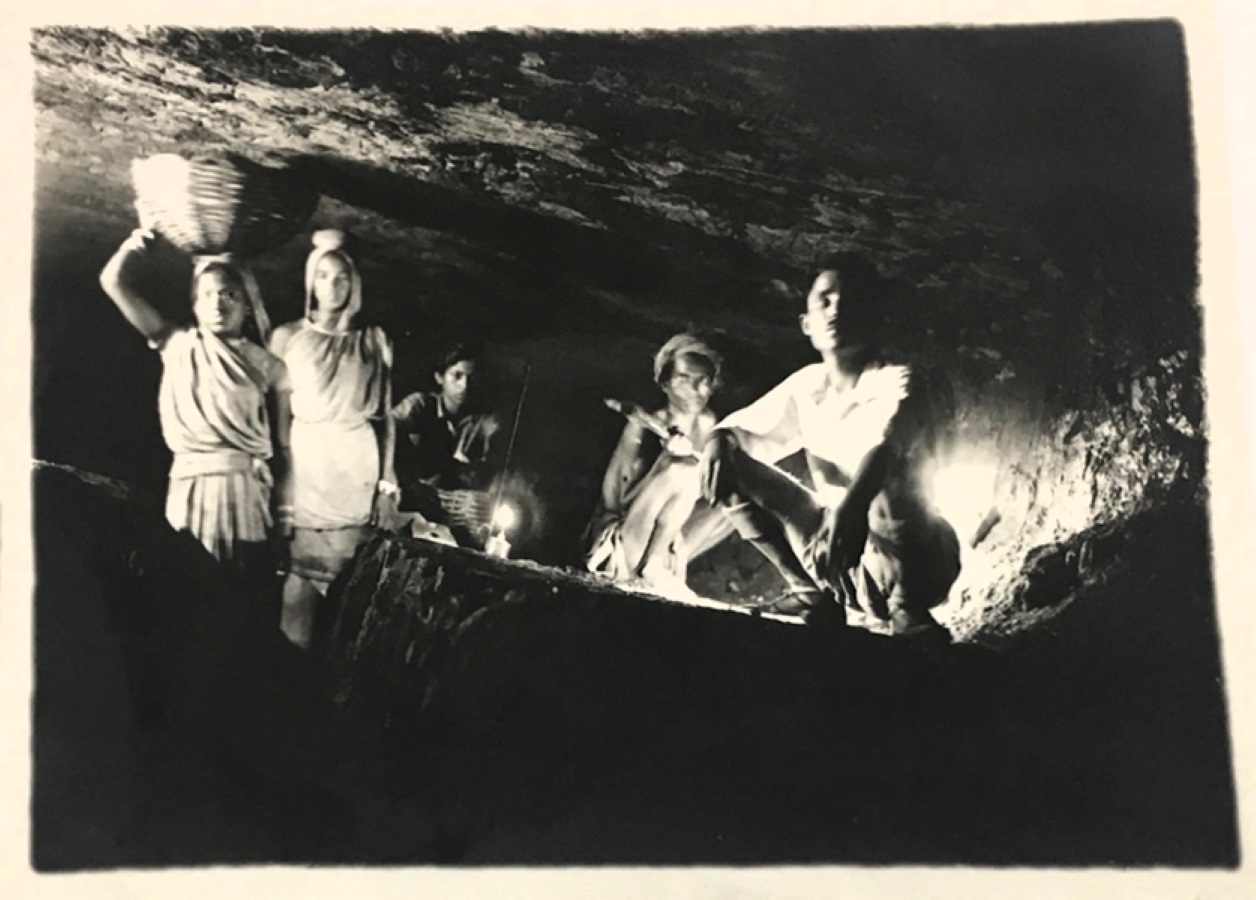
A survey of 1931 conditions and some extraordinary numbers, such as: in all branches of industry in colonial India women accounted for one-third of the proletariat; women made up half of all agricultural laborers; 32.2 of adult labor in all mining were women; over one-quarter of construction workers were women; wages of women were less than half of their male counterpart in India; and one-twentieth that of male British workers.
‘The Situation of Working Women in Indian Industry’ by F. Gaichenko from International Press Correspondence. Vol. 12 No. 10. March 3, 1932.
The working woman is becoming more and more the active factor in the Indian revolution. The development of local industry, in spite of the efforts of imperialism to check the course of its development, is drawing in women and child labour, which is more defenceless and cheaper under capitalist conditions and therefore more profitable from the point of view of unlimited possibilities of exploitation.
Capitalist rationalisation of industry has led to a considerably higher percentage of women workers in the industrial enterprises of India. The percentage of adult women employed in all branches of industry is over 30%, excluding the great numbers of adolescents and little girls who are employed in industry and on the plantations. On the plantations, the percentage of women workers reaches 50%.
General data on the distribution of woman labour according to branches of industry, taken from the Indian Year Book for 1931 gives the following picture. The proportion of adult women workers (unskilled) is 508 for every thousand adult men. The majority of women work on the plantations, where the proportion is a high as 50% of all the adult labour. The proportion of women employed in the coal industry is higher than 30% and the same is true of the textile industry.
The Indian Year Book shows the further growth of women labour on the plantations and in the textile industry. Women work also in the mines, where they are employed for underground work. According to the material of the Whitley Commission, the figures for women employed in the mines for various occupations in 1928 were as follows:
Working Underground—Women 28,408—Men 68,727
In open pits—Women 8,019—Men 9,442
Above ground—Women 13,455—Men 36, 097
Total—Women 49,882—Men 114,266
Even according to these figures woman labour in the mines amounts to 32.2% of all adult labour power. These figures deliberately underestimate the number of women. The governmental commission did not submit any proposal whatsoever to improve the conditions of women in the mines, under the pretext of the small number of women employed. Actually, however, in 1928 there were nearly 80,000 women employed in the mines, 31,000 of whom were employed in underground work.
Other branches of industry where the percentage of women is fairly large are the following: The building industry, where women make up 28% of all adult labour, and glass manufacture and food products.
The chief source from which woman labour is drawn is from the peasant farms which are being ruined. In the towns of India the proportion of women to men is considerably lower.
The woman comes into industry from the country, where in addition to the hardships resulting from the breakdown of peasant economy she has to bear the burden of social and legal subjection and family cares. The woman moving to town is an exile. She has no right to return to the village or to her family.
But also in industry, under conditions of factory labour, the social and legal subjection of women is reflected. It is expressed in the labour conditions, wages and qualifications and in the absence of special legislation for the protection of woman labour and maternity. The situation of the Indian proletariat is considerably worse than that of the workers of Western Europe, because of the colonial position of India, and this is reflected even more clearly in the situation of the proletarian women.
What are the labour conditions of working women?
For the most part women perform unskilled and heavy labour. In the transport and building industries they carry bricks and other building material for long distances. In the mines, they pull loads and carry baskets of coal. The working day is not less than 11 hours officially, and as a matter of fact it amounts to considerably more owing to the complicated system of shifts.
The inferior position of women workers is brought out most sharply in wage payments. If the pay of an Indian worker in 1929 was on the average one-tenth of the pay of a British worker, the pay of a woman worker for the same labour was half as much. In Bombay the average monthly wage for men in the cotton industry in 1929 was 37 rupees, while the women got an average of 17 rupees, i.e. less than half the men’s wage. In the seasonal enterprises of Madras, the daily wage of a man working at a cotton press during that same year amounted to Re. 0-9-6 (a little over half a rupee), while the daily wage of women average Re. 0-5-10, that is about half. A man coolie gets: Re.0-10-0 a day while a woman coolie gets 0-6-0 rupees a day.
But these figures do not show the real wages of the working women, for apart from the many deductions and fines taken out of her wages by the employer, a great part of it goes into the hands of the foremen, or forelady, known as the “Mistri”. The working woman gets paid by the “mistri”, who receives the money and distributes it among the women. This “mistri” gets the money for the women working under her from the overseer, who in turn keeps part of it for himself.
The many statements of women workers before the Whitley Commission, throw a light on the actual state of affairs. Here is a statement from a woman employed in carrying coal to the harbour:
“I work for the contractor Rambab. I am a widow with two children. One of my daughters works here with me. She is not yet 12 years old. The other is 7 years old. She is at home and there is no one to look after her. I get 6 annas a day and my daughter gets the same. I came from Malkapur, which is three miles from here”. (Whitley Evidence, Vol. VII, Part 2, page 47).
The Indian working woman has absolutely no maternity protection or assistance of any sort during child-birth. Moreover, she is fired from her job if she does not come to work because of child-birth. The working woman has the choice: either to be thrown out into the streets, or to give the foremen a bribe amounting to one-month’s salary, or to give birth in the shop and go on working. In this connection the statement of the special government commission for the investigation of woman labour in industry in Bengal in 1924 is most illuminating: according to the data of this commission, out of the 132 working women who were questioned, 102 of them had given birth to 338 children, 139 of which, i.e. over 41%, were born in the shop.
The working woman keeps her new born baby with her while she tends her machine. She often attaches the basket with the child in it to the machine, which leads to terrible accidents. The drugging of children with opium is very extensive. Obliging manufacturers were found who prepared special opium pills for babies, “baby opium”.
Consequently, the extremely high infantile death rate in India is not surprising. For every three children born, scarcely two reach the age of one year. The general death rate for infants in Bombay in 1931 according to minimized estimates, was 556 out of a thousand, while there is an average death rate of 660 per thousand for the first year of life. Those of them who do live have only the contractor to look forward to, with prospects of the most brutal exploitation from 5 years of age on.
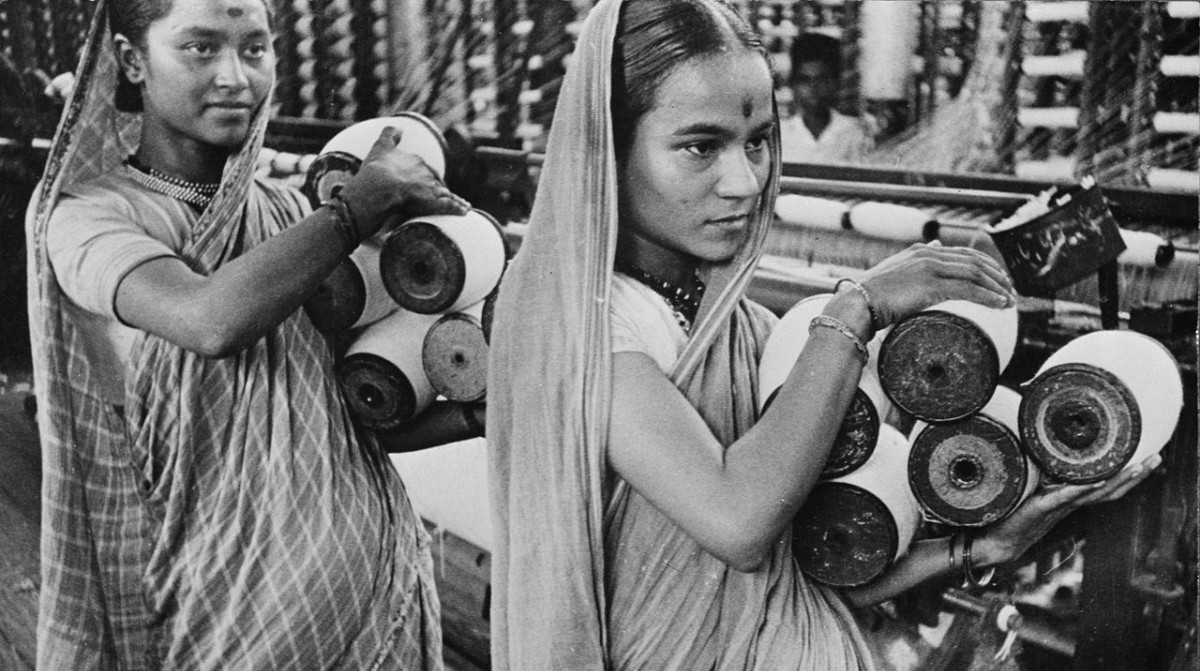
The Whitley Commission, which recently published the results of its work, did everything possible to conceal the actual situation of women in industry. Its conclusions with regard to women workers are a model for the legitimisation by imperialism of the most frightful exploitation, treated by the commission as a virtue.
The Whitley Commission denied the possibility of introducing an 8-hour working day and upheld a formal 10-hour working day, which in actual practice amounts to much more.
In seasonal undertakings or plantations, which for the most part belong to British capital and employ the highest percentage of women, the working day for women, according to the findings of the same commission, is no less than 13% hours. Basing itself on the argument that in seasonal occupations the workers do not work the year round and have the possibility of returning to “the healthy conditions of nature in the rural districts”, the commission concludes that “it would be inexpedient to reduce the working day in these undertakings (i.e. to 10 hours).”
The commission appears to be taking up the defence of women working in non-seasonal undertakings. But this “defence” is only apparent. Here is an example which illustrates the situation. The time during which the commission recommends the utilisation of women labour amounts to 17 hours, while the length of time for the utilisation of one unit of woman labour, including rest periods, amounts to 13 hours, i.e., in all, half an hour less than at the present time.
The working men and women of India can convince themselves once more of the true character of bourgeois and imperialist legislation and of the falseness of all statements about the improvement of the position of the working class under the existing system. No imperialist commission can solve this problem. The working woman can improve her economic and legal situation only by joining the general struggle of the proletariat under the leadership of the Communist Party.
The working woman of India is even more oppressed and deprived of rights than her brother workers. The working women make up more than one-third of the India proletariat. With this large proportion of women in the great mass of the Indian proletariat, it is impossible to develop a real revolutionary struggle without drawing in the women workers, The fact the working women have no rights is bound to drive them into the struggle. The stormy growth of the labour movement in India during the past year is marked by the increased militancy of the working women. In a number of strikes and conflicts they were models of heroism and bravery, and in many cases they were the most persistent elements in supporting the continuation of strikes, and active opponents of the offensive of capital.
As a result of the social, family and legal subjection of women, the feminist movement in India is growing. But this movement does not go further than economic demands within the limits of the existing order.
This bourgeois feminist movement is not for the working women. The working woman must realise that the liberation of women in India must come through the overthrow of imperialism and the native treacherous bourgeoisie and landlords, and the establishment of a workers’ and peasants’ Soviet Government. The proletariat of India, under the leadership of the revolutionary trade unions and the Communist Party, must include in its demands the demand for improving the material situation of working women, labour protection for women, organisation of day nurseries and maternity hospitals, and the raising of wages for women to the same level as wages for men, at the same time explaining that all these partial demands can only be obtained in full after throwing off the yoke of the imperialist and native bourgeoisie.
It is by tenaciously struggling, together with the whole proletariat, that the Indian working woman will gain her freedom.
International Press Correspondence, widely known as”Inprecorr” was published by the Executive Committee of the Communist International (ECCI) regularly in German and English, occasionally in many other languages, beginning in 1921 and lasting in English until 1938. Inprecorr’s role was to supply translated articles to the English-speaking press of the International from the Comintern’s different sections, as well as news and statements from the ECCI. Many ‘Daily Worker’ and ‘Communist’ articles originated in Inprecorr, and it also published articles by American comrades for use in other countries. It was published at least weekly, and often thrice weekly. Inprecorr is an invaluable English-language source on the history of the Communist International and its sections.
PDF of full issue: https://www.marxists.org/history/international/comintern/inprecor/1932/v12n10-mar-03-1932-Inprecor-op.pdf
 Revolution's Newsstand